A Game Changer in Iran?
Also, the White House’s nonpartisan affection, the first polls of an election year, and more.
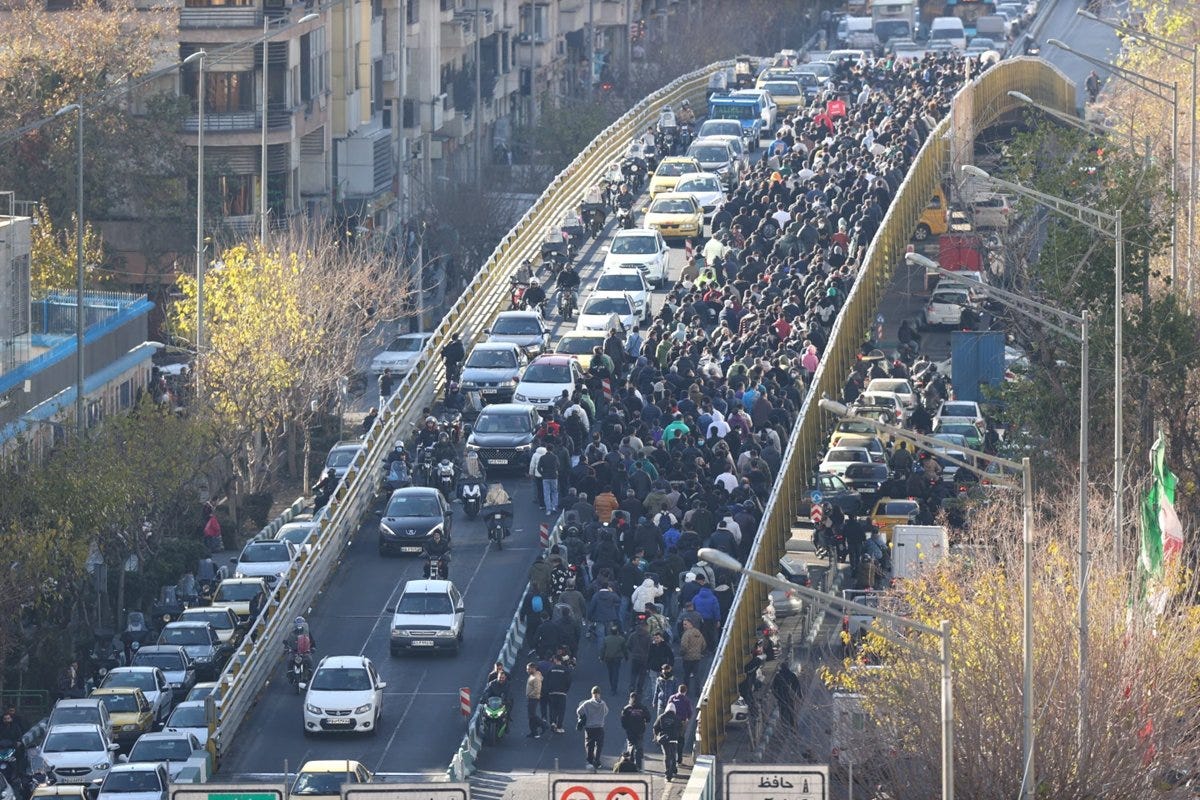
Protest in Iran on Wednesday.
It’s Friday, January 2, and in classic Donald Trump fashion, the American president may have changed the world through social media. Earlier today, he posted on Truth Social:
“If Iran shoots and violently kills peaceful protesters, the United States of America will come to their rescue. We are locked and loaded and ready to go.”
This is huge—and in no way dampened by Trump’s nonchalant:
“Thank you for your attention to this matter.”
Trump has been flirting with regime change—just ask Nicolás Maduro in Venezuela—so the show of support for Iranian protesters isn’t surprising. What is surprising is the explicit offer of U.S. protection for a protest movement on foreign soil. To my knowledge, this is the first time Trump—or any U.S. president in decades—has extended the American aegis to civilians challenging another government’s rule.
The regime’s advantage over the protesters has always been its control of organized violence. But if Trump’s statement is taken seriously, the regime’s biggest piece may have just been taken off the board.
This isn’t just good for the protesters.
As I wrote earlier this week, regimes fall because of guns and the people who hold them. In Iran, there’s more than one armed force—alongside the Revolutionary Guard stands the Iranian army. In Jerusalem, talk of a possible top-down coup has been growing. And if guns can’t be used on the protesters, perhaps someone else with guns could use them on someone other than the protesters.
It’s impossible not to contrast this with the last American reaction to an Iranian protest movement—Barack Obama’s response during the Green Movement in 2009. Obama said he was “deeply troubled” by the violence but wanted to “avoid the United States being the issue inside Iran.”
The regime understood his concern as a green light to crush the uprising.
I don’t think Trump is as “deeply troubled” as Obama, but his statement is certainly more helpful.
Still, the key question remains: Is Trump serious?
I don’t know. But the last people who can afford to underestimate him are the Iranian leadership. The last time they didn’t take the president’s threat seriously, they ended up with smoking craters where their nuclear sites used to be.
The second question may be even more consequential: Do the Iranian people believe him? Because if they do—if tonight a critical number take to the streets to test Trump’s commitment—then the guarantee of support may not even matter.
Either way, interesting days lie ahead.
Benny Gantz meeting with Donald Trump in 2020 (@gantzbe/X)
There was one moment in the Knesset speech on the day the war ended that particularly troubled Likud. It happened when the president spontaneously praised Yair Lapid. “He’s a nice guy,” he said to Netanyahu—and then jabbed the prime minister: “You don’t need to be so tough now that the war is over.”
Was this a hint that the president intends, God forbid, to adopt neutrality in the upcoming election campaign?
There are precedents. Netanyahu, as we recall, hung a giant poster of himself with Trump on the side of the Ze’ev Fortress, the Likud HQ, during the 2019 campaign. Yet the American president at the time made sure to invite Netanyahu’s direct rival, Benny Gantz, to the White House as well—much to the fury of the Prime Minister’s Office. Even the most hawkish president on peace and territory, and the friendliest to Netanyahu, preferred to appear above Israeli electoral politics.
The reason is that, then as now, a quiet struggle is taking place inside the White House over Netanyahu. Jared Kushner, for example, is far from an enthusiastic supporter of the prime minister. Steve Witkoff holds an even more negative view of him. One can reasonably assume that the sharp (and in hindsight very inaccurate) briefings against Netanyahu ahead of this week’s meeting in Mar-a-lago came from those quarters. There are powerful figures in the American administration who would very much like to see a different Israeli prime minister—for personal reasons as well as ideological ones.
But even larger parts of the administration—Secretary of State Rubio, Defense Secretary Hegseth, Ambassador Huckabee, and others—remain full-on Likudniks, if not further to the right of it. And where does Trump stand? In polls, he has been classified as “leaning Likud.” The result so far is unequivocal: “With almost any other leader, Israel would not have survived,” he has said repeatedly in front of the cameras at Mar-a-Lago. Netanyahu himself could not have phrased it better. Few understand better than he does the dramatic electoral significance such a statement may carry—or, for that matter, the impact of showing up to receive the Israel Prize on the eve of a campaign launch. After all, someone who pressures for a pardon can also astonish with moves no one anticipates.
Still, efforts to push Trump away from supporting Netanyahu have not ceased. For example, Naftali Bennett recently hinted that the way to reach the president’s heart is to establish a large political framework, together with Eisenkot and preferably also Lieberman. Someone known for his fondness for “extra large”—everything about him bigger than life, from hotels to signatures—is unlikely to even glance at boutique parties.
This is an excerpt from my weekly column in Israel Hayom.
To read the article on my website click here
Me explaining the polls on Channel 12 last night. (n12)
It’s official—election year has begun. And after all the noise surrounding Trump and Bibi’s dramatic Mar-a-Lago meeting, you might expect some kind of political aftershock, right?
Well, not so much.
If anything dramatic happened electorally, it’s not showing up here. Predictions remain steady: Likud holds at 26 seats, while Bennett 2026 trails with 21. The Democrats, led by Yair Golan, take 11; Yair Lapid follows with 10. Yisrael Beiteinu, Shas, and Ben Gvir’s Otzma Yehudit each sit at 9, with Gadi Eizenkot just behind at 8 and United Torah Judaism holding 7. The Arab bloc is unchanged—Hadash–Ta’al and Ra’am both at 5.
Here’s the small drama: Smotrich’s Religious Zionism doesn’t cross the electoral threshold. That’s one seat less for Netanyahu’s bloc and one more for Lapid’s, but in the grand scheme, the map barely moves. The coalition stands at 51, the opposition at 59—neither has that magical number of 61. But if you add Ra’am, the opposition scrapes past the threshold.
Still, everything remains within the margins we already know.
But here’s where it gets interesting. The more revealing question isn’t who you’d vote for—it’s who you actually trust to steer the country.
And there, Netanyahu is still king of the hill.
In a head-to-head against the opposition leader, 45 percent say he’s the most suitable for prime minister. Yair Lapid? Just 22 percent. Against Naftali Bennett, Netanyahu leads by 8 points—his strongest showing in months. Against Eizenkot, the gap widens to 13.
The message is clear: Even if Likud’s numbers have stalled, Netanyahu himself remains the gravitational center of Israeli politics. Everyone else is still orbiting him.
As for the national mood—it’s split right down the middle. Among coalition voters, 53 percent believe 2026 will bring improvement, and only 7 percent think things will get worse. Among opposition voters, optimism plunges: 25 percent expect better days ahead, while 30 percent expect decline.
But here’s the key question: Are opposition voters—the ones who say change is coming, who believe the next election could finally flip the map—assuming that the real outcome will somehow differ from what most polls show?
Because for now, the numbers don’t lie. It’s the voters who still might.
I joined Dan Senor and Nadav Eyal on Call Me Back to discuss the possibility of another war with Iran. Also discussed were the other aspects of Bibi and Trump’s meeting and the future administration of Gaza. As always, it’s worth a listen.
To listen, click here
Shabbat Shalom. We’ll be back on Sunday.


