Gaza Famine Debunked
Also, Pro-Qatar statements fabricated by Israeli officials, Greece and Cyprus come to Jerusalem, and more.
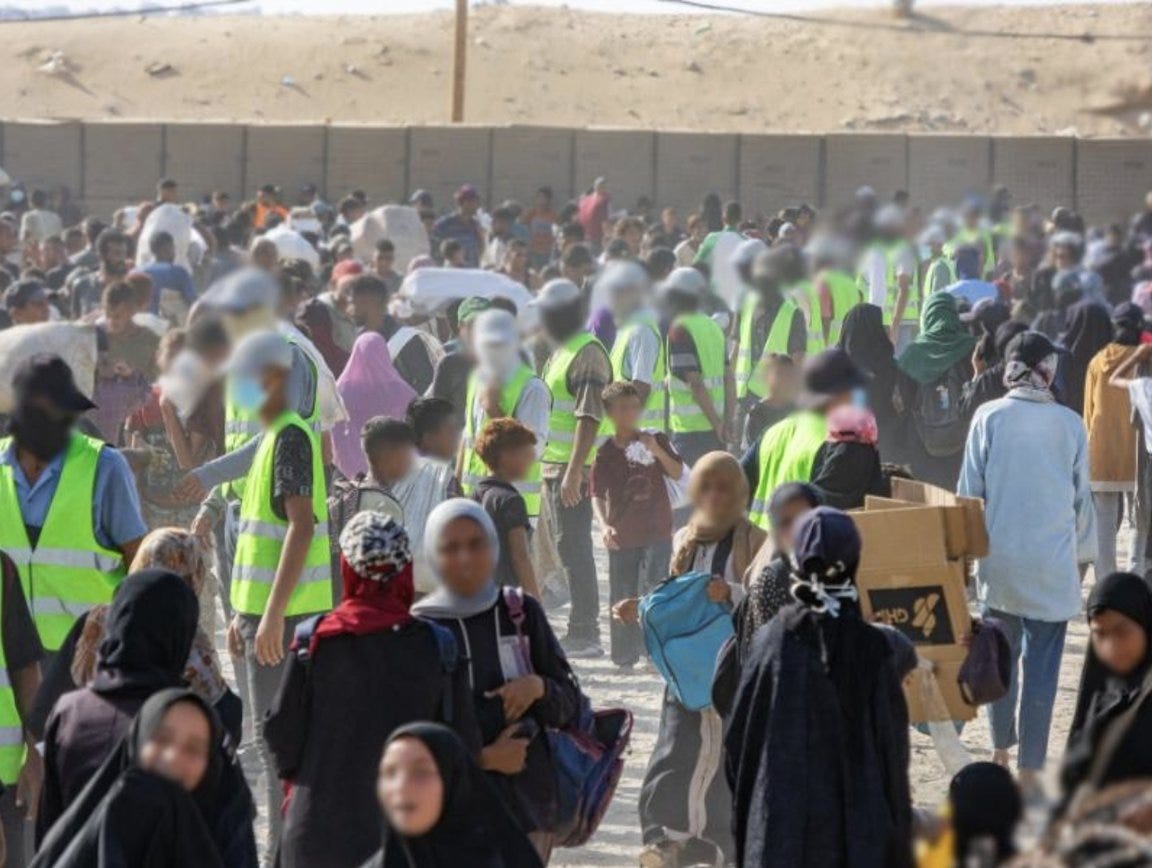
Gaza Humanitarian Foundation site in October. (@GHFUpdates/X)
It’s Monday, December 22, and imagine you are given a set of data, and you ask yourself: How do I make up a famine? This is the question I imagine the Integrated Food Security Phase Classification Famine Review Committee asked themselves in August when they declared that there was famine in the Gaza Strip.
According to two mathematicians who released a letter yesterday, here’s how they did it:
Method one: count more deaths as starvation.
A famine, by definition, requires more than two non-trauma deaths attributable to hunger per 10,000 people per day. To estimate Gaza’s death rate, the IPC relied on a study that explicitly distinguished between violent deaths (from combat) and non-violent ones. The IPC then blurred that line, folding violent deaths into the non-trauma mortality baseline, inflating a reported rate of 0.18 to about 1 per 10,000 people per day—a small sleight of hand that made the numbers more than five times worse than they actually were.
To put it another way, in order to qualify for famine 400 people would have to die from non-violent potentially hunger related causes in Gaza per day. The real number at its peak was closer to 18. According to the IPC’s method, if you were a Hamas fighter killed in battle, congratulations—your death was hunger related.
But even including the more explosive deaths of starvation, the IPC still couldn’t meet the threshold.
So, they resorted to method two: wild speculation. To meet the famine threshold—increasing from one non-violent death per 10,000 to two (ten times the actual number)—the IPC simply estimated an exponential surge in starvation. Never mind that rates of malnutrition and hunger-related deaths held steady in August and even declined by mid-September; the IPC mathematically insisted that a huge increase in deaths was just around the corner.
While the IPC was preaching famine, reality didn’t meet politically biased projections. The rate of nonviolent deaths kept declining—from an average high of six per day in August to fewer than one by early October.
That may sound like a lot—and any death of this kind is tragic—but in a population of two million during a time of war, lack of access to medication, vaccines and reliable sources of food will lead to deaths outside of combat scenarios. Add to that natural deaths (which the Gaza Health Ministry includes) and a terrorist group intentionally causing more suffering by, for example, hoarding baby formula, and nonviolent deaths were inevitable.
Bottom line: No, there isn’t, nor was there ever, a famine in Gaza. They couldn’t find the numbers, so they made them up.
Prime Minister Benjamin Netanyahu with Yonatan Urich and Yisrael Einhorn a few days before the elections, April 1, 2019 (Courtesy)
Pro-Qatar official statements were fabricated by Israeli government officials. That’s according to i24’s Avishai Grinzaig, who has released a new report on the WhatsApp conversations of Eli Feldstein and Israel Einhorn.
A quick reminder:
This is part of the “QatarGate” scandal, which blew up earlier this year. Three associates of Benjamin Netanyahu—Yonatan Urich, a close and longtime aide; Feldstein, the military affairs spokesman for the prime minister; and Einhorn, a political adviser and consultant who had worked with Bibi—are alleged to have received money from Qatar.
So, what does Grinzaig’s report reveal?
Starting in April 2024, Feldstein and Einhorn drafted talking points, invented briefings, and attributed statements to “senior Israeli,” “senior American,” or “security” officials—often without basis—to shape coverage. Urich appears in the report as the connector, providing Feldstein with Einhorn’s number.
What were they pushing?
Three points:
Qatar is the only effective and trustworthy mediator for hostage negotiations.
Egypt is unreliable, corrupt, and economically complicit with Hamas through smuggling.
Attacks by Israeli politicians on Qatar harm negotiations, and Qatar should lead the “day after” as a U.S. partner.
Feldstein later said he believed he was advancing messages consistent with the Prime Minister’s Office—his texts referring to Qatar as “we” suggest otherwise.
My take: This is insane. Israel’s press was fed lines shaped by insiders working to amplify a hostile country’s interests.
In one of the texts, Einhorn summarized the affair quite succinctly:
“We are creating reality.
Cyprus President Nikos Christodoulides, Greek Prime Minister Kyriakos Mitsotakis and Israeli Prime Minister Benjamin Netanyahu shake hands before a meeting at the Presidential Palace in Nicosia, Cyprus, September, 2023. (GPO)
Israel, Greece and Cyprus are meeting in Jerusalem—and the timing couldn’t be more ironic. On the last day of Hanukkah, the festival of independence from the Greeks, Israel is now allying with its once-oppressors against the new threat to the north: Turkey.
But first, some more recent history is necessary.
Up until the early 2000s, Israel’s closest regional ally was Turkey. When Greece formally recognized Israel in 1990—one of the last countries in Europe to do so—Israel and Turkey were conducting joint military exercises.
Why did this change?
His name is Recep Tayyip Erdoğan. When he was elected in 2002, relations took a sharp nosedive. A watershed moment came in 2010 with the Gaza flotilla incident. Turkish activists launched an expedition to break Israel’s naval blockade of Gaza; the boats were intercepted, and several Turks were killed in the resulting clash. In response, Ankara withdrew its ambassador and froze military cooperation. Greece, seeing an opportunity, stepped quickly into the vacuum.
Within weeks of the incident, the Greek prime minister visited Jerusalem. And a year later, when activists planned another Gaza-bound flotilla from Greek ports, Athens quietly stopped them.
Symbolic? Absolutely.
Fifteen years and a trilateral agreement later, an alliance ostensibly devoted to Israeli gas has evolved into an excuse for regular talks about Turkey.
So, what’s the meeting about today?
Reports last week hinted at a possible trilateral rapid-response force including Israeli, Greek and Cypriot units. The report was swiftly denied by all sides. But those denials tell us something.
The partners aren’t ready to acknowledge active military coordination, but signs are pointing in that direction.


