Don’t Give Erdogan F-35s
Also, the endless saga of Israel’s Prime Minister’s residence continues.
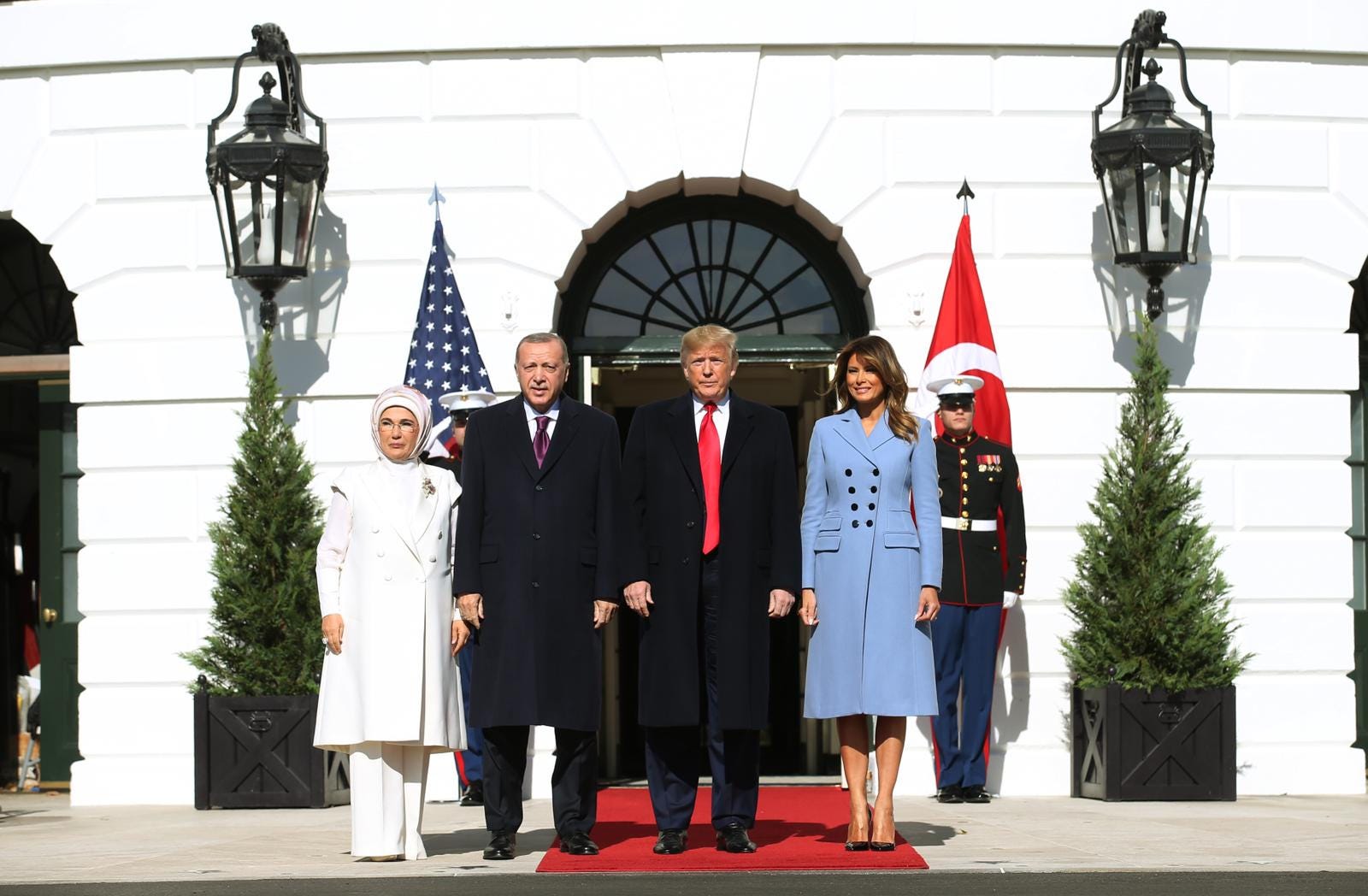
Turkish President Recep Tayyip Erdoğan meeting with Donald Trump in 2019 (@trpresidency/X)
It’s Thursday, December 25, and in psychology, it’s called “projection”: When Turkish President Recep Tayyip Erdoğan accuses Israel of attempting to establish the ancient “Greater Israel” on the territory of its neighbors, he is expressing his own collective desire, and that of his supporters, to revive the Ottoman Empire that once ruled those very same regions. When he claims, without basis, that Israel seeks to destroy Turkey, he ignores his own calls to bring about Israel’s end. While claiming that Israel is committing genocide against the Palestinians, he denies the genocide his own country committed against the Armenians. Even when he accuses Israel of attempting to turn the Muslim Al-Aqsa Mosque into a Jewish temple, he ignores the fact that the only one who turned an ancient structure of one religion into that of another is he himself: In 2020, he declared the Hagia Sophia, originally built as a church, a mosque, ignoring the protests of the international community.
Turkey was once the “Sick Man of Europe.” Now, together with Qatar, it is the dangerous Muslim brother of the Middle East. It stands by every problematic actor in the region, supports terror, and fuels instability. It aids Pakistan against India, builds military bases in Sri Lanka, and above all—hosts Hamas members and grants them protection. When Hamas leader Ismail Haniyeh, one of the planners of the October 7 massacre, was eliminated by Israel in Tehran in July 2024, the flag at the Turkish embassy in Tel Aviv was lowered to half-mast. Imagine what would have happened had a foreign embassy in Washington lowered the flag to half-mast after the elimination of Bin Laden.
This is one of the reasons why not only Israel opposes the integration of Turkish soldiers into the multi-national force in the Gaza Strip. Behind closed doors, the Saudis and Emiratis also strongly oppose this. If Turkey is trying to preserve and nurture Hamas in Istanbul, there is no reason to assume it wouldn’t do the same in Gaza. This is in distinct contrast to President Trump’s approach, that the terror organization must be disarmed.
In short, nothing good will come of increasing Turkish power in the region. Therefore, the Turkish request to President Trump to sell it advanced F-35 fighter jets should be viewed with growing concern. A senior Israeli official told me this week the chance of the sale being approved is 40%, much higher than he thought just a few weeks ago.
For what purpose does Turkey, already a global military power, need such an advanced fighter jet? Israel had reservations about selling identical jets to Saudi Arabia and the UAE, but it is clear to everyone that in the foreseeable future, these aircraft are meant to defend against Iranian aggression, not to practice attacking Tel Aviv. But Erdoğan, unlike them, is very careful to maintain Tehran’s honor and preaches for the destruction of the “bloodthirsty gang” in Jerusalem.
These fighters are intended for a future war with Israel. The Jewish State was added just this year to the Turkish “Red Book” as an existential threat to the country, under the false pretext that Israel seeks to conquer Anatolia, part of the Kingdom of David. 37 percent of Turks view Israel as the greatest threat to their country, with the United States in second place. While Erdoğan cozies up to Trump, his people see the U.S. as the ‘Great Satan’ and Israel as the ‘Little Satan.’ They reject everything Western—save, of course, for its military technology
Selling the jets to Turkey would grant the United States a short-term cash profit but carry a massive cost to national security. It would violate the delicate balance in the region and harm—even if not cancel entirely—the IDF’s Qualitative Military Edge (QME), which the US is committed to maintaining by Congressional legislation. Michael Doran, a Middle East expert, has already suggested that if the United States wishes to keep its two friends in the region calm, it must separate them as much as possible. Thus, for example, they should be kept apart in Syria, creating a significant buffer zone without the presence of both countries. So why allow a future scenario where F-35 jets conduct dogfights against each other?
The esteemed Orientalist Bernard Lewis said in the nineties that the day would come when Iran would be Turkey and Turkey would be Iran. The intention was that the Ayatollah regime would be replaced by a secular democracy, while the secular republic of Turkey would turn into a threatening Islamic empire. In Operation “Rising Lion” last June, American-made Israeli jets destroyed outdated F-14s left to the Iranians from the days of the Shah. It would be a mistake to take the risk that the next Iran will be equipped with much more advanced American weaponry.
This is an excerpt from my column in The Wall Street Journal.
To read the article in the WSJ click here
The Fortified Entrance to the House Compound in Balfour | Photo: n12
The prime minister’s residence is getting a 103 million-shekel ($32 million) renovation. What’s crazy isn’t just the price tag—the biggest ever for a house in Israel that isn’t even that big—it’s that this comes after an almost 20-year battle for the prime minister to live anywhere else.
Israel’s prime minister doesn’t actually have a purpose-built residence. Before 1974, every prime minister mostly worked out of their own home. Famously, Prime Minister Golda Meir’s humble kitchen hosted some of Israel’s most important meetings—staff huddled over policy papers while she bustled around the kitchen serving thick, aromatic coffee, warm apple strudel, and, like every Jewish grandmother, a steaming pot of chicken soup.
Since then, Israel’s “White house” has been a 1930s villa on Balfour Street awkwardly repurposed into an executive compound.
There have been several attempts to fix this. Back in 2009, the government launched Project Almog—a plan for a brand-new, purpose-built residence near the Prime Minister’s Office, with a price tag of 650 million shekels.
What happened? Well, in his first meeting as prime minister, Benjamin Netanyahu, unwilling to waste so much money, cancelled it.
But that wasn’t the end. The project was revived in 2014—this time with a price tag of over a billion shekels. Most of that ballooning cost came down to new security requirements.
Security requirements are also why six years later, after 100 million shekels were spent on foundations, the project was canceled. The planning had taken too long, and now a public transport artery was planned to run in front of it, while surrounding high-rises had an unobstructed view into what was meant to be the most secure building in Israel.
Still not the end. After Project Almog was permanently frozen, Project Shira began. It received 5 million shekels in funding last year, and just like that, the story starts all over again.
But why does the prime minister need to move? Well, a couple of reasons.
The current residence sits in the middle of a residential neighborhood. When I used to visit Israel’s “White House,” I could smell the neighbors’ barbecues wafting through the window. Meanwhile, they could peek through that same window to see whom the prime minister was meeting. Not exactly ideal for national security.
Meanwhile, the locals hate it. They aren’t exactly thrilled about the constant protests and security—neither are the other Jerusalemites, who intermittently lose one of their main streets.
But beyond the inconvenience, there is serious risk. In an emergency, the prime minister has to reach his office fast. Right now, it takes about five to seven minutes on a clear, secured route. Add traffic, or one of the regular protests, and it’s 20. Israel can only pray that in an emergency, 20 minutes don’t turn out to be decisive—say, in a nuclear exchange with Iran.
But back to the renovation. It’s its own disaster—five years in construction so far. The official residence has been stuck in “upgrading” mode so long that Israel’s prime ministers have had to go back to their private homes, each one upgraded at taxpayer expense.
Netanyahu’s two apartments had to be refitted, Lapid’s Tel Aviv flat was reinforced, and Bennett’s Ra’anana home got the full treatment. And let’s be honest—after all that, it’s hard to imagine Netanyahu bustling around his kitchen serving coffee, strudel, and chicken soup.
So here we are, almost 16 years since the first plan and hundreds of millions of shekels poorer.
My take: Enough patchwork—just build the damn house.


