Israel Exits Trump Talks with More than Expected
Also, Iranian protests threaten regime collapse, Trump wins an award he can’t receive, and more.
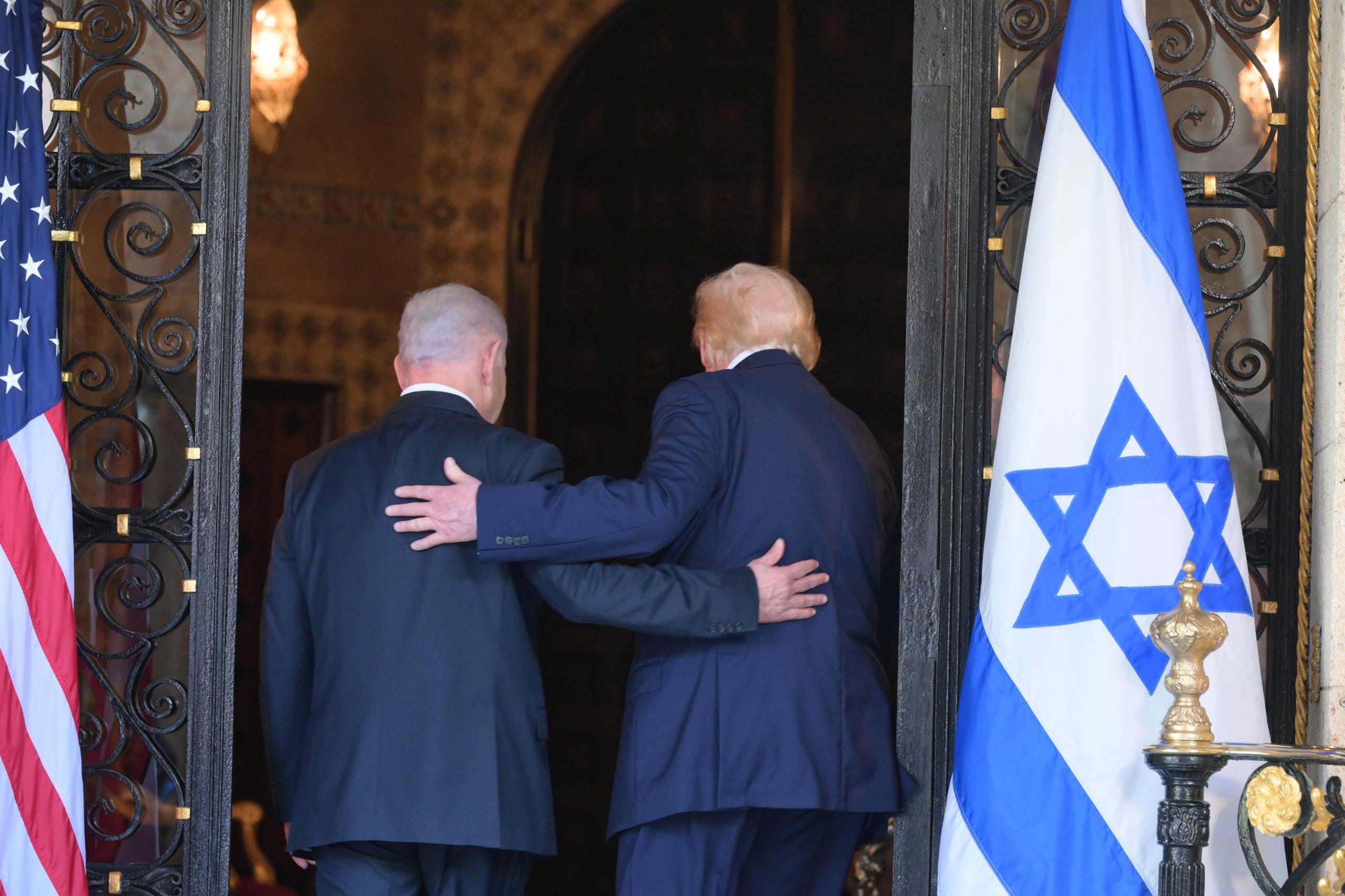
Benjamin Netanyahu and Donald Trump before thier meeting. (@netanyahu/X)
It’s Tuesday, December 30, and Donald Trump and Benjamin Netanyahu just wrapped up an incredibly productive meeting. Here’s what Trump said that actually matters:
No Phase B without Hamas disarmament.
A strike may be justified if Iran restarts its missile program.
And, most surprisingly, President Isaac Herzog has “promised” a pardon for Netanyahu.
Before we dive in, let’s acknowledge the sound everyone heard: the bursting of a few balloons—those being the claim that there is a deep rift between Trump and Netanyahu, that Israel and the U.S. are at odds, or that Trump intends to abandon the demand to disarm Hamas.
In reality, Israel got about 90 percent of what it wanted. And Netanyahu—apropos the pardon—got roughly 110 percent of what he expected.
On to the analysis.
First, Trump made clear that there is no such thing as “rebuilding Gaza” without dismantling Hamas. The quid pro quo still stands. As long as this principle holds, and as long as there is no sign that Trump intends to retreat from it, Israel is not required to withdraw from the areas it currently controls—roughly 58 percent of the Gaza Strip.
And the strikes to degrade Hamas that were “threatening” the cease-fire? I didn’t hear Trump complain; if anything, he was supportive. If they didn’t disarm, Trump said he would “not blame Israel for what will happen,” and it will “be terrible.”
Second, and perhaps more consequential, is Iran.
That is where the existential threat lies. Here, too, Trump narrowed the daylight between Washington and Jerusalem. His message was clear: even if Iran moves only to restore its ballistic missile program—not its nuclear one—he is prepared to support an Israeli strike.
This matters enormously. Iran has been seeking exactly this path: advancing its non-nuclear military capabilities while staying below the nuclear threshold. Trump is now signaling that this distinction no longer protects Tehran.
However, it is important to acknowledge, he will support an Israeli strike, not participate in one; no midnight hammer is coming down on the ballistic missiles.
Third, and most unexpected, was Trump’s comment about the pardon.
My first thought was: poor Herzog. That’s twice now that Trump has put him on the spot—and twice he’s had to find a polite way out. Trump boasted, “I spoke with the president, and he told me it’s on the way.” Within hours, Herzog’s office rushed to clarify that it wasn’t. According to their statement, they merely explained to a Trump aide how Israel’s pardon process works—which, apparently, Trump mistook for a promise to make it happen.
So, Israel got permission to stay in Gaza, keep degrading Hamas and, if necessary, strike Iran.
What was the 10 percent it didn’t get?
That would be Turkey.
The meeting made clear there’s a lot less daylight between Washington and Jerusalem than pundits claimed—but the remaining shadows are all about Ankara and its backing of the ex-Jihadi regime in Syria.
Israel had hoped Trump would draw a firm line—a clear statement that there would be no Turkish deployment in Gaza. Instead, what they got was classic Trump:
“If it’s good, then it’s good. But a lot depends on Bibi. Erdoğan is excellent—not sure about you, Bibi.”
Before every columnist runs to their keyboard to proclaim that Trump is “not sure about” Bibi’s excellence and the next round of political hot air begins, let’s make one thing clear: this meeting was a success. And it’s probably not the last one.
In Iran yesterday, a man sits still in the middle of a Tehran freeway, descended upon by the Islamic regime forces sent to crush protests. (Courtesy)
Major protests broke out in Iran yesterday after the country’s currency plummeted to a record low against the U.S. dollar. So, is the regime finally on the verge of collapse?
You’d think that after hearing that line so many times, people would be a bit more cautious. Some calm is in order. For now, it’s still just demonstrations—brave ones, yes, but bravery alone doesn’t topple a regime.
So far, the number of protests hasn’t even surpassed those earlier this year, and the crackdown has only just begun. The anti-riot police are already on the streets. If the unrest spreads, the Revolutionary Guard and its street enforcers, the Basij, won’t hesitate to move in.
One fact is inescapable: What topples regimes are guns—and the people who hold them.
In Iran’s case, that means two groups: the Islamic Revolutionary Guard Corps and the regular Iranian army. That’s right—Iran has two armies: one to protect the regime and export terror, and one to actually protect the country.
No one expects the IRGC to suddenly switch sides. But the faint hope—and for now, it is just that—is that the army might one day act on its own, while the IRGC finds itself either unable or unwilling to stop it.
That also seems to be Israel’s bet. During Operation Rising Lion earlier this year, Israel deliberately avoided striking the regular army, focusing on IRGC positions.
This is actually a shift in thinking. For years, Jerusalem believed regime change would come from below—through the people in the streets. Now, the whispers are about a top-down coup, led by the military itself.
It’s clear that Israel hopes a combination of economic pressure and military discontent might one day loosen the regime’s grip.
Regardless, we all wish the Iranian people support in their fight for freedom. As Barack Obama said during the protest in Egypt, “The world is watching.”
The Israel Prize (gov.il)
Trump will be receiving the Israel Prize. The surprise? He wasn’t eligible until today.
The Israel Prize is the country’s highest civilian honor, awarded each Independence Day to individuals who’ve made exceptional contributions to Israeli society, culture, science or the arts.
Its closest equivalent is America’s Presidential Medal of Freedom, and in spirit, that’s about right. But there are a few differences. For one, the U.S. president personally chooses Medal of Freedom recipients, while Israel’s Education Ministry—through independent committees—decides the Israel Prize winners.
But the most important difference? The Medal of Freedom can go to anyone—including Israel’s own former Prime Minister Shimon Peres. But only Israeli citizens are eligible for the Israel Prize.
That was until today, when they changed the rules for Trump.
It’s worth mentioning that Israel already has a Presidential Medal of Honor that can be awarded to non-citizens—Joe Biden received it in 2022. Netanyahu didn’t forget he had this option. He just wants to give Trump something bigger—something Biden hasn’t touched.
Receiving the Presidential Medal of Honor is one thing. But being the only non-Israeli ever to receive the Israel Prize? That’s next level.
If we’re being honest, Trump deserves every prize Israel can offer. But beyond the flattery, there’s a more strategic political layer here.
Trump is expected to come to Israel to receive the prize. The ceremony takes place on Independence Day in April, just months before the October election. Just picture it: Trump mounts the stage to accept his prize, looks over at Bibi and repeats the line he said yesterday—“The country would be destroyed without you.” The campaign starting gun fires. Likud’s ads hit the air with that quote playing over and over again.
Jay Leno once said, “Politics is just show business for ugly people.”
Leaving looks out of it—this one’s pure show business.
A copy of my book A Call At 4 AM.
“A smart and often hilarious crash course in Israeli political history.” That’s how The Wall Street Journal’s Elliot Kaufman described my book, A Call at 4 AM in his review—and I have to agree. Even if Kaufman affectionately calls me “one of those bad Jews,” it’s a fantastic review — and, if I may say so, a fantastic book. Check out the piece, or better yet, read it yourself and see if he’s right.
To read the review at the WSJ click here
To buy the book on Amazon click here


