


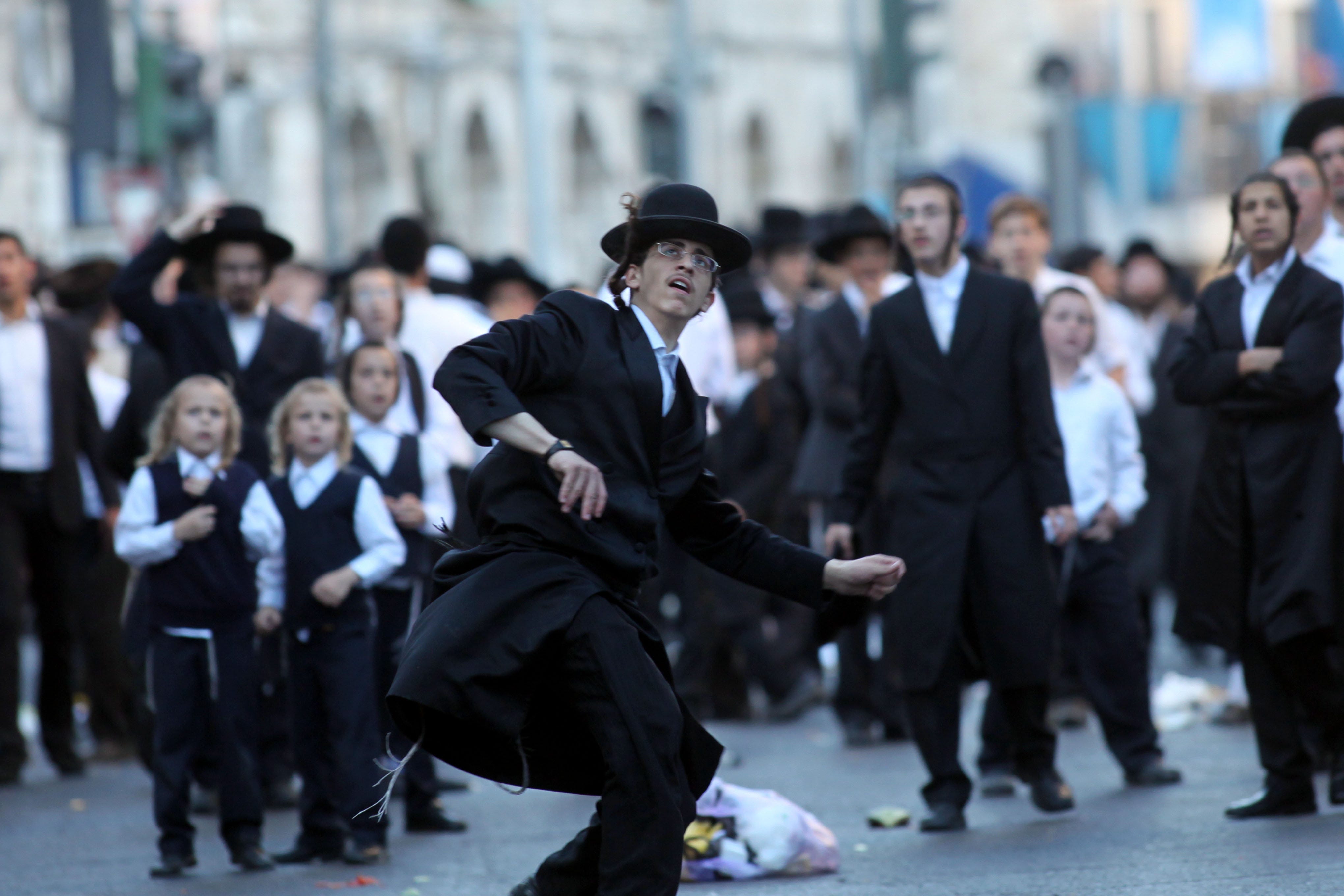
Hundreds of ultra-Orthodox protestors riot in the streets at the ultra-Orthodox Meah Shearim neighborhood to protest against what they view as Shabbat desecration in the capital, 2009. (Yossi Zamir/Flash 90)
It’s Thursday, September 17, and in the alleys of the ultra-Orthodox Jerusalem neighborhood of Meah Shearim, there stood a table collecting ballots. The station was identical to the dozens of others scattered around the British Mandate of Palestine in every way but one: here each man voted twice.
The ultra-Orthodox Old Yishuv, unwilling to allow women to take part in public life, had refused to participate in the Mandate’s first election in 1920. Without their participation, the British would not recognize the newly elected assembly as the authentic voice of Palestine’s Jews. So, the Zionist New Yishuv compromised, allowing every man to vote twice: once for himself, once for his wife. Even so, factions of the Old Yishuv rejected any pre-messianic Jewish autonomy in the Holy Land as heresy. Voters standing at the tables were harangued with shouts of “Es iz asur!”—it is forbidden—as opponents told those who participated that they had “no part in the Torah of Moses and Israel.”
The secular leadership had no patience for the “clericalism at war with the equality of women,” as Vladimir Jabotinsky, father of the Zionist right, put it. His archrival and future prime minister, David Ben-Gurion, agreed, contemptuous of the backwardness of what he called the “sick part of the Yishuv.” And yet the ideological heirs of both men would go on to make a thousand compromises with the heirs of the Old Yishuv. Women’s equality would, in the end, largely win out, though clericalism was far from defeated. Over the next eight decades, the ultra-Orthodox would strengthen, going from two votes each to four as they routinely prevailed in 80/20 initiatives.
It is easy to mistake the uniformity of ultra-Orthodox views, or the genuine uniformity of their wardrobe, for a monolith. In truth, the ultra-Orthodox come in countless sects and subsects. There are the Eastern European Ashkenazim and the Middle Eastern and North African Mizrahim; the fervent Hasidim and the analytic Lithuanians; the modern and the reactionary; some quietly Zionist, others militantly opposed to the very existence of the state of which they are citizens.
This apparent uniformity is intentional; it is a closed society bent above all on rigid continuity. Open a children’s coloring book in Meah Shearim and you will discover that the community apparently believes Abraham wandered the ancient Middle East clad in a kaftan and high white socks. And yet, for all that assurance of thousands of years of received tradition, the current lifestyle and the politics of the ultra-Orthodox are only around 50 years old—serendipitously coinciding with the introduction of color television to the state, when it became possible to spot who was wearing black and white.
To explain the Haredi journey from radical clericalism to moderation and back over the course of 70 years, we must start at the beginning, that of the first compromise in 1947.
Hoping to wash its hands of the chaos unfolding in its mandate, Britain handed the future of Palestine to the United Nations. The U.N. Special Committee on Palestine, known as UNSCOP, arrived to weigh partition, and just as it had with the mandate election almost 30 years before, the Zionist establishment needed the ultra-Orthodox to support the initiative.
Ben-Gurion took it upon himself to strike the deal with Agudat Yisrael, the Orthodox movement founded in Europe for the express purpose of, among other things, fighting Zionism. Few were less suited to the role of guarantor of religious privilege. Ben-Gurion was a committed Jew of the historical rather than the religious variety—”I am not a religious person,” he said flatly—and he had no patience for religious coercion. When he offered the religious philosopher Yeshayahu Leibowitz a place on Mapai’s Knesset slate, Leibowitz set as a condition the separation of religion and state. Ben-Gurion’s answer was total: “I will never agree to separate religion from the state. I want the state to keep religion in a grip.” He signed a letter guaranteeing the status quo, allowing the Orthodox to maintain their Ottoman-era jurisdiction over Sabbath observance, dietary law, marriage and divorce, and education. Orthodoxy, he and his advisers were sure, was a Diaspora contrivance, a way for a scattered people to wall itself off from its neighbors, and it would dissolve the moment the Jews had a modern state of their own to live in.
The remarkable thing is that the Haredim agreed with him. To them a “secular Jew” was a contradiction in terms, an accident of history that, like other accidents, would correct itself. Each side signed the same paper convinced it was humoring a doomed relic.
With the Agudah on side, UNSCOP endorsed partition.
Partition was perhaps the most consequential event for Jewish identity since Emancipation a century before. The creation of the state was an earthquake that fractured pre-state groups, creating fault lines in the new ideological landscape as Jews desperately scrambled to understand what it meant to be Israeli. The ultra-Orthodox remained largely unaffected; their identity had been forged by a different cataclysm, three years earlier.
The Holocaust had annihilated the great centers of Torah learning in Lithuania, Poland and Hungary. What reached the new state was a fragment of a fragment: a scattering of surviving rabbis, yeshiva students and Hasidic courts intent on rebuilding. “To spite Hitler” became the community’s raison d’être. Partly out of sympathy and partly as a political concession, Ben-Gurion exempted 400 yeshiva students from military service so they could rebuild. They did, perhaps too well.
A student in the study hall of the Mir, transplanted from Belarus to Jerusalem, still lived theologically in Europe. He prayed for Jerusalem and the Temple as though they were not a 20-minute walk away across the armistice lines. He saw himself as a chosen bearer of a 3,000-year tradition handed down from Sinai, one that had barely survived extermination and now needed urgent revival. Beside that task, building a state was marginal.
The approach was canonized in the community’s founding myth. Americans have George Washington and the cherry tree, honesty as the root of leadership. The Swiss have William Tell and the magistrate, defiance as the root of liberty. The Haredim have a conversation in a small apartment in Bnei Brak, in October 1952, between an aging rabbi and the state’s first prime minister.
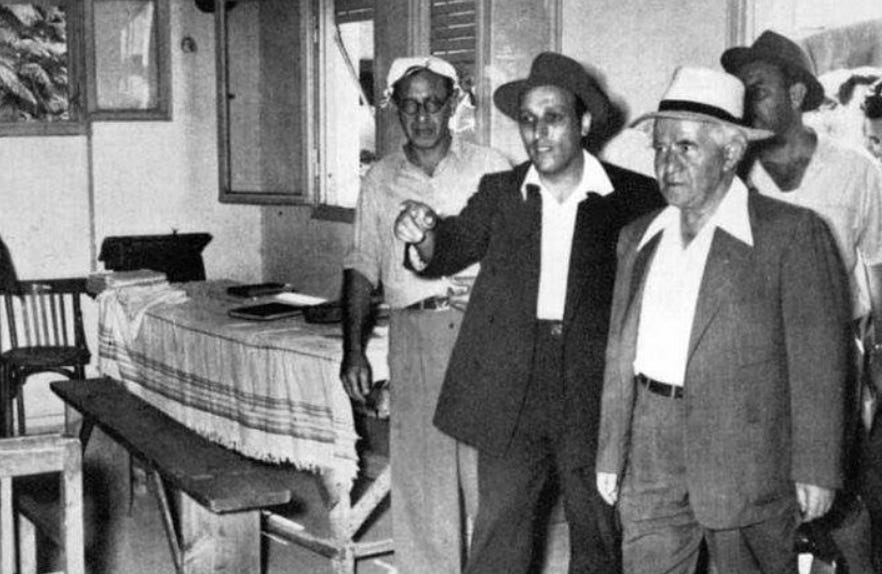
Prime Minister David Ben-Gurion at the entrance to the home of the Chazon Ish in Bnei Brak.
Rabbi Avraham Yeshayahu Karelitz, known by the title of his magnum opus, the Chazon Ish, held no official post and headed no yeshiva, yet the prime minister would come to his modest Bnei Brak apartment.
They met in his study, which doubled as his printing room, reception hall and bedroom. Ben-Gurion had come with a large question: Now that there is a state, Jews must live off one another and make their own laws, and every individual depends on the collective. There are religious Jews like you and secular Jews like me. How do we live together?
The Chazon Ish answered with a Talmudic parable. Two camels meet on a path too narrow for both, one bearing a full load and one carrying nothing. The unladen camel yields. The Orthodox, he said, carry the yoke of 613 commandments.
Ben-Gurion did not accept it. Only the religious bear a yoke? Is settling the land not a commandment? Working the soil? And guarding life and the borders, is that a light commandment in your eyes? They give their lives for these.
Unlike the archetypal sage story, both the petitioner and the sage left the conversation unconvinced. The Chazon Ish never carried an Israeli identity card and never voted.
Ben-Gurion had already tried his own version of coexistence by cultivating friendly relations with Haredi politicians. He had discovered what every prime minister after him would: the Haredim were useful. To his left stood Mapam, Marxist, pro-Soviet and spoiling for a fight over economics. To his right stood Herut and the General Zionists, hostile on economics from the opposite direction. The religious parties had no ambition to lead the country and little interest in economic policy; they made for the perfect partners.
In Israel’s first election, the two forms of Israeli Orthodoxy, religious Zionism and ultra-Orthodoxy, ran in a single bloc. The religious Zionists took governing seriously. This was for many of them the beginning of the redemption; governing was consequently a holy act. Meanwhile, Agudah policy on government participation was similar to that of Boris Johnson on cake: “pro having it and pro eating it.” Maximum independence and maximum benefits.
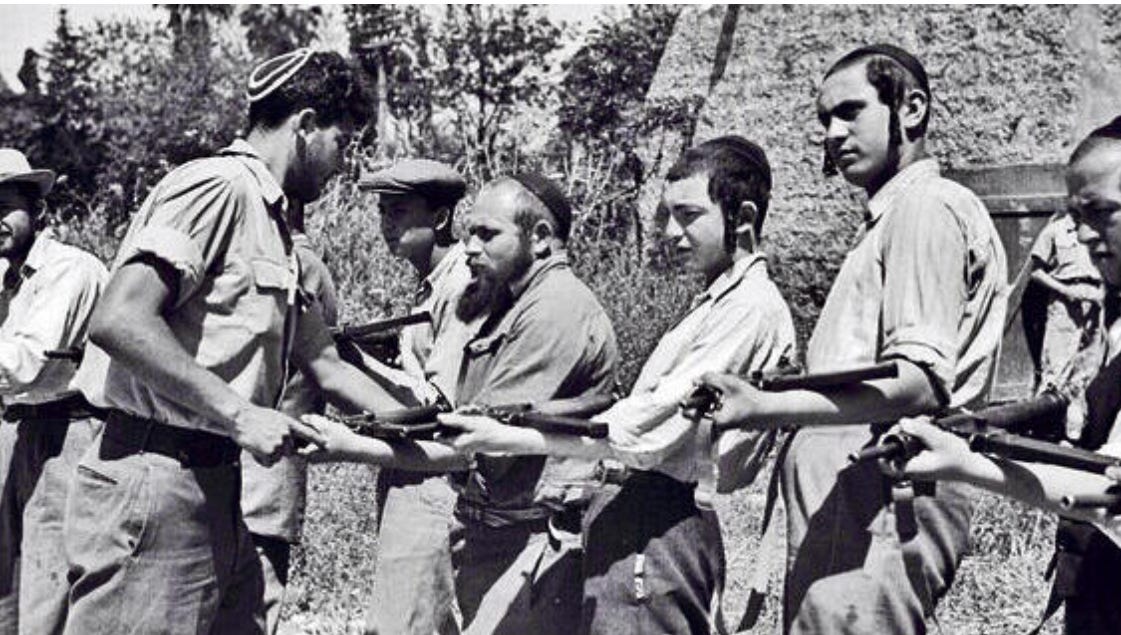
Haredi soldiers in training, 1948. (Fred Chesnik, KKL-JNF Archives)
Yet this was before a shared appetite for budgets was enough to hold a bloc together. Religious Zionists could run alongside the ultra-Orthodox because both were, to different degrees, invested in the state. Fresh off the boat, the Haredi community had not yet absorbed the hard-line anti-Zionism of the Old Yishuv. After the Holocaust, the Agudah leadership’s attitude to the Zionist project ranged from ambivalent to openly supportive. The Agudah set up its own draft centers, celebrated the state’s victories in its publications and flew the flag over institutions whose successors would now consider the act heresy. The zealots kept this moderation intact by staying out, since on principle they refused to take part in state politics.
The moderates found their home in Poalei Agudat Yisrael (PAI), the ultra-Orthodox workers’ party. In today’s climate, a Haredi labor movement sounds like a punchline. Yet PAI ran agricultural settlements where men in Haredi black and white worked the land as fervently as secular pioneers in khaki. Most of its members were not pioneers, instead working in small commerce or as teachers, scribes and ritual functionaries. Overall, Haredi male employment stood at about 84 percent. The “society of learners,” in which nearly every man studies indefinitely while the state and his family absorb the cost, was decades and a wholesale shift of mind away.
Zionism aside, the religious parties shared an essential character: flexible on economics, immovable on religion. Ben-Gurion had tried to defer the religious question with his status-quo letter, but it proved a paper shield. The clashes came almost immediately.
The first puncture came in the transit camps, which were filling with traditional Jews from Yemen and North Africa. Someone would have to educate their children, who were many and multiplying, and both the labor movement and the religious parties regarded those minds as theirs to claim. The religious side charged that “an entire generation of religious children has been done away with,” taken from their parents and marched into secular schools. The labor establishment saw religious functionaries poaching in its camps and, in Golda Meir’s words, was ready for a “religious war.” Ben-Gurion dreaded a culture war and kicked the can once again. He resigned and formed a new government with a different education minister.
His next government tripped over the same can. In 1952, national service for women had the religious parties up in arms again. PAI, worldly and embedded in the state’s economy, was prepared to live with it. The Agudah, pulled by Lithuanian hardliners bent on walling the community off, was not. The welfare minister, the Gerrer Hasid Yitzhak-Meir Levin, put their case plainly: “If we face the choice of transgressing the laws of Moses or the laws of the state, we will violate the laws of the state, not those of Moses.” The Council of Torah Sages ordered both the Agudah and PAI out of the government.
Aside from PAI’s brief stint in government against the rabbis’ wishes 10 years later, the Haredim would make their home in opposition for the next 29 years.
Once again, the ultra-Orthodox bucked a trend that swept the rest of Israeli society. The wars of 1967 and 1973 recast religious Zionists as settlers, the left as peaceniks and Israeli Arabs as Palestinians, but left the Haredim largely unchanged. They remained softly Zionist, and the 1967 victory brought their attachment to the state to its peak. Dancing in the streets was followed by debate over marking the day of Jerusalem’s reunification as a religious occasion. The wave soon subsided. The development of those years that mattered most for the ultra-Orthodox future was the rise of two rabbis.
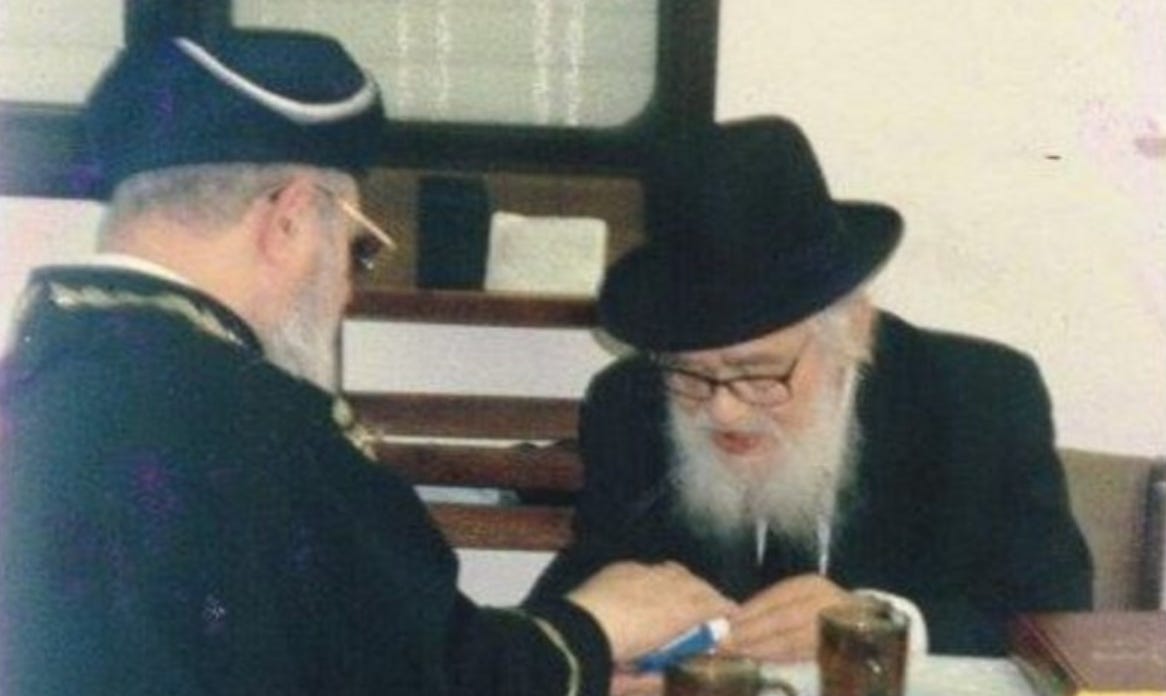
A meeting of Rabbi Elazar Shach and Rabbi Ovadia Yosef.
They could hardly have been less alike. Rabbi Elazar Menachem Shach was a Lithuanian of the old European mold, head of the Ponevezh yeshiva in Bnei Brak. He had never held a state post, and his anti-Zionism would never let him. While other Agudah leaders celebrated the miraculous victory of 1967, Shach dismissed it as a fluke, a single occasion on which the wicked Zionists happened to prevail.
For all his reverence for tradition, Shach was an original. Most anti-Zionists of his stature refused to touch politics. Shach combined a fierce rejection of the state with a determination to bend it to his will.
Rabbi Ovadia Yosef was a Mizrahi Jew, born in Baghdad and raised in Jerusalem, a halachic authority of prodigious recall. He had spent his entire career inside the state’s religious establishment, rising to the role of Sephardi chief rabbi of Israel in 1973. He never declared himself a Zionist, but he was far friendlier to the state than Shach. He stopped short of the religious Zionists’ view of the state as sacred, though he entertained the idea at several points in his career.
Shach’s flock was the Ashkenazi yeshiva world. Yosef’s was the vast, marginalized Mizrahi periphery that the Ashkenazi establishment, Shach’s world very much included, had spent decades overlooking.
One might assume the Haredi world is a geniocracy, where whoever commands the most Talmud dictates policy. But no system, religious or otherwise, is immune to the power of crowds, and both rabbis rose by popular demand. Neither was the charismatic street preacher one imagines at the head of a mass movement; instead, they wielded the pen and the pulpit better than most could swing a sword. For all their differences, they would end up simultaneously allied and at war, the twin poles of Haredi power for a generation and more.
Their rise began with the Upheaval.
The 1977 election upended Labor’s three decades of dominance, and the three decades of Haredi life. After eight straight electoral defeats, Menachem Begin finally sat in the prime minister’s office. He was a natural partner for the Orthodox. He was born in Brisk, a great center of Torah learning, liked to quote traditional sources and was a fierce defender of the state’s Jewish character. From the Knesset pulpit he had fought pig farming in Israel, an issue the Haredim would return to time after time as an example of the state’s secular bona fides. “When I was a boy they tried to rub pork lard on my lips,” Begin told the Knesset. “I fought back with all my might and stood up to them.” He returned to that boyhood story more than once after taking power, including a feature in his notice to El Al to stop flying on Shabbat.
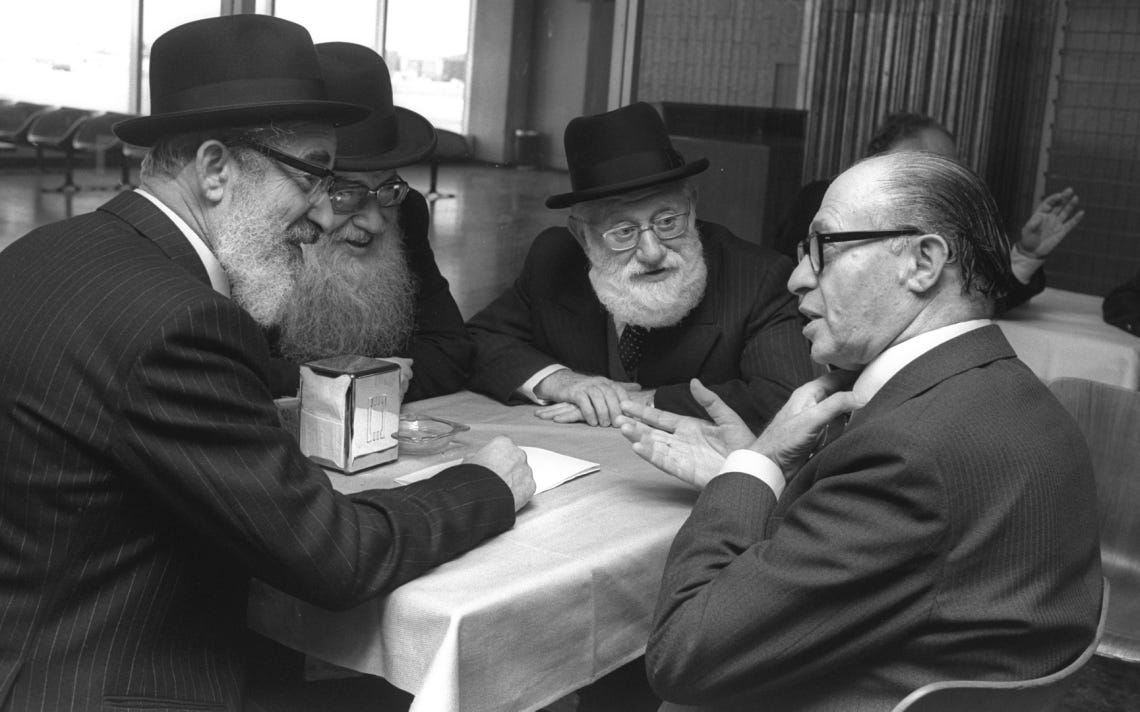
Prime Minister Menachem Begin with ultra-Orthodox MKs, 1977. (Saar Yaakov)
Begin’s standing among the Haredim exceeded anything a Hasidic rebbe could claim. A rebbe is revered by his own followers and resented by everyone else’s. In Bnei Brak, Begin was revered by all. He led the national camp, and although he stayed faithful to the liberal inheritance of his mentor Jabotinsky, he largely dropped Jabotinsky’s attacks on “clericalism.” More than any budget or security policy, Jewish identity held Begin’s camp together, of which Haredim were an essential part. His government would coax them in through the front gate with unlimited yeshiva draft deferments, generous funding for Haredi communities and a larger role for religion in public life.
Shach’s star was rising. Despite his anti-Zionism, he justified joining the coalition with a parable from his own teacher. A woman stood weeping in the market as a gang of boys stole her apples, until a wise man told her, “Don’t cry—everyone’s grabbing, so stand there and grab too.” With subsidies ballooning and no cap on deferments, Shach set about building his “society of learners.” The Chazon Ish had designed full-time study for “a small group of top students,” partnering each of the learners with a working counterpart to ensure self-sufficiency. But Shach viewed Torah study as a pursuit necessary not for some but for all, and rather than fostering a symbiotic relationship within the community, he attached the umbilical cord to the state.
His reasoning wasn’t that full-time Torah study was a commandment incumbent on all; it was strategic. Ordinary life outside the study hall, Shach told one petitioner, was no longer possible. The secular world was a “stormy sea,” and only those who kept learning would stay safe. “There is no alternative.”
Religious societies are a lot kinder to zealots than political systems; there is an attraction in being labeled the “most pious,” in a way there isn’t for being the “most political.” In Bnei Brak, the morning routine would consist of ritual hand-washing, prayer and finding out who Shach was attacking that day.
The incentive to avoid the army and the deepening stigma against secular education, both of which Shach worked hard to reinforce, reshaped Haredi society with startling speed. Over two decades, Shach and a cadre of like-minded hard-liners were able to reshape an entire culture, presiding over a collapse in Haredi male employment from 83 percent in the 1970s to under 40 percent by the early 2000s.
Regardless, Ben-Gurion’s brief appreciation of their value came to center stage in the newly religiously inclined Israel. The ultra-Orthodox held a handsome cluster of seats, controlled by a handful of rabbis and insulated from grassroots pressure. They nursed no delusions of grandeur. They never coveted defense, foreign affairs, finance or the premiership. While everyone else clawed up the greasy pole, the Haredim kept their feet on the ground, content to trade the prestige portfolios for budgets. From then on, Israeli elections turned on a single question: “who would form a government with the Haredim?”
But just as Israel was facing an internal revolution from the ultra-Orthodox, the ultra-Orthodox were facing an uprising of their own.
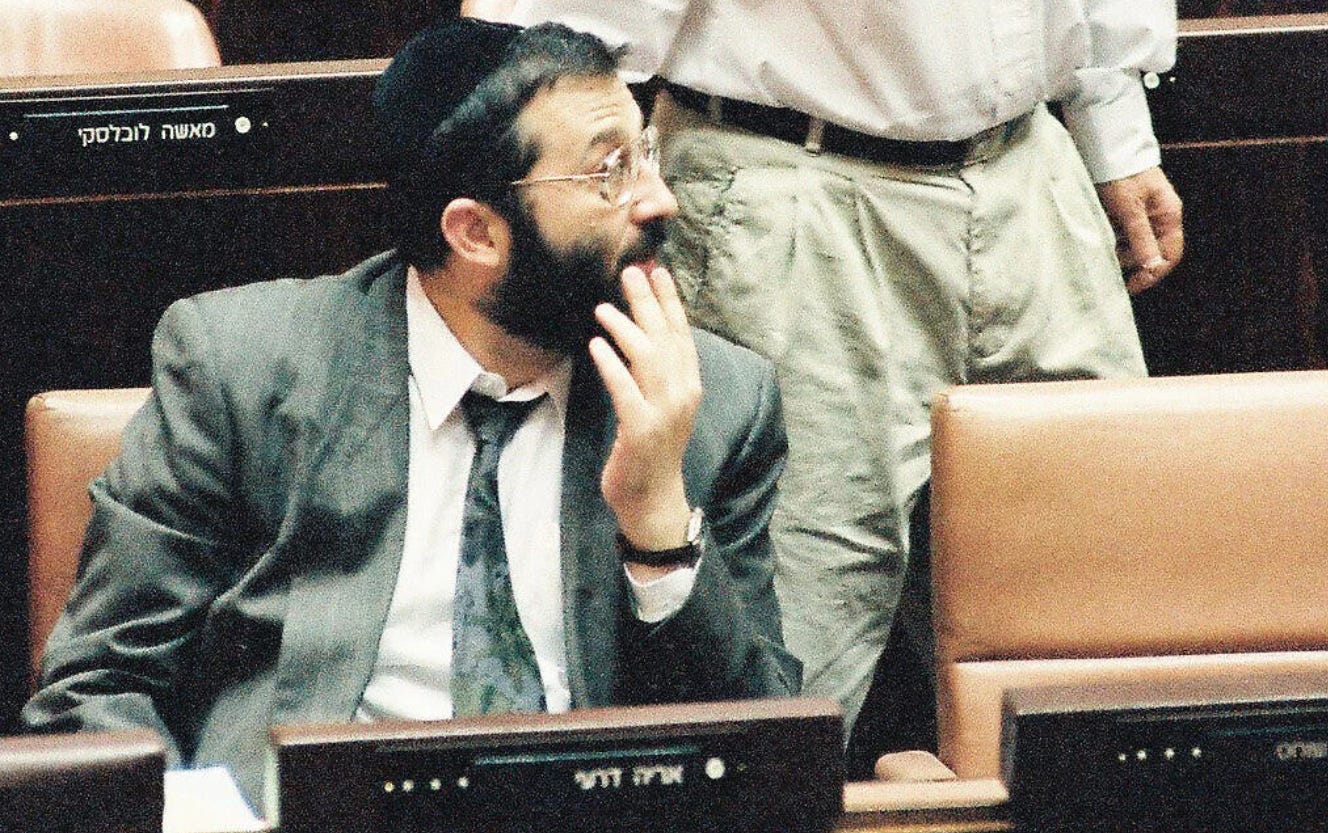
Aryeh Deri in the Knesset, September 27, 1993. (Flash90)
It began in the study hall. A young Moroccan student at the prestigious Hevron Yeshiva named Aryeh Deri noticed that Sephardi students and their rabbis always deferred to the Ashkenazim. It was a self-abasement he refused to accept. “That’s how I got the idea for Shas,” Deri later claimed, the acronym standing for Shomrei Torah Sfaradim, the Sephardi Guardians of the Torah. The idea took shape in Yosef’s house, conceived as an alliance between Shach and Yosef that would give Sephardi Jewry its own political representation while carrying, as Deri put it, the religious backing of the Ashkenazim.
The party, formed to contest municipal elections in Bnei Brak and to catch stray Mizrahi Haredi votes, would catch rather more than that.
For the Jews of Baghdad, Casablanca and Sana’a, the Promised Land had not fulfilled its promise. They stepped off the boats into a cloud of DDT, then boarded trucks to the ma’abarot, the transit camps on the periphery, where many waited years at the back of the line for a real apartment. The powers that be feared being “consumed by the Orient” and set about Westernizing what Ben-Gurion called “human dust.”
In the yeshivas of Bnei Brak and Jerusalem, the Haredi establishment ran the same operation. Convinced their Talmud study was the gold standard, the Lithuanian rabbis appointed themselves guardians of their Sephardi brethren. As guardians, they would take over their education and their spiritual guidance.
But the embrace had limits. Elite yeshivas and seminaries kept quiet quotas for Sephardim, and matchmakers rarely paired a Sephardi groom, however brilliant, with a respectable Ashkenazi family.
By the late 1980s, with Mapai’s cultural discipline broken, the Shas party offered a platform of “Restoring the crown to its former glory,” a revival for the downtrodden of Israeli society who had never stopped holding their tradition in high esteem. Its first national election in 1984 netted four seats; four years later it would take six. Perfect for Shimon Peres’ conspiracy.
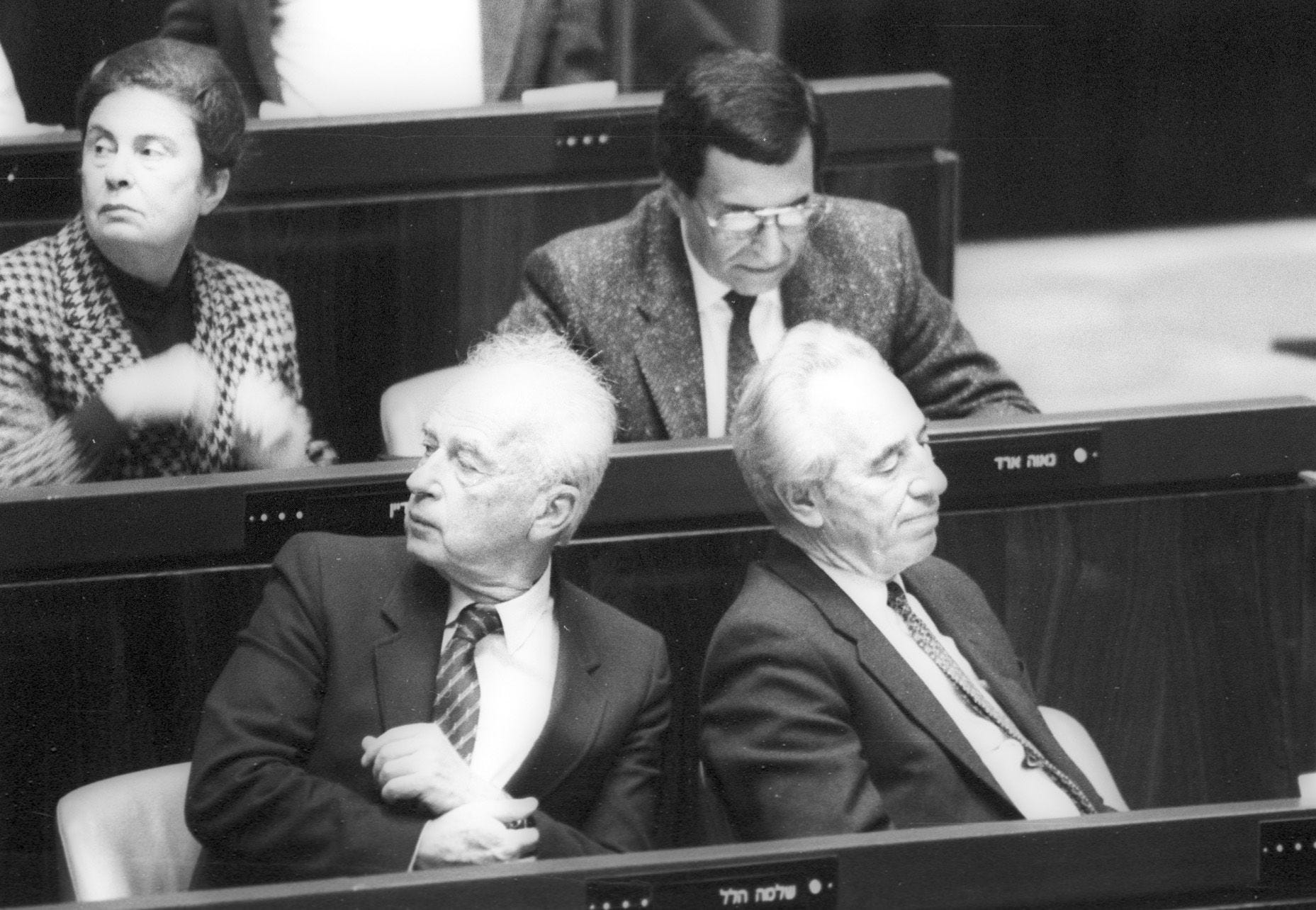
Yitzhak Rabin and Shimon Peres listening to the speeches of the PM and ministers.
A little over a year into their unity government, Peres tired of Yitzhak Shamir and cut a secret deal to bring it down. He succeeded in dissolving the government but discovered that demolition is far easier than construction. With a gap of just two extra seats, all the attention fell on the Haredi parties: Shas, Agudat Yisrael and a new player, Degel HaTorah.
Degel HaTorah was another Shach creation. Tired of the Hasidim in Agudat Yisrael and eager for a vehicle of his own for his community, he founded a party for the Lithuanians.
During Peres’ scramble, the 91-year-old Shach summoned his followers to, of all places, Maccabi Tel Aviv’s basketball arena. Ten thousand men filled Yad Eliyahu. Women reporters were barred at the door; one from Al HaMishmar disguised herself as a man but was caught. Through failing loudspeakers, barely audible, Shach delivered not a coalition verdict but a sermon. He asked whether kibbutzim that do not know what Yom Kippur is, or Shabbat, or a mikveh, that breed rabbits and pigs, have any connection to their ancestry. They had “severed themselves from our entire past,” he said, and wanted a “new Torah.” Then the closer: if there is no Shabbat and no Yom Kippur, in what way is he a Jew?
The press left disappointed. They had come for a ruling on the government and received a lecture on Jewish identity, and the commentary that night complained that the country was being run by ayatollahs. Reporters distracted by the rhetoric had not noticed that Shach had closed the door on a coalition with Labor, permanently.
On the morning of the fateful confidence motion for the new government, after signing a coalition deal with the non-Shach-aligned Agudat Yisrael, Peres discovered that two ultra-Orthodox legislators—Eliezer Mizrachi and Avraham Verdiger—had disappeared. His fears intensified when he looked over the coalition deal and noticed that Verdiger’s signature was not even on the document. Peres’ staff ran to the archives of Israel’s only TV channel, rewatched the tape of the news report and realized that the smarmy Verdiger had only waved his pen over the agreement, without actually signing it. Mizrachi was found in an orchard near Rehovot, Verdiger in a cowshed at Yad Binyamin. The “Dirty Trick,” or literally “stinking maneuver,” as Yitzhak Rabin called the episode with evident glee, indeed ended with the strong whiff of cow dung.
Rabin rose from Peres’ explosion and carried Labor to victory in the 1992 election. Meanwhile, Ovadia Yosef had spent the two years since the Dirty Trick nursing a pair of grudges. The fresher one was against Shach, who had forced him to turn his back on Peres in 1990. The older one was against the right, which had unceremoniously pushed him out of the Sephardi Chief Rabbinate in 1983.
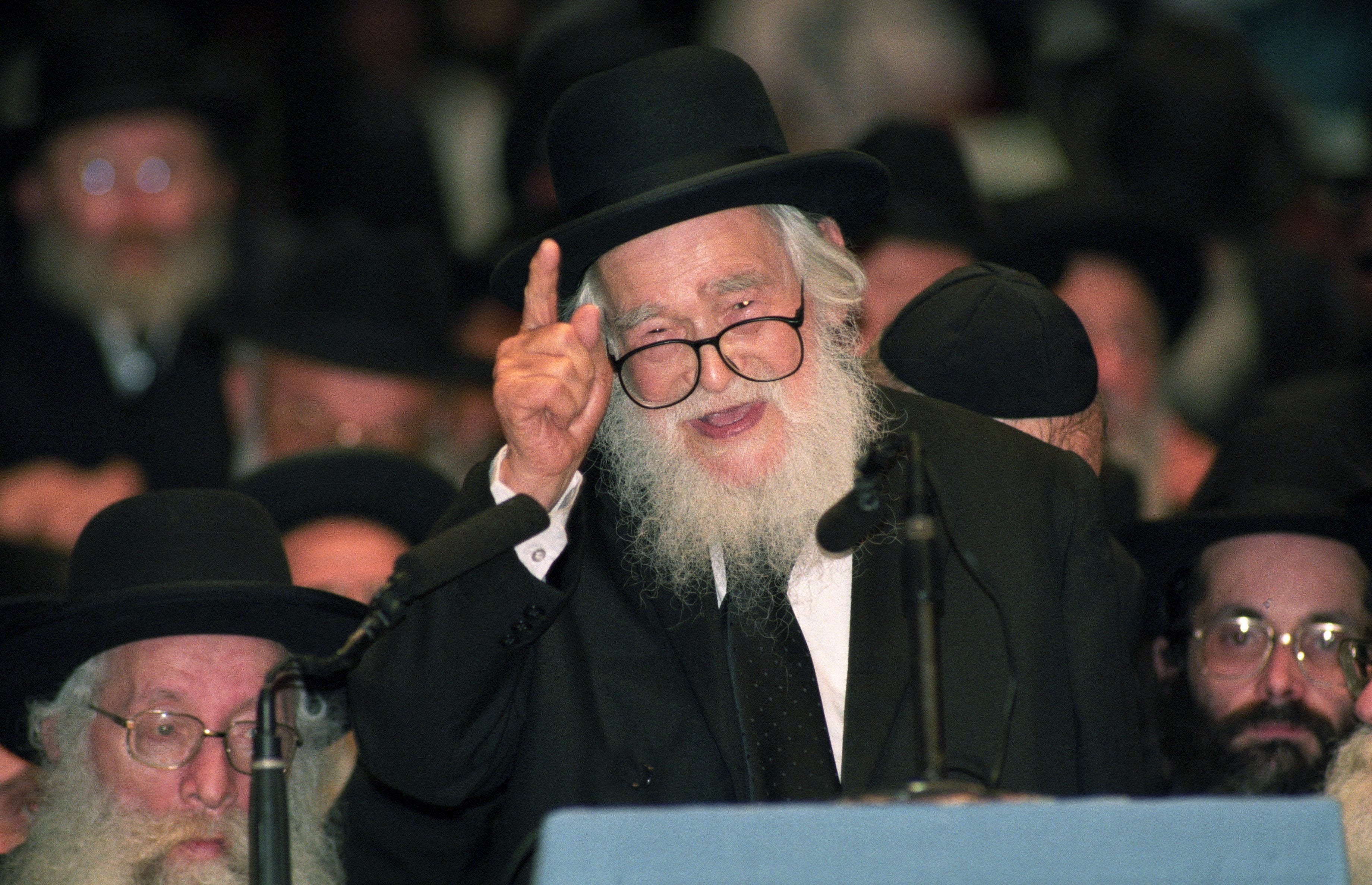
Over 15000 ultra-orthodox gathered at the Tel Aviv Cinerama to listen to the lecture given by Rabbi Shah, the spritual leader of the political parties, 1992. (IPPA)
Shach had been busy building an empire of his own. Having walked out of Shas in 1988 to found Degel HaTorah, he now welded his new party together with Agudat Yisrael into a single list: United Torah Judaism. Most of the Ashkenazi Haredi world now marched behind him. But as the Yiddish proverb has it, nit tantsn oyf tsvey khasenes: you can’t dance at every wedding. By leaving Shas to throw a party of his own, Shach had given up his place at the Sephardi wedding.
That did not stop him from trying to crash it. In an effort to prevent them from joining Rabin, Shach declared that the Sephardim were “not yet ready for leadership.” It was a spectacular own goal. Sephardi voters took the insult personally, and Yosef’s grip on Shas only tightened.
When the votes were counted, UTJ’s four seats were pledged to boycott the left, and the coalition crown came down to Shas. Deri, by then Shas’s leader but still Shach’s disciple at heart, could not bring himself to defy his rabbi. It took Yosef physically hauling him off the sofa to form Rabin’s government.
With Shach still boycotting the left, the prime-ministerial crown fell into the hands of Shas, and to general surprise, the party set it on Rabin’s head. In a country where politics increasingly turned on a single question—are you more Jewish or more Israeli?—nobody was more Israeli than Meretz, and nobody was more Jewish than Shas. Yet they had both fallen in behind Rabin.
The relationship worked because Shas’s rabbis were not, at heart, hawks. Years earlier, Yosef had ruled that returning conquered territory for a genuine peace was permissible, since the saving of life overrode the holding of land. Even Shach, no dove, had issued a similar ruling in the 1970s; his hostility to the left was cultural, not strategic. Deri himself had always carried a center-left worldview. Deep into the 2000s he was still insisting that, given the chance, he could bring his voters and his rabbis around to a large-scale withdrawal, even from parts of East Jerusalem.
Before flying to Washington for his infamous handshake with Yasser Arafat, Rabin hurried to Yosef’s home, and the rabbi sent him off with a blessing: go in peace and return in peace. When the accords reached the Knesset, Shas abstained on Yosef’s orders, allowing the first Oslo Accords to sail through with a cool majority of 61 in favor, 50 against.
Support for the process began to waver as Arafat’s doublespeak and Hamas’ campaigns of bus bombings rocked the country. Oslo’s life was saved at the cost of Rabin’s. His martyrdom at the hands of a right-winger sanctified the process, and the 1996 election was the choice of Benjamin Netanyahu’s “Secure Peace” or Peres’ “A Strong Israel,” presumably also secured with peace.
According to Rabbi Isaac Luria, God first contracted Himself to make an empty space for the universe, then poured divine light into ten vessels to form creation. If you are wondering what 16th-century mysticism has to do with an election, you are where most Israelis were in 1996. In the days before the country went to sleep with Peres and woke up with Netanyahu, voters were treated to the spectacle of the 98-year-old kabbalist Yitzhak Kaduri being flown by helicopter from rally to rally for Shas, rewarding the faithful with amulets promising health, prosperity and romance.
Even a decade after its debut, Shas remained a riddle, wrapped in a mystery, inside an enigma. In the United States, pundits speak of shy voters, the ones who will not admit to a pollster that they intend to vote Republican. Long before the term existed, Israel had the Shas voter. Few would say out loud that they were backing a party whose every Knesset member was an ultra-Orthodox Mizrahi man, almost all bearded, almost all titled rabbi. Yet the base was expanding fast among traditionalist Mizrahim in the country’s poorest neighborhoods, and it carried Shas from six seats to ten.
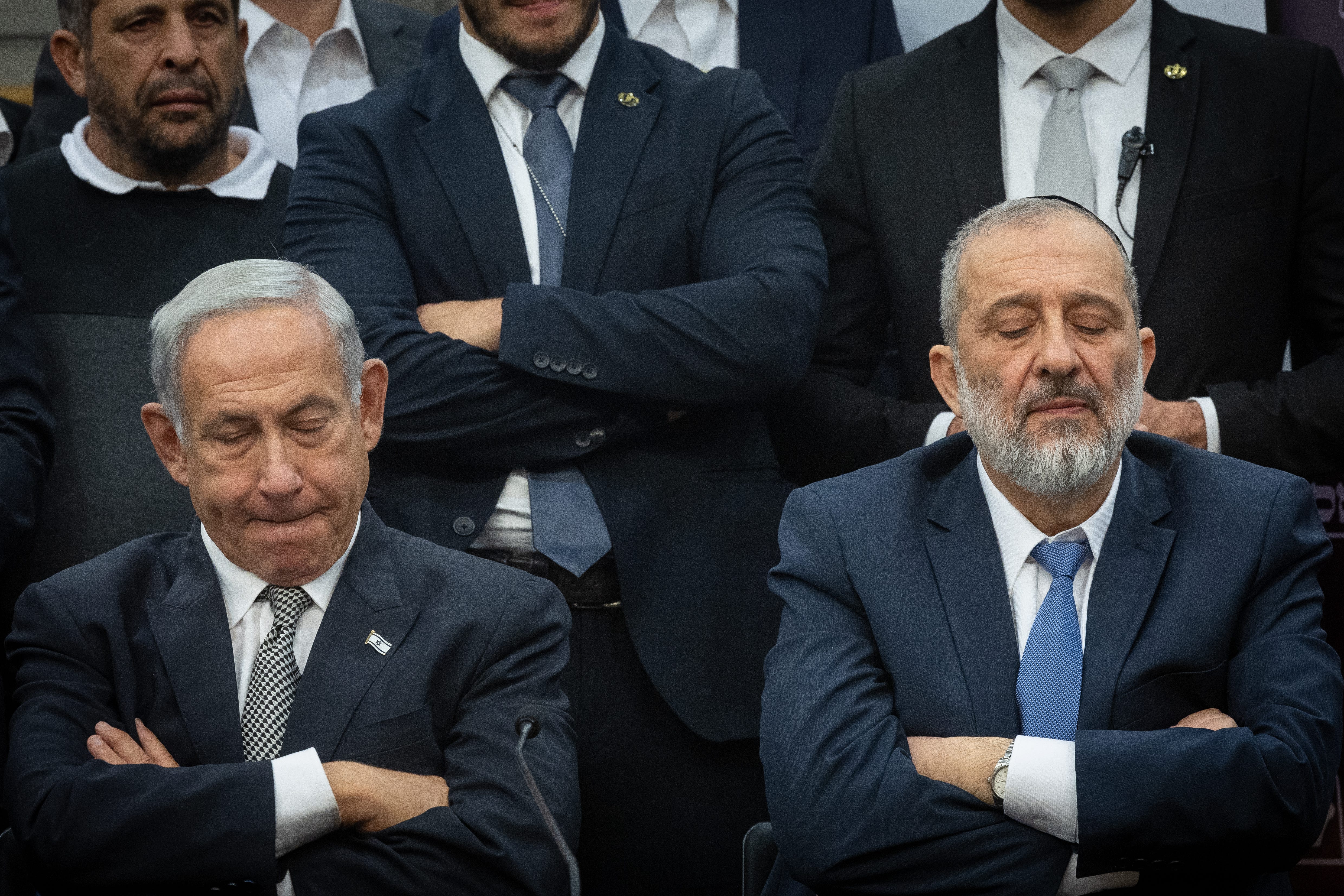
Shas leader MK Aryeh Deri and Israeli prime minister Benjamin Netanyahu seen during a Shas party meeting, at the Knesset, the Israeli parliament in Jerusalem, on January 23, 2023. (Yonatan Sindel/Flash90)
Deri must have collected one of Kaduri’s matchmaking blessings along the way. After the 1996 election, he embarked on a romance with Netanyahu that is still going strong 30 years later.
Deri, naturally, dressed up the match in lofty terms. “Labor wants to make peace but cannot,” he said. “Likud can make peace but is unsure whether it wants to.” Shas, he explained, had joined the coalition to nudge Netanyahu toward the negotiating table.
It was a noble sentiment, but it was not what held the couple together. On peace, the two men never saw eye to eye. What they shared was a deep understanding of power, a commitment to Jewish identity, and suspicion of the legal establishment, which had been chasing Deri over corruption allegations for the better part of a decade and was about to come knocking on Netanyahu’s door as well.
Seven months into the marriage, the couple produced their first child. In January 1997, Netanyahu’s government appointed Roni Bar-On, a Likud activist and little-known lawyer, as attorney general. The legal establishment was appalled, and Supreme Court President Aharon Barak made clear that he considered Bar-On unfit for the job. Bar-On lasted two days.
Then came the real bombshell. Channel 1 reported that the appointment had been part of a backroom deal. Deri, then on trial for bribery, would deliver Shas’s votes in the cabinet for the Hebron Agreement, which Netanyahu badly needed to pass. In return, a friendly attorney general would hand Deri a lenient plea bargain.
For years the Haredi place in Israeli society had been the source of a simmering tension; Bar-On turned it into a multifront war.
The first front ran through the courts. Led by Barak, they sought to put an end to Haredi parties’ horse-trading in the Knesset. The second front was secular, and it had been opened years earlier by the Labor MK Shulamit Aloni in her crusade against what she called Haredi “Khomeinism.” The third front, which would open at the end of the decade, ran through the center. Tommy Lapid, a pugnacious television pundit who took over the Shinui party, built a political career on two grievances: Haredi economic dependence and the draft exemption. Running beneath this tension with Israel’s elite was another factor, the Haredi parties’ steady drift into the arms of the right.
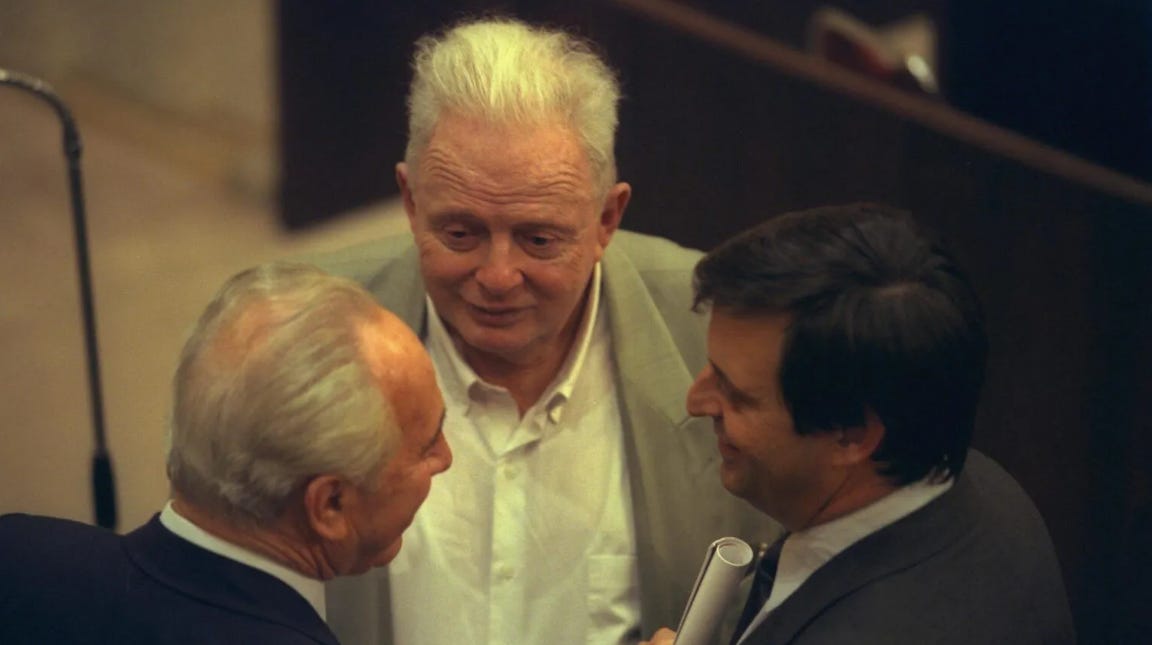
Shinui party leader Tommy Lapid (center) speaks with fellow Knesset members Shimon Peres (left) and Dan Meridor before the swearing-in of a new government July 6, 1999. (Avi Ohayon, GPO)
Lapid had picked up the discarded sword of Jabotinsky, denouncing the subordination of Israel’s security, economy and public policy to the “ghetto rabbis.” The draft exemptions, while never popular, were until the 1990s largely considered baked in. No party was eager to pick that fight, and the negligible number of ultra-Orthodox never made it a priority. But growing entitlements, the burden on soldiers and explosive Haredi population growth brought the issue into the limelight.
The secular Lapid must have been blessed with the gift of prophecy. His refounding pitch for Shinui contained a familiar message of the 2026 election: “The Israeli middle class is sick of being the only one that pays taxes, the only one that does reserve duty, the only one that keeps the law, the only one holding the whole state on its shoulders, while the others exploit its silence to fatten their own coffers.” The similarity isn’t coincidental; he bequeathed his platform along with his mission to his son, Yair.
Meanwhile, the battle over the public square spanned everything from the cabinet to the street. From the Education Ministry, Aloni pushed to put evolution into the curriculum and picked so many fights with Shas that she nearly brought Rabin’s coalition down. Outside the ministry, she married couples the rabbinate refused to wed, in open defiance of its monopoly on Jewish marriage. In 1993, Rabin moved her out of the Education Ministry. That did little to tame her. In 1994, she kissed the Pope’s hand at the Vatican, an image the religious press would replay for years.
Meanwhile, the fight spilled onto the street. Bar-Ilan Street, a main artery running past Haredi neighborhoods, became the front line when the Haredim demanded that it be closed to traffic on Shabbat. For three years, the street convulsed every Saturday. Haredi crowds blocked the road and hurled insults and stones at cars and police officers. Secular Jerusalemites drove through on purpose, as a matter of principle. It became known as the Haredi Intifada.
The episode revealed the limits of the alliance. The left and the Haredim could join hands on territory, but never on whether Israel was, first and foremost, a democratic state or a Jewish one. And since the Haredim were the kingmakers, it was the left that had to trade one for the other. For Rabin, peace was worth more than evolution.
The third front, the courts, proved both the most successful and the most futile. It opened in December 1998, when the Supreme Court ruled that a draft exemption arrangement this sweeping could no longer rest on the defense minister’s discretion, where it had sat since 1948. A matter this fundamental, Barak wrote, required primary legislation.
The Knesset took its time. In 2002, it answered with the Tal Law, which largely wrote the existing arrangement into statute. Yeshiva students would continue to defer service by default, and at 22 they could take a “decision year” to try working or a shortened stint in uniform. The law was billed as temporary and given five years. Like most temporary things in Israel, it lasted twice as long, surviving extensions and petitions until the court finally mustered the nerve to strike it down in 2012.
The next attempt came in 2014. Yair Lapid and Naftali Bennett, having kept the Haredim out of government, passed the Equal Burden Law, complete with enlistment quotas and criminal sanctions if the quotas were missed. The Haredim returned to government the following year and gutted it. In 2017, the court struck down what they had left behind.
It became a game of cat and mouse with no end in sight. The court could block a law, but it could not write one. Every ruling produced a workaround, and every workaround produced a new ruling. Through it all, the yeshiva students stayed at their Talmuds, looking up only occasionally to protest and to riot.
The Wye River Memorandum, which committed Netanyahu to continue the Oslo process, blew apart his coalition and forced the 1999 election. That year, Deri was convicted of bribery—and Ehud Barak won by a landslide, helped along by Yosef’s blistering epithet for Netanyahu: “a blind goat.” But winning was the easy part; Barak still had to form a government. Barak faced Rabin’s dilemma: he could go with Shas or attempt a unity government with the Likud.
The crowds packing Rabin Square for the victory celebration had already expressed their preference, roaring: “Anyone but Shas! Anyone but Shas!” Barak heard them and promptly ignored them. “I could have formed a government that would have addressed domestic affairs, a unity government with the Likud,” he explained 20 years later. “But we were three years past the deadline for a permanent settlement with the Palestinians, and Clinton had a year and a half to go.” In the end, the crowds accepted it, as Aloni had done years before, donning a shtreimel for peace. But Barak had one condition: the indicted Deri must surrender the leadership.
Yosef was more than happy to oblige. He had grown sick of his independent-minded consigliere; he believed the party would be better without him. “Thirty, forty percent will leave Shas,” he predicted. “Why? Because he was convicted in court. Why take a thief, a bribe-taker?” The rabbi had seriously misunderstood his own base. Deri was carried shoulder-high above a roaring crowd of supporters, recast not as a convict but as a martyr—the persecuted Mizrahi hero framed by an Ashkenazi establishment. It was the oldest and most potent story Shas told about itself: the revenge of the ignored. Riding an unprecedented protest vote against the conviction under a J’accuse! campaign and helped by an electoral system that let voters split their ballot between prime minister and party, Shas leapt from 10 seats to 17—almost level with the Likud.
Shas’s ability to support the peace process must be counted one of the greatest maneuvers in political history. Its voters have always been the most right-wing element of the Israeli electorate—more nationalistic than the right-wing National Union, more hostile to law enforcement than the Likud, more resistant to territorial concessions than Mafdal, and, to top it off, more devoted to the Likud’s leader than Likud voters themselves. And yet, for more than a decade, Yosef’s personal commitment to the peace process took the wheel of a fiercely right-wing electorate and parked it, improbably, in the left camp.
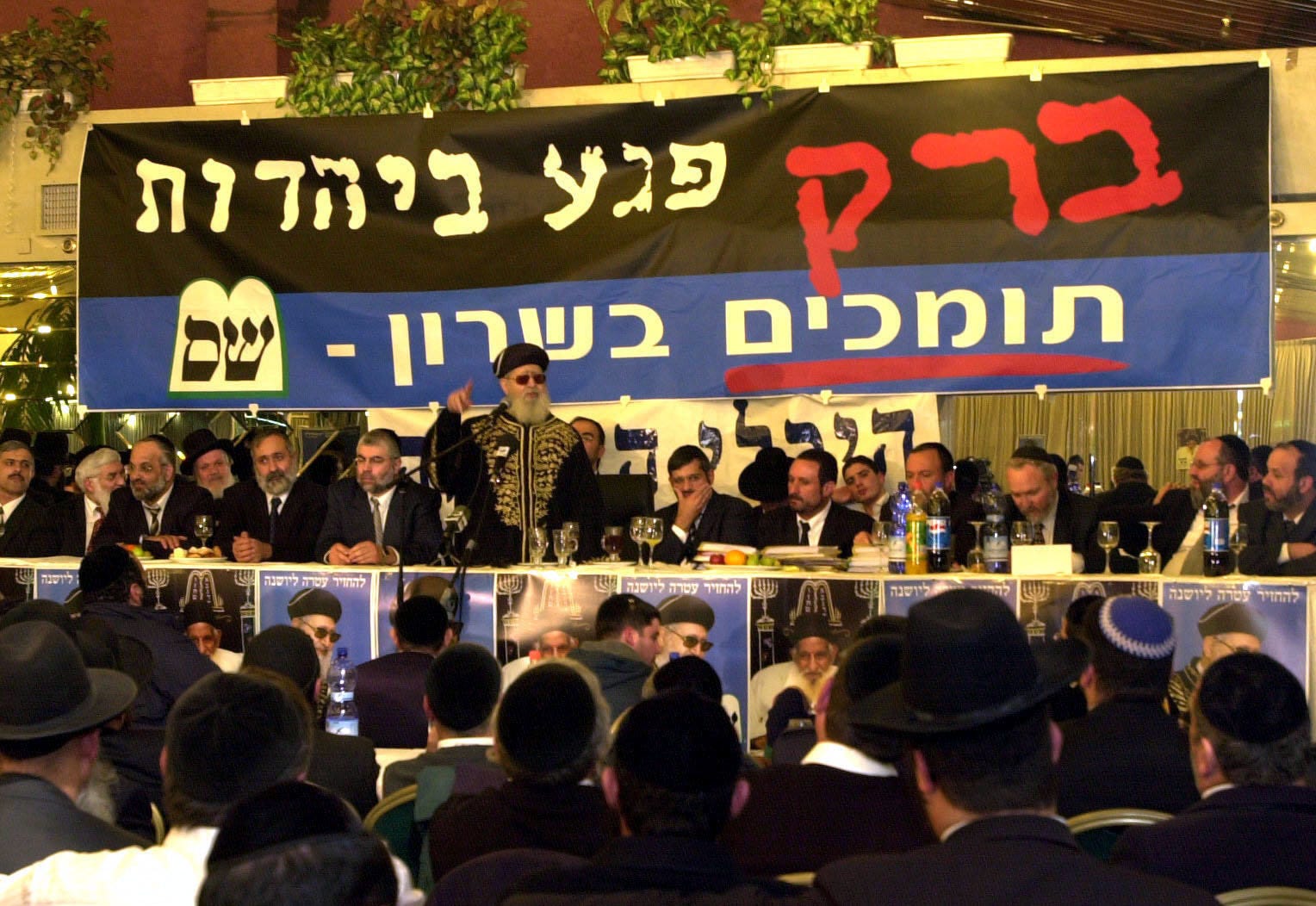
Rabbi Ovadia Yosef and ultra orthodox Jews protesting against Ehud Barak and for Ariel Sharon. January 23, 2001. (Nati Shohat/Flash90)
But it was a hard balance to strike. Yossi Sarid, Meretz’s chairman and another of Yosef’s old antagonists, took the Education Ministry. It was Aloni all over again; this time Yosef crowned Sarid “evil Haman, Satan, who must be uprooted from this world.” Barak had set out to end a century of war with the Arabs but could not even broker a cease-fire in the Jewish civil war inside his own coalition.
Days before the summit that was supposed to end the conflict, Sarid resigned from his beloved ministry in tears—he “could not take responsibility for the collapse of the peace process”—leaving so that Shas could stay in the government.
It wasn’t enough. Unable to pay the costs of peace Barak was setting, Shas waited three weeks and then walked out too. Barak flew to Camp David with a coalition already crumbling behind him and came home with neither peace nor a government. Only then, too late, did he remember he was a secularist. One Saturday night he summoned his colleagues and proclaimed a secular revolution—civil marriage, public transport on Shabbat, the dismantling of the rabbinate—and offered the Likud a secular unity government, declaring he would even walk back what he’d conceded at Camp David to get it. The Likud simply laughed. Shas, after its long and unlikely sojourn on the left’s turf, had finally come home; the Likud was not about to tell it, “Sorry, we’re not home.”
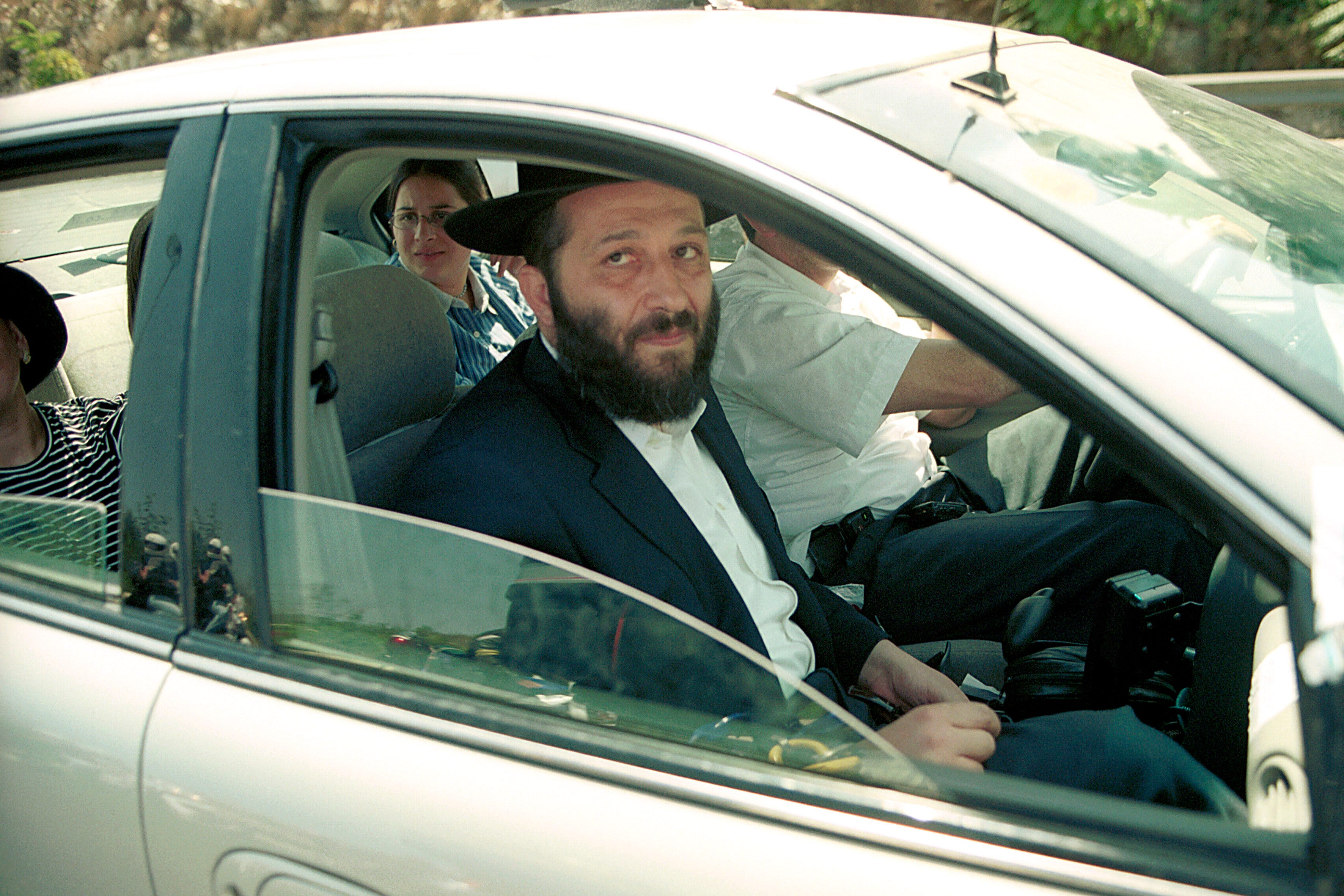
Aryeh Deri on his way to Maasiyahu prison, convicted of taking $155,000 in bribes while serving as Interior Minister, September 03, 2000. (Flash90)
In 2002, the heavy doors of Maasiyahu Prison had not yet closed behind the freed Deri when he stood at a microphone amid a crush of supporters and asked forgiveness. Not from the court, and not from the public. From the late Shach—for the sin of taking Shas into Rabin’s government in 1992 against his master’s explicit orders. That, Deri remains convinced to this day, was the real crime for which he served two years. Not the envelopes stuffed with dollar bills.
While Deri was still languishing in prison, the old general Ariel Sharon had risen from the flames of the second intifada. Nicknamed the Bulldozer, he gave everything in his path the same treatment, regardless of head covering or lack thereof.
As a minister and rank-and-file member of the Knesset, he had visited the courts of rabbis and Hasidic rebbes more than any other politician, wearing a big black kippah on his white hair. But the moment that he was elected to the highest office in the land, he dropped this old habit. When pushed to make the traditional pilgrimage to Yosef required of a Shas-aligned coalition, “The prime minister doesn’t go to anyone,” he responded. “They come to him.”
The Haredim were late to realize that they were no longer in charge. In May 2002, they torpedoed a scheme for government cuts to save the collapsing economy. Sharon wasted no time. That same night, he fired Shas and UTJ’s ministers. With this, he became the first and last prime minister to date to have voluntarily booted the Haredim out of a coalition instead of begging them to enter it. He derived immense, almost sadistic, pleasure from this act. “Nu, have the letters arrived yet?” he kept asking his cabinet secretary every other minute, in case the courier with the dismissal letters had gotten stuck in traffic. Only after the Haredim begged him did Sharon agree to let them back into his government, but not for long. After the 2003 elections, Sharon decided to bring into the government Tommy Lapid’s secular Shinui party, which had just won 15 seats, at the expense of the Haredi politicians, who were used to thinking of their ministerial seats as their private property. Shinui’s new ministers walked around their new ministries like kids who were let loose in a (non-kosher) candy store. Their first act was to erase the letters BS”D (short for “with the help of Heaven” in Aramaic) from the Interior Ministry’s letterheads.
But then Shinui discovered that all sheep in Sharon’s flock meet the same end: slaughter. When Mafdal quit the coalition in protest at Sharon’s disengagement plan and Sharon needed religious representatives around the table to defend against charges of heresy, he had no qualms about switching the clean-shaven Shinui for the lustrous beards of UTJ in his cabinet. “They’re against everything that’s Jewish,” Sharon said in horror about Lapid and his colleagues with considerable delay, as if his retinue had just landed back from a state visit to Mars.
The religious question of disengagement fell to Rabbi Yosef Shalom Eliashiv, the 94-year-old sage who had succeeded Shach at the head of UTJ’s council of sages. Eliashiv avoided textual or even ethical arguments in his responsa. Sharon had the votes for disengagement anyway, he reasoned, so UTJ’s five would not be tipping the balance.

Settlers from Kfar Maimon in Gaza protest against the disengagement plan. The settlers are wearing orange shirts, the color orange is a symbol of Gush Katif and those wearing the orange are outwardly expressing their opposition to the transfer of Jews from the area. July 22, 2005. (Flash90)
The Haredim dependent on public transport had been savagely hit by the intifada bus bombings, but while religious Zionists flocked to the Gaza Strip, Haredim stayed home. This was a community that had proven, over and over, that it could put tens of thousands and sometimes hundreds of thousands onto the streets. Left to their own devices, many might well have added orange to their black-and-white ensemble, but when the showdown came in the summer of 2005, the Haredim simply weren’t there. Eliashiv’s decision was final, and despite his ethnicity his ruling spilled over onto the Sephardi world too, where Yosef’s followers, despite formally being in opposition, stayed home as well.
Sharon’s Kadima had been an idea inside one man’s head, and when the head failed, so did the party. The party limped through the 2006 election on Sharon’s face rather than Ehud Olmert’s, drowned over the next two years in a swamp of criminal probes and evaporated. The Haredim did not join the religious Zionists in their sighting of divine intervention in Sharon’s stroke, but after the decade and a half of peace, they, like most of Israel, craved stability.
And waiting for them, chastened by his own exile, was Netanyahu. As Sharon’s finance minister, Netanyahu had done to the Haredim what finance ministers tend to do: he cut child allowances to the bone. The economy recovered. The household budgets of thousands of large families, many of them potential Likud voters, did not. The Haredi press branded the cuts “Netanyahu’s decrees,” a term that summoned up centuries of edicts handed down by hostile gentile rulers. A Haredi Knesset member staged a hunger strike outside his office, and a furious Yosef refused to receive the Likud leader for years. When the old sage finally relented, Netanyahu had to be smuggled into the house through the room where the family kept its strollers and bicycles.
Sharon’s walkout from the Likud before the 2006 election left the party Netanyahu inherited to crash to 12 seats. Picking through the rubble, Netanyahu drew a single lesson: never mess with your base.
Sharon had built modular coalitions, with slots that could fit any party and be swapped out as needed. Netanyahu wanted a house that would stand. When he returned to power in 2009, he poured the Haredim into its foundations.
But before the cement could dry, the wave that brought the Muslim Brotherhood to power in Egypt took Israel’s religious fundamentalists out of government. In the Israeli Occupy Wall Street, thousands filled Rothschild Boulevard and the plazas of Tel Aviv demanding to know “where’s the money.” Riding this wave on a board named Yesh Atid was ex-TV star Yair Lapid, who by his father Tommy’s deathbed had promised to finish the job that the old secularist had started. The man beside Lapid on this mission was an unlikely ally for a war on the Haredim: Bennett, a kippah-wearing settler, heir to the national-religious right. But Bennett was no ordinary religious Zionist. In the Bnei Akiva youth movement, there is a standard exercise that asks the young where they feel they belong—closer to the Haredim, or closer to secular Israelis. Bennett’s answer was clear: secular.
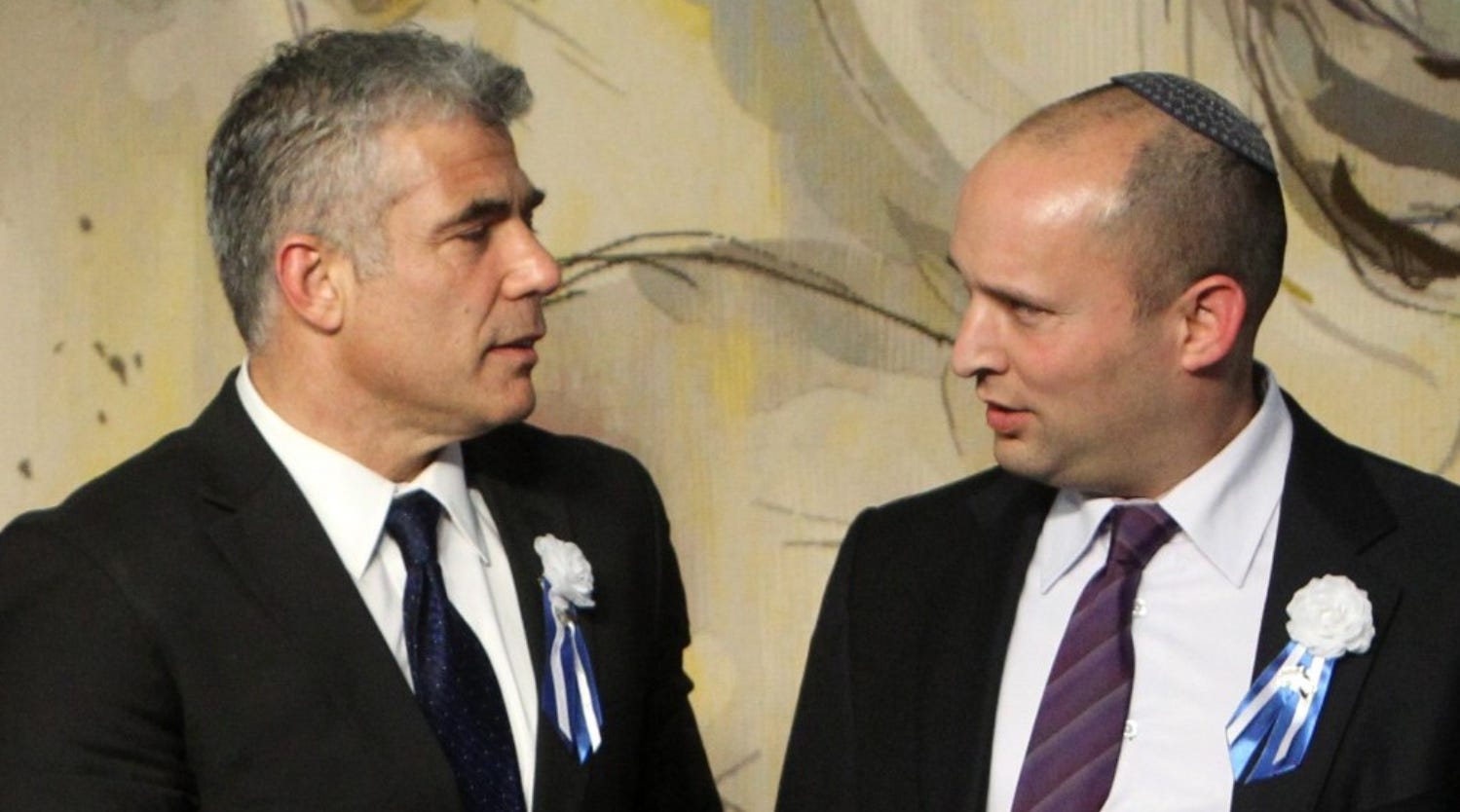
Finance Minister Yair Lapid, left, and Economy Minister Naftali Bennett at the opening session of the Knesset in January, 2013. (Miriam Alster/Flash90)
His Jewish Home and Lapid’s Yesh Atid formed what they called an “alliance of brothers”—they made one demand of Netanyahu: no Haredim.
For the first time in his career, Netanyahu built a coalition without Shas or UTJ. It passed a Haredi enlistment law, threatening the sacred deferments that ran unbroken back to Ben-Gurion through even the hostile reign of Sharon. It passed a mandatory core curriculum, threatening to force mathematics and English into schools built around the sea of the Talmud.
The Haredi world turned its fury on Lapid with a venom more potent than anything it had used in any period of land concessions. The ultra-Orthodox are acutely sensitive to matters of lineage, and nothing could be further from the respect owed a grand ancestry than Lapid son of Lapid. He was variously labeled Hitler, Amalek, a dog and a rodef, the halachic category that permits a man to be killed.
Ironically, the Haredi Jews were not fans of exile. The secular center that once joined hands with them on peace now waged war on their lifestyle. Meanwhile Netanyahu, inside a government he did not fully control, was reminded that the king could not easily rest in a coalition of ambitious princes like Lapid and Bennett. He missed his mercenary friends trapped in opposition.
Netanyahu, sick of being governed by his own partners, brought down his own coalition in late 2014 and called the election that would bring the Haredim home for good. Netanyahu won, and Deri leapt into the government at record speed. The reward was immediate: the Religious Services Ministry, handed to Shas. The coalition agreement stripped out everything the outgoing government had fought for. No equal-burden clause. No core curriculum. The enlistment law softened into irrelevance, the deferments and the child allowances restored. Whatever admiration Bennett still nursed for Netanyahu died for good.
But the alliance that had made Netanyahu unbeatable was also the trap that eventually sprang shut on him.
Avigdor Lieberman had come up inside the Likud—its director general, an immigrant from the former Soviet Union who galvanized the Russian vote and built it into the very bloc he would one day detonate. His people were a strange fit for the house Begin built. Immigrants from left-wing dictatorships tend to vote right, and the “Russians” duly opposed territorial withdrawal, distrusted the Arabs and were intensely nationalistic—Jabotinsky, he writes, would have felt at home among them. But they were nationalistic, not religious: the million Soviet Jews who filled Israel’s streets with Cyrillic supported civil marriage and Shabbat buses and fueled a surge in supermarket pork. Once the old argument over peace and territory subsided, the only thing binding them to the right frayed, and they found themselves more at home with the secular Lapid than among the kippah-wearing lawmakers of the national camp.
So when a personal feud with Netanyahu handed him the opening, Lieberman walked out, taking 150,000 Russian-speaking voters with him and raising, in place of the banner of the right, the banner of secularism. He would not sit in any government beholden to the Haredim. And because the Russians were the real weathervane of Israeli politics—for 30 years, whoever won them won the election—Lieberman’s defection was decisive. With him gone and his camp waving the never-Bibi flag, Netanyahu, who had a right-wing majority in everything but this, lost the ability to form a government, and Israel plunged into four consecutive elections.
No coalition is free of contradictions—a lesson Bennett learned the hard way as he scrambled to plug holes and keep his fragile alliance of settlers and Islamists afloat. In the end, despite the absence of the Haredim, the fatal leak was still sprung by religion. When Health Minister Nitzan Horowitz of Meretz enthusiastically defended bringing chametz into hospitals over Passover, it proved to be a bridge too far for Idit Silman, whose own religious commitment extended only to a modest head covering rather than a Haredi wig.
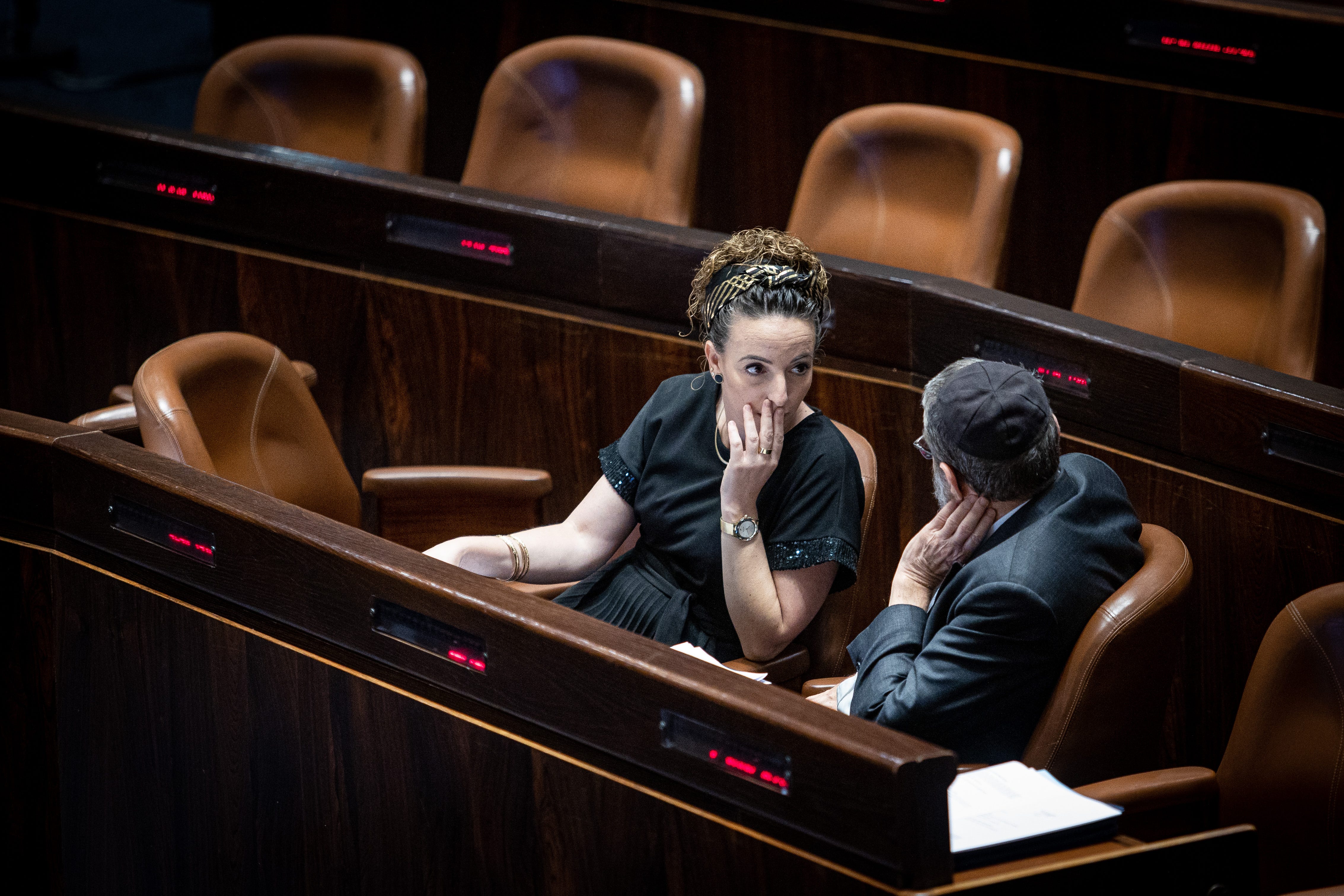
MKs Moshe Gafni and Idit Silman at a plenum session at the assembly hall of the Israeli parliament in Jerusalem, on August 15, 2022. (Oren Ben Hakoon/Flash90)
The lesson the Haredim learned from the short Change government was that the secular center had chosen Islamists over ultra-Orthodox Jews and would do so again. Their only refuge was the bloc that had followed them into exile, Netanyahu’s. Netanyahu learned a similar lesson and offered the Defense Ministry to Deri, a man who himself had not served and had not sent his children to do so. “You, me and Ron Dermer will be a trio that makes history,” Netanyahu told the leader of Shas, Kaduri’s amulet still at work. Peace with Saudi Arabia, a possible war with Iran, both waiting later in the term. Deri demurred, preferring something less conspicuous. He still got the most Haredi-friendly coalition in the country’s history: budgets, autonomy and, above all, a promised legislative fix to bury the draft question for good.
It was not the least popular proposal in the country. The army was steadily downsizing; the cost of integration, to many, was higher than the potential reward of a few more soldiers; and a blanket exemption would finally push the Haredim from thier shelter in the Yeshiva into the workforce.
The issue might have been settled, if not for October 7.
Aside from being intensely emotional, its effect was mathematical. The sight of yeshiva students sitting out a war of national survival made the exemption, for the first time, cost more to defend than it was worth. That didn’t stop Netanyahu from throwing everything but an explicit exemption at the ultra-Orthodox to keep them in the government, knowing internally that the High Court would ensure none of it came to pass. It was both enough and insufficient.
UTJ and Shas left and returned. Despite clumsy attempts at flirting with the opposition, they were rebuffed; the mercenary kingmakers that easily jumped from one side to the other have been tainted by their long relationship with Netanyahu and draft evasion. They let the coalition live out it’s entire lifespan, trapped in a relationship that had given them the most but simultaneously put thier political future in question.
Haredi leaders, excluding Deri, are open to conceding Netanyahu but cannot compromise on the draft issue. Behind closed doors, they don’t deny the inevitability of some form of draft, but publicly they are trapped by their own constituency. After promising blanket exemptions and preaching that any life outside the walls of the houses of study was tantamount to spiritual death, they cannot easily justify a mass sacrifice to their flock.
But the community has never been black and white.
The modern wing is pushing for integration even as the hardline angle pushes ever more determinedly in the opposite direction. As has been a trend in the community, the “most pious” seem likely to win.
Even if they succeed in cowing the moderates, the Haredim face overwhelming odds in Israeli public opinion. They have been too long in politics and government to call themselves neutral observers of Zionism, despite the attacks of the Old Yishuv and thier descendants, political participation has become an essential part of Haredi religious practice. No matter how much they pray for the status quo, a higher power is forcing change, whether that be the High Court, the Knesset or G-d Himself.
English Editor: Ari Tatarka
If you enjoy the newsletter, you can show your support by becoming a paid subscriber—it really helps keep this going. I’m also offering a special monthly briefing for a small group of premium members. I’d love to have you join us—just click below to find out more.
Thanks for reading It’s Noon in Israel! Subscribe for free to receive new posts and support my work.


Excellent article on the Haredi community who developed the philosophy of sloth which worked well for a while but as their percentage in the total
Population grows and grows, they will either become part of Israeli society or destroy Israel as the Finacial implications of their position will become untenable for the country.
The fact that I’m going to have to re-read this to sort it out says a lot about the situation in Israel! It also helps me understand the intense feelings of a couple of my friends in Israel. Thank you!!!