1000 Days Since October 7
Where are we now?
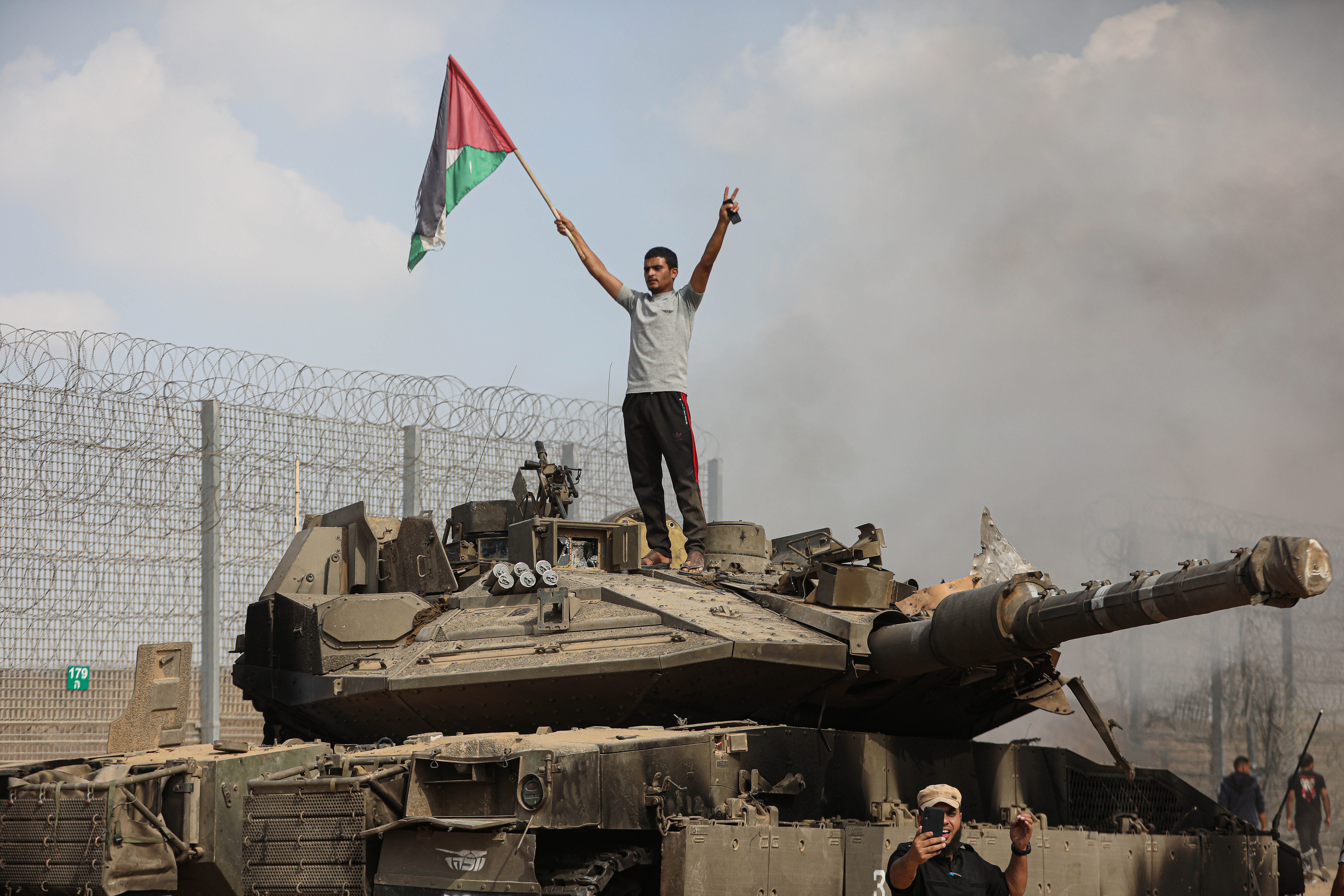
Palestinians stand next to a burning tank inside the border fence with Israel in the city of Khan Yunis in the southern Gaza Strip. October 7, 2023. (Yousef Mohammed/Flash90)
It’s Thursday, July 2, and almost 1,000 days since October 7. There is a passage in the Talmud that describes the limits of language: if all the seas were ink, and all the reeds were quills, and all people were scribes, they still could not exhaust the wisdom contained in the Torah. It is not a claim about length. It is a claim about a category of thing that writing simply cannot contain. I have found myself returning to that image in considering the rupture of October 7. There is a before and an after, and I do not mean that as a figure of speech. I mean it as two worlds, discontinuous, with no word carried over from one that lands the same way in the other. The seas-and-scribes formula keeps surfacing in my mind because when faced with the enormity of such an event, with its countless reverberations and emotions, the best one can do is gesture at the impossibility of describing it. What follows is my attempt.
Almost 1,000 days ago, at 6:29 a.m., the old world ended and a new world began. That new world was born in a conflagration of the old—over 1,200 killed, hundreds kidnapped, all of it filmed, uploaded, and celebrated in real time—as Israel’s enemies gloried in the atrocity. Israel, for those first hours, could do nothing but watch. The infamous conceptzia—the notion that Israel’s enemies could be deterred or bought off—evaporated on that day. The foundation of the state as a place where Jews are safe from massacre was irreparably damaged. The country was left in shock: exposed, without a way to engage with what it had experienced, and without a clear sense of where to go from there.
Israel has spent every day since trying to rebuild, to restore a semblance of what it was. On day 128, it proved that it will rescue its hostages by any means, not just negotiation, when a raid in Rafah freed two men alive. On day 245, Operation Arnon proved it again—four hostages walked out of Gaza alive, pulled from the center of the enclave in broad daylight. On day 356, it proved that even the most protected man in Hezbollah was not, in fact, protected, when the strike that killed Hassan Nasrallah reached a bunker its target believed was unreachable. On day 375, it proved the same of Yahya Sinwar, hunted into an alley in the city he once ruled. And on day 615, Israel struck Iran itself—not the tentacle, but the head, without which October 7 could never have happened, and which Israel had vowed never again to allow to threaten its existence. Two hundred sixty days later, on day 875, it proved this once more.
Israeli soldiers operating in Beit Lahia, in the northern Gaza Strip, December 28, 2023. (Yonatan Sindel/Flash90)
My first visit to Gaza after October 7 showed a relatively intact city, hidden amidst plumes of smoke and sounds of battle. A year later, in November 2024, Jabalia was a massive pile of rubble, stretching from horizon to horizon, with packs of dogs roaming among the ruins and garbage. On the thousandth day of the war, nothing remained in the area. The once densely populated city looked desolate and quiet, like the surface of the moon. Engineering drills searched for tunnels below ground, with D9 bulldozers operating above. In the vast majority of Gaza, nothing remained, neither above ground nor below it.
This is the situation in all the territory controlled by Israel, which now makes up about two-thirds of the Strip’s territory. Rafah was wiped off the face of the earth, as were most of Khan Yunis and huge swaths of Gaza City. Ninety-two percent of the tunnels have been completely destroyed; the rest will soon follow.
Inside Hamas-controlled Gaza, there have been increasing reports of a resurgence, tunnel rehabilitation, training exercises, and an inevitable IDF operation. These reports should be viewed with intense skepticism. Hamas is failing to genuinely rearm after its smuggling routes in the air, on land, at sea, and underground were choked off. Three hundred sixty-two smuggling tunnels from Egypt were destroyed in Rafah. Training is conducted in hiding, reconstruction materials are not arriving, and the newly dug tunnels in the sand are barely shored up with whatever is available: sheet metal, wood scraps. Iran bends over backward to protect Hezbollah; for Hamas, it does not even pick up the phone. That is the consequence for a proxy that starts a war without permission and becomes a lost cause.
Perhaps this is why Hamas recently agreed to terms that include handing over all heavy weaponry, tunnel maps, production sites, and weapons caches. Its leaders agreed that the weapons would be surrendered to a committee, not to Israel. The multinational force that will subsequently deploy will serve as a buffer between Hamas and Israel, and will be responsible for the collection. Israel will withdraw only after Hamas is disarmed, the militias’ weapons are also collected, all government positions are handed over to a technocratic committee, and police officers who fail a security clearance are forced to retire. The agreements make no mention of small arms, which flood Gaza by the tens of thousands. How many are there? The divisions operating in Gaza used to transport rifles to the Israeli border, where bulldozers would run them over and crush them. At a certain point, they asked to stop collecting weapons because it had become their primary activity.
“Make no mistake,” says a very senior army officer, “of all the enemies we have faced, they are the most cruel, the most hateful toward us, and the most uninhibited.” And this is exactly the reason why it was forbidden to stop and “fight another day,” as Nitzan Alon and others suggested. From the perimeter, without this level of destruction and without isolating them from their patrons, Gaza would have recovered rapidly. By day one thousand, it would have already become a monstrous threat again, rather than a wave of rubble and despair.
Jews attend a prayer for the return of the Israeli hostages held by Hamas terrorists in the Gaza Strip, at the Western Wall. (Chaim Goldberg/Flash90)
It is almost impossible to hold all the emotions of the countless days I reported through—the wonder of day 347, when more than 3,000 pagers exploded simultaneously in one of the greatest intelligence operations in history, against the mourning of day 328, when Hersh Goldberg-Polin and five other hostages were murdered days, perhaps hours, before rescue might have reached them. Still fresh in my mind is day 842, when the remains of the last hostage, Ran Gvili, were finally brought home—not a rescue this time, but a closing, the moment the count itself could stop. It felt like the beginning of something akin to healing: an immense national catharsis, too large to fully describe even now. But looking back today, I can say this much—through victories and defeats, across a thousand days of heroism and sacrifice, Israel and her people have clawed their way back from the brink of despair.
There is a verse in Ezekiel that has taken on new meaning for me: “And when I passed by and saw you flailing in your blood, I said to you, though you were in your blood, Live! I said to you, though you were in your blood, Live!” Ezekiel is recounting God’s adoption of the Jewish people—his command to live is his first order to his new nation.
It is not a promise that the blood is wiped away, or that the wound stops being a wound. It is a command spoken over a body that has not yet answered—twice, because once was not enough to be believed. Israel, on the morning of October 7, was exactly that: flailing, exposed, drenched in its own blood, with no guarantee it would rise. What the thousand days since have shown is not that the wound healed, but that the command was heeded. Every hostage returned, every enemy brought low, every reservist who answered the call—all of it is the same word, spoken back, day after day: live.
English Editor: Ari Tatarka
If you enjoy the newsletter, you can show your support by becoming a paid subscriber—it really helps keep this going. I’m also offering a special monthly briefing for a small group of premium members. I’d love to have you join us—just click below to find out more.
Thanks for reading It’s Noon in Israel! Subscribe for free to receive new posts and support my work.


Amen!
Fantastic writing and imagery. Very moving . Brought me to tears. Thank you