It’s Noon in Israel: 2,000 to 12,000 Dead in Iran: What Will Trump Do?
Also, Benny Gantz offers a new hope of national unity, and celebrities are mad at the wrong country.
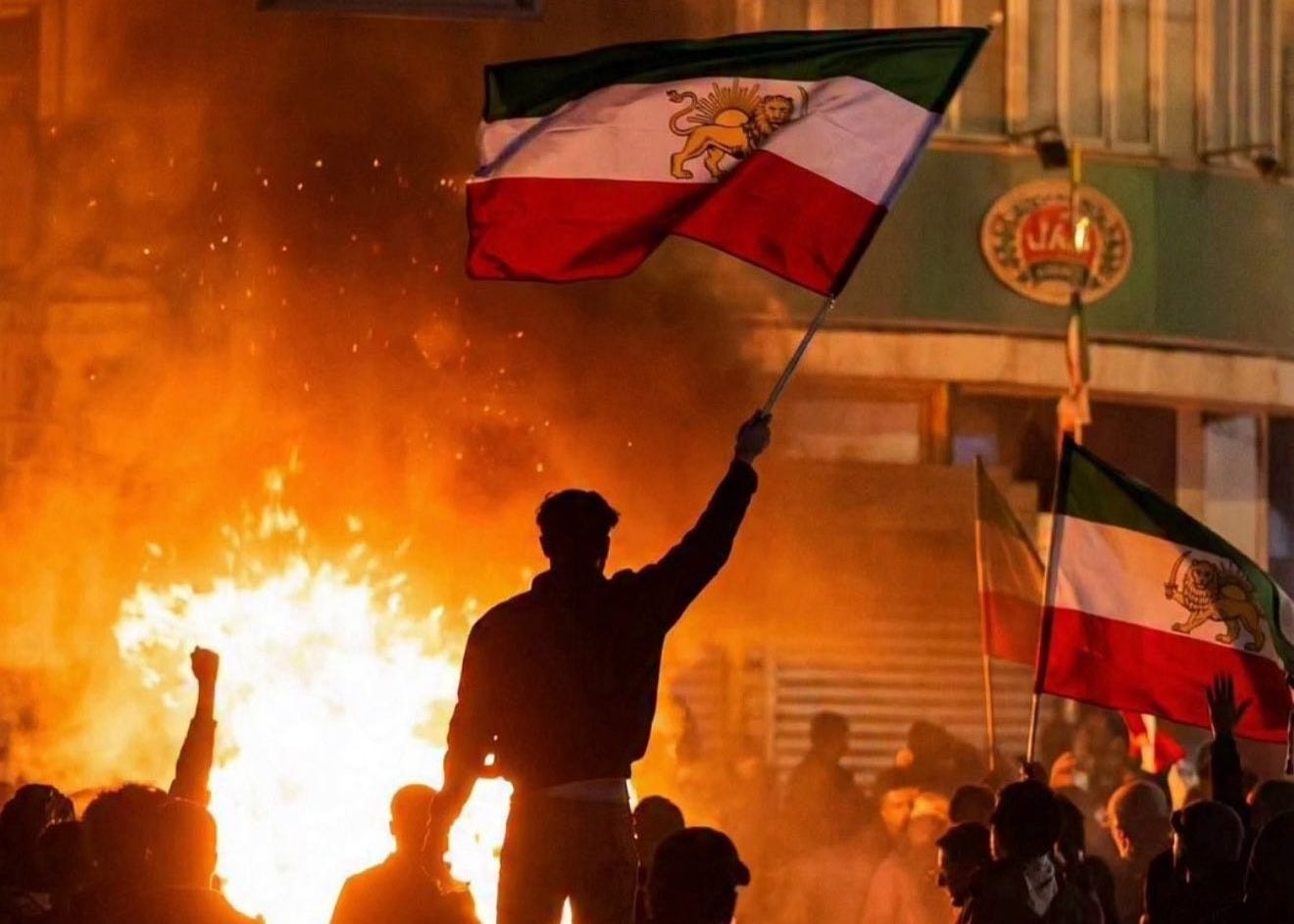
A protester waves the pre-Islamic Republic flag at a protest in Iran. (@Helihellix/X)
It’s Tuesday, January 13, and yesterday, Donald Trump announced an additional 25 percent tariff on anyone doing business with Iran. Meanwhile, Steve Witkoff is reportedly in contact with Iranian Foreign Minister Abbas Araghchi to explore a negotiated solution with Iran. Does this mean a strike is off the table?
Well, taken in isolation, it’s discouraging. Iranian protesters were expecting air support—not economic pressure.
According to Iran International, the death toll from the protests has now exceeded 12,000, as the regime mows down demonstrators in the streets. Hospitals are overwhelmed, the internet has been shut down, and Starlink is being jammed. All of this, according to Trump, marks the regime “starting” to cross his red line.
Meanwhile, the reported negotiations appear to be an Iranian initiative, relayed to Steve Witkoff through Qatar—few of those intermediaries inspire much confidence. What is clear, however, is that Trump seems willing to hear them out.
So none of the current signals are particularly encouraging. But remember—this is Trump we’re talking about.
If you took all of Trump’s comments in June in isolation—about how Iran and Israel should “make a deal” to end the war—you might have thought he wouldn’t get involved. And yet, a week later, he was congratulating American pilots on a job well done.
So we have to ask: Are the signals real?
The last time Witkoff was in negotiations with Araghchi was two weeks before American B-2s destroyed Fordow. People are afraid that Trump will fall for the Iranian trick of dangling negotiations to buy time. He didn’t fall for it last time, which I take as an encouraging sign that he won’t this time.
But there are also the tariffs. At any other time, this would be a celebrated move—and we can still take it that way. I doubt tariffs were the extent of what Trump was planning when he said the U.S. was “locked and loaded.”
After all, I don’t think Trump wants to find himself in President Obama’s position—encouraging Iranian protests, only to abandon them when the regime’s repression began. The failure of that approach is now on constant replay every time unrest in Iran is discussed.
Does Trump really want to become the next cautionary tale when the next wave of protests erupts?
Perhaps, ironically, the hit Israeli spy thriller Tehran is currently airing its third season on Apple TV—while Trump and Iran is playing its new Season on every major news network.
Season One of Trump and Iran featured plenty of diplomatic episodes and fake-outs, but ended with an explosion. Season Two seems to be following a similar arc—and I have a feeling it’s going to end the same way.
Blue and White chairman Benny Gantz in the interview last night. (Screengrab used in accordance with Section 27A of the Copyright Law.)
A new electoral outcome may be opening up. In an interview last night, Benny Gantz said that in the event of an indeterminate election, he would encourage the opposition to include Netanyahu and Likud.
Here’s why that’s interesting: that outcome is looking likely.
Recent polling puts the Change Bloc at 58 or 59 seats, the coalition at 51 or 52, with that magic number—61—still out of everyone’s reach.
That’s been the reality for months, and the leaders of the opposition have had a few responses.
Chairman of Yisrael Beiteinu Avigdor Lieberman seems content to stay in opposition—his party may be less so—but that’s one approach.
Naftali Bennett and Yair Lapid are opting for optimism, insisting that the bloc will win a majority despite the polls. Keeping their contingency plans opaque.
Gadi Eisenkot, for his part, soft-launched a more practical solution: let the Arabs in. With the five seats of the pacifist-Islamist Ra’am party, the Change Bloc would pass the threshold. His plan? Pass a few popular measures—like establishing a state commission of inquiry into October 7—and then immediately dissolve the Knesset for ideally more successful elections.
Now, putting aside whether that would actually work, the proposal breaks at least one of the Change Bloc’s two principles: moderate and Zionist. Last time I checked, Ra’am isn’t exactly Zionist.
Benny Gantz is taking a different approach. Likud—the country’s largest right-wing party—fits the Change Bloc qualifications. Add them, and you’ve got an 85-seat government with no Ben Gvir, Haredim, or Arabs. The last time Israel saw that kind of unity was in the 1980s, when the economy was imploding.
Gantz’s trade is simple: the snake you know instead of the extremist you hate.
But there’s a problem: he has no seats to give.
There’s a cautionary tale here in Israeli politics. Six years ago, Benny Gantz was the great hope, poised to finally dethrone Netanyahu, leading a party just one seat shy of the largest in the Knesset. In 2024, polls had him as the largest party in the mid to high 30s. Today, he doesn’t even clear the 3.25 percent threshold.
Whether his message transcends his electoral prospects—that remains to be seen.
A scene from 2019’s Joker starring Joaquin Phoenix.
Yesterday, another letter signed by dozens of celebrities and NGOs was published, accusing Israel of deliberately inflicting deadly conditions on Palestinians in Gaza and the West Bank. Today’s particular shade of Israeli crime? Targeting medical facilities.
Now, is anyone surprised? I should hope not. This must be the hundredth note directed at the Jewish state. One hopes the signatories would have realised by now that their autographs are valued by fans, less so by governments.
This isn’t the first time Joaquin Phoenix has acted like a clown, but this time, he’s also channeling his character’s nauseating cruelty.
The double standard and tone-deafness of celebrities claiming Gaza is the world’s worst humanitarian disaster might almost be forgivable. The images of destruction were plastered across social media, and we already assume most celebrities are about as globally conscious as 12-year-olds addicted to TikTok.
But social media is currently exploding with a far worse humanitarian disaster. As I mentioned earlier, according to Iran International, the death toll from the protests has surpassed 12,000. And the response from the holy moral arbiters of Hollywood? Crickets.
It’s not just the celebrities; campuses are quiet for the first time in years—and I wish I could say that was a surprise.
Iranians fighting for their basic rights are being gunned down by a dictatorial Islamist regime—and yet, five months into a cease-fire, the cause célèbre for celebrities is still the Jews.
If you enjoy the newsletter, you can show your support by becoming a paid subscriber—it really helps keep this going. I’m also offering a special monthly briefing for a small group of premium members. I’d love to have you join us—just click below to find out more.


Who takes celebrities seriously? What pathetic adults ever listened to them in the first place?