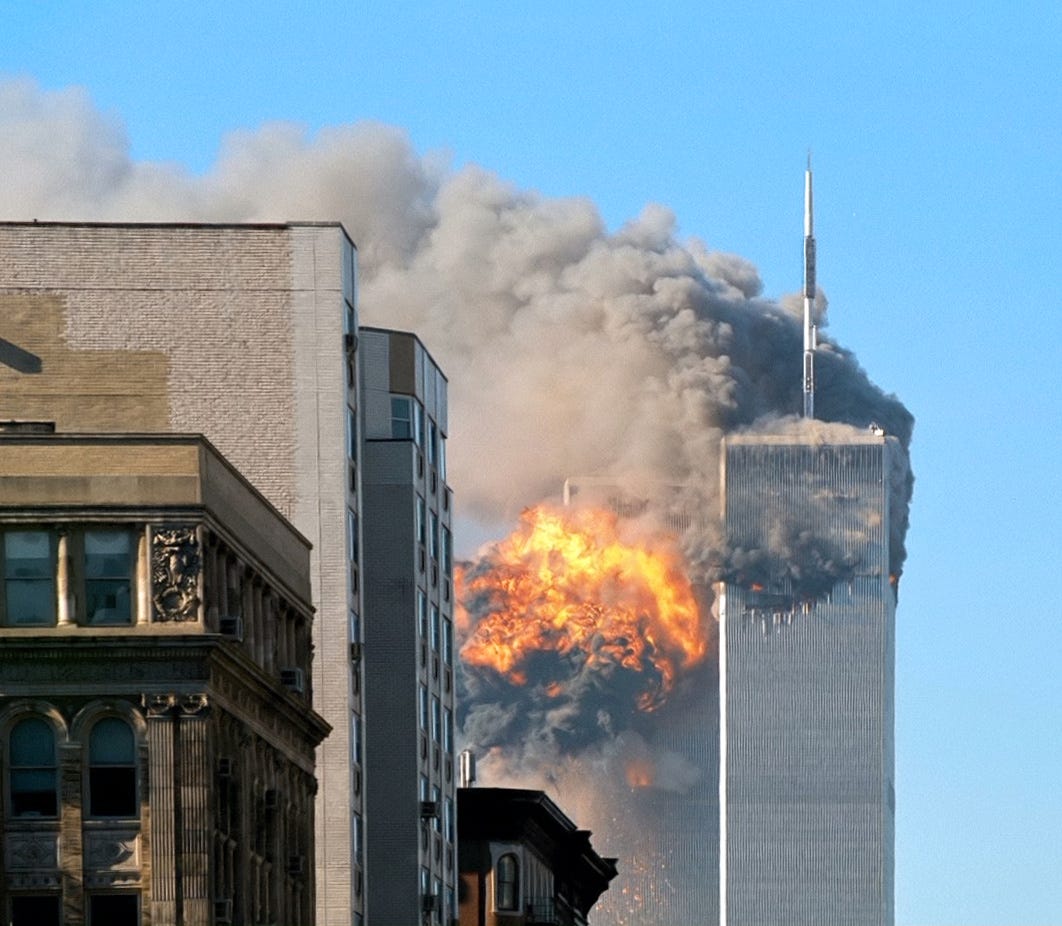
UA Flight 175 hits the south tower on September 11, 2001.
It’s Thursday, September 10, and everyone remembers where they were on September 11, 2001. It was a regular afternoon in the last year of my army service; I was sitting in an Army Radio station across from a friend who is now one of Israel’s most senior Arab affairs commentators. When news arrived that a plane had hit the first tower, he received a call asking him to comment. “Why do you want me?” he asked. “The attack was most likely by a Muslim, no?” was their reason. “This attack was far too complex, no way they could have organized it,” he confidently responded.
Even before he was definitively proven incorrect, thousands of Israelis gathered for an evening candlelight vigil at Zion Square in central Jerusalem. A national day of mourning was declared and the Israeli flag was lowered to half-mast at every military base, consulate and government building.
Israelis understood how Americans were feeling. 9/11 was of an unprecedented scale, but of a familiar type to the Israeli public. That summer was the peak of second intifada suicide bombings. Twenty-one people were killed at the Dolphinarium in Tel Aviv in June. Two attacks on September 9, two days before the towers fell, left 17 dead. As Supreme Court Justice Aharon Barak put it, Israel not only had September 11 but “September 10 and September 12” as well. The scenes playing out in Palestinian cities—celebration, flag waving and trays of sweets usually saved for particularly gruesome terror attacks—bonded the events still further.
The blast of the plane colliding the first tower was heard around the world. Everyone, especially in the Middle East, fell silent, waiting to see how the world’s only superpower would respond. At Ground Zero, Bush promised first responders that those responsible would soon hear from America. Nine days later he stood on the White House Lawn and declared a “war on terror.”
Yet the next 25 years of the Middle East would not be defined by an uncompromising crusade against Islamism, but by the U.S.’s attempt at answering the question 9/11 posed.
Why?
What could motivate such hatred? Bin Laden claimed it was a response to America’s Middle East policy, their desecration of holy places by their presence, their support for murderous autocracies and most of all their relations with Israel.
Exactly 11 years before the attack, as the Soviet Union was in the midst of collapse and Saddam Hussein was consolidating his conquest of Kuwait, George H.W. Bush stood before a joint session of Congress and announced a new world order, a world where the “rule of law and not the law of the jungle would govern the conduct of nations.”
Some believed that this state of affairs had come about naturally. History had taken them out of the jungle, revealed to them the law, and assigned America the role of groundskeeper to watch over the process. Others read the new world as having been achieved by America taming the jungle, axe in hand, and that it, the sole remaining superpower, was now tasked with building the new world order on the stumps.
September 11 posed the groups a question. One side assumed that the cause lay in their mismanagement of the post-Cold War world—how else could al-Qaeda resist history’s natural deforestation? The other side didn’t have to ask why; they were still in a jungle, and radical Islamism was simply a new weed to be pulled.
Both answers had implications for Israel. Was the Palestinian issue, as al-Qaeda claimed, the American mistake that had caused its unnatural growth, or was Israel similar to the U.S., a villa fighting against the same encroaching jungle?
President George W. Bush answers a question about Osama bin Laden with Defense Secretary Donald H. Rumsfeld and the National Security team. September 16, 2001. (White House)
Bush fell somewhere in the middle. The tough-talking Texan had declared a war on terror, not a renewed diplomatic effort. Bush refused to negotiate with terrorists, but he wanted to starve radicalisation, which necessitated listening to their complaints, Palestine among them. The president wanted to fight bin Laden like there was no Palestine, and fight for Palestine like there was no bin Laden. This was his strategy from day one. While the towers were still smoking, Bush, receiving condolences from Prime Minister Ariel Sharon, confirmed their shared struggle against terrorism, before pivoting into pushing Sharon to meet with Arafat. Sharon was the first person in the world to say no to the president after 9/11.
Bush pursued a two-state solution as a front in the war on terror. He was the first president to make Palestinian statehood an explicit objective of American policy. He backed Sharon’s disengagement from Gaza, then he pushed the 2006 Palestinian elections that brought Hamas to power, believing in the naturally moderating forces of democracy. Even after that failed, he attempted another peace process at Annapolis in 2007.
But despite his best efforts, when Bush left office the world looked as though history’s arc didn’t bend in any direction in particular. Since 9/11 the world had been plunged into a financial crisis, a revanchist Russia was in Georgia, and two wars raged in the Middle East.
But Barack Obama was confident utopia was still within reach.
From the new president’s perspective, Bush had damaged the arc of history by riding into the region guns blazing. Obama was confident that democracy and freedom would push back the jungle on their own. All America had to do was be a model citizen, make up for its past mistakes and allow history to resume its course.
President Barack Obama speaks at Cairo University, June 4, 2009. (White House/Chuck Kennedy)
In search of a “new beginning” he went to Cairo, promising a relationship based on “mutual interest and mutual respect,” decrying any role of America as a world policeman and apologising for their previous efforts at vigilante deforestation. He named three sources of tension—the three blockages to history’s course: America’s presence in Iraq, Iran’s pursuit of nuclear weapons, and the “intolerable” situation of Palestine.
Iraq failed first, as his promise to withdraw American troops and leave “Iraq to the Iraqis” ended in rivers of blood rather than a multi-ethnic democracy.
His Iran deal survived his administration but grew from the same belief, claiming the agreement that allowed Iran limited enrichment and unfroze billions of frozen assets would strengthen the hand of those “more moderate forces inside of Iran” by bringing it back into the global system.
But where Palestine had been a side front on Bush’s war on terror, it was the key to Obama’s campaign. By his administration’s accounting, Arab anger over Palestine limited American partnerships, fed al-Qaeda recruitment, and, as Biden whispered to Netanyahu, endangered American forces across the entire region. John Kerry met Netanyahu and Abbas more than 100 times with nothing to show for it.
After eight years of Obama, the gap between the world Americans expected and the world they actually inhabited was impossible to ignore. Post-Cold War optimism was dead and buried, and Donald Trump rose from its ashes.
President Donald J. Trump delivered remarks at the Arab Islamic American Summit, May 21, 2017. (White House)
Trump’s first speech in Riyadh couldn’t have been further from Obama’s in Cairo. “We are not here to tell other people how to live, what to do, who to be, or how to worship,” he told the assembly of Arab leaders. From now on, America’s role would be one thing: “defend itself.” In the 6,000-word address, democracy wasn’t mentioned once.
After 15 years of ambitious foreign policy, Trump’s approach was a breath of fresh air for the entire region. Trumpism didn’t tell a grand story of what America could do for the world, but asked what the world could do for America. Israel had a lot to offer, so the relationship grew. Most states felt similarly; few Arab states could offer Obama the democracy he craved, but Trump loved oil and money, and they had both in abundance. The Abraham Accords were the product of the new transactional order; Obama couldn’t envision a rapprochement between Israel and the Arab states outside of history’s journey toward justice that runs through Palestine, but Trump certainly could.
Even when Obama’s successor, his vice president Joe Biden, retook the White House, Biden’s Middle East was more similar to Trump’s than to Obama’s. Even if Biden was mentally still in the post-, or perhaps the pre-, Cold War era, the American mood had not changed. After over a decade of answering why al-Qaeda had attacked, for no gain, they were more focused on the how.
Trump narrowed the war on terror to eliminating threats rather than addressing the roots of radicalization. Biden branded it “over the horizon” counterterrorism, essentially built on Trump’s two nos: no boots on the ground, no nation-building.
This was Israel’s ideal.
President George W. Bush and Israeli Prime Minister Ariel Sharon laugh together during their joint press conference in the Rose Garden, July 29, 2003. (White House/Paul Morse)
From the moment the plane struck the first tower, Israel was ready and willing to assist in Bush’s war on terror. Within weeks, delegations from every security agency of every allied country began to land at Ben Gurion before being ushered to Shin Bet headquarters. Sharon ordered them to “show them everything.” With more than 40 years of experience fighting terrorism, Israel was more than an ally; it was the indispensable arsenal of democracy. While Sharon had discouraged the invasion of Iraq, U.S. forces entered the country with Israeli training. The war inaugurated a new era of military cooperation. February's Operation Epic Fury was the climax of the joint-war against terror that began in 2001.
Bush had raised the banner against terror, endowing Israel with desperately needed legitimacy in its own struggle with extremism. Under that banner, Sharon launched Operation Defensive Shield and crushed the second intifada. Ehud Olmert destroyed Syria’s nuclear reactor to near-total international silence. Netanyahu sent bombers to Sudan’s capital to destroy an Iranian arms shipment on the airport tarmac. Israel’s standard of near-zero tolerance for terror became the international standard.
But while Israel was an enthusiastic ally, it was a far less willing battlefield. “Israel will not be Czechoslovakia,” Sharon declared in October 2001. “Do not try to appease the Arabs at our expense.” The Americans ignored him. The 20 years following the attack, contained more than six separate American attempts at peace—more than in the previous 52 years of the country’s history.
Before 1991, Israel was a strategic asset in the struggle against the Soviets. Palestine was a problem insofar as it interfered with the Arab world switching sides, not because it fueled Soviet hostility. 9/11 placed Israel at the center of American security, both as a partner in the fight and as a barrier to vanquishing the threat altogether. Israel was simultaneously empowered by the U.S.’s ideological struggle and trapped in its specificities.
Even as Trump took a more apolitical approach to the region, domestically Americans were still contending with why al-Qaeda had attacked. Radicals offered a new answer. They recast America not as the groundskeeper of a natural growth of peace, justice and democracy, but as its primary obstacle, with Israel playing the part of its most deleterious creation. These individuals rallied in the wake of October 7, Israel’s 9/11. Many of these activists were children, if they were alive at all, when the towers came down. Yet, confident in their narrative of history, they turned their eyes from the atrocities, insisting that America, and especially Israel, deserved the monstrous violence.
It’s evidence that talk of the arcs of history and global politics tends to trivialize tragedy and suffering, so let me end with this.
The 9/11 Twin Towers Living Memorial in Jerusalem Park. (KKL-JNF Photo)
High above the forests of the Jerusalem hills stands a monument.
It is a bronze ribbon unfurling, twisting, rising as if caught mid-air between collapse and ascension. What begins below as a heavy, draped flag curls upward into a soaring column, its crest tapering into an eternal flame. Embedded beneath clear glass at the base of the sculpture rests a jagged shard of melted steel brought from Ground Zero.
The sculpture is enclosed by a low, circular wall with plaques, embossed with almost 3,000 names. It is the only memorial outside of the United States that lists every victim. As it is written at Israel’s Holocaust memorial Yad Vashem, “Unto every person there is a name.”
For all its symbolism and political weight, we must not forget the simple duty inscribed as deeply on the hearts of terror-stricken Israelis as it is into the marble at Ground Zero: Never forget.
English Editor: Ari Tatarka
If you enjoy the newsletter, you can show your support by becoming a paid subscriber—it really helps keep this going. I’m also offering a special monthly briefing for a small group of premium members. I’d love to have you join us—just click below to find out more.
Thanks for reading It’s Noon in Israel! Subscribe for free to receive new posts and support my work.


I want to comment, as your article deeply affected me, but words cannot describe how profound and well written this article is.
Never forget, as a jew hating Muslim is elected mayor of New York. It seems some have forgotten. Thanks for a great read.