
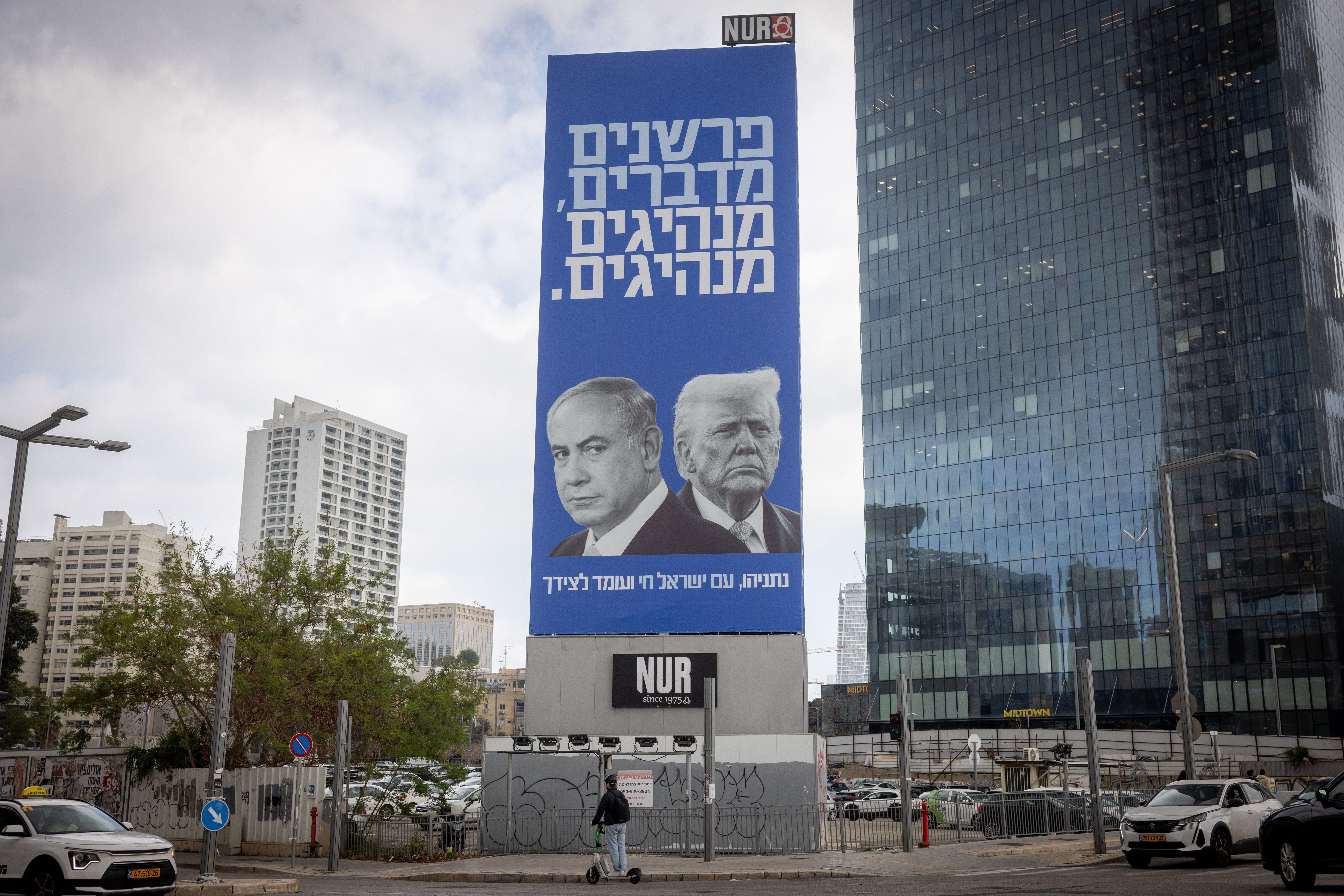
Large billboards near Ayalon highway in Tel Aviv, showing support for Israeli PM Benjamin Netanyahu and US President Trump, April 13, 2026. (Miriam Alster/FLASH90)
It’s Wednesday, October 14, and on Monday, Fox News asked Donald Trump whether he would get involved in Israel’s election. “I think it’s more appropriate for me to stay out of that,” he said. Then he added: “However, I might lend my support to someone.”
The media have been rabidly speculating on the latter statement, though they probably shouldn’t. “Maybe I’ll do something” is Trump’s all-purpose holding pattern, a close cousin of “we’ll see about that.” Run it through an AI translator and the output is: leave me alone.
That matters, because Trump’s help is no small thing. In March 2019, two weeks before the April election, he signed a proclamation recognizing Israeli sovereignty over the Golan Heights with Benjamin Netanyahu standing beside him at the White House. Nobody needed a decoder ring. Netanyahu came within a whisker of a majority.
Nor is Trump shy about foreign elections. He has thrown his weight behind a whole string of candidates abroad, most recently Flávio Bolsonaro, a Brazilian senator and the son of former President Jair Bolsonaro, whose first-round finish in Brazil Trump hailed as a “very, very big victory.”
So why, 13 days before Israelis vote, is he sitting this one out? I’d suggest four reasons.
The first is Budapest. Trump did everything he could to get Viktor Orbán reelected in Hungary, and Orbán lost. Trump does not like being seen with losers. He likes it even less when he’s photographed endorsing them. He will put his name on an Israeli candidate only if he is sure his name is what gets them over the line. Currently, neither candidate in Israel looks likely to be one Truth Social post from victory.
Trump may be especially conscious of that risk. A week after Israelis vote, Americans go to the polls for the midterms, with all 435 House seats and 35 Senate seats up for grabs. If Trump’s writ runs overseas, it’s a show of strength. If Israelis reject his candidate, it could be a preview of more rejections to come.
The second is the polls. The numbers sitting on desks in the White House veer closer to the majority of Israeli polls than the more rare ones predicting a comfortable Netanyahu win. The White House runs its own polls in the country. If those surveys begin to show Netanyahu closing the gap in the final week, the math could change.
The third is the cat. Hebrew has an idiom for a falling-out: a black cat has passed between them. I wouldn’t go so far as black. But a dark shade of gray cat has certainly passed between Trump and Netanyahu. In July, Netanyahu flew to Washington hoping for a public show of support. According to Axios, when the race came up, Netanyahu hesitated, and an adviser stepped in: “Mr. President, he is winning.” The endorsement never came. Since then, Trump has kept pressing Israel to halt the targeted strikes in Gaza that are stalling his 20-point plan.
The fourth is Tucker Carlson. Not the man himself, but the impression he has helped create that a slice of Republican voters is allergic to Israel. Whether or not that electorate is real, it is doubtful that the conversation in the Oval Office centers around how to bring Bibi into the national conversation before the midterms.
A senior White House official put the odds to me plainly. A 60 percent chance we stay out. A 30 percent chance we help Netanyahu. A 10 percent chance we help the other one.
He couldn’t remember the other one’s name.
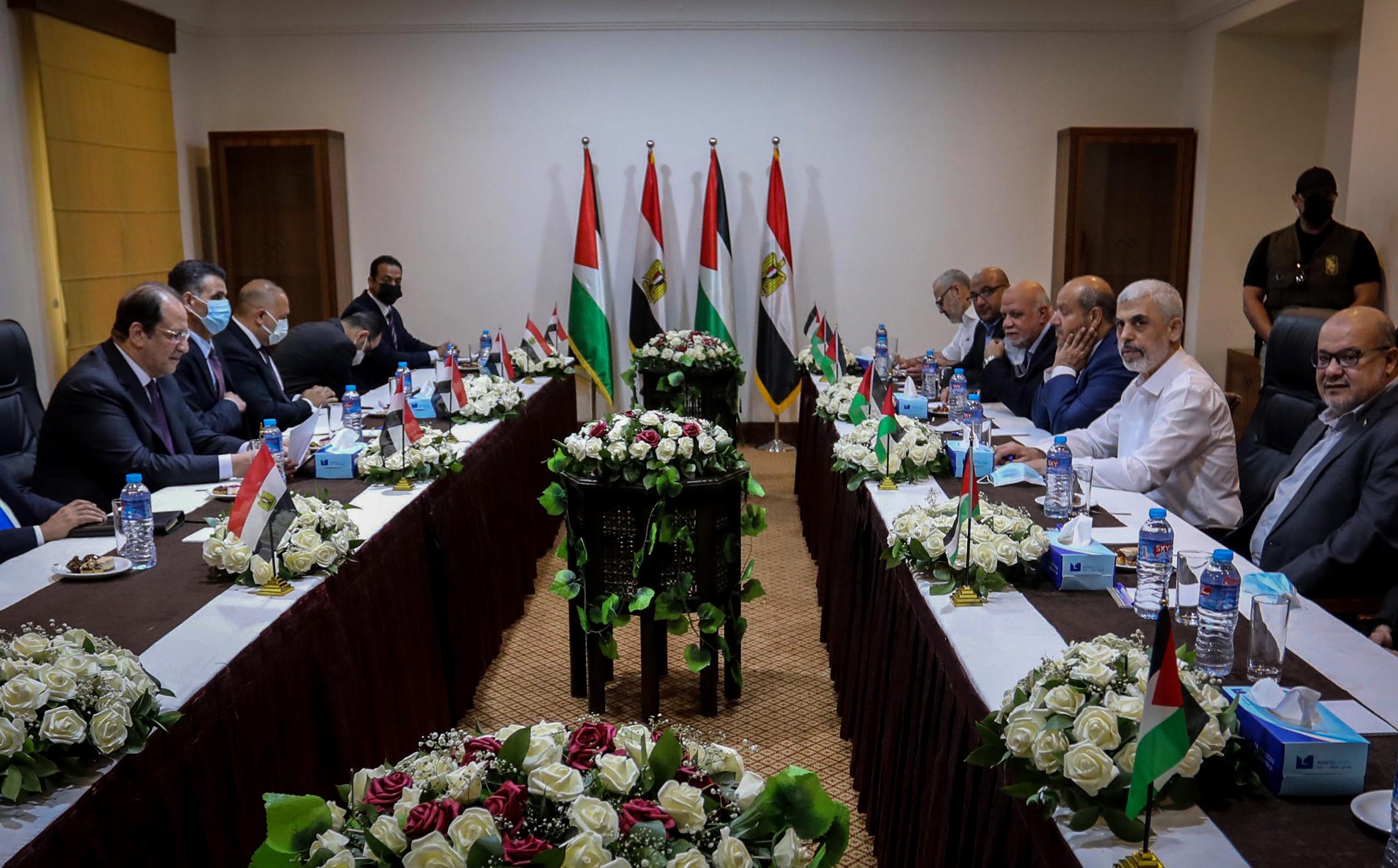
Yahya Sinwar, Hamas' political chief in Gaza, meets with General Abbas Kamel, Egypt's intelligence chief, as Kamel arrives for a meeting with leaders of Hamas in Gaza City, May 31, 2021. (Abed Rahim Khatib/Flash90)
“There was an Egyptian intelligence minister here,” Netanyahu told Channel 14 on Tuesday night. “He spent 59 minutes on the ground. I’m turning to the security and enforcement agencies. I want to know who he met with. Someone who met with him is trying to pin this on me.”
But who?
With 13 days to go before the election, we are back to the old question: who was warned about October 7?
According to The Atlantic, on September 26, 2023, 11 days before the massacre, an Egyptian intelligence aircraft touched down in an isolated corner of Ben Gurion Airport, stayed about an hour and flew back to Cairo. On board was Abbas Kamel, then Egypt’s intelligence chief, who reportedly warned that Hamas was preparing a major attack.
Netanyahu insists he never met him. “Since when does an intelligence chief speak with a head of state?” he asked, before going further: “It never happened to me once. There’s no such thing.”
Awkward, given that his own office released video of him hosting Kamel at the prime minister’s residence in 2021.
Still, whoever Kamel met, it does not appear to have been Netanyahu. In a painful bit of irony, the prime minister was at a ceremony marking 50 years since the Yom Kippur War, the last great Israeli intelligence failure.
Netanyahu’s own former military secretary, Avi Gil, says he knows of no warning, but concedes that “someone, it seems, met someone who arrived from Egypt.” Knesset Speaker Amir Ohana suspects it was one of the security chiefs who did not inform the prime minister.
Behind all this speculation lies an assumption: that a single meeting, squeezed into 59 minutes on a tarmac, would have shattered the conceptzia. Israel would have rushed forces to the southern border, Hamas would have been devastated or called off the attack entirely and the world as we know it would be unrecognizable.
I’m skeptical. The power of a conceptzia is that it absorbs warnings rather than heeding them. Golda Meir didn’t believe King Hussein when he came to Israel secretly to warn her in 1973. Would a warning from the Egyptian spy chief really have overturned an assumption held at every level of the security establishment?
Still, the question remains: who met with the Egyptian?
English Editor: Ari Tatarka
If you enjoy the newsletter, you can show your support by becoming a paid subscriber—it really helps keep this going. I’m also offering a special monthly briefing for a small group of premium members. I’d love to have you join us—just click below to find out more.
Thanks for reading It’s Noon in Israel! Subscribe for free to receive new posts and support my work.

