A Day to Remember
A musician, a medic, and a guardian.
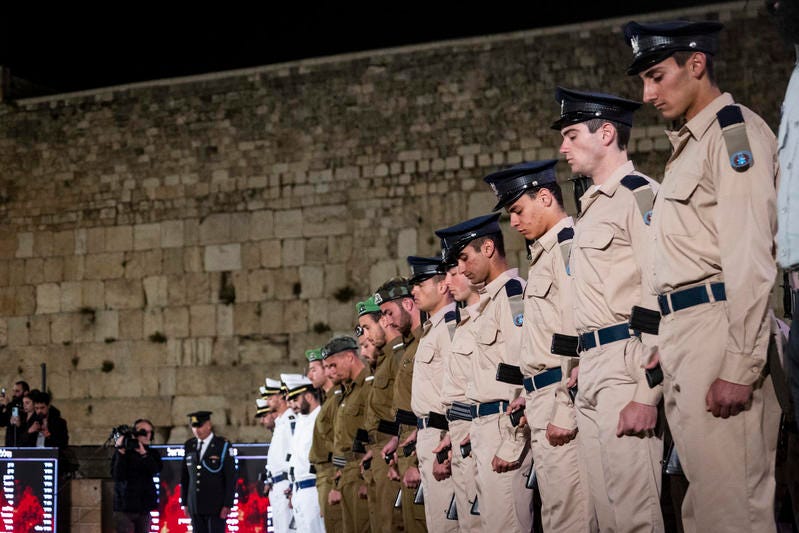
Israeli soldiers stand at attention during a Memorial Day ceremony at the Western Wall, Judaism's holiest site, in Jerusalem's Old City, as Israel commemorates its fallen soldiers and victims of terror. (Chaim Goldberg/Flash90)
It’s Tuesday, April 21, and Israel’s Memorial Day. Two years ago, I found myself at a Shabbat gathering for bereaved families in Tel Aviv. On a typical Shabbat, a full synagogue might hold a handful of travelers needing to say a special blessing, a mother who recently gave birth saying the same, perhaps a bar mitzvah boy his first time rising to bless the Torah, and three or four mourners reciting the Mourner’s Kaddish.
But when the time came for Kaddish that morning, the entire sanctuary—hundreds of congregants—rose as one. A chorus of voices echoed, “Yitgadal v’yitkadash shmei raba” (May His great name be exalted and sanctified). Every one of them was standing for a loved one lost on Simchat Torah of that year, or in the grueling months that followed.
The sheer volume of their grief brought another memory rushing back. A year earlier, in the synagogue at Hadassah Ein Kerem Hospital, I had witnessed the exact inverse. There, a sudden line had formed: half a dozen fathers waiting to name their newborn daughters, alongside families celebrating three different circumcisions.
I thought about these two sacred spaces, seemingly absolute opposites. I thought about the painfully short distance between the naming of a child and the reciting of the Kaddish. The fallen remain frozen in time as teenagers or twenty-somethings, but to the rest of us—the ones who continue to age—they look impossibly, heartbreakingly younger every time we remember them.
Today, a siren will sound, and the entire country will freeze—on the highways, in office buildings, and in private homes. The siren, which for the last two and a half years has been warning us of danger, will sound today to remind us of the cost of protecting us from that danger.
Every year, the Defense Ministry releases the names of the soldiers, police, and members of other security services who died in the past year, whether in the line of duty, or as a result of an accident, illness, or, most tragically, suicide. 170 soldiers have fallen since Israel’s last Memorial Day. Their names are now added to the 25,648 who have fallen since 1860, when Jews left the walls of Jerusalem’s Old City to establish new neighborhoods in the Holy Land.
It is an impossible task to capture the depth and breadth of this day in Israel. I will try, in my own small way, to embrace the 59,583 family members in Israel who have lost something irreplaceable. Today, all of Israel takes time to focus on the 8,420 bereaved parents, 4,872 widows, 14,430 orphans, 31,814 bereaved siblings, 12 fiancées, and 35 guardians left behind.
There are countless stories I could tell; here, I will focus on three.
Staff Sgt. Aner Shapira, 22.
“He had a personality of leadership and a love of people.”
Few acts of heroism in Israel’s history have seared themselves into the national consciousness quite like the standoff at the “Shelter of Death” on October 7.
When armed terrorists approached in white pickup trucks, Aner Shapira—a 22-year-old fighter in the Nahal Reconnaissance Unit—positioned himself squarely in the shelter’s narrow doorway. Looking back at the terrified civilians inside, he gave a simple command: “I’m taking responsibility for the grenades. If they throw them in, I’ll throw them out.”
What followed were 34 harrowing minutes. Completely unarmed, Aner stood his ground against a squad of roughly 20 terrorists, successfully catching and throwing back seven live grenades. Throughout the assault, he kept speaking to those huddled behind him, instructing them to stay alert and telling them that if he fell, they would have to step up and continue the defense.
A recent military probe has revealed the agonizing extent of his sacrifice. After being struck by an RPG blast that severed one of his hands, Aner refused to collapse. The report confirms that in his final moments, he used his remaining hand to throw back two more grenades, holding the line to his very last breath.
Aner’s heroism saved 10 people.
Aner’s dream was always to publish his music, using his songs to share his perspectives and help change the world around him. In the wake of his sacrifice, his family and friends established the Aner Shapira Foundation, to ensure that dream is realized.
A year after he fell, his mother spoke to Maariv. “Aner is still here,” she said. “I’m his mother even more so now. People can keep living after death in a very powerful way, and that’s what happened with Aner.”
Staff Sgt. Agam Naim, 20.
“She completed the paramedic course with flying colors, earning a score of 97, an exceptional achievement, and we were all so proud.”
Agam Naim had already renewed her passport. The 20-year-old paramedic from Kibbutz Mishmarot was planning a getaway with friends—a brief, much-needed return to the normal life of a young woman after six grueling months deployed in Gaza.
Instead, two days before she was scheduled to leave the Strip, she became the first female soldier to fall in the Strip since October 7, killed in a building explosion alongside three of her comrades.
After spending the weekend at home sick, the unit doctor told Agam she didn’t need to return to the combat zone; her assignment was ending that Thursday anyway.
Then comes the moment—that simple action I see in so many stories of our soldiers, yet one that leaves me speechless every time.
She went back anyway. When she was first deployed, Agam had told her aunt that she wouldn’t be able to look into the eyes of her comrades’ mothers if she wasn’t there to take care of their children. True to her word, she insisted she couldn’t leave without saying a final goodbye to her team.
“We spoke to her on Monday before she entered,” her family recalled. “She called from the staging area, saying she loved us and everything was fine, but that she would be unreachable as she would turn off her phone. We told her we loved her and to take care of herself. And that was it.”
Warrant Officer Ibrahim Kharuba, 39.
“He acted with honor; he was a deeply moral person.”
Ibrahim Kharuba was a Bedouin tracker in the Gaza Division from the northern city of Maghar. Ibrahim was killed on October 7 while battling Hamas terrorists at the Nahal Oz IDF outpost.
The base was home to the tatzpitaniyot—the female observation soldiers whose repeated warnings were ignored in the weeks preceding October 7. The outpost became the site of the slaughter of 14 unarmed young women and the kidnapping of seven others, in a battle that stands as one of the most agonizing symbols of that day in October.
When the base was breached, Ibrahim engaged dozens of terrorists in a fierce firefight, desperately defending the young recruits inside the war room. Seeing another officer fall wounded, Kharuba dragged him to safety, shouting a final, urgent command to the women inside: “Lock the door!” Throughout the standoff, he called out to the attackers in Arabic, attempting to use the name of Islam to convince them to spare the women.
When the terrorists demanded his surrender, his answer was clear: “Never.” Holding his ground, his bullets carved a literal line of defense; reports credit him with felling 17 attackers. He fought until his magazine was empty. When the battle was over, his body was discovered at the position closest to the door.
For his extraordinary bravery, Ibrahim is one of two individuals recommended by the military investigation to receive the Medal of Valor (Itur HaOz)—the second-highest decoration in the IDF. The medal is remarkably rare; it has been awarded only 220 times since the establishment of the state and was last bestowed in 2007 to six soldiers who fought in the Second Lebanon War, which itself ended a 23-year period in which the medal was not awarded.
According to the surviving observation soldiers, Ibrahim’s final words before he fell were: “It was my greatest honor to die for you.”
Ibrahim, Agam, and Aner are just three names out of thousands. Stories of such profound heroism and bravery punctuate every chapter of Israel’s history, but perhaps none more so than the agonizing one we are currently writing. To borrow a Talmudic saying, “Even if all the seas were ink, all the trees were quills, and all the people were scribes,” we still would not have enough words to properly thank them for their sacrifice.
I will leave you today with the words of the poet Natan Alterman, from Israel’s most famous poem to the fallen, The Silver Platter:
Dressed in battle gear, dirty,
Shoes heavy with grime, they ascend the path quietly
To change garb, to wipe their brow
They have not yet found time.
Still bone weary from days and from nights in the field
Full of endless fatigue and unrested,
Yet the dew of their youth.
Is still seen on their head
Thus they stand at attention, giving no sign of life or death
Then a nation in tears and amazement will ask: “Who are you?”
And they will answer quietly,
“We Are the silver platter on which the Jewish state was given.”
Thus they will say and fall back in shadows
And the rest will be told
In the chronicles of Israel
We are taking a break for Yom Ha’atzmaut.
We will be back on Thursday.
English Editor: Ari Tatarka
If you enjoy the newsletter, you can show your support by becoming a paid subscriber—it really helps keep this going. I’m also offering a special monthly briefing for a small group of premium members. I’d love to have you join us—just click below to find out more.
Thanks for reading It’s Noon in Israel! Subscribe for free to receive new posts and support my work.


A moving tribute on this solemn day. Ahm Yisrael Chai
I am moved to tears buy the incredible acts of bravery described by Amit. Hashem yevarech et ha'am ha'yehudi.