A New Challenger Enters the Race
Also, casualties in Lebanon, a conversation about Israel's options, and more.
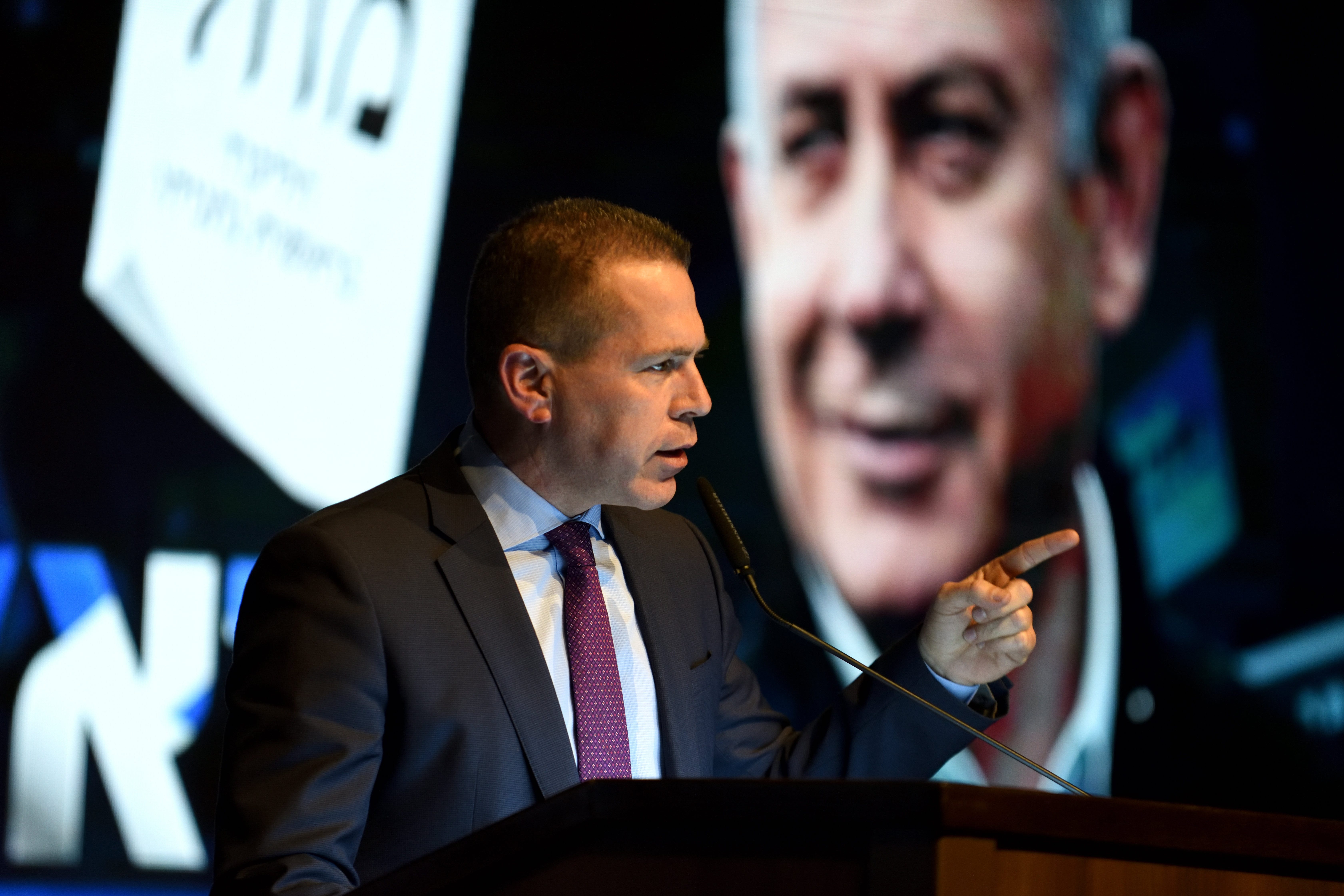
Israeli Minister of Homeland Security Gilad Erdan delivers a speach at the Likud Party election rally in Or-Yehuda, February 13, 2020. (Gili Yaari / Flash90)
It’s Thursday, August 6, and former UN ambassador Gilad Erdan launches his new right-wing party tonight, alongside fellow Likud refugee Yuli Edelstein. Will this be enough to tip the scales in the coming election?
Like divided border cities during the Cold War, in the twilight zone called the “Unity Bloc,” the “Third Bloc,” the “National Right,” or any other name, foreign powers are scheming.
Because with all due respect to the campaign so far, the fate of the elections will be determined by the question of who, if anyone, can squeeze four or five mandates out of this not very juicy lemon. Take, for example, the Channel 12 poll from this week: Chili Tropper and Yoaz Hendel’s joint party cross the blocking threshold, and bring the Gadi Eisenkot bloc to 60 mandates, on the verge of forming a stable government for four years. On the other hand, if those four mandates go to Erdan and Edelstein, or Ofer Winter, who do not rule out Netanyahu, it means that Eisenkot has no majority to form a government even with Arab abstention. Ten thousand votes that moved from here to there—and the result will be completely different.
To everyone’s surprise, Eisenkot is meanwhile showing higher competence. The scenario now is ideal from his perspective, one in which right voters move directly to a party that will recommend him for forming the government and will join him, for all intents and purposes, and to prevent elections. Tropper, aware of the danger of being lumped in with the bloc of Yair Golan and Yair Lapid, has been explaining lately that although his final destination will be Eisenkot, he does not rule out coupling with another party just before the candidate slates close and riding it to the Unity Government station.
Netanyahu, meanwhile, only rules people out: he does not trust Winter and does not speak with Gilad Erdan. Channel 14 treats the former Likud minister with the same coldness it reserves for Yair Lapid and Yair Golan. This is not some sophisticated scheme to peel Erdan away from Netanyahu—it is the very reason Erdan is not trying to make his way back through Likud in the first place. Likud, for its part, would be glad to see Benny Gantz clear the electoral threshold, rightly guessing that he would sooner hand the premiership to Tali Gottlieb than to Eisenkot, who abandoned him and left him to drown.
If the Bennett-Eisenkot contest was the semifinal, what is unfolding now is the Oceania qualifiers for a spot in the intercontinental playoff on the road to the World Cup: a crowd of tiny national teams competing for half a berth. The Erdan-Edelstein announcement of a new party was meant to drag everyone else underwater by force. Once they have all swallowed water and started to thrash, an instant before blacking out for good, the strongest one will surface. Gantz is counting on his money to draw the others in; Tropper, on his poll numbers. Erdan’s weapon is having no alternative—he has burned his ships in Likud. Tropper has a home port to return to and Gantz has a pension to fall back on after long years of service, but Erdan’s message to all of them is: I am staying to the end, and whoever wants to survive is welcome to join me.
Smoke rises from southern Lebanon during an Israeli military operation, August 5, 2026. (Ayal Margolin/Flash90)
Two soldiers were killed and four seriously wounded by an explosive device in the southern Lebanese town of Majdal Zoun. The blast pushed the military to resume strikes on Hezbollah and strained the truce talks underway in Rome. The question is whether it was intentional.
According to an initial probe, the troops had entered a building to demolish Hezbollah infrastructure when the structure exploded. It remains unclear whether the bomb was planted before the ceasefire, and whether it was triggered automatically or manually. Israel branded the blast a blatant violation of the fragile truce and launched its first strikes since August 1. That, in turn, brought the Rome negotiations to an early close, with Israel’s ambassador to the United States, Yechiel Leiter, accusing the Lebanese delegation of repeatedly leaking false information and asking the American mediators to pause the talks.
If the explosion was meant to blow up the negotiations, it worked. That is not to say the framework has gone the way of the MoU: a U.S. official insisted the sessions had been productive, and for now this looks like a flare-up rather than a rupture. The fundamental interests of Lebanon and Israel still largely align. But if the blast was deliberate—and worse, if it was planned in Tehran—we should expect more flare-ups and more casualties.
The distance between the Lebanese and Iranian fronts has fluctuated wildly over the past few years. Israel needs it as wide as possible; Iran needs it gone. What holds the two battlefields apart right now is the Lebanese state itself—lending Israel legitimacy to operate in the country’s south while stripping Hezbollah of its cover as the defender of Lebanon. Iran wants that barrier removed at all costs; Israel, however feeble the partner, has every reason to keep it standing.
What should Israel do in Gaza? Does the Lebanese state have a chance of disarming Hezbollah? What is next in Trump’s Iran strategy? Last night I joined Dana Loesch to discuss all this and more.
Israeli chess champion Boris Gelfand recieves a gift from MK Danny Danon as he attends an Abosrption and Immigration committee meeting in the Israeli parliament, June 06, 2012. (Miriam Alster/FLASH90)
Grandmaster Boris Gelfand is the first Israeli chess player ever to be elected a member of the World Chess Hall of Fame, joining just 61 other inductees in St. Louis. The World Chess Hall of Fame brings together the most prominent figures in the chess world, those who have made an exceptional contribution to the game’s development. Its members include world champions, both men and women, historians, and promoters of the sport of chess.
Gelfand, who immigrated to Israel from Belarus in 1998, is widely regarded as one of the greatest chess players in the country’s history. He remains the only Israeli to have won an Olympic chess title, taking gold at the 1990 Chess Olympiad playing for the Soviet Union team. Later in his career, he became the only Israeli to win the Chess World Cup, taking the title in 2009. Two years later, he won the Candidates Tournament and qualified for a match for the world championship.
The defining moment of his career came in 2012, when he challenged Indian world champion Viswanathan Anand for the title. Gelfand fought Anand to a 6-6 draw, with Anand retaining the crown only after winning the rapid tiebreaker.
For more than two decades, Gelfand was the leader of Israel’s national chess team and played a central role in its greatest achievements, among them the silver medal at the World Chess Olympiad in 2008 and the bronze medal in 2010.
Gelfand’s name will henceforth stand alongside the greats of chess, among them Emanuel Lasker, Mikhail Tal, Bobby Fischer, Garry Kasparov and Judit Polgár, potential Hungarian president and strongest female chess player in history.
English Editor: Ari Tatarka
If you enjoy the newsletter, you can show your support by becoming a paid subscriber—it really helps keep this going. I’m also offering a special monthly briefing for a small group of premium members. I’d love to have you join us—just click below to find out more.
Thanks for reading It’s Noon in Israel! Subscribe for free to receive new posts and support my work.


