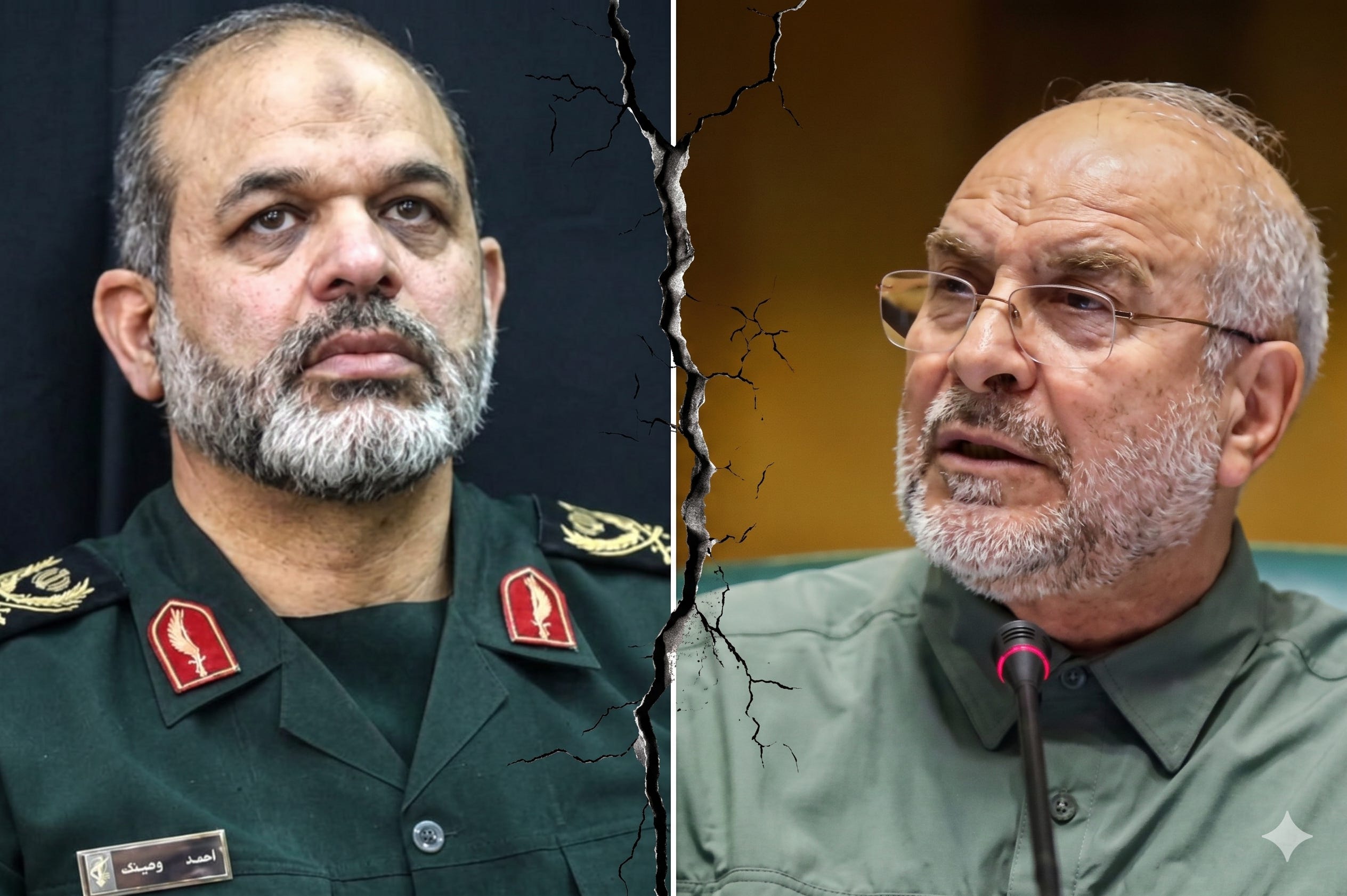
A Split at the Summit of the Regime
Also, the semi-ceasefire in Lebanon.
IRGC Commander-in-Chief Ahmad Vahidi and Parliament Speaker Mohammad Ghalibaf.
It’s Sunday, April 19, and according to Iran’s Foreign Ministry spokesperson Esmaeil Baghaei, “The statements by American officials are filled with contradictions and lies”—a sign, he claims, of their “desperation and helplessness.” Israel and the U.S. must have eliminated all the adults in the Foreign Ministry, because Baghaei is effectively playing a geopolitical game of “I know you are, but what am I?”
Despite Foreign Affairs Minister Abbas Araghchi’s announcement on Friday that the Strait of Hormuz was “completely open” to commercial traffic, the IRGC Navy attacked several commercial vessels the very next day, declaring that no vessel of “any type or nationality” is permitted passage. This jarring disconnect may be a sign of something more serious than desperation: a coup d’état.
It is quite the allegation, but let’s look at the evidence. Beyond the strait’s schizophrenic travel regulations, the Foreign Ministry confirmed that new talks will occur, even though a date has not yet been set. Meanwhile, IRGC-affiliated media simultaneously announced that Iran has refused to participate in another round of negotiations with the United States due to “excessive” U.S. demands.
Furthermore, the institutions of the Iranian state seem to be picking sides. The Khatam-al Anbiya Central Headquarters—roughly the equivalent of the U.S. Joint Chiefs of Staff—has released a statement defending the IRGC attacks in the waterway. The Supreme National Security Council joined the chorus, declaring that Iran will control the strait until the war ends.
The split runs along a well-trodden divide: On one side, the political leadership, represented by President Masoud Pezeshkian, Abbas Araghchi and Parliament Speaker Mohammad Ghalibaf; on the other, the men with the guns, led by an IRGC firmly under the control of Ahmad Vahidi.
Let’s meet our aspiring generalissimo.
Vahidi boasts a notoriously dark résumé, beginning as the IRGC representative during the Iran-Contra debacle that almost upended the Reagan administration, before playing a direct role in the 1994 AMIA Jewish community center bombing in Argentina that killed 85 people. His most recent experience was bathing in blood during his tenure as interior minister in 2022. It was Vahidi’s forces that severely beat and later murdered Mahsa Amini in the hospital over an “improper hijab”—igniting the Woman, Life, Freedom protests. Those same forces under his command executed the ruthless crackdowns that followed, with a death toll estimated as high as 5,000.
In short: even The New York Times would struggle to label Vahidi a moderate in his—hopefully imminent—obituary.
Yesterday’s shipping attacks confirm he has already assumed de facto control over Iran’s military apparatus, but his ambitions clearly extend beyond martial domination.
Preceding the talks in Islamabad, Vahidi reportedly attempted to insert a commissar—Secretary of Iran’s Supreme National Security Council Mohammad Zolghadr—into the delegation to keep an eye on the negotiations, despite the resistance of the political leadership. Zolghadr’s mandate was intended to inform leaders in Tehran if the diplomatic delegation strayed from Supreme Leader Mojtaba Khamenei’s wishes. Though, given Mojtaba’s continued incapacitation, calling them Vahidi’s wishes might be more accurate. Ultimately, Zolghadr, likely bitter over his exclusion and opposed to what he saw brewing in Islamabad—specifically the delegation’s flexibility regarding support for the Axis of Resistance—issued a scathing report, prompting senior leaders in Tehran to recall the negotiating team entirely.
If there is a coup underway, its most immediate effect will be on the negotiations. Despite his denials, Parliament Speaker Mohammad Ghalibaf is the official on the phone with the Americans. But even if he agrees to terms, the current power struggle does not bode well for his ability to hand over regular Iranian dust, let alone the nuclear enriched powder.
From Israel’s perspective, the central question hanging over the possible coup is what will emerge on the other side. A “Pakistan model”—where an Islamic government still pragmatically aligns with Western interests—would be viewed as a manageable, even successful, outcome. But if the coup gives rise to an even more hardline, uncompromising dictatorship, the situation may have gone from bad to worse.
Israel and the U.S. likely have contingency plans for the latter, but I think everyone, including the Iranians, is hoping that pragmatism will prevail.
Fallen soldiers Command Sgt. Maj. Barak Kalfon, 48, and Sgt. First Class Lidor Porat, 31.
If the goal of the ceasefire was silence, its first three days are a resounding failure. Since Friday, the fragile quiet has been shattered by the loss of two reservists, Command Sgt. Maj. Barak Kalfon and Sgt. First Class Lidor Porat, in southern Lebanon. Meanwhile, the IDF has continued its operations, actively targeting imminent Hezbollah threats within the security belt.
Before sounding the drums of war, it must be noted that the ceasefire remains in force. Israeli clearing operations inside the security zone are permitted under the agreement, and the IEDs that tragically claimed the lives of these reservists appear to have been planted before the truce began. The fallout from these deaths inflicts a heavier toll on public trust than on the agreement itself.
The ceasefire began life unpopular. According to a survey by Dr. Nimrod Nir of the Agam Institute and the Hebrew University of Jerusalem, 65 percent of Israelis opposed the deal before it began, while a mere 15 percent supported it. Furthermore, while the U.S. touted the truce as a strategic submission by Iran, 70 percent of Israeli respondents viewed it as an American concession to the Islamic Republic.
This lack of popularity was predictable. While Hebrew uses the idiom of “pushing a boulder up a hill” to describe an endless, Sisyphean task, “invading Lebanon” may soon replace the phrase entirely. Israelis were prepared to shoulder the burden of one more push—one final advance to neutralize Hezbollah once and for all—so they could finally rest. Now, they find themselves halted mid-climb, watching as diplomatic pressure pushes the rock in the opposite direction. The ultimate Israeli nightmare is that, after all this sacrifice, they will find themselves right back at the bottom of the hill.
The public’s skepticism is rooted in a sense of unfinished business. According to Dr. Nir’s survey, only 10 percent of Israelis see the war as a significant success, while 32 percent view the campaign as an outright failure. Furthermore, 63 percent of respondents stated the war has gone worse or much worse than expected, whereas only 13 percent felt it had gone better.
To put it simply, Israelis are not in a celebratory mood. It is difficult to celebrate when an entire region of the country may still have to flee to shelters in the middle of the festivities.
Netanyahu was hoping to ride a clear military victory toward electoral success, but it won’t take an outright defeat to cost him the election—even a perceived “draw” is enough to lead him to a devastating loss.
But with all the talk of the macro, let us not forget the people most affected by recent events in Lebanon.
“Next week you would have celebrated number 49,” said Barak Kalfon’s cousin, Sapir, at his funeral. “You didn’t even need to be in uniform anymore. But even so, you insisted on volunteering for reserve duty. That’s who you were. Always with a bright face, always smiling, always embracing and including. Calm, with a heart bursting with goodness.”
May his memory, and the memory of Lidor, be a blessing.
English Editor: Ari Tatarka
If you enjoy the newsletter, you can show your support by becoming a paid subscriber—it really helps keep this going. I’m also offering a special monthly briefing for a small group of premium members. I’d love to have you join us—just click below to find out more.
Thanks for reading It’s Noon in Israel! Subscribe for free to receive new posts and support my work.


Does Vahidi have a zebiba? Yeah, not going to get very far with a guy with that prayer callous on his forehead.