America and Israel at 250
The people behind Israel's most important relationship.
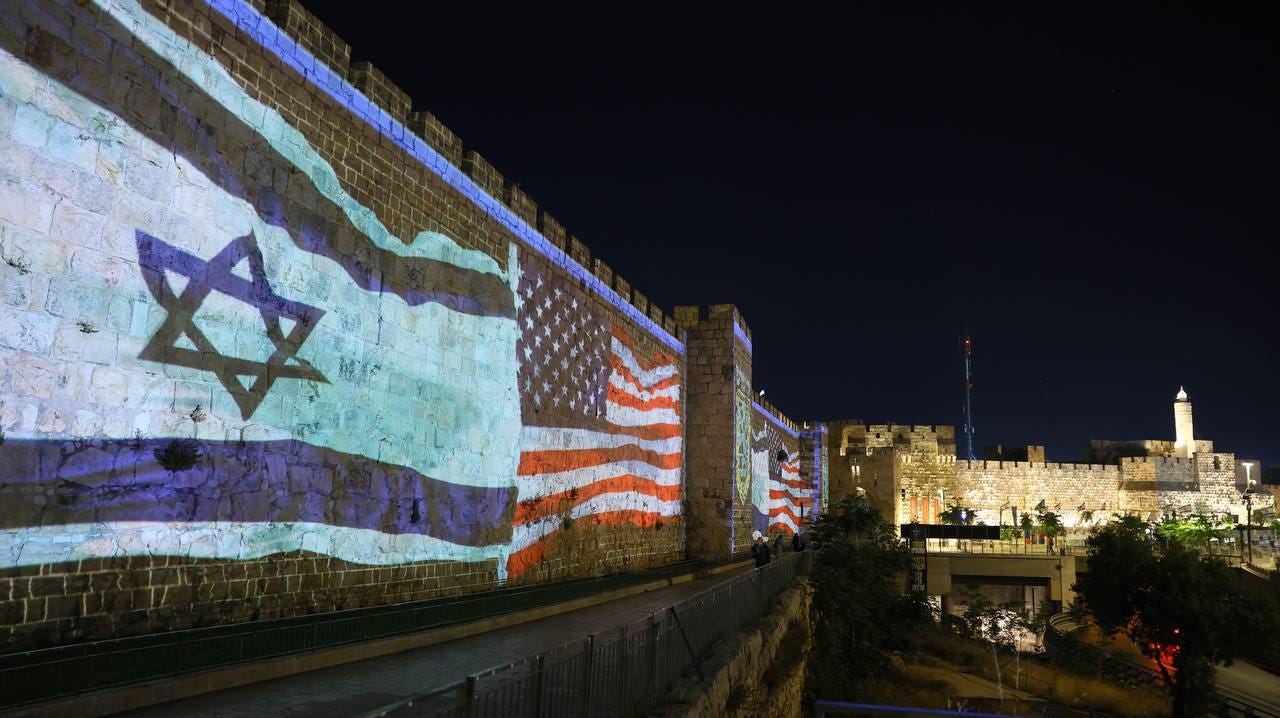
The walls of the old city of Jerusalem lit with the Israeli and American flag’s in honor of Donald Trump’s visit to Israel, October 2025.
It’s Friday, July 3, and as the first skyscrapers appeared in the distance as his ship drew into New York Harbor, a young lawyer and Zionist activist, stunned by the sight of the burgeoning United States, wrote in his journal:
“We, who want to build a new land in a wilderness out of ruins, need to learn how the deportees and persecuted people from England founded a huge, rich country with unparalleled treasures and creative power.”
That man was David Ben-Gurion, Israel’s own founding father—and the sentiment stuck.
With the bicentennial approaching, and the recent high point of U.S.-Israel cooperation during the Iran war still fresh, it felt like the right moment to look back at the people who built this relationship, brick by unlikely brick.
The seeds of American Zionism were planted well before the state’s establishment—and in a strange twist, Americans were arguably more Zionist than the Jews were. Six years before the First Zionist Congress even convened, American preacher William Blackstone organized a petition urging President Benjamin Harrison to back Jewish resettlement in Palestine, signed by an eclectic group of religious figures and notables alike—J.P. Morgan and John D. Rockefeller among them. Christian America wanted a Jewish state before the Jews had agreed on wanting one. The relationship was further cultivated by figures like Supreme Court Justice Louis Brandeis, who lent the cause unlikely establishment credibility, using his influence to push Washington toward supporting the 1917 Balfour Declaration.
Then came the state itself. In one of the canonical Jewish American stories, President Harry Truman was wavering on recognizing the new state until his old haberdashery business partner, Eddie Jacobson, personally appealed to their friendship to get him to meet Chaim Weizmann. Truman recognized Israel within minutes of its declaration, casting himself as a modern-day Cyrus in the process. Behind the scenes, meanwhile, an unlikely cast of Americans broke the harsh embargo imposed after recognition to arm the fledgling state: test pilot Al Schwimmer smuggled surplus U.S. aircraft to Israel, Las Vegas newspaperman Hank Greenspun ran weapons, and even Teamsters boss Jimmy Hoffa was tied to arms-smuggling networks. Frank Sinatra got in on the act too—evading federal agents in 1948, he slipped out the back of a New York nightclub carrying a paper bag packed with a million dollars in cash to pay a ship captain for a critical, embargo-breaking munitions delivery.
Rev. John Stanley Grauel may be the most cinematic figure of this early era—a Methodist minister who joined the Haganah’s underground network and sailed undercover aboard the refugee ship Exodus 1947. When British forces seized the ship, he was arrested but managed to get his eyewitness account to the press, then was smuggled to Jerusalem to testify before the U.N. Special Committee on Palestine. His testimony carried a weight that Jewish survivors’ own accounts, unconscionably, weren’t afforded—and was credited by Golda Meir as pivotal in swinging the U.N. toward the 1947 Partition Plan vote.
When Israel lost its arms relationship with France in the early 1960s, Washington stepped into the gap. John F. Kennedy became the first U.S. president to make a formal security commitment to Israel, breaking a long-standing arms embargo with the 1962 sale of Hawk antiaircraft missiles. He’s said to have told Ben-Gurion privately, “You know I was elected by the Jews. I have to do something for them.” The deal itself was less his doing than his aide’s. Myer “Mike” Feldman, a White House counsel, who became the unofficial back channel to both the Israeli government and the American Jewish community—shepherding the Hawk sale through a bureaucracy still resistant to arming Israel at all, and, by most accounts, leaking the story to The New York Times once it was done.
Israeli Prime Minister Golda Meir with Sen. Henry “Scoop” Jackson during a reception at Israeli Ambassador to the United States Yitzhak Rabin’s residence in Washington, D.C. (Moshe Milner/GPO)
By the 1970s, the relationship had hardened into something closer to strategic alliance, and towering over it was Senator Henry “Scoop” Jackson of Washington State—Israel’s most important champion on the Hill. Time called him “Israel’s best friend in Congress,” and he proved it during the Yom Kippur War, pushing through the 1973 airlift of military supplies that helped turn the tide. Jackson’s grip on the cause outlived him. Delivering his eulogy on the Senate floor in 1983, a young Senator Joe Biden singled out Jackson’s hawkish pro-Israel stance as the thing that shaped him most, declaring, “Scoop Jackson changed a major part of my political life.” Decades later, as president, Biden was still quoting his old mentor—telling Netanyahu in a private 2021 conversation that he was under pressure at home, because, as he put it, “this is no longer Scoop Jackson’s Democratic Party.”
Around the same time, James Angleton—the CIA’s legendarily paranoid counterintelligence chief—personally ran the “Israel desk” from 1951 until his forced resignation in 1974. Angleton treated Mossad less like a foreign intelligence service and more like an extension of his own shop, sharing satellite intelligence, nuclear know-how and covert planning to a degree that unsettled even his own colleagues. When he died in 1987, Mossad’s chiefs held a secret memorial ceremony on a Jerusalem hillside in his honor—an unusual tribute for an American spy, and a quiet reminder of just how personal the “strategic” relationship really was.
The late 20th century brought a different kind of influence: money and media. Publishers like Mortimer Zuckerman, philanthropists like Max Fisher, and later figures like casino magnate Sheldon Adelson and DreamWorks investor Haim Saban became major forces in American political life specifically because of their commitment to Israel. Meanwhile, cultural figures—Leon Uris with Exodus, and Holocaust survivor-turned-author Elie Wiesel—kept the emotional case for the alliance alive in American popular culture.
Even now, as we face rising hostility toward Israel, it’s worth reflecting on how strange this all is. Here are two countries with no shared border, no meaningful economic dependency, not even a common language—and yet, decade after decade, one has shown up for the other, and the two seem inextricably attached. No self-interest bound them together at the start, yet something in the American psyche has always been attached to the story of the Jewish people and the return to their homeland.
Pepole walking next to a large American flag at the Tsahal Square in Jerusalem, in honor of Donald Trump, October 12, 2025. (Yonatan Sindel/Flash90)
While there is still so much left to say about the U.S.’s relationship with Israel, it seems worth closing with a few words on how Israelis perceive the U.S..
Israelis hold a deep admiration for America—not just as the source of their Amazon packages, but as a font of aspiration and support. One cannot ignore the powerful influence of the thriving American Jewish community. Even those Jews who went east instead of west, choosing Israeli hardship over American prosperity, could see in the cultural imports and the wealthy philanthropists that America truly was the “Golden Medina.” In the 1990s, and to some degree still today, “Made in America” has been shorthand for quality and luxury because, in the collective imagination, America remains a land of wealth and possibility.
Israeli rock legends Rami Fortis and Berry Sakharof describe the Israeli image of the U.S. quite well in their song “America”:
An open Chevrolet drives toward the great freedom
Disneyland strikes the world, everyone wants it all
There is no fear and no sadness, everything here is so perfect
America sells everyone’s dreamIs there a limit?
There is no limit.How many songs can be written about America?
Perhaps the clearest symbol of this attachment is the man who has drawn so much American wrath in recent years: Benjamin Netanyahu. He is Israel’s answer to the American coastal elite—American-educated, fluent in English, and the man who imported American-style campaign tactics to Israeli politics. Far from hurting his career, that fluency with America—the accent, the degree, the media instincts—made him seem more qualified to lead, not less.
But the connection runs deeper than material culture. In the Israeli imagination, America still occupies the place it always has—the promised land’s own promised land, a place defined by unlimited possibility. It’s the country, as Marco Rubio recently described, “where anyone, from anywhere, can achieve anything.” For a state built by refugees and exiles, that idea lands differently than it does for most. “Give me your tired, your poor, your huddled masses yearning to breathe free”—written by the Jewish poet Emma Lazarus and inscribed on the Statue of Liberty—could just as easily describe the mission Israel set for itself decades later.
Writing from the original shining city on the hill to an audience that, in large part, lives on the new one, I’ll close with this: On the 250th anniversary of the Declaration of Independence, it’s worth saying plainly that Israel would not exist, or thrive, the way it does without the United States—not only because of the direct support, but because of the world that was created the day that ship landed at Plymouth Rock, the day that shot was fired at Concord, and the day a declaration opened with the words that all men are created equal. That world is the one in which the Jews could return to their ancestral homeland and flourish in the 21st century.
Happy Fourth of July and Shabbat Shalom! We will be back on Sunday.
English Editor: Ari Tatarka
If you enjoy the newsletter, you can show your support by becoming a paid subscriber—it really helps keep this going. I’m also offering a special monthly briefing for a small group of premium members. I’d love to have you join us—just click below to find out more.
Thanks for reading It’s Noon in Israel! Subscribe for free to receive new posts and support my work.


