It’s Noon in Israel: American Boots on Israeli Soil for the First Time
Also, hypocrisy on Iran is 100 times worse than you think, Lebanon’s emigration crisis, and more.
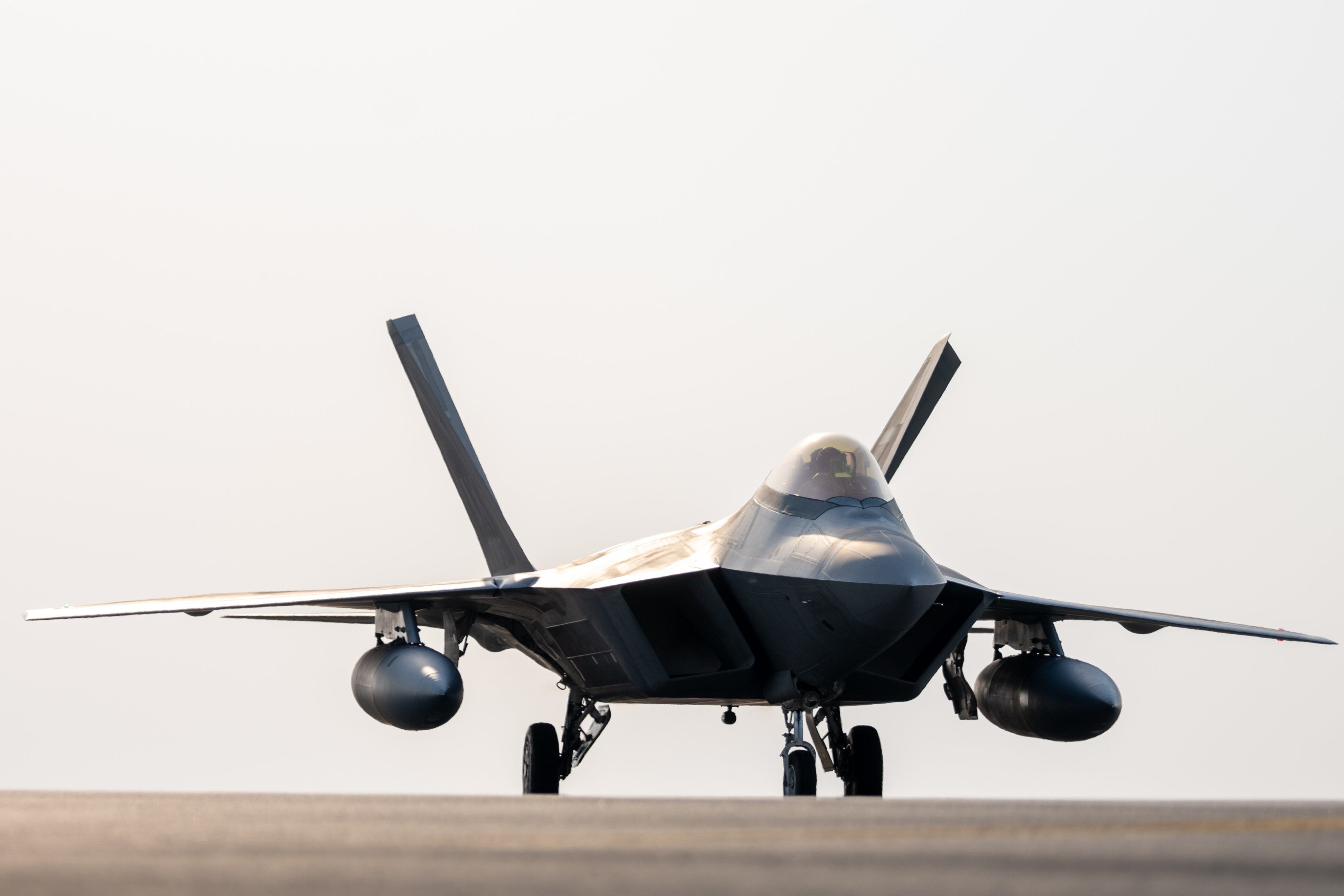
F-22 Raptors arriving in the Middle East in 2024. (@CENTCOM/X)
It’s Wednesday, February 25, and a squadron of F-22 Raptors has landed at an Israeli airbase in southern Israel. This marks the first time American offensive weapons have been stationed in the country and another Israel taboo the Trump administration has broken.
For decades, stationing U.S. fighters in Israel risked loosing the American bases in Saudi Arabia, Qatar and Iraq. Given that the Gulf is better positioned for operations across the Middle East, that trade-off has never been profitable.
The closest Israel came to permanent American bases were a radar station, the recent Civil-Military Coordination Center for Gaza, and what might be called strategic bribes to limit Israeli action. George H.W. Bush deployed Patriot batteries during the Gulf War to prevent Israel from responding to Saddam Hussein’s Scud missiles. Joe Biden deployed THAAD missile defense systems during the 2024 exchanges with Iran—at least in part to prevent Israeli retaliation.
Today, the risk is less angry Arab allies and more angry anti-Israel Republicans. But unlike the former, the latter has a simple antidote: success. If the operation ends well, few will care where the jets launched from—no matter how much Tucker Carlson whines.
But why now?
Israel is farther from Iran than bases in Saudi Arabia or Qatar. There are already roughly 200 fighter jets in the Middle East and more than 300 if you include those in Europe, more than that if you include the strategic bombers that can launch from anywhere globally. One squadron will not tip the balance in any potential strike.
These aircraft are here to signal something else: that when it comes to Iran, Israel and the U.S. are working from the same place—literally and figuratively.
It is about as close to confirmation as we are likely to get, short of seeing the planes in the air, that if there is an American strike, Israel will be flying alongside.
It has been decades since Ronald Reagan’s secretary of state, Alexander Haig, described Israel as “the largest American aircraft carrier in the world that cannot be sunk.” It seems the U.S. is finally making use of it.
A protester waves the pre-Islamic Republic flag at a protest in Iran. (@Helihellix/X)
Remember all the drama over the IDF’s operation in Rafah? Kamala Harris studying maps, the world’s “eyes” fixed squarely on the city, the EU warning of an “unspeakable humanitarian catastrophe.” It’s hard to forget.
Remember the outrage over the massacres in Iran? Neither do I.
We know the phrase “no Jews, no news.” But just how different was the coverage?
According to a recent report from the Jewish People Policy Institute: about 100 times.
During a 22-day period around the Iranian massacres, only 25 protests were held in the United States. In a comparable 22-day period during the Rafah operation, there were 2,120.
The Iranians didn’t even receive 25 supportive protests. Some of the demonstrations that did occur were protests demanding the U.S. stay out of Iran—a distinct change in tone from the “ceasefire now” rallies during Rafah.
For my faith in humanity, I don’t want to do the math.
But estimates for civilian deaths during the months-long Rafah offensive range from dozens to hundreds. The Iranian government killed more than that in a single day. By Tehran’s own heavily discounted figures, 2,985 were killed. Human rights groups confirm more than 7,000. Independent estimates place the number above 35,000.
Let that sink in: a massacre 100 times worse received 100 times less outrage.
It doesn’t stop with the public. During the Iranian demonstrations, many organizations that had led protests against Israel were slow or silent in expressing solidarity. Even when statements eventually came, they were often lukewarm. During the 22-day period around Rafah, coverage of the Palestinian issue was nearly twice as extensive.
As an Israeli, I expect hostility. But if I were Iranian, the least I would be hoping for is sympathy.
Lebanon’s national carrier, Middle East Airlines, at Beirut-Rafic Hariri International Airport. (@MEAAIRLIBAN/X)
Emigration is a controversial topic in Israel. How many people are leaving—and why—is politically charged. But it could be worse.
In Israel’s northern neighbor, it is an undeniable crisis threatening to destabilize the already unstable country.
In 2025, around 220,000 people left Lebanon—roughly the same number that left between 2017 and 2021 combined. According to the Arab Youth Opinion Poll, 90 percent of Lebanese youth say they are thinking about or actively seeking emigration—the highest ratio in the Arab world.
It is not just the scale; it is who is leaving. A 2021 survey found that more than 40 percent of Lebanon’s doctors had already emigrated. Add to that young professionals in IT, engineering and other middle-class sectors, and the country’s economic future looks bleak.
Before anyone sporting a keffiyeh gets excited, this is not Israel’s fault. Lebanon’s economic collapse predates Israeli strikes, though the persistent shadow of war certainly does not help.
The demographic implications also do not benefit Israel. While emigrants come from all religious sectors, higher Shiite birthrates tilt Lebanon’s future in a less Christian, more Islamic direction. It is worth remembering that Lebanon’s previous civil wars were largely ignited by shifts in the demographic balance.
Here, however, is a possible glimmer of hope.
Hezbollah’s durability rests less on its missiles than on its constituency, cultivated through extensive social services. Unlike Hamas—which existed before Iranian backing—Hezbollah is almost entirely an Iranian project. Upward of 70 percent of its budget comes from Tehran.
To put it simply: No regime in Tehran means no Hezbollah. No Hezbollah means the boot off the Lebanese government’s neck—and perhaps some measure of stability.
Hezbollah is far from the only problem plaguing the country. But the road to a better Lebanon may run through Tehran rather than Beirut.
Let’s end on a lighter note. I’m not sure why the U.S. keeps sending musically talented ambassadors to Israel, but we appreciate it. Trump’s first ambassador to Israel, David Friedman, joined current ambassador Mike Huckabee on stage for a rendition of “Hound Dog,” dedicated to Israel’s recent three-hour visitor, Tucker Carlson.
“Well, they said you was high-classed / Well, that was just a lie” is apt enough. But “You ain’t no friend of mine” is especially satisfying coming from a member of the Trump administration.
If you enjoy the newsletter, you can show your support by becoming a paid subscriber—it really helps keep this going. I’m also offering a special monthly briefing for a small group of premium members. I’d love to have you join us—just click below to find out more.


Always appreciate your daily posts, thank you! Specially appreciate the lighter note, at the end of today’s 😎
Correction - American troops were present with boots on the ground in 1991 during the first Gulf war, manning the Patriot missile batteries that were deployed in Israel.