Anatomy of a Blood Libel
Also, Shas or Abbas: Arabs or the ultra-Orthodox?
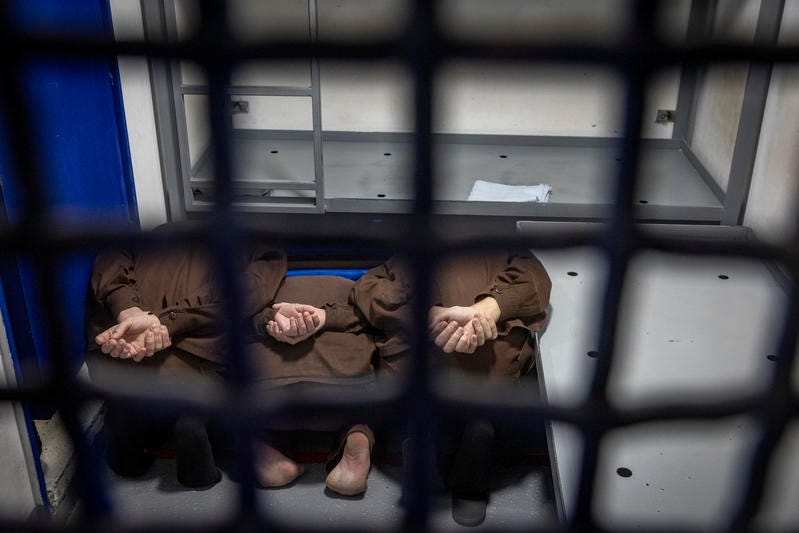
Hamas terrorists captured during the October 7 massacre are seen in a jail cell at a prison in central Israel, 2026. (Chaim Goldberg/Flash90)
It’s Friday, May 15, and George Orwell once said, “Some ideas are so stupid that only intellectuals believe them.” The New York Times’ latest blood libel, featuring fantastical tales of Israeli guards training dogs to rape Palestinian prisoners, is even worse than it appears. Beyond the specific story, Hebrew University professor Danny Orbach argues that it points to a deep rot within Western institutions of expertise and their related sources of knowledge.
Over the past week, Orbach notes, two investigations into sexual violence in the Gaza war were published. The first—the report of the Civil Commission headed by Dr. Cochav Elkayam-Levy—deals with the acts of rape and sexual abuse committed by Hamas and other Gazan factions against Israeli and international women on October 7 and thereafter. Reading the report is emotionally taxing, but it is one of the most serious studies ever produced in the field: 300 pages of cataloged eyewitness accounts, cross-referenced with geolocation, Hamas videos, documents, and forensic data, all built upon a solid theoretical foundation. It contains many shocking new headlines, the most significant being evidence that Hamas terrorists forced family members to perform sexual acts on one another—using familial bonds to satisfy sadistic impulses. Furthermore, he explains, the commission shows that not only Hamas fighters but many ordinary Gazan civilians also participated in the rape and torture.
The second investigation is a relatively short entry published by Nicholas Kristof, a veteran war correspondent for the New York Times. Due to its controversial nature, it was Kristof’s column that captured the bulk of public attention.
In the piece, published curiously as an op-ed rather than a news investigation, Kristof accuses the State of Israel, its prison system, the IDF, and the Shin Bet of systemic rape of Palestinian prisoners—primarily men, but also women. These are serious accusations, and it is certainly possible, if not inevitable, that abuse, even sexual, occurs within the prison system, as it does in almost every prison system worldwide. Whenever there is real evidence of such acts, it must be properly investigated and the guilty punished. However, for accusations to be taken seriously, they must be backed by actual evidence. In this regard, Kristof’s column is an absolute failure.
The column falls short of almost any journalistic standard, according to Orbach. He points out that the reporter relies on only 14 unverified and uncorroborated testimonies, lacking details that would allow for investigation, verification, or refutation, to claim that systemic sexual abuse is widespread throughout the Israeli prison system. For comparison, in 2020, approximately 16,000 complaints of sexual assault and harassment by guards against prisoners were recorded in the United States, with only a tiny fraction proven to be based on real incidents. Of Kristof’s witnesses, only two identify themselves by name or provide details that could help locate the case. One of them, Sami al-Sai, is presented by Kristof as a “journalist.” In reality, he is a Hamas propagandist who cheered the mass murders of October 7—hardly a reliable source. At the very least, Kristof owed his readers a disclosure regarding who this man is. Prominent journalists have already pointed out that the two identified witnesses provided Kristof with “reheated noodles”—versions that changed and became “more sophisticated” over time, adding new gruesome details every time they spoke to a different reporter.
If it ended there, one could dismiss Kristof’s article as merely a negligent op-ed, but Orbach stresses that from here, things deteriorate. He explains that a large portion of the anonymous testimonies come from Euro-Med Monitor, which Kristof presents as a “human rights monitor.” In reality, this is a Hamas front organization whose chairman, Ramy Abdu, cheered October 7 and spread debunked lies and conspiracy theories—such as massacres at Shifa Hospital, organ harvesting, or the claim that humanitarian aid contained only burial shrouds—claims not taken seriously even by most anti-Israel journalists during the war. Unsurprisingly, Kristof mentions nothing to his readers about this organization’s reputation. Furthermore, another “source” Kristof cited in a video interview as a “man in the know” is actually an Israeli Hamas supporter and delusional conspiracist who was dismissed from the university where he worked due to sexual offenses. A “man in the know,” indeed.
The interviewees, of course, were not found or selected by chance. This raises the question: who was Kristof’s “fixer”? Reporters who do not know the language almost always rely on local fixers, and Kristof claims he found the interviewees through “human rights organizations,” which Orbach suggests points to a pre-planned direction by Euro-Med or its ilk. In the Palestinian arena, there is a documented pattern of witness coaching and bias, a phenomenon rarely caught but exposed during the “Jenin Massacre” libel that never was in 2002.
Perhaps the most absurd blood libel in the column, attributed to an anonymous “Gazan journalist,” is the claim that Israeli guards trained dogs to rape prisoners. As Orbach notes, many critics pointed out to Kristof after publication—including doctors and expert dog trainers—that this is biologically impossible. In response, Kristof pointed to three scientific papers that do not actually support his claims. They do contain the only known cases of penetration by a dog, but Orbach specifies that one is unexplained, and the other two are actually cases of zoophilia involving minors. It appears that Kristof never actually read the articles in question, but found them via a superficial AI search, like a failing student with no time to write a term paper.
To grant the investigation an air of respectability, Kristof turned to none other than former Prime Minister Ehud Olmert. In the article, Olmert is quoted as confirming the allegations. One must ask why Kristof turned only to Olmert, who has not been prime minister for almost 20 years, and not, for example, to Naftali Bennett or Yair Lapid, who were prime ministers closer to the period in question. This was not just selective witness selection but a gross distortion of Olmert’s words. As the former PM clarified in a letter to the New York Times, he told Kristof he had no information regarding the allegations and did not confirm them in any way.
So, what do we have here? A “respected war correspondent,” winner of two Pulitzer Prizes, accusing a state of systematic rape based on 14 testimonies—12 of them anonymous, two public but highly problematic—with zero disclosure regarding the witnesses or the biases of the organizations providing the information. Unlike the Civil Commission’s report on October 7, Orbach emphasizes that Kristof made no real attempt to cross-reference the testimonies, used no forensic evidence, and did not attempt to interview Israelis who served in prisons or civilian doctors. The only senior Israeli he did interview, Ehud Olmert, apparently never said what was attributed to him.
This is not Kristof’s first time. In the early 2000s, Kristof championed a Cambodian anti-prostitution activist, calling her a “hero” in column after column. When it turned out she was a fraud who staged the scenes that brought her fame, Kristof admitted the mistake and the paper apologized. His current column shows that his tendency to believe anyone who seems “just” to him, without critical source analysis, remains intact. He has learned nothing, Orbach concludes.
Unfortunately, Orbach asserts, the story reflects structural problems far broader than the negligence of one journalist. He references Chen Mazig, noting that in 2017 the New York Times decided to abolish the role of the Public Editor—the official who seriously investigates public complaints and is authorized to criticize the paper’s editorial line. In its place, the paper employs spokespeople. Immediately after criticism of Kristof’s column was published, the paper rushed to release a statement from a spokesperson, one Charlie Stadtlander, who deflected the criticism with the remarkably relevant claim that Kristof has extensive experience and two Pulitzers. As Mazig clarified, and Orbach echoes, in the absence of a substantive ombudsman, “Charlie is the only one left.” The paper prefers PR and instinctive defense over independent criticism and the pursuit of truth.
This, Orbach declares, is the state of “expertise” in 2026. He believes we live in a world where rot is spreading rapidly through traditional institutions that generations of citizens trusted implicitly for decades. The New York Times, once considered one of the most serious newspapers in the world, has abandoned any pretense of journalistic standards; celebrated reporters are revealed as charlatans; UN experts whose job is to identify famine publish negligent forecasts on Gaza with fabricated data and absurd statistical methodology, refusing to admit error even when exposed. Orbach points out that leading famine experts explicitly stated in early 2025 that even if food were brought into Gaza, “we are on the verge of an exponential leap in starvation deaths”—and when this failed to materialize, they continued to insist they were right all along. Meanwhile, he continues, prosecutors and judges in international courts issue arrest warrants and verdicts based on entirely unfounded data, accepting hearsay and NGO gossip instead of forensic cross-referencing of first-hand evidence. Finally, academics and “genocide scholars” use standards that resemble astrology more than science, obscuring reality instead of clarifying it.
Is it any wonder, Orbach asks, that populists attack the entire expert class, to the horror of those within it who still maintain professional integrity? He concludes with a stark warning: Every reporter, editor, expert, and professor who sells their professional prestige on the altar of political crusades betrays the trust placed in them, gradually sawing off the branch they (and we) are sitting on. Into the vacuum will step frauds of a different kind: fringe conspiracists, anti-vaxxers, and other dark figures. “And we will all pay the price.”
Head of the ultra-Orthodox Shas party Aryeh Deri and head of the Arab Ta’al party Ahmad Tibi (Yonatan Sindel/Flash90)
There are many ways to look at this election campaign: “Only Bibi” vs. “Anyone but Bibi”; the failure of October 7 vs. the successes of the pager operation and the attack on the Iranian nuclear facility; or judicial reform vs. regime coup. Yet, there is another angle that may ultimately define the elections: Who do you want to rely on less—the Haredi or the Arab parties?
We haven’t seen polling data like this in a long time. There is an almost absolute tie regarding the preferred coalition option. However, the leading preference, at 35 percent, is the belief that it is better to head to new elections than to rely on either faction. This data reveals just how effective a Netanyahu campaign could be among opposition voters if he successfully embeds the claim that Bennett and Eisenkot cannot form a government without Arab support. If faced with that scenario, 12 percent of opposition voters—equivalent to about six mandates—would prefer a coalition with the Haredim, while 38 percent would prefer yet another round of elections. Furthermore, two-thirds of Bennett’s voters, more than half of Eisenkot’s voters, and 80 percent of Avigdor Liberman’s Yisrael Beiteinu voters are deeply opposed to a government that leans on the Arab leaders Mansour Abbas and Ahmad Tibi.
On the flip side, the job of Netanyahu’s opponents should be even easier. After all, Netanyahu has no path to a government without the Haredim—a fact that isn’t even denied. Tellingly, a third of Likud voters would prefer new elections over recreating the current coalition. “Without Goldknopf, he has no government” sounds like an effective and catchy slogan.
The fake divorce of the Haredim from the Netanyahu bloc and the fake disavowal of the opposition bloc from the Arab parties do not make much of an impression on the public. A significant portion of the electorate is repulsed by the choice between the two: between non-Zionist parties and anti-Zionist parties. Once again, in-depth data seemingly reveals an opening for a new centrist party that would disavow both extremes.
One more point to consider: against the backdrop of voter disgust with these potential partners, the importance of the polls published between now and Election Day is rising. As long as the change bloc enjoyed more than 61 mandates in the polls, it was exempt from nagging questions about sitting with or relying on the Arab parties. The more the polls show the change bloc strengthening, the more Bennett and Eisenkot will be able to ignore what is undoubtedly their weakest point. In a parallel universe, perhaps Netanyahu would have called for unity with them, and they with him, thereby neutralizing this political minefield. However, their respective voters loathe that possibility even more than they recoil from cooperating with the wings of Israeli society that do not serve in the military.
English Editor: Ari Tatarka
If you enjoy the newsletter, you can show your support by becoming a paid subscriber—it really helps keep this going. I’m also offering a special monthly briefing for a small group of premium members. I’d love to have you join us—just click below to find out more.
Thanks for reading It’s Noon in Israel! Subscribe for free to receive new posts and support my work.


Only a complete idiot would believe Kristof’s anti-Semitic ravings. Unfortunately, the world is filled with idiots who would believe anything about Jewish people. Of course, this is not new, blood libels against Jewish people have been perpetrated by hateful people for thousands of years.
My hope is that there is a time when Kristof meets his maker and has to explain his hateful ways and his anti-semitism.
As an American-Israeli centrist, center right on some issues center left on others, I find it difficult to understand why forming a government with Mahmoud Abbas is such a nonstarter. Abbas has recognized Israel as a Jewish state, and according to a recent poll the majority of Arab youth wants to serve the state. Hasn’t the time come to further integrate loyal Arab citizens into the national framework instead of treating them like a fifth column? Help me understand.