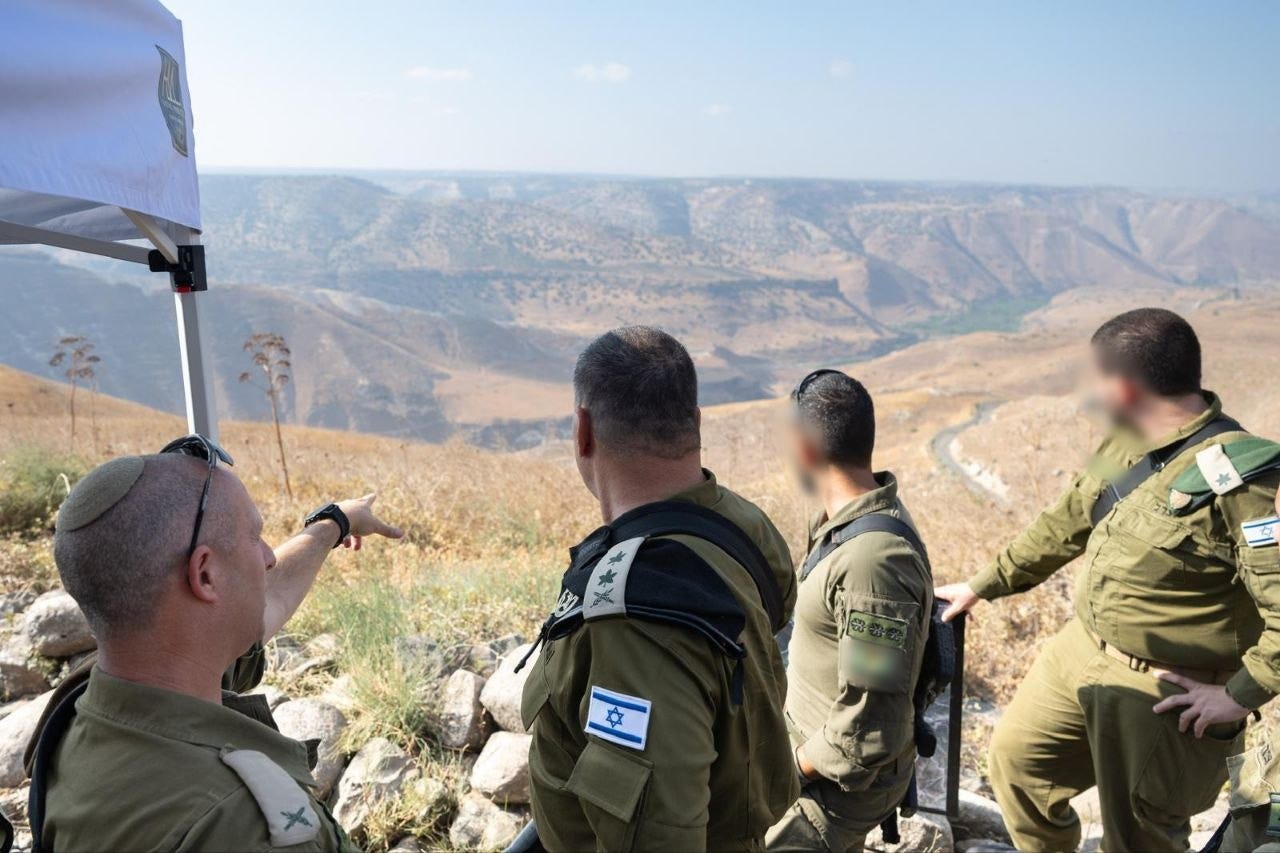
IDF Chief of Staff Eyal Zamir visiting southern Syria a day after the Israeli Air Force’s activity in the north of the country.
It’s Thursday, August 20, and 78 years ago Israel fought Lebanese forces in its own territory. Forty-four years ago it fought Syrian forces on Lebanese territory, and for the past year it has been fighting Turkish forces in Syria.
For the first time since March, Israeli jets struck deep inside Syria on Tuesday, cratering the Abu al-Duhur airbase to head off a Turkish deployment. Israel and Turkey had reached an understanding in Azerbaijan, drawing a line—physical and qualitative—past which Turkey wouldn’t move its forces. When Turkey looked set to cross it, Netanyahu says he sent Damascus a one-word message: “Don’t.” Unlike Biden, who aimed the word at Iran and watched it ignored, Israel attached consequences.
This isn’t the first time. In March and April 2025, when Turkish teams were surveying airbases as candidates for the deployment of Turkish air defense, Israel cratered the runways hours before the delegations arrived.
Both strikes hit two Islamists with one bomb. When Assad fell in December 2024, Israel was wary of the former al-Qaida member’s connections to Turkey, and of al-Qaida itself. The bombing campaign and the expansion of the security zone that followed were intended to blunt the capabilities of any future force on the northern border, Turkish or Syrian.
Neither has given much reason for confidence since. Just this week, Syrian army soldiers assembled outside the historic Damascus Citadel were filmed chanting: “I am coming for you, Jew … I will make your blood flow in rivers.” Not encouraging—and it overlapped with the first flight of Syrian fighter jets earlier this month. This is to be expected from a military built out of former terror-group members and foreign fighters, many of whom took part in the massacres of minority populations in 2025. Al-Sharaa has tried to balance his radical elements with a moderate face and integration into the international system. Whether his heart bleeds for a new, less radical Syria, or it is simply cover for the restoration of a caliphate, varies from pundit to pundit.
A similar situation holds in Turkey, whose President Recep Tayyip Erdoğan has been calling for the liberation of Jerusalem, accusing Israel of multiple genocides, and was reportedly on the verge of joining Operation Epic Fury on the side of Iran before Donald Trump talked him down. Turkey is determined to maintain a long-term presence in Syria. It is the primary engine rebuilding the Syrian army—reportedly set to supply UAVs, air defense systems and training—all the while inching closer and closer to Israeli territory.
Al-Sharaa said last month that Damascus is “actively working to reach a security agreement with Israel,” with several countries involved, and hopes it could be a gateway to comprehensive peace. Those talks are likely ongoing—but they have a silent third party: Turkey. U.S. envoy Tom Barrack has signaled he is working on a Turkey-Syria-Israel deconfliction framework, and while that is a start, a hotline to abort an unnecessary confrontation doesn’t change the facts on the ground. Israel will not allow Turkey to restrict its freedom of action; Turkey wants very much to do exactly that. There is no framework that easily squares those two.
George Bush famously said that after meeting Putin he had “looked the man in the eye. I found him very straightforward and trustworthy ... I was able to get a sense of his soul.” He was wrong, but Israel does not run a similar risk with al-Sharaa or Erdoğan. It is not interested in parsing the souls of its enemies, only in what is in their hands. So long as new and dangerous capabilities arise on the northern border, the proxy war in Syria will continue. Israel’s geography guarantees that the threats you don’t deal with abroad, you will soon be fighting at home.
U.S. naval forces in the Arabian Sea, July 2026. (CENTCOM)
Last night, the Trump administration announced a massive escalation of pressure on Iran, with the president vowing to launch “the MOST CRUSHING ECONOMIC OPERATION EVER TAKEN AGAINST ANY COUNTRY.” His tendency toward hyperbolic rhetoric has caused several problems already, but underappreciated is the naming crisis: What do you even call a policy more extreme than “Economic Fury”?
Trump may have given us a hint as to the origin of this latest escalation: “No one has given the Islamic Republic of Iran a greater opportunity to make a Deal than me,” he claimed. “TRAGICALLY, for them, they have failed to take it.” The latest deal rumored to be underway was the splitting of the waterway between Iran and Oman 50-50. Earlier this week, they had agreed on the “shipping map” that would have divided the strait. Clearly, Trump wasn’t satisfied.
From now on, according to the president, all purchases of Iranian oil or petrochemicals must stop, and any country or person buying any would be immediately subject to secondary sanctions and barred from doing business with the U.S. “in any way, shape, or form.” In practice, this means targeting the Chinese “teapot” refineries that account for about a quarter of Chinese refinery capacity and buy more than 80 percent of Iran’s shipped oil. Which, in further practice, means targeting the major Chinese banks that finance the trade—something the U.S. has so far refrained from doing.
If these new sanctions offered a risk-reward profile obviously favorable for the Trump administration, they would have been implemented already. Sanctioning Chinese banks and oil refineries means a confrontation with China and—perhaps more frightening for Trump—a spike in oil prices. A significant part of what has kept a lid on prices was China dipping into its oil reserves, and the U.S. allowing some Iranian ships slip through the blockade to those teapot refineries.
The question is whether Trump has considered the implications of what I will call “Operation Fiscal Bloodbath”—whether he is ready to bear the consequences, or will flinch when the price spikes.
Last night, freed hostage Eliya Cohen married fellow survivor Ziv Abud, his partner of a decade, in front of 1,000 guests. After 10 years together, and the 505 days he spent in Hamas captivity, they are finally together.
The two had been at the Nova festival on October 7. When the shooting began they fled to the infamous “death shelter,” where Aner Shapira heroically threw back seven grenades one after another to save those inside, before he was killed by the eighth.
Ziv, hiding under piles of bodies, survived. Eliya was taken to Gaza. Only after the kidnapping did Ziv learn he’d planned to propose: “His mother told me he’d bought a ring—and told everyone except me. He wanted to surprise me.” Eliya was eventually released during the ceasefire in February 2025.
As the couple entered, the recorded voices of two friends murdered at Nova—Amit Ben Avida, Ziv’s nephew, and Yonatan Chai Azoulai—accompanied them. Amit began by naming his own absence: “If you’re hearing this voice now, then I’m probably not standing beside you the way we imagined.” Then: “I wish you routine. Yes, routine. Ordinary days, without drama ... Even after everything you went through, don’t stop believing you deserve good.” He closed: “That you’ll build a life without apologizing. And don’t be afraid of joy. Love you, Amit.”
Then Yonatan: “Life isn’t measured by what you achieved, but by who stays when it’s hard and you have nothing left.” To Eliya directly: “Look after Ziv, and look after yourself too. You’re allowed to be happy, to build a future, even when we’re not part of it.”
The couple asked Aner Shapira’s father, Moshe, to write their ketubah, the Jewish marriage contract. “Aner was part of the moment that changed our lives, and today his father will write our ketubah and take part in the moment we choose life and love,” they said. “The wedding that’s arriving now feels like a small victory of life.”
Eliya had vowed there would be no wedding until every living hostage was home. Last night, the promise was kept.
English Editor: Ari Tatarka
If you enjoy the newsletter, you can show your support by becoming a paid subscriber—it really helps keep this going. I’m also offering a special monthly briefing for a small group of premium members. I’d love to have you join us—just click below to find out more.
Thanks for reading It’s Noon in Israel! Subscribe for free to receive new posts and support my work.


