Ben Gvir Faces Dismissal
Also, negotiations with Lebanon successful and an argument for victory.
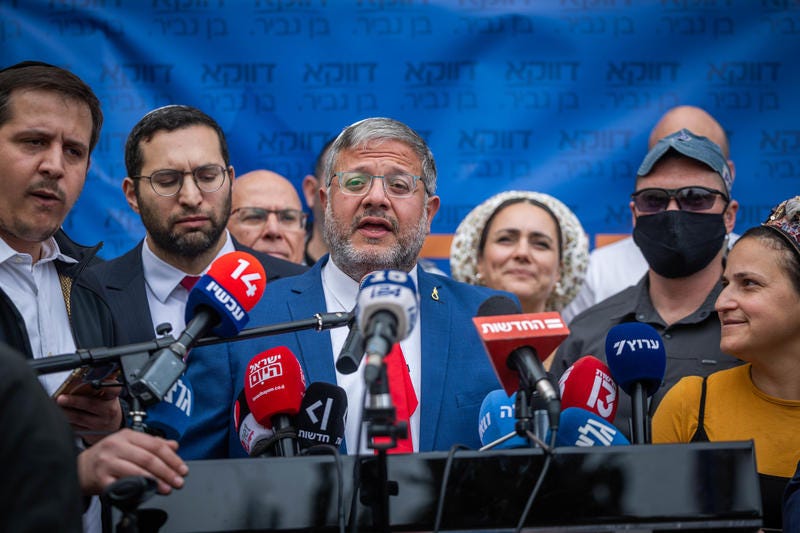
National Security Minister Itamar Ben-Gvir speaks to the media outside the Supreme Court in Jerusalem this morning. (Yonatan Sindel/Flash90)
It’s Wednesday, April 15, and Internal Security Minister Itamar Ben Gvir faces the High Court today, with his political survival on the line. But should Attorney General Gali Baharav-Miara succeed in ousting him, she may find it a pyrrhic victory
But first, some context.
Israel’s attorney general is seeking the national security minister’s removal by invoking the “Deri Doctrine.” Established in the 1990s, this precedent arose when the High Court compelled Prime Minister Yitzhak Rabin to dismiss Shas leader Aryeh Deri from his cabinet following a criminal indictment. The doctrine mandates that a prime minister is legally obligated to fire a minister if they are charged with offenses involving “moral turpitude.” The underlying rationale is that the public’s confidence in the government’s integrity is so foundational to democracy that it must override a prime minister’s executive discretion to maintain his cabinet.
So, has Ben Gvir been indicted? Not exactly.
Attorney General Gali Baharav-Miara is attempting to stretch this judicial doctrine into uncharted territory. She is advancing a “cumulative conduct” theory, arguing that while no single act of Ben Gvir’s may have warranted an indictment, the aggregate weight of the minister’s interventions—in police promotions, investigative priorities and protest policing—has caused irreparable harm to the rule of law, the apolitical character of the police and the fundamental principle of equality in enforcement.
The court faces a dilemma, not just of legal principle but also of “political” pragmatism. The question of dismissing Ben Gvir expands far beyond the validity of “cumulative conduct” as a legal doctrine; it encompasses the risk of antagonizing the coalition and its base without any guarantee that Ben Gvir would actually retreat from public life.
For evidence that judicial dismissal is rarely the end of a political road, one need only look to the namesake of the precedent itself: Aryeh Deri. Despite indictment, imprisonment and 30 years, he remains one of the most powerful figures in the country.
There is an additional cautionary lesson in Deri’s “downfall.” In the 1999 elections—held as Deri faced the looming reality of prison—Shas surged from 10 to 17 seats. This record-breaking performance was fueled by a “persecution campaign” that framed Deri as the victim of the country’s traditional elite. If Ben Gvir is dismissed, the chances the “persecuted victim” narrative becomes his central election message are slightly above 100 percent.
A stronger Ben Gvir is what keeps Baharav-Miara up at night; I can’t imagine how she’ll sleep when her reviled minister of national security eventually returns as the minister of defense.
The trilateral meeting held between U.S., Israeli, and Lebanese officials at the State Department yesterday. (@yechielleiter/X)
The highest-level direct talks between Israel and Lebanon in history have concluded with neither side getting what they wanted. Regardless, the summit was a resounding success.
Lebanon entered the negotiations hoping to achieve an immediate ceasefire, reportedly threatening to walk away from future talks unless this condition was met. Israel, meanwhile, came to the table demanding a concrete commitment and a clear timeline for the disarmament of Hezbollah north of the Litani River. While neither delegation walked away with their demands fulfilled, further talks are already confirmed. As U.S. Secretary of State Marco Rubio noted after the meetings, this will take time; the talks “are a process, not an event.”
In statecraft, as in life, you cannot expect others to treat you with respect if you do not first respect yourself. For the first time in decades, Lebanon’s government is asserting itself as a sovereign entity, and for the first time in decades, Washington is officially recognizing it as such. Prior to yesterday, whenever Washington needed something done in Beirut, it dialed Damascus, Tehran, Doha or Riyadh.
The question is whether the government is actually in charge.
The mere fact that the Lebanese government chose to engage in the negotiations is a good sign. Hezbollah Secretary-General Naim Qassem explicitly warned against the summit, labeling it “futile” and declaring it a “stab in the back to the resistance.” Had Hassan Nasrallah issued a similar warning in 2021, his word would have been an insurmountable veto. But two years of relentless Israeli military pressure, coupled with the succession of the significantly less imposing Qassem, has considerably defanged the organization.
Still, breaking the psychological hold Hezbollah maintains over the country requires the Lebanese government to treat it like the paper tiger it has become, rather than the actual tiger it once was.
Israeli Ambassador to the United States Yechiel Leiter addressed the media following the meeting, claiming that the officials on both sides discovered they are actually on the “same side of the equation” and are “united in liberating Lebanon.” Most intriguingly, Leiter suggested that once the security situation is resolved, the two nations “can embark on a harmonious relationship” akin to the Abraham Accords countries.
For the past 78 years, the only visits Israelis have made to their northern neighbor have been conducted in helmets and combat gear. While there has been no shortage of such excursions, I share the ambassador’s hope that the only suits Israelis will wear there in the future will be of the business or bathing variety.
Large billboards near Ayalon highway in Tel Aviv, showing support for Israeli PM Benjamin Netanyahu and US President Trump. (Miriam Alster/FLASH90)
Even before it became clear whether the ceasefire in Iran had survived, the American and Israeli media were already filled with commentaries suggesting that the Ayatollah regime had won the war. The reason: it managed to survive an attack by the strongest superpower in the world and the strongest air force in the region.
Here is a different interpretation: this war is a victory because the regimes in the United States and Israel survived. It sounds strange, but it is the truth.
The overarching goal of the Ayatollah regime was to eliminate the West. First, its frontline outpost, Israel, and then the entire West. This is the fundamental difference between other dark states and Iran: North Korea, a dark nuclear dictatorship, is indeed an enemy of the United States, but it has no goal of turning America communist or crowning Kim Jong Un as the ruler of the United States. Iran, on the other hand, is interested in turning the entire world into a Shia Muslim kingdom. This is the difference between a “mere” dictator and a fundamentalist theocracy.
For almost 50 years, the regime has been chanting “Death to America, Death to Israel.” Contrary to claims, these are not empty chants or radicalization for electoral purposes. This is the Iranian plan for the 21st century. The pilot was Israel and the attempt to destroy it, known as the 2040 plan, which was later moved up to 2030: suffocating the Jewish state using missiles and the invasion of motorized light forces.
Those in the U.S. who believe there is a difference between what the Iranians say and what they do are invited to call their friends in Middle Eastern countries. The Qataris invested years trying to bribe the Iranians, the Omanis mediated between them and the U.S. until the moment before the war, the Emiratis maintained a suspicious friendship with them, the Saudis trembled in fear of them, and the Turks bought energy from them. It didn’t help any of them: all these countries, and seven others, were violently attacked. What makes anyone think an atomic bomb wouldn’t have threatened London, Paris and Washington as well? We have already learned in recent years that when it comes to Islamic fundamentalists, there is no point dwelling on assessing intentions, only capabilities.
Opponents of the war also argue that it is very difficult to win an asymmetrical war. Here is the news for those who have just joined: this war was not meant to be asymmetrical. Iran is 10 times larger than Israel, with four proxy armies in the region comprising hundreds of thousands of fighters, hundreds of thousands of rockets, and a comprehensive threat to the Middle East. This was meant to be a war in which the advantage would actually belong to Iran. It is not for nothing that American presidents and Israeli prime ministers hesitated for years to enter the campaign. They understood Iran’s power very well. For years, Iran had a shared border with Israel through Hamas, Hezbollah, the Houthis and the militias in Syria, but Israel had no border with Iran, which is farther away than the range of most of its fighter jets. Only two years of war to eliminate the proxies, along with two more surprise attacks that decapitated the Iranian leadership and paralyzed its power, made this war unequal.
Is the regime’s survival a victory for Iran? The Middle East is full of sick Muslim dictatorships that have never interested the United States, and rightfully so. America might be the world’s policeman, not its educator. If someone is interested in destroying the lives of their citizens, the U.S. military will not be sent to protect them. President Trump’s interest in Iran was piqued, as far back as 1987, when it became clear that its action plans included destabilizing the Middle East and later the entire world. Two years ago, still during President Biden’s term, historian Walter Russell Mead argued that if the United States wanted to project power against the axis of Russia, China and North Korea, it must attack Iran. It is the junior and poorest member of the axis, and the only one that does not yet possess nuclear weapons. In this way, it would be made clear to the dark side of the world that the United States will not stand idly by and will not hesitate to use force. Biden did not listen; Trump did.
Most importantly, it is too early to draw conclusions. The Iranian regime has already split under the pressure into two competing groups. On one hand, the extremist Revolutionary Guards, for whom power and violence are the answer to every question. On the other hand, the political echelon of President Pezeshkian and Foreign Minister Araghchi, who sought to appease the Gulf states and expressed a certain willingness to discuss the nuclear issue with the United States—in violation of instructions from Tehran. Six months after Rising Lion, the masses took to the streets and almost brought down the regime. The United States’ pressure on Iran has not failed; it will be measured in the coming months, both on the streets of Tehran and in the smoke-filled rooms of the regime’s upper echelon.
English Editor: Ari Tatarka
If you enjoy the newsletter, you can show your support by becoming a paid subscriber—it really helps keep this going. I’m also offering a special monthly briefing for a small group of premium members. I’d love to have you join us—just click below to find out more.
Thanks for reading It’s Noon in Israel! Subscribe for free to receive new posts and support my work.


