It’s Noon in Israel: Bibi Ambushed with a Likud Revolt
Also, Israel is still searching for bodies in Gaza, and drama in the Knesset as the Indian prime minister plans his address.
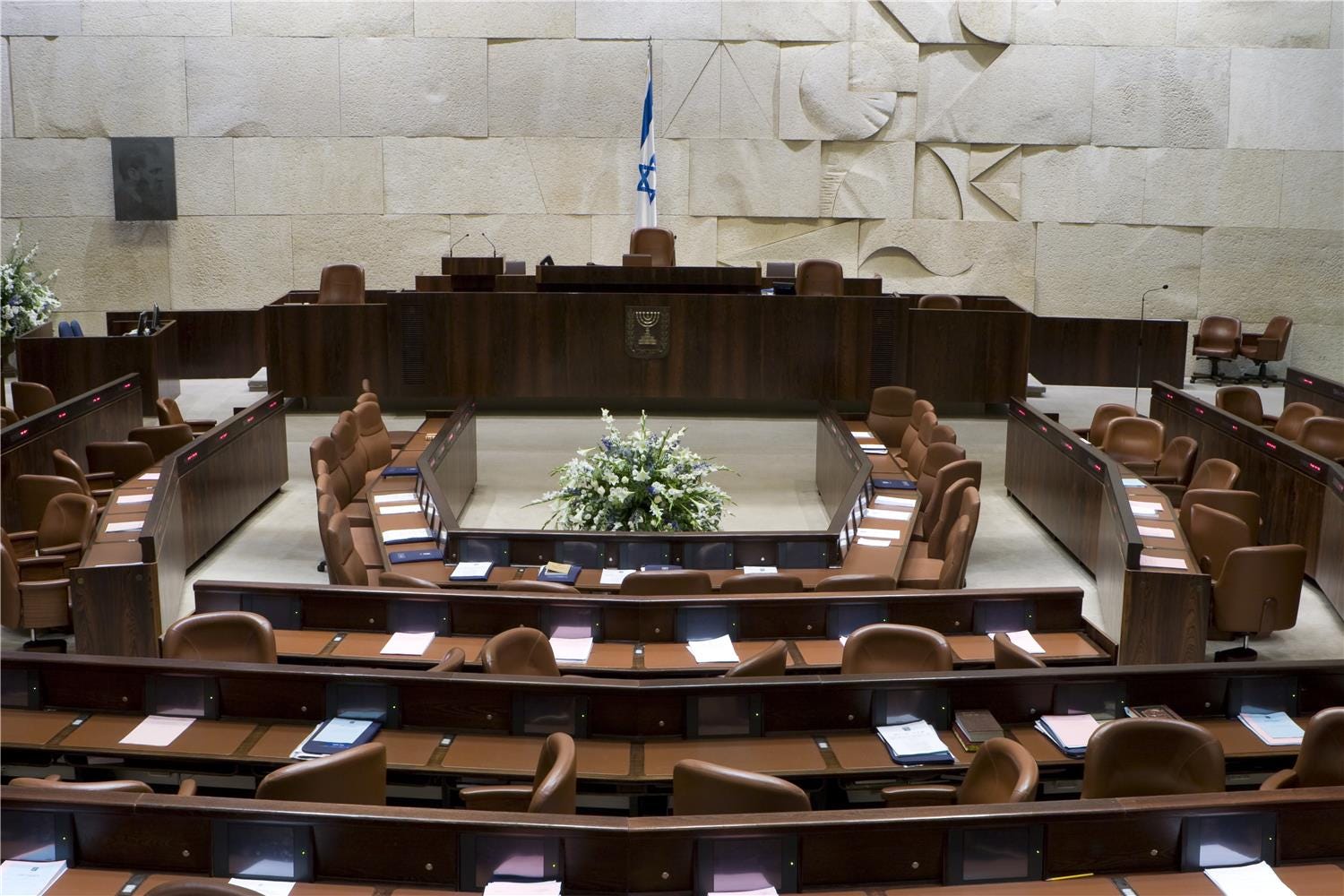
Knesset Chamber (Knesset.gov)
It’s Tuesday, February 24, and Benjamin Netanyahu lost control of the coalition. Last night, Finance Minister Bezalel Smotrich’s proposal to increase the VAT exemption on imported goods from $75 to $150 was struck down 25-59 as part of a Likud rebellion.
Why is this so significant?
It isn’t just that Israelis about to click “buy now” on that new $149 Amazon appliance were disappointed. Bibi, on the verge of what may be one of Israel’s most consequential moments, took his eye off his own party.
Don’t tell Tucker Carlson, but it’s an open secret that when Bibi calls the most powerful man in the world, Donald Trump, he picks up. But when he tried calling virtually anonymous Likud lawmakers last night, they let it ring.
Why did Likud revolt over VAT?
Unfortunately, not out of any deep commitment to free-market economics.
Likud primaries are approaching, and unlike national elections, the reputations of candidates ranked 2-32 on the list actually matter. Individual candidates competing for spots have to distinguish themselves and build support if they want to secure a realistic placement for the next election.
Likud MK Eli Dallal posted this picture on Friday with the caption “Smotrich’s order is already on the fire —On Monday they’re canceling it in the Knesset!” (EliDallal/Facebook)
Standing up for Likud’s ideological principles is one method. But a more effective strategy is cultivating the backing of organized interests—domestic businesses that would be hurt by cheaper imports, for example.
A unique eccentricity of Likud’s new populist economics is that in many cases it’s more corporatist than populist. Several million Israelis buy things overseas; far fewer sell things domestically. The difference when it comes to internal elections: Lawmakers don’t face the people, just the party.
But back to the matter at hand.
Unless you’re one of the five or so friends Netanyahu personally places on the list, angering him matters less than securing a seat.
That doesn’t mean we’ll see an eruption of one-man filibusters against Bibi erupting from within Likud—anyone who pokes his head up alone will quickly find it chopped off. But when there’s sufficient shared interest, fear of the chairman won’t be enough to keep them in line.
The problem is bigger than VAT. If Netanyahu can’t organize his party behind him, larger issues like the Haredi draft law and the budget may face a steeper uphill climb. Without that legislation, Likud might find itself facing national elections sooner than it had planned.
The Garden of the Missing in Israel’s national cemetery Har Herzl.
The IDF is still searching for the bodies of four soldiers in Gaza: Shmuel Arava, Shmuel Gabrielides, Meir Mizrahi and Yosef Penso. Those names may not sound familiar. After all, they went missing long before October 7—75 years, to be precise.
Today is one of Israel’s lesser-known national days: the Memorial Day for soldiers whose burial place is unknown. After years of discussion about the long quest to bring home the hostages, it’s time to give attention to the painstaking work to recover those soldiers who are lost but not held.
In the early 1990s, the IDF established the Eitan Unit, a branch dedicated to searching for all of Israel’s missing soldiers, from 1948 until today. During Operation Braveheart—the recent mission that recovered the final hostage, Ran Gvili—hundreds of bodies were checked in a Gazan cemetery for a DNA match to the fallen hero. But Ran was not the only person for whom they were testing.
It doesn’t stop at DNA. Amid the chaos and displacement of the war, the unit has been searching for and interviewing Gazans who may know something about Israel’s War of Independence soldiers. You can do the math: Eitan has been tracking Gazans aged 90 and above for testimony and details.
Their efforts have borne fruit across the country. They located two of Israel’s fallen in Kibbutz Nitzanim in the south; one in the central city of Petah Tikva; one near the archaeological site of Gezer; and another in the town of Rehovot.
Still, many are believed to remain in Gaza: David Mizrahi, Ezra Afgin and Yaakov Bracha from Israel’s first intelligence unit, the mista’arvim (“those who live among the Arabs”); two fortification workers believed to have been abducted from nearby settlements, Yosef Hubshi and Zecharia Yahya; and the American volunteer pilot Robert Lester Wickman, who flew south to halt the Egyptians and never returned. Others whose location is less certain include Moshe Hoffman, Avraham Zimmerman, Shlomo Schweitzer, Yaakov Shapir and Shmuel Arava.
From left to right: Shlomo Schweitzer, Robert Lester Wickman and Shmuel Arava. (Izkor)
You may think it pointless to recite the names of people long forgotten. But in Israel, they are remembered. Israel does not have a Tomb of the Unknown Soldier because every possible effort is made to redeem each fallen soldier from anonymity and to bring everyone home for burial.
The juxtaposition of Israel’s Memorial Day and Independence Day is well known: One precedes the other because without the first, the second could not exist. The Memorial Day for the missing falls on the 7th of the Jewish month of Adar—the day of Moses’ death, as recorded in the Bible. The parallel is intentional. We know the contributions of both to the Jewish people are incalculable. But we don’t know were either are buried.
Benjamin Netanyahu and Indian Prime Minister Narendra Modi during the India-Israel Business Summit in 2018. (Avi Ohayon/GPO)
Indian Prime Minister Narendra Modi is visiting Israel tomorrow. In a rare move for a foreign head of state, Modi will address the Knesset—well, half of it.
According to Israel’s ambassador to India, Reuven Ezer, the most significant part of the trip will be signing an “update of the security agreement,” aimed at enabling deeper defense cooperation between the two countries. According to Ezer, “There is a great acceleration in the relationship.” India has become Israel’s largest defense customer, accounting for 34 percent of all exports between 2020 and 2024.
Since the war, Israel has been looking to cement itself as a key node in the global defense supply chain, ensuring both military independence and its strategic indispensability to other countries. Expecting that the honeymoon period with the U.S. may be drawing to a close, the Ministry of Defense is preparing for a post-Trump defense future. That future is looking increasingly Indian.
The growing importance of this relationship may explain why Modi is addressing the Knesset—a rare move for a foreign head of state, especially in the wake of the war.
But there is, of course, drama. The opposition is boycotting the speech, demanding the presence of Israeli Supreme Court President Yitzhak Amit, who was not invited. The coalition is still rejecting his presidency of the court and decided to replicate the guest list from Trump’s October speech—namely, without Amit. The difference is that the opposition feels comfortable making a statement with Modi, less so with Trump.
The Prime Minister will not be addressing an empty chamber; the coalition has reportedly arranged for former Knesset members to sit in the opposition’s seats during his address.
Still, if India is truly a major part of Israel’s future, a boycott may not be the best way to inaugurate the new relationship.
If you enjoy the newsletter, you can show your support by becoming a paid subscriber—it really helps keep this going. I’m also offering a special monthly briefing for a small group of premium members. I’d love to have you join us—just click below to find out more.


Do you think it’s acceptable for the coalition to show disrespect for the President of the Supreme Court by repeatedly refusing to invite him to these major Knesset events? He assumed this role pursuant to longstanding rules. The Justice Minister wants to change that rule but it’s not up to him. Why do you put the onus on the opposition for its response to the triggering event? Staying away in protest is their only way to signify their refusal to go along with the decision to exclude the President of the Court.