Bibi at 30
Who is the man that has defined modern Israel?
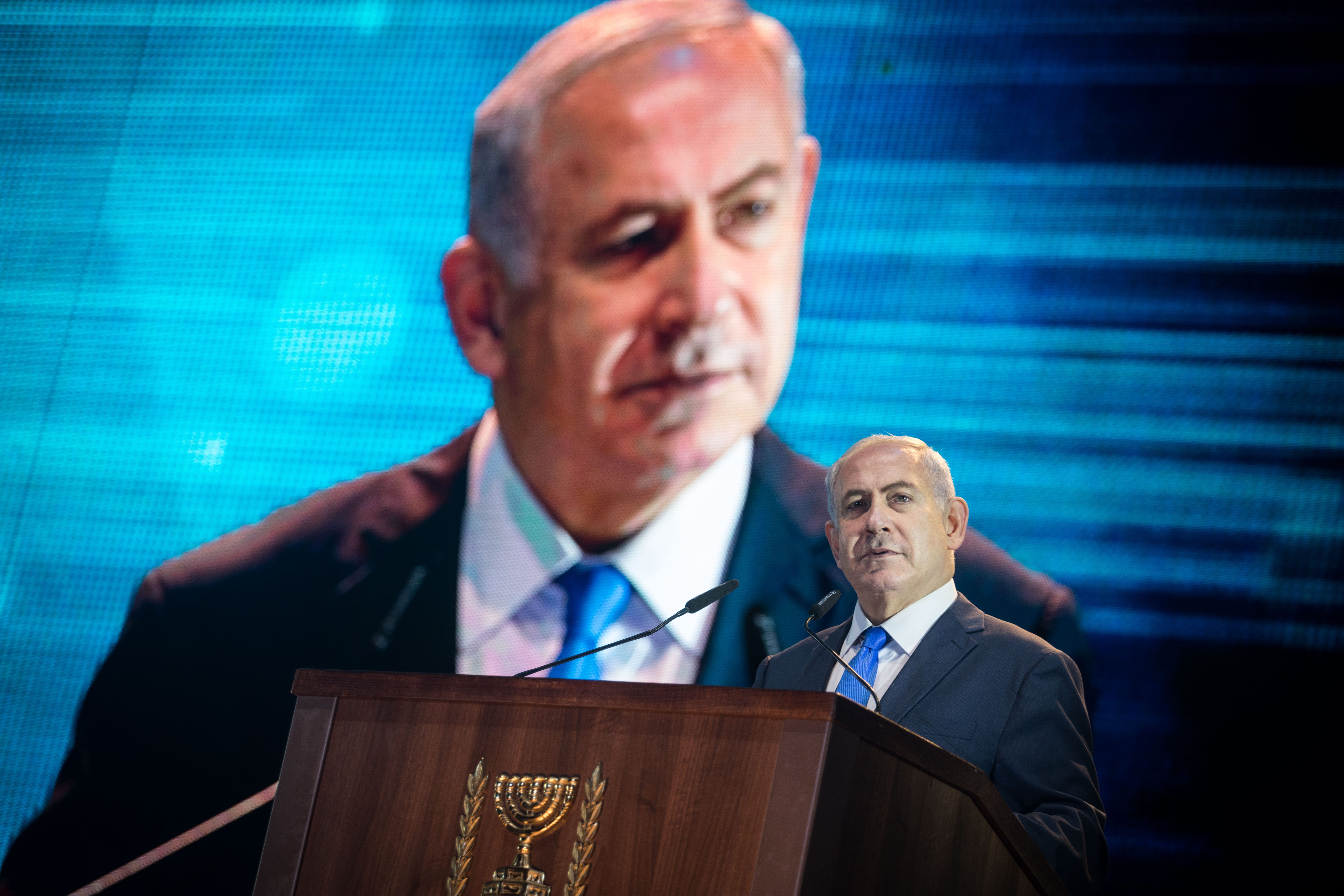
Israeli prime minister Benjamin Netanyahu at an event celebrating 120 years of Zionism, at Mt Herzl, on September 27, 2017. (Hadas Parush/FLASH90)
It’s Friday, May 29, and 30 years ago today, following one of the most fiercely contested elections in Israel’s history, a man walks into the Prime Minister’s Office. He is the first premier to do so with young children. Should he win the next election, he will be the first to leave with great-grandchildren. That man is Prime Minister Benjamin Netanyahu.
Who is this man who has shaped Israel more than anyone since the founding generation? Is he a populist, a staunch conservative ideologue, or perhaps something in between? What lies in store for Israel’s longest-serving prime minister, and what will the country become when he is finally gone?
Let’s start at the beginning—or at least, the beginning of his rise. It is 1995. Prime Minister Yitzhak Rabin shakes Palestinian Liberation Organization Chairman Yasser Arafat’s hand for the second time. Peace was on the agenda, and withdrawals from Palestinian cities in Judea and Samaria are imminent. The country is violently split: half rallied for peace, while the other half warned of a war of terror. Drowned out only by the constant plays of singer Miri Aloni’s “Shir LaShalom” and the earsplitting explosions of suicide bombers, the political debate descended into a cacophony.
Leading a fervent opposition to the Oslo Accords was a man with American suits, American manners, and the English to match. The young Netanyahu was a paradoxical leader for Israel’s right wing—the exact opposite of his base. The son of a Hebrew University professor and a MIT graduate himself, he was elite where they were working-class; of European origin where most were from the Middle East. While his voters lit Shabbat candles on Friday night, Netanyahu’s synagogue visits were somewhere between infrequent and never. Yet none of that mattered. He said the right things, and he said them exceptionally well. He was tough on terror, hawkish internationally, and pro-free-market in his economics. He was Israel’s Ronald Reagan. But he wouldn’t stay that way.
A campaign poster from the 1996 election that reads “Netanyahu – Making a Secure Peace.”
Three shots rang out. Rabin was assassinated by right-wing extremist Yigal Amir. The mood of the country shifted instantly; Rabin’s martyrdom made bellicose cries of “resistance” and “traitor” strictly taboo.
Suddenly, the ideologue Netanyahu had to pivot. His slogan condemning the “surrender to terror” was replaced by a catchy election jingle: “Netanyahu – Making a Secure Peace.” Across the aisle stood Rabin’s former deputy, Israeli Statesman Shimon Peres, promising to finish what his predecessor had started. Heading into the 1996 election, Peres seemed unstoppable: he had Rabin’s hand on his right shoulder, U.S. President Bill Clinton’s on his left, and a uniformly left-wing media aggressively pushing the peace.
But the young Netanyahu adapted, taking every interview to speak directly to the people through the new medium of commercial TV, hammering home a singular, terrifying question for voters: “Who is going to split Jerusalem?” Still, at midnight 30 years ago, Peres was leading, but by morning Netanyahu was declared the winner. It remains the legendary day Israelis “went to sleep with Peres, and woke up with Netanyahu.”
So the right-winger had won. But was the peace process doomed under Netanyahu’s leadership? That depends on who you ask. This is where the paths of Netanyahu the ideologue and Netanyahu the opportunist diverge. Both paths pass through the same historical milestones: withdrawal from Hebron that legitimized the Accords he had relentlessly attacked, a forbidden handshake with Arafat, and the release of prisoners with blood on their hands—shattering yet another explicit promise to his base. The difference is purely a matter of internal motivation. Following the election, Clinton reassured the international community that Netanyahu was not a hardline right-winger, but rather a moderate who would ultimately finish the peace process. Was he right? Was Netanyahu fighting a losing battle against the Accords with the intention of pulling the plug at the absolute last second, or had he happily hopped aboard the peace train?
We might have easily verified his true intentions at the ultimate talks in Camp David, but Netanyahu wouldn’t make it that far. He had moved to the center, but he couldn’t bring his political camp with him. By 1999, his coalition collapsed, and the peace—secure or otherwise—was out of his hands.
Prime Minister Benjamin Netanyahu meets with U.S. President Barack Obama at the White House, May 18, 2009.
But as we all know, the Netanyahu saga didn’t end there. Ten years later, he was back—and so was the peace process. This time, a different Democrat was in the White House. Netanyahu and Clinton had their battles, but next to Obama, the 42nd president felt like a lifelong friend. Over the next few years, Netanyahu’s electorate experienced intense déjà vu as Obama pushed for peace: settlements were frozen and prisoners were released. Yet, when it came down to a definitive proof of Netanyahu’s willingness to sign a final deal, the decision was taken out of his hands once again. Palestinian Authority President Mahmoud Abbas walked away from the table, driving the peace train off a cliff.
Yet, for all his back-and-forth on the Palestinian issue, there was one country on which he never deviated: Iran. Who could forget Netanyahu standing at the podium of the United Nations, a cartoon depiction of a bomb in one hand, a red marker in the other, drawing a literal line in the sand? It was an image that encapsulated a lifelong obsession. He had been sounding the alarm on Iran since his first Knesset term in 1992, and had testified before Congress on multiple occasions long before that infamous 2015 visit to attack the nuclear deal drove the Obama administration into fits of “Bibi Derangement Syndrome.”
Benjamin Netanyahu and then Republican presidential candidate Donald Trump meeting at the Trump Tower in New York, September 25, 2016. (Kobi Gideon/GPO)
By 2016, Prime Minister Benjamin Netanyahu had settled into a comfortable pattern: avoid U.S. President Barack Obama, manage the status quo, and form stable, center-right coalitions. Then, the future descended down a golden escalator. U.S. President Donald Trump shattered the Republican establishment and rewrote the global playbook on electioneering. He walked onto the stage with a raw, populist script, and Netanyahu began taking notes.
Raging against the establishment was nothing new for Israel’s right. For decades, the movement had been powered by an alliance of traditional, historically marginalized Mizrahi voters and an older right still carrying the scars of 29 years of uninterrupted hegemony by the left-wing founding elite. These voters didn’t need to be taught how to resent a privileged establishment or distrust a hostile press. Netanyahu—harboring his own deep suspicions of Israel’s “deep state"—was perfectly positioned to harness that raw, pre-existing resentment.
While he had always possessed a knack for speaking directly to the public, he now bypassed the traditional media almost entirely, opting instead to communicate via social and alternative media. Further mirroring Trump, he assembled an entourage defined less by ideological loyalty to the party than by personal loyalty to himself. This was the moment Netanyahu traded the Reagan playbook for the Trump model.
What is truly unique about Netanyahu brand populism is how seamlessly it encompasses both the more bourgeois, professional right and the working-class base. Trump built a similar alliance, but he had the structural advantage of a two-party system. In Israel, where voters have their pick of niche parties, Netanyahu’s personal charisma has prevented his base from abandoning him for more extreme populist or technocratic alternatives.
Israeli prime minister Benjamin Netanyahu speaks during a press conference about the coronavirus COVID-19, at the Prime Ministers office in Jerusalem on March 25, 2020. (Olivier Fitoussi/Flash90)
What does the future hold for this Israeli political giant? Despite predictions that his coffin would be carried onto the campaign trail well into the 2040s, he appears to be rallying for a final election, seeking one last opportunity to crystallize his legacy. Prime Minister Benjamin Netanyahu has always been a man of contradictions—moving from opposing peace to championing it, and from a champion of peace to what he is now: the first leader to expand Israeli territory since 1967. Through it all, however, he remained the “Iran guy.” At his 20- and 25-year milestones, the ultimate fate of the Iranian threat was still open to ambiguity. Today, at 30, it is undeniable that this issue will not only define his legacy, but determine his electoral prospects this September.
Even if he emerges victorious, and even if he may struggle to visualize it, there will be a post-Netanyahu Israel. Partially by Netanyahu’s own design, and partially because providence has simply not granted anyone else the sufficient talent, there is no direct successor waiting in the wings. When he finally departs, the populist elements of Likud and factions like Itamar Ben Gvir’s are poised to grow, while Likud’s more ideological members defect to the center. As is the case with all titanic politicians, successors will try to reunify his fractured constituency, though likely with little success.
This only scratches the surface of Netanyahu. As a political communicator, Netanyahu became a master of all generations, shifting seamlessly from the television studios of 1996 to the early internet, and finally to social media. His structural endurance remains an absolute anomaly in the volatile arena of Israeli politics: 19 years in power, six coalitions—an unmatched span of survival executed entirely from the helm of a single party.
Equally hated, revered, and begrudgingly respected, Netanyahu leaves no one neutral. Was he a populist or an ideologue? A pragmatist or an extremist? Ultimately, the labels fade before the reality of his political longevity. Despite 17 highly volatile years at the top, his electorate has proven they care far less about the ideological preamble than the concrete results. For his voters, the bottom line speaks for itself: no Palestinian state exists on his watch, even if the Iranian regime still does. Whether it will remain so will ultimately determine the legacy of modern Israel’s most iconic figure.
English Editor: Ari Tatarka
If you enjoy the newsletter, you can show your support by becoming a paid subscriber—it really helps keep this going. I’m also offering a special monthly briefing for a small group of premium members. I’d love to have you join us—just click below to find out more.
Thanks for reading It’s Noon in Israel! Subscribe for free to receive new posts and support my work.


Netanyahu's lasting legacy may well be his transformation of Israel's economy into the high-tech entrepreneurial powerhouse it is today.
Many factors contributed but Netanyahu's free market reforms 25 years ago were essential. This transformed the Middle East by making Israel an economic and technological power as well as a military one.
He is just a terrorist!