
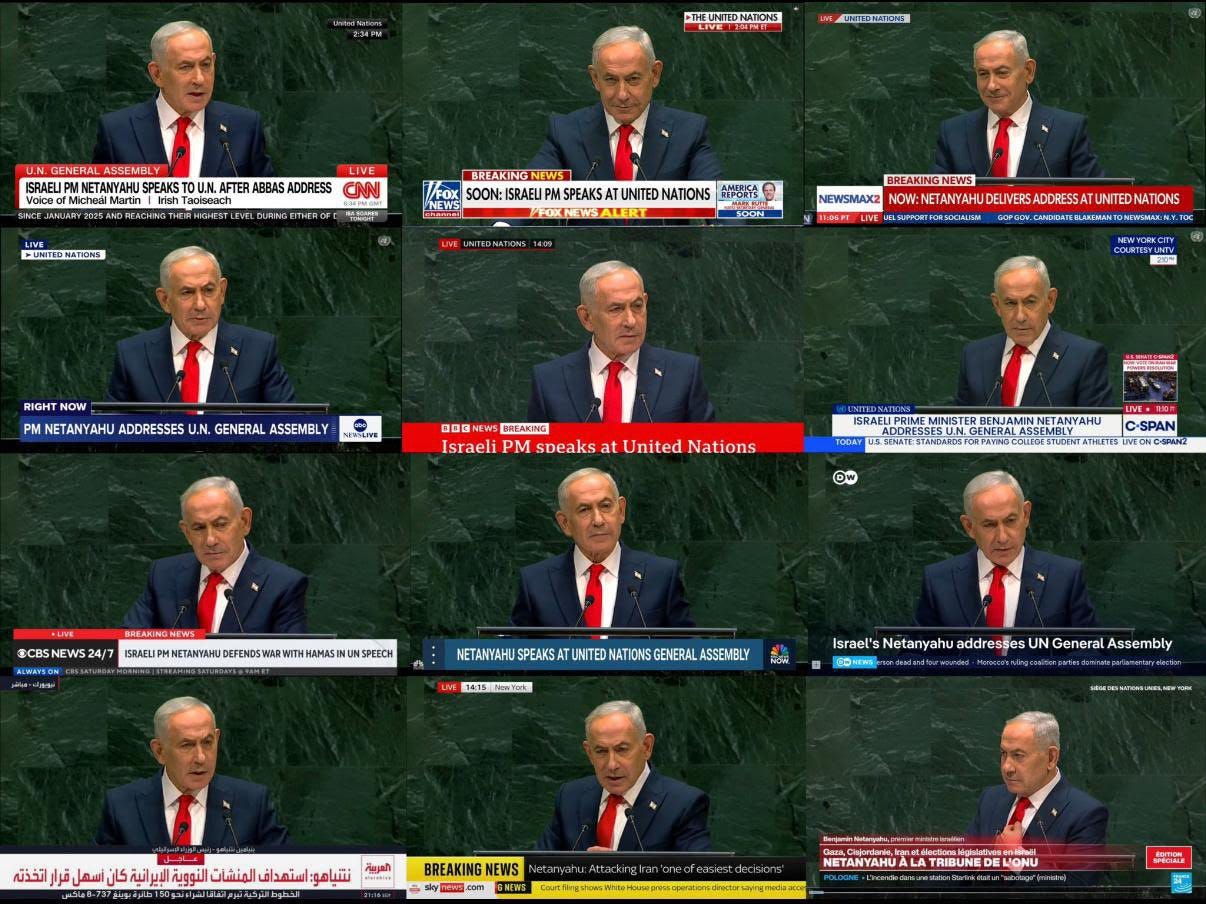
Benjamin Netanyahu delivering an address to the United Nations General Assembly last night.
It’s Friday, September 25, and something set Israeli Prime Minister Benjamin Netanyahu’s performance at the United Nations General Assembly last night apart from every other one of his annual productions. On the surface, all the recognizable elements were there: props, plenty of pauses for applause, and a generous number of quotable lines. The difference was the audience.
Even though he was ostensibly addressing the international community, Bibi has always had one eye locked on his domestic audience. Only this year, he was staring directly at them.
Bibi has never agreed with Israel’s founder, David Ben-Gurion’s derisive dismissal of what the latter called “Um-Shmum.” After all, it was in this highly broadcast arena that the young Netanyahu, as Israel’s ambassador to the organization, built his reputation by eloquently sparring with Israel’s enemies.
Yesterday, in one of his broadest-spanning speeches, the prime minister addressed Gaza, Iran, the West Bank, international isolation, Emmanuel Macron, and Zohran Mamdani, careful to provide as many viral clips as possible for Likud’s next month of campaigning. The primary question is: did it work?
Probably not. No matter how flashy his performance, his words were not sufficient, nor intended to beckon opposition voters into the coalition fold. This was Bibi trying to show what Bibi does best: defending Israel, attacking enemies, and bragging about his achievements, all in perfect English, a capability Gadi Eisenkot, notably lacks. He is hoping that showing himself in top form will instill just that extra ounce of energy necessary for demoralized Likud voters to turn out to the polls and give him that vital extra inch.
The biggest problem with that plan is timing. Besides UNGA taking place while voters are busy preparing for the holiday of Sukkot, the circumstances surrounding the speech do not easily build to a grand oration. Last year’s speech was delivered while hostages were still in Gaza; the year before, as Israel prepared for an advance in Lebanon and was still in the aftermath of a direct exchange of fire with Iran. Had he delivered this same speech in March during the war, the brief MoU stage, or the active exchange of fire, he likely would have had a larger impact. Instead, he attempted to heat up some fronts that have been frozen for months, and, judging by Donald Trump’s statements, are unlikely to defrost until after the elections, both Israeli and American.
Nor was the speech of such enthralling quality that it could obscure the successive parade of anti-Israel diatribes that marched in lockstep from the heart of Europe to Pakistan. To no one’s surprise, even UN Secretary-General António Guterres took time on the opening day to put it at the center of the conference. Donald Trump’s solidarity and the shockingly direct, and always welcome, statements from Argentine President Javier Milei could hardly be heard over the din of accusations.
Given Israel’s size and exposure in a hostile region, international relations have always been a key part of security, and security is voters’ highest priority. Bibi would like to flex his vast experience in the field, while omitting recent circumstances in the international arena. Fortunately and unfortunately for the prime minister, UNGA will likely be forgotten by election time. His latest U.N. performance can comfortably be filed along with most of the organization’s speeches, in the drawer labeled pointless.
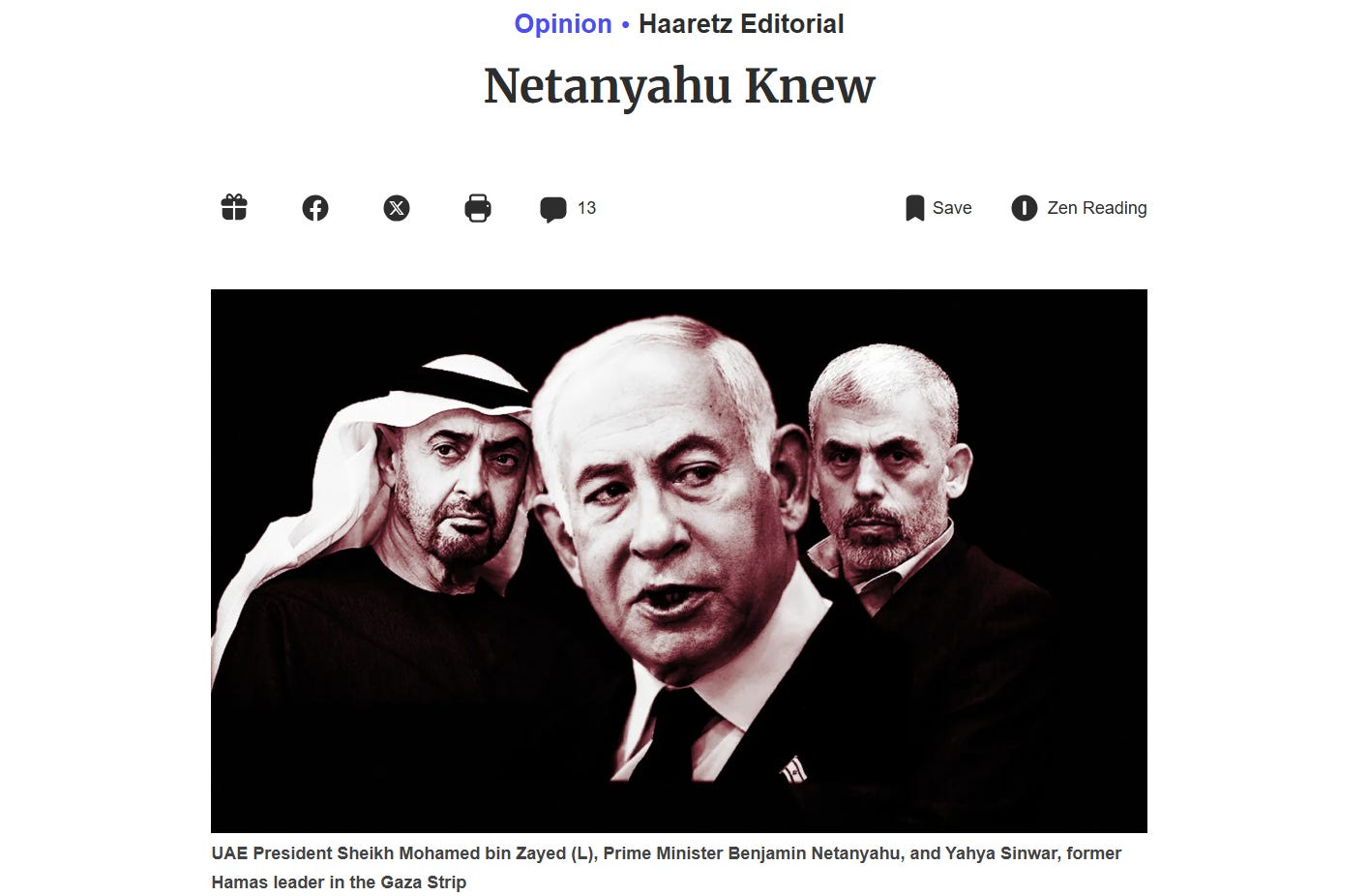
The Haaretz editorial by Shlomi Eldar and Ruthie Yuval alleging that Netanyahu was warned about October 7 by the UAE’s president Mohamed bin Zayed.
Let’s assume that the biggest story for last week was entirely true, that there really was a lengthy phone call between the UAE leader and Netanyahu. Let’s even assume a warning of October 7 was passed on, and that it was very specific. Let’s assume everything journalists Shlomi Eldar and Ruthie Yuval have published is true, and set aside for a moment the string of side details that were quickly debunked (the Egyptians didn’t personally warn Netanyahu, the Emirati official never spoke to Isaac Herzog about Gaza at all, no proposal was submitted on October 8 to release all the women and children).
Reading the two authors’ book reveals something remarkable. Israel’s government stands accused of, before October 7, ignoring the warnings and not acting against Hamas with enough force and resolve. From October 8 onward, it stands accused of acting with too much force and resolve.
To one’s astonishment, the book portrays the tormentor Yahya Sinwar as a rational figure who, before the massacre, was practically begging Israel’s government to give him an off-ramp and just give him economic aid. “We all understood the explosion was only a matter of time,” an anonymous source recounts. “It couldn’t go on. Gaza had no economic horizon.”
Right after the massacre—which, we’re told, was launched for lack of any choice—Hamas is once again supposedly extending a generous hand to Israel’s government. “I wanted to pass on that Hamas is ready to release all the civilians right now, and that we’re ready to mediate,” recounts senior Fatah official Samer Mashharawi (we’ll come back to him). “...But Netanyahu isn’t willing to talk about anything.” Never mind that even US Secretary of State Antony Blinken called this an outright lie. Does anyone seriously believe Hamas offered a release with nothing in return, and Israel simply said no? Have you forgotten the two American women released with nothing in return a week later, whose release everyone celebrated? Only someone who buys the absurd lie that Sinwar rushed to tell Israel about a coming all-out war in the immediate term—a secret he supposedly kept even from Hassan Nasrallah and Ali Khamenei—could believe this. It’s a belief Eldar has held for years: the leading light of Hamas normalizers in Israel, the Arab-affairs correspondent who assured readers back in 2009 that “Hamas is not a satanic junta” (Ha’ir, January 16, 2009), and who predicted the chance of “reaching a 30-year hudna with them, which is essentially a peace agreement.”
If Netanyahu had told the cabinet about the call with the UAE leader, and if Eldar and Yuval had been ministers, they’d have proposed one thing: economic benefits, and under no circumstances eliminations. That is exactly what Eldar preached for decades, all while opposing every Israeli operation. He even attacked the killing of mass-murderer “the Engineer,” Yahya Ayyash (”a no-going-back decision that landed a mortal blow on the whole delicate fabric of the Oslo Accords”), mocked the hunt for tunnels (”instead of searching for them underground, we should fix the reason there’s a need to dig the tunnel in the first place”), and dismissed every IDF operation in the Strip (”it only added fuel to the fire... they failed to stop the Qassam fire”). After Guardian of the Walls, even a kill ratio of one and a half terrorists per Israeli civilian drove him out of his mind (”indeed, the landlord has lost it”). “Farewell Gaza, goodbye and don’t come back,” he waxed poetically in 2007. “We already know that to avoid going back there, we need to treat your residents as human beings, ease the passage of goods through the crossings, and open the airport and seaport.”
Tragically, Netanyahu and Bar followed the Yuval-Eldar method: economic easements, in the hope of feeding the very monster whose elimination by military means Eldar had opposed for years. The pair’s manipulation—the claim that Israel should have adopted the Shin Bet chief’s proposal to “put out the fire with an explosion in Gaza, a preemptive strike”—ignores the fact that no such proposal ever really existed. That same Bar stated three days before the massacre that “renewing the calm-for-easements understandings between Israel and Hamas will allow stability to be preserved for a long time.”
Once you scrape away the pile of anonymous sources, it turns out the entire book rests on two shaky sources, two aging senior Fatah figures: Sufian Abu Zayda, who supposedly received the warning from Sinwar, and Samer Mashharawi, who supposedly heard from Sinwar about his readiness to release hostages. This pair has been force-feeding Eldar fantasies and nonsense for 30 years now. They sell, he buys. In his book “Gaza Like Death,” Eldar unquestioningly adopts Mashharawi’s claim that killing Yahya Ayyash foiled, at the last moment, a merger of Hamas into PA forces and an end to terror activity (”a one-time chance that will never come again,” the aforementioned whined in his ear). Abu Zayda, for his part—”coal eyes”—looked out with him over Netzarim in 2004 and declared that terror attacks happen only because of the settlements. “You’re paying with your future and claiming there’s no partner.” “Maybe we really didn’t look hard enough,” Eldar echoes him like a parrot. Sufian and Samer, folk tales Inc.
Eldar and Yuval have written an absurd manifesto on Fatah’s behalf, one that adopts substantial parts of the Hamas narrative, resting on a dubious pair who’ve been spreading falsehoods for decades. It turns out you can know every alleyway in Gaza, every operative in Jabaliya, and still not know your right from your left.
Why are you even bothering with Shlomi Eldar, some readers are probably asking themselves. Well, for years Netanyahu and those under him operated by the line set by the media, the think tanks, academia and the Supreme Court: always react, never initiate. Always offer the carrot, never the stick, and if you absolutely must—then the smallest possible stick.
And so, the responsibility for the tragedy rests entirely with the decision-makers, but Eldar and Yuval aren’t exempt from some harsh soul-searching of their own. After the policy they preached was adopted in full and led to flight, paralysis and a horrific massacre, they go on writing books, the old Israeli habit of shooting first and crying about it after, except this time without ever having pulled the trigger.
This is an excerpt from my weekly column in Israel Hayom.

Recently, I joined Dan Senor and Nadav Eyal on Call Me Back to talk about Benjamin Netanyahu’s brief UN visit weeks before the election. We also touch on Israel’s fast-eroding standing in America even as Netanyahu’s political position at home improves, and whether Israeli voters feel that isolation with anything like the urgency diaspora Jews do.
To listen, click here.
English Editor: Ari Tatarka
If you enjoy the newsletter, you can show your support by becoming a paid subscriber—it really helps keep this going. I’m also offering a special monthly briefing for a small group of premium members. I’d love to have you join us—just click below to find out more.
Thanks for reading It’s Noon in Israel! Subscribe for free to receive new posts and support my work.


Am I upset by Israel's increasing isolation? Not particularly. If we can become a pariah state like N. Korea who everyone is afraid to mess with because they are bat sht crazy.... well thats fine by me. And anyway we can't escape the inevitable Gog and Mgog. Lets prepare for it.
Amit Segal
“Every appearance or every speech of Prime Minister Netanyahu in the United Nations is first and foremost a musical which is played on Broadway, but the audience is Israeli.”
Yes, it was a Tony Award winning performance.
שבת שלום
חג שמח