Blockade: A Negotiation Tactic
Also, new energy opportunities, Orbán's ironic defeat, and more.
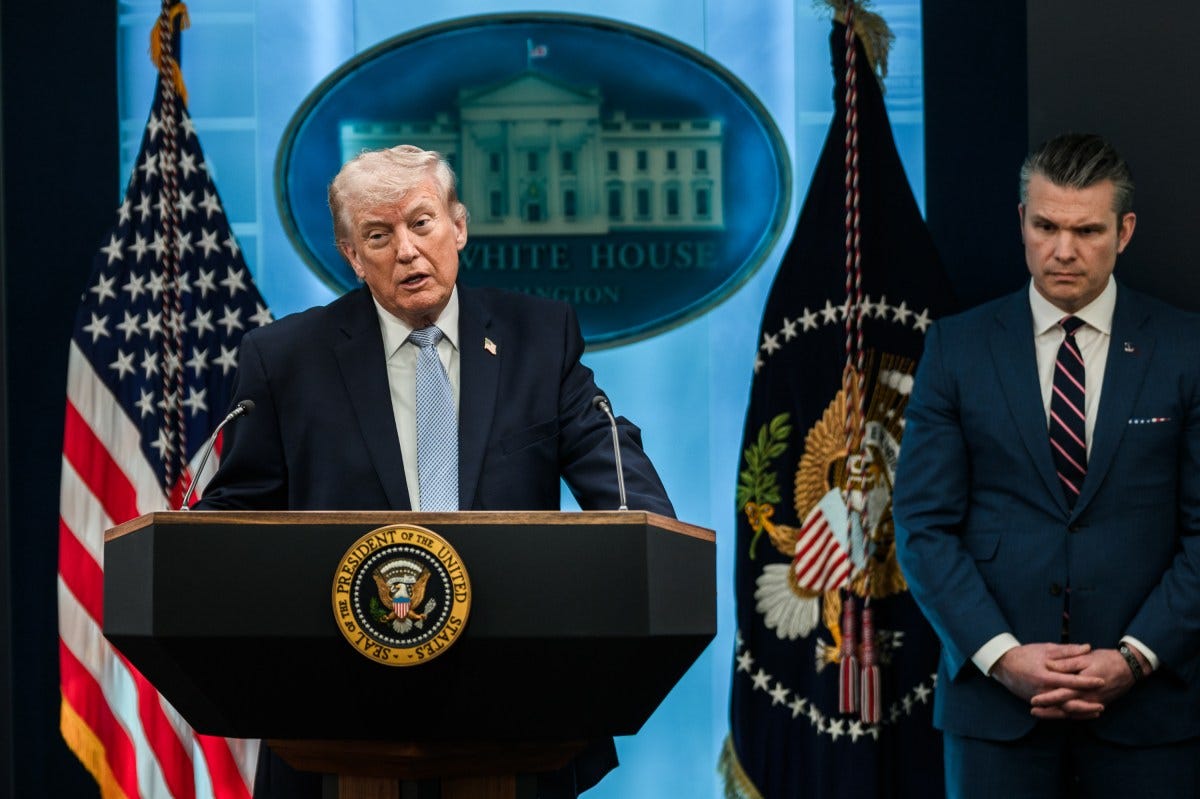
Donald Trump updates members of the media on the rescue of missing U.S. airmen in Iran two weeks ago. (White House)
It’s Monday, April 13, and there is a cardinal rule in diplomacy: everything that happens before a deal is closed—the threats, the slammed doors, the declarations that “it’s over”—is simply negotiation by other means. Donald Trump’s recent move to blockade the Strait of Hormuz falls squarely into this category.
Even when the strait was effectively closed during earlier military operations, Iranian, Russian and Chinese tankers sailed through unimpeded. Although the U.S. navy could have easily stopped them, increasing the pressure on Iran and its key sponsors, Trump deliberately chose not to escalate. The president was walking a tightrope: maintaining heavy pressure on Tehran without triggering a catastrophic spike in global oil prices. At the time, a total blockade would have instantly removed millions of barrels of oil from global circulation. Now, however, with the countervailing force of negotiations calming the energy markets, Trump has the freedom to ratchet up the pressure.
But this raises a more fundamental question: What is he hoping to get out of this tactic?
As Trump himself has noted on numerous occasions, “Iran has never won a war, but it has never lost a negotiation.” Trump must know that the chances of the Iranians folding and voluntarily surrendering their nuclear program are essentially zero. After all, if the regime refused to concede under direct military pressure, it certainly will not concede at the negotiating table.
Just look at the terms currently being floated in Islamabad. The U.S. is reportedly offering to release a portion of frozen funds and end the war in exchange for a 20-year freeze on enrichment, the removal of enriched material, and free navigation in the Strait of Hormuz without tax payments.
Yet even this remains miles from the Iranian position. Anyone familiar with the region understands that the complete surrender of their nuclear program is the ultimate Iranian red line—one they have never and will never cross. To be fair to the Iranian perspective, latent nuclear capability is their ultimate deterrent; had they already weaponized, Rising and Roaring Lion would have remained permanently on paper.
So why is Trump going down the path of negotiations? There are two possibilities.
The first is legal: The War Powers Act requires American forces to be withdrawn within 60 days of initiating hostilities unless the operation receives formal authorization from Congress. According to recent reports, Speaker of the House Mike Johnson warned Trump that any military operation—even a strictly limited one—would not survive a vote in the Republican-controlled House. Launching a military campaign with a 60-day ticking clock is unfeasible, so entering negotiations may simply give Trump the ability to appear before Congress and declare, “We tried diplomacy; we have no other choice.”
The second possibility is pragmatic: Trump understands he lacks the domestic political support required for an extended military entanglement. By initiating talks, he is attempting to maximize his off-ramps and explore any possible avenue for freezing the conflict, no matter how slim the odds might be.
Bulldozers working to clean the area from an oil leak in the Eilat-Ashkelon pipeline in southern Israel. (Chen Leopold/Flash90)
“One of the unique aspects of this war is that, unlike in the past—when I received many calls from friends in Arab countries telling me to ‘stay safe’—this time I found myself calling quite a few friends to tell them to stay safe,” said Yossi Abu, CEO of NewMed Energy, the largest stakeholder in Israel’s Leviathan gas field.
The intense targeting of Gulf energy infrastructure and the effective closure of the Strait of Hormuz may have rattled the energy sector, but Abu views the crisis as a historic opportunity to reshape regional dynamics—positioning Israel as the new “gateway to the Mediterranean.”
Under normal conditions, 25 million barrels of oil pass through Hormuz daily. However, with alternative routes like Saudi Arabia’s East-West pipeline, the UAE’s Fujairah port, and uninterrupted flows from Iran and Oman, only about 16 percent of global oil production is actually stranded.
The natural gas market faces a far more severe crisis. In 2025, global LNG production reached 380 million tons. With Qatar (77 million tons) and the UAE (6 million tons) cut off, a full 20 percent of the world’s LNG supply is blocked. Because gas is significantly harder to store than oil, this bottleneck has triggered what Abu calls a “race for secure energy.”
Abu predicts that in the short term, the U.S. will redirect LNG from Europe to Asia. In the medium to long term, this shock will drive massive investments toward accessible, reliable natural gas reserves—putting Israel and the broader Mediterranean squarely in the spotlight.
To meet this need, Abu proposes an “energy triangle” linking the Gulf states, resource-rich Azerbaijan, and the Mediterranean transit hubs of Israel and Egypt. He envisions two major, newly secured energy corridors:
The Northern Route: To get gas from Qatar/Saudi Arabia to Azerbaijan and Turkey, the pipeline network must travel geographically northward through Iraq/the Caucasus before heading west into Europe.
The Southern Route: To get oil to the Mediterranean via Israel and Egypt, the tankers travel south and west out of the Gulf, around the Arabian Peninsula (or bypass it to the Red Sea), entering Europe through the southern Mediterranean corridor.
Abu believes this infrastructure shift could catalyze a broader geopolitical realignment. Binding Saudi Arabia to Israeli infrastructure through shared economic necessity could pave the way for its entry into the Abraham Accords. Furthermore, he notes surging European interest in Mediterranean gas and even sees potential for indirect swap deals to supply gas to Syria.
“The strategic move is to create a gateway to the Mediterranean for Saudi and Emirati oil,” Abu concludes. “Once pipelines are laid, oil is just the beginning—railways, communication cables, and data centers will follow. The potential is enormous. Oil is the foundation. It’s a strategic win-win.”
Benjamin Netanyahu and Viktor Orban hold a joint press conference at the Parliament building in Budapest in 2017. (Haim Zach/GPO)
Sometimes life gives you an opportunity to indulge your niche interests. For me, that’s electoral systems, and Viktor Orbán’s recent defeat in Hungary is the perfect opportunity.
Defense Minister and veteran politician Israel Katz once said that electoral reforms tend to backfire on their authors.
True to Katz’s word, Viktor Orbán created the means of his own destruction. Through his 2011 and 2024 electoral reforms, he changed Hungary’s district-based system—altering seat numbers, calculations and constituency balances to benefit his party. He designed a system intended to amplify a modest, geographically concentrated majority into a massive parliamentary edge.
That’s how ~54 percent of the popular vote gave him ~70 percent of the seats for most of his 16-year reign. And it is how, when the electorate flipped against him yesterday, ~40 percent of the vote left him with barely a quarter of parliament.
District systems amplify wins, but also losses. When it works, you dominate. When it doesn’t, it’s a massacre.
Israel’s founding father, David Ben-Gurion, could relate to Orbán’s electoral regret. After establishing Israel’s proportional representation system in 1949, Ben-Gurion found himself permanently shackled to small factions just to maintain a fragile majority. He spent the next 20 years trying to undo the mistake, fiercely advocating for a winner-take-all district system. He failed, but Israel Katz’s warning remains perfectly intact: had Ben-Gurion successfully engineered that district system to benefit himself, today it would be handing Likud a 70-seat parliamentary monopoly.
The most impactful takeaway from the Hungarian election for Israeli politics lies less with the candidates and more with the statistics. John McLaughlin—the pollster for both Donald Trump and Benjamin Netanyahu—was projecting a comfortable five-seven point victory for Orbán. Instead, Orbán lost by 15. Israel’s electoral system might be fundamentally different, but a 20-point polling blind spot in Israel’s October elections would spell disaster in any system.
Pallets of Coca-Cola being prepared to be brought into Gaza.
“Six months on, the ceasefire has failed to end the genocide against Palestinians in Gaza, with Israeli authorities continuing to impose conditions intended to destroy conditions of life,” declared Claire San Filippo, emergency manager for Doctors Without Borders, three days ago. Meanwhile, today’s deliveries to Gaza included racks of Coca-Cola, boxes of gummy candy, and pallets of Nutella.
Clearly, San Filippo has unearthed Israel’s most sinister military strategy yet: a campaign of mass genocide by diabetes. It’s a theory that matches the intellectual rigor of all the other genocide charges.
According to the ceasefire agreement, 600 trucks of aid must be brought into Gaza every day. According to the soldiers managing the transfer, the storage facilities are already filled with flour, clean drinking water and other necessities, so Israel has been resorting to sweets to fill out their quotas.
It seems the Gazans are at least better off than the French: when they were out of bread, Marie Antoinette offered cake; the Gazans get to have both.
English Editor: Ari Tatarka
If you enjoy the newsletter, you can show your support by becoming a paid subscriber—it really helps keep this going. I’m also offering a special monthly briefing for a small group of premium members. I’d love to have you join us—just click below to find out more.
Thanks for reading It’s Noon in Israel! Subscribe for free to receive new posts and support my work.


“Clearly, San Filippo has unearthed Israel’s most sinister military strategy yet: a campaign of mass genocide by diabetes. It’s a theory that matches the intellectual rigor of all the other genocide charges.”Love this. Kill them with sweets.
Our president is so smart!