Ceasefire in Lebanon: An Israeli Victory or Defeat?
Also, is the opposition against the coalition, or just Netanyahu?
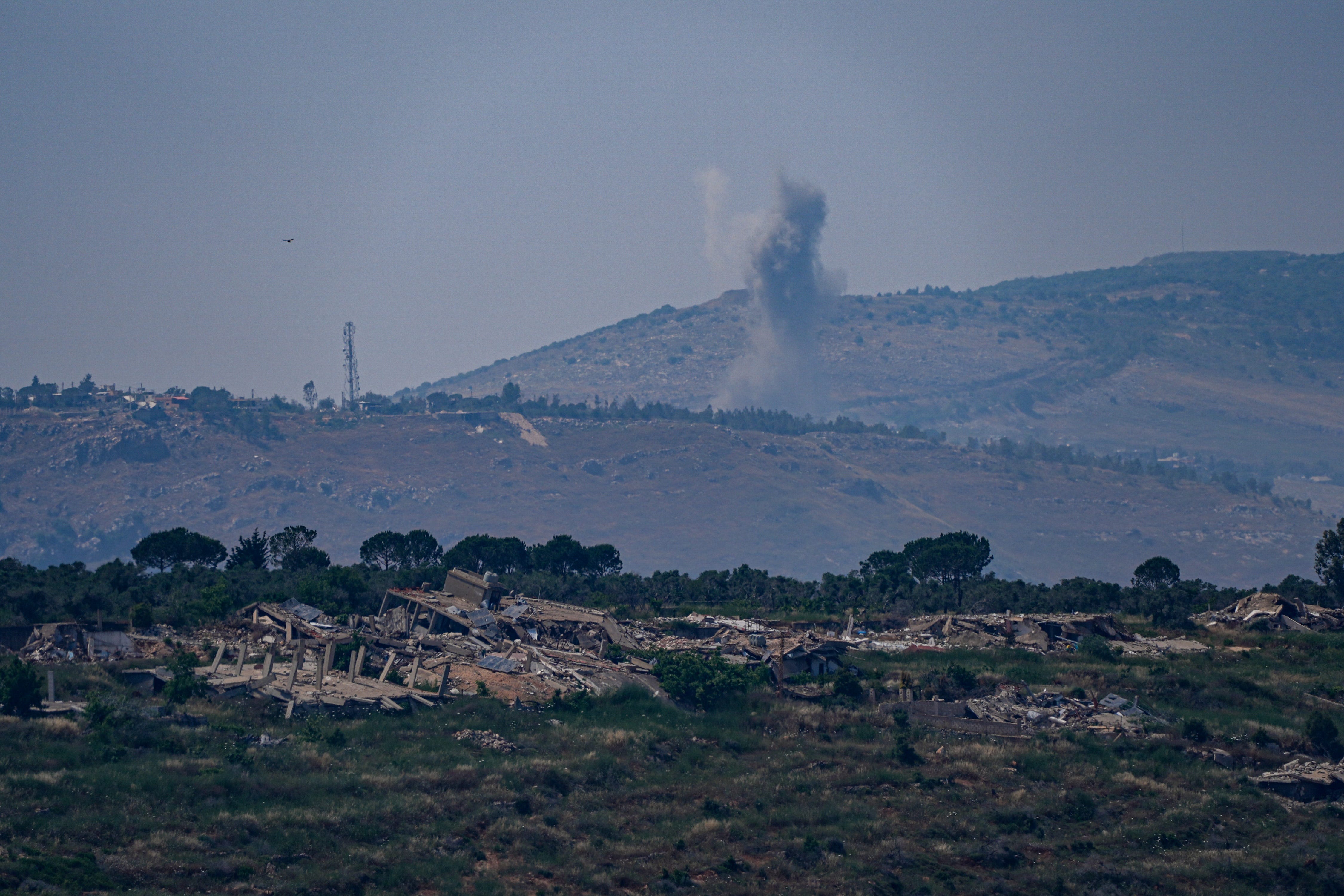
Explosions and smoke rise following Israeli airstrikes in southern Lebanon, as seen from the Israel-Lebanon border. (Ayal Margolin/FLASH90)
It’s Tuesday, June 2, and last night, Donald Trump announced that Hezbollah had agreed to a “full and immediate ceasefire” and that Israel was calling off its planned strikes on Hezbollah strongholds in Beirut. The declaration followed a phone call between Trump and Benjamin Netanyahu that Axios described in explosive terms. According to the report, the president called the prime minister “f---ing crazy” and yelled, “What the f--- are you doing?” over Israel’s escalating operations in Lebanon, adding: “You’d be in prison if it weren’t for me. I’m saving your a--. Everybody hates you now. Everybody hates Israel because of this.”
However, a very senior source in the Prime Minister’s Office paints a completely different picture. According to the source, the conversation was significantly less dramatic—less Real Housewives and more actual strategic dialogue. The source insists Trump did not say anything personal to Netanyahu along the lines of warning him to stay out of jail, nor did he claim that Netanyahu or Israel is hated around the world. The conversation was indeed tense, the source says, but the friction came from mutual complaints over their dueling social media posts the night before, where both leaders were trying to publicly spin the outcomes of the ceasefire on their own terms. Ultimately, the discussion ended with Israel agreeing to the ceasefire conditions so long as Hezbollah upholds its obligations.
The conditions in question appear to be a quid pro quo: Israel will not strike Beirut and, in exchange, Hezbollah will not strike Israel proper. Meanwhile, the grinding war in southern Lebanon continues exactly as before, with ongoing IDF ground maneuvers and Hezbollah drone strikes. In short, it is a ceasefire for the cities and a continue-fire for the rest of southern Lebanon.
Here is the question everyone is asking: Is this a success?
If it works, then yes. Recall Israel’s position this past Sunday: locked into a low-intensity attritional conflict in the south, restricted from utilizing its full power or striking Beirut, even as the north of Israel faced ongoing bombardment. Ideally, an agreement would veer closer to the status quo preceding Operation Roaring Lion, keeping Beirut in the crosshairs while the IDF strikes Hezbollah’s infrastructure in the south—though this time with a significantly larger IDF presence. But the perfect shouldn’t be the enemy of the good. Securing a full night’s sleep for residents of Israel’s north while continuing operations in Lebanon’s south is a major step forward.
That is if it works, of course. Last night, Hezbollah expanded its range, firing rockets deep into the city of Tiberias. We are now waiting to see whether this was just a final, face-saving volley before the ceasefire actually takes hold, or the first sign that yesterday’s diplomatic production was nothing more than theater.
Family and friends of Israeli soldier Staff Sgt. Michael Tyukin attend his funeral at the Military Cemetery in Ashkelon. He was killed during Israel’s ground offensive in southern Lebanon. (Tsafrir Abayov/Flash90)
Regardless, the reaction in Israel has been far from celebratory. Strategic success or not, this ceasefire does not expedite the end of the conflict in any substantial way. The ceasefire promises that the slow, attritional warfare in southern Lebanon will grind on, bringing with it daily casualties. Israelis are exhausted. Since the April ceasefire, the public has been forced to live with a deep and stressful unpredictability. They are stuck in a constant state of limbo where schedules can be scrapped at a moment’s notice, flying abroad means risking getting stranded, and you never quite know when the next siren will force you back into a safe room.
The IDF, meanwhile, is caught in its own limbo. Its mission in southern Lebanon is straightforward: dismantle Hezbollah’s infrastructure, expand the security zone, and prevent the terror group from recovering. Conspicuously missing from these objectives, however, is a comprehensive strategy to eliminate the group entirely. But it is hard to plot the destruction of the tentacle while the fate of the head remains undecided. A major geopolitical shift on the Iranian front could open new doors for the IDF—perhaps even prompting an intervention by the fabled Lebanese Armed Forces. Yet as it stands, the patron is alive and kicking. Until that changes, the military is relegated to the grueling, uncreative work of slowly degrading Hezbollah’s capacity.
The current state of affairs triggers a distinct sense of déjà vu. Once again, an Israeli escalation against Hezbollah is attempting to break a disadvantageous deadlock, though whether it will succeed in substantially changing the dynamic—as it did in 2024—remains unclear. What is unique about this ceasefire is that it achieves the exact opposite of the previous: it actively links two active fronts rather than separating them.
In this agreement, Tehran’s decision to suspend negotiations with the U.S., rather than Israeli military pressure, brought Hezbollah to the table. If true, Iran just scored a major strategic victory. It successfully shielded Hezbollah from further degradation while artificially extending the diplomatic timeline—likely hoping to outlast Trump’s attention span on the issue. Furthermore, it validates Tehran’s preferred narrative: the collapse of the U.S.-Iran talks is a result of Israeli military operations, masking the true cause of the deadlock: the regime’s obstinacy.
But there is an alternative possibility. The sequence of events might actually be flipped, with the localized ceasefire preceding the Iranian declaration. In this scenario, Hezbollah was so terrified of an imminent Israeli strike on Beirut that it initiated the de-escalation independently, leaving Tehran scrambling to jump on board and retroactively spin the retreat to its advantage.
My take: Is this ceasefire a defeat? It’s too early to tell.
Leader of the Democrats party Yair Golan leads a faction meeting at the Knesset, June 1, 2026. (Yonatan Sindel/Flash90)
“Prime Minister Shimon Peres followed the exit poll results on television. Afterwards, he calculated possible coalitions on paper.” This sentence appeared in the morning papers 30 years ago. The issue went to press after the exit poll predicting his victory over Benjamin Netanyahu was published, but was printed just as the actual results arrived, rendering Peres’ calculations obsolete.
Another news item in Maariv that same morning stated that Peres wanted to form a coalition with the National Religious Party, the ultra-Orthodox, or both. Early this morning, at 1:30 a.m., Israeli politicians were back to doing coalition math. Following a marathon debate, lawmakers voted a staggering 106-0 in favor of the first reading of a bill to dissolve the Knesset, setting the stage for early elections somewhere between September 8 and October 20.
The catalyst for this collapse? The ultra-Orthodox. Currently the anchor of Netanyahu’s coalition, the Haredi factions have effectively pulled the plug over the military draft crisis. Yet the irony is thick. Three decades after Peres, his successor in the Labor Party—now “The Democrats”—has also spoken in favor of a partnership with the ultra-Orthodox rather than with Netanyahu. It leaves a fundamental question unresolved heading into Netanyahu’s 12th election campaign: Does the center-left loathe Netanyahu because of his coalition, or are they repulsed by the coalition because of Netanyahu?
In recent years, it seemed cause and effect had flipped. If the debate was once primarily ideological, and the animosity toward Netanyahu stemmed from his role as the organizer of the bloc that opposes withdrawals, supports settlements, and fills the yeshivas—over the years, as the debate over the future of Judea and Samaria subsided, the overriding goal of the opposing bloc became the ousting of Netanyahu. The clearest manifestation of this was, of course, the “Change Government.” Yitzhak Rabin and Peres would be turning in their graves if they knew who Labor had installed as prime minister and to whom they had handed the finance ministry.
It is no surprise, therefore, to hear The Democrats leader Yair Golan’s remarks this week. The mainstream left has always preferred partnering with the ultra-Orthodox and fighting Likud and the settlers over the reverse. United Torah Judaism has no aspirations to lead the state and change its face; Likud and the national-religious certainly do. The 2026 elections are characterized by the fact that Netanyahu’s Achilles’ heel is his alliance with the ultra-Orthodox, but on the day after, the ultra-Orthodox are the most convenient and available partners for both sides. Thirty years into the alliance of “natural partners,” the right-wing and the ultra-Orthodox, it remains unclear who is the donkey and who is the Messiah.
English Editor: Ari Tatarka
If you enjoy the newsletter, you can show your support by becoming a paid subscriber—it really helps keep this going. I’m also offering a special monthly briefing for a small group of premium members. I’d love to have you join us—just click below to find out more.
Thanks for reading It’s Noon in Israel! Subscribe for free to receive new posts and support my work.


The American sponsered ceasefire between Israel and Hezbollah is another example of American hubris and its terminal lack of understanding of Middle East politics.
As for Trumps reported words with Israels Prime Minister if true show a lack of respect for the Jewish State. Both men Netanyahu and Trump represent their respective countries and such caustic language is patronising at best and hateful at worst.
Self- interest is often not pretty to witness and when indulged by a baffoon ugly in the extreme.