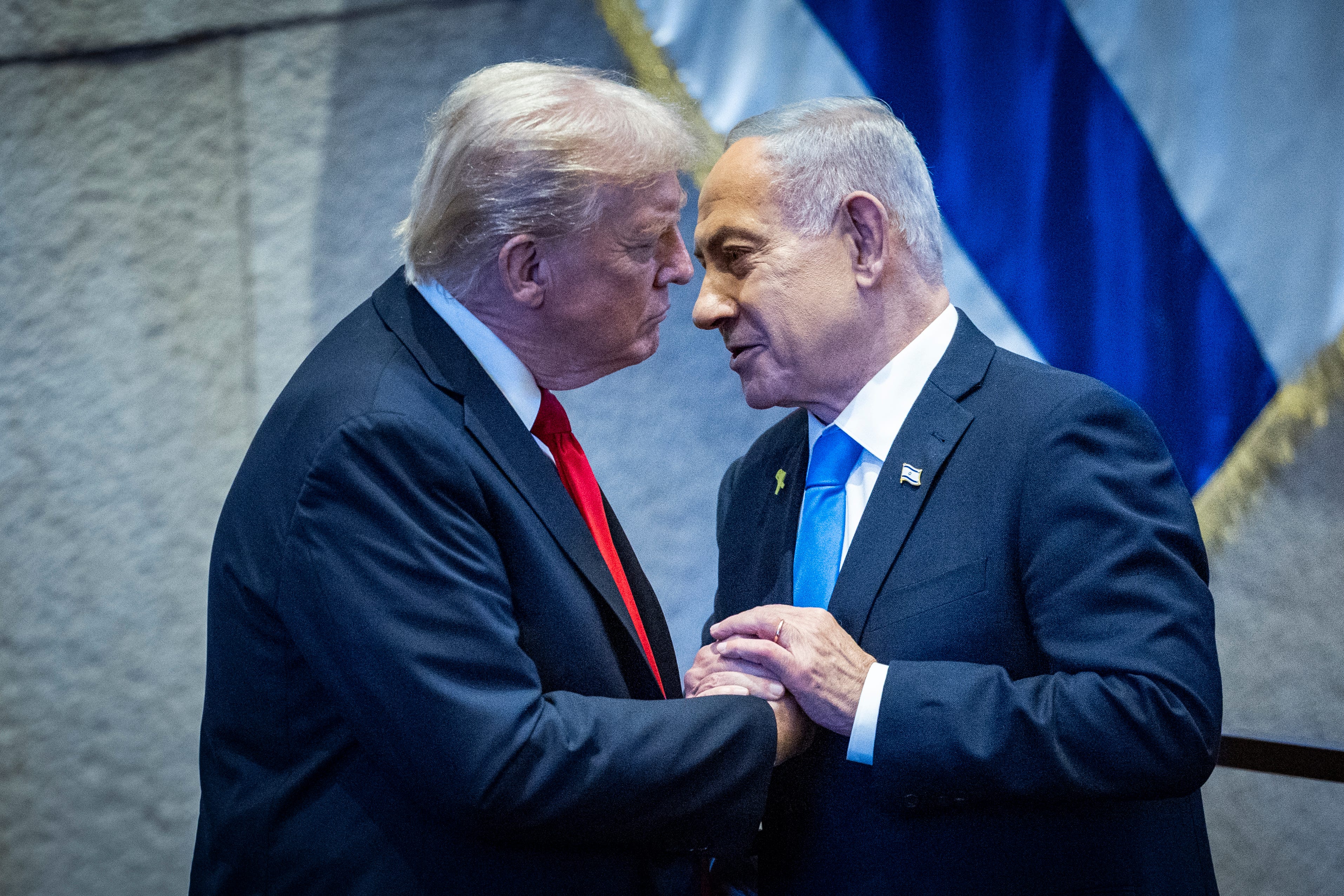
U.S. President Donald Trump with Israeli Prime Minister Benjamin Netanyahu during a special plenum session in honor of President Trump at the Knesset, Israel’s parliament in Jerusalem, on October 13, 2025. (Yonatan Sindel/Flash90)
It’s Friday, September 4, and when Donald Trump pays Netanyahu a compliment these days, it is done sparingly and in the past tense: he was an outstanding prime minister in wartime, he did a great deal for Israel. That is a radical shift in both frequency and rhetoric.
On the other hand, it has also become somewhat less urgent for Netanyahu that Trump back him ahead of the coming election. The American president’s standing in public opinion here collapsed completely when he signed the memorandum of understanding with Iran, which was perceived here as a betrayal. At roughly the same time, it also became clear that a US president’s support guarantees nothing, since after a vigorous campaign on Viktor Orbán’s behalf, the right was defeated in Hungary’s election. The effort Bennett invested in keeping the White House neutral petered out as the numbers of both the former prime minister and the sitting president fell here in parallel.
But the election is next month, and a turn may yet be taking shape. Netanyahu himself is currently weighing whether it is worth the effort to secure the president’s support after all. Surprisingly, it emerges that he considers the matter entirely within his control. If he wants it, he gets it; if he doesn’t, he won’t. After all, the memorandum of understanding is dead, the siege on Iran is tightening, and Trump is currently doing exactly what Israelis want—strangling the ayatollahs’ regime without Ben-Gurion Airport being shut down and everyone here heading down into the shelters. It is entirely possible that next month his standing will have recovered enough for him to deliver Netanyahu a last-minute October surprise.
Not that there is any shortage of people around him who oppose it. The president’s confidants, Witkoff and Kushner in particular, would probably be glad to see a different prime minister. In 2020, the president’s circle made a point of bringing the challenger of the day, Benny Gantz, to the White House over the Deal of the Century, and in doing so hollowed out Netanyahu’s comparative advantage. This time too there will be those who advise Trump not to bet on a lame horse trailing in most of the polls. They will pop the champagne if Eisenkot is elected. But in the Prime Minister’s Office they remain convinced that it depends on them alone, and that if they need it, they will get the full support package from the man who was, until very recently, the most popular politician in Israel—despite living on the other side of the pond.
This is an excerpt from my weekly column in Israel Hayom.
IDF forces in a Hezbollah tunnel in southern Lebanon. (IDF)
For 40 years Iran built a ring of fire around Israel. The jewel in the crown was Hezbollah. Hezbollah’s own jewel was the complex it dug into the Ali Taher range—the closest base of that caliber to the “little Satan.”
Yesterday, it fell to the IDF.
Twenty years in the making, with Iranian help and enormous expense, the base contained command-and-control rooms, weapons and supply depots and field clinics, all buried 30 to 50 meters into solid rock. Just ten kilometers from the Israeli border, with a clear view of the Litani and the Israeli Hula Valley, it was the place from which Hezbollah intended to coordinate its own October 7 in the Galilee.
Israeli forces first reached the ridge on the thirty-first of May. By the twelfth of June, the division had taken Kfar Tibnit and the main body of the ridge. Then the ceasefire, a week later, leaving 40 Hezbollah fighters trapped beneath Israel’s feet. An assault would have inflicted casualties Israel was unwilling to absorb and broken a ceasefire it was unwilling to break.
So they began a siege. They shot down every attempt at relief, infiltrators and supply drones alike, and escalated steadily from there—pushing their own drones into the shafts, running loudspeakers into the ground around the clock. After a summer of siege, the men below broke—some retreating, others unable—leaving the IDF in full control of the ridge.
In mid-August, Iran warned Washington that a full Israeli assault on Ali Taher would draw a large-scale response. More than a dozen IRGC personnel were on the ridge, three officials told Reuters, including at least two senior officers. Set aside the obvious question of what a foreign army’s officers were doing on sovereign soil—after all, it isn’t sovereign, it’s Lebanon. The fortress has now fallen, and the question of a response falls to Iran.
The trouble is that the Iran that made the threat is not the same Iran that has to keep it. In the intervening month, the United States blinded Tehran in the strait, restored much of the commercial shipping it had disrupted, and drew the economic noose tighter. A month of siege has sapped much of the bravado from the Islamic Republic.
They have three options: a large response, a small one, or silence. A large response inevitably resumes the war. The prospect has its attractions for a regime on the edge: wartime discipline is the easiest form of crowd control, and if Iran is even weaker than we believe, a heroic death in resistance is well within Jihadist sensibilities. A small response risks arriving at the same place by accident—Israel is eager to answer disproportionately to any provocation and weaken the regime further.
They may still risk it. But Tehran has had chances to significantly escalate in recent weeks and declined every one, settling instead for the uneasy equilibrium of neither war nor peace.
It is a tightrope, and the regime may well make it to the other side. But while desperately trying to balance it won’t be able to stop Israel plucking the jewels from its crown, one fortress at a time.
English Editor: Ari Tatarka
If you enjoy the newsletter, you can show your support by becoming a paid subscriber—it really helps keep this going. I’m also offering a special monthly briefing for a small group of premium members. I’d love to have you join us—just click below to find out more.
Thanks for reading It’s Noon in Israel! Subscribe for free to receive new posts and support my work.


The fall of Ali Taher range is the best news of the day! Thanks for sharing it Amit!
Good to hear .. hoping the Hezbollah rats continue to suffer.