Elections Are Coming Early
Also, Netanyahu trapped between Trump and Xi.
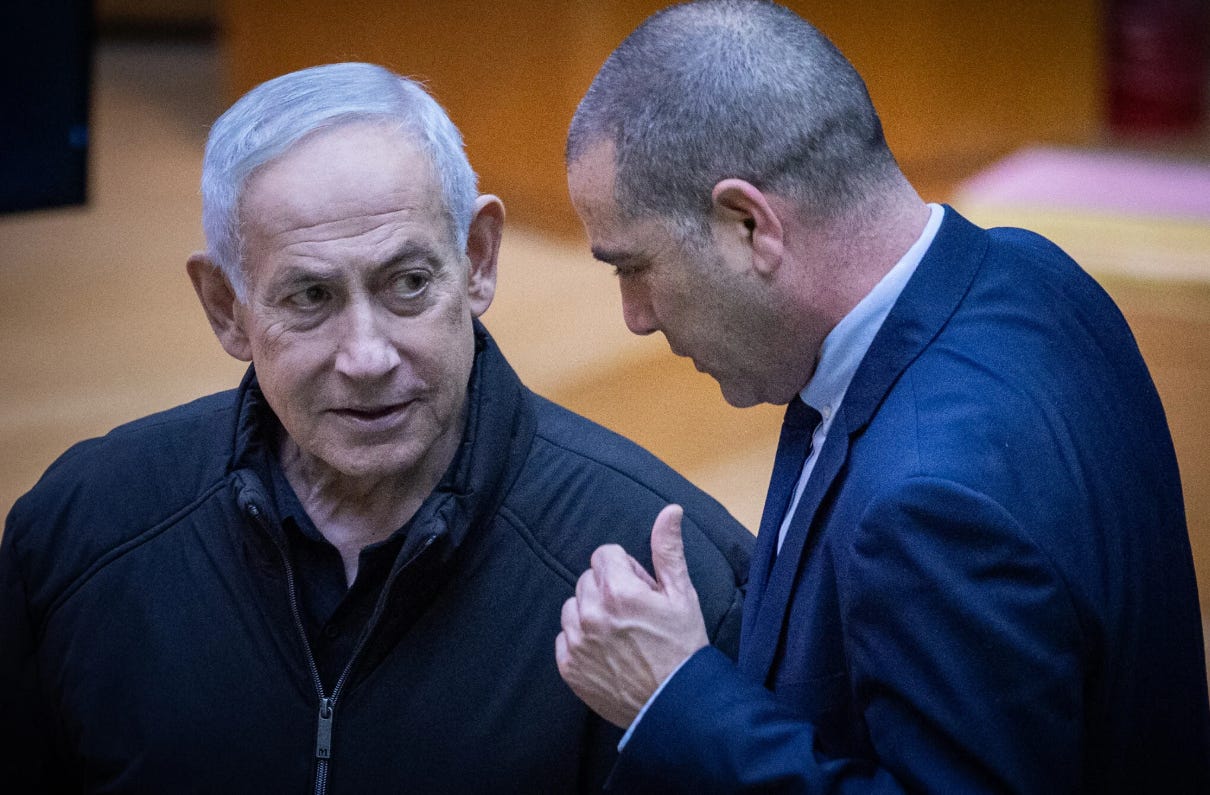
Prime Minister Benjamin Netanyahu and coalition whip Ofir Katz seen in the Knesset, 2026. (Yonatan Sindel/Flash90)
It’s Thursday, May 14, and there comes a point in the life of every aging car when you realize you’re spending a fortune just to keep it wheezing down the highway. In the grand scheme of things, the difference between throwing in the towel at 300,000 miles versus 310,000 is relatively minor. The same logic applies to aging political coalitions. Amid threats from ultra-Orthodox factions to dissolve the Knesset over the lack of military draft legislation, Benjamin Netanyahu has decided to drive the vehicle off a cliff—but he gets to pick the cliff.
Last night, Likud MK Ofir Katz finally signaled for the tow truck by submitting a bill to dissolve the Knesset. Crucially, the legislation does not set a specific date for the ballot, instead delegating that decision to the Knesset House Committee—a panel conveniently chaired by Katz himself. By keeping the date unresolved in a committee he controls, Netanyahu sets the pace of dissolution and keeps his coalition together until the last minute.
Due to the legally mandated 90-day campaign period, the earliest the elections could be set is late August. In Israel, an August election is a logistical wreck; between the mass exodus of families traveling abroad and the nightmare of converting schools into polling stations during summer break, it is a path rarely taken. S
trip away August and strike out the Tuesdays compromised by the High Holidays, and only two viable dates remain: September 1 or September 15. September 1 is the first day of school, and the prospect of converting newly prepared classrooms into polling stations excites neither parents nor teachers. If I were putting money on Polymarket, the 15th is the far better bet.
But why are the Haredim threatening to walk away in the first place? After all, when the opposition’s entire campaign is fundamentally framed against them, their bargaining power in any future, non-Netanyahu government seems negligible at best.
Degel HaTorah chair Moshe Gafni (R) and United Torah Judaism party chair Yitzhak Goldknopf attend a plenum session at the Knesset in Jerusalem, 2026 (Yonatan Sindel/Flash90)
The most obvious answer is deterrence. An ultimatum only works if you are actually willing to walk away. If the Haredim fold on the draft exemption and decide to stay comfortably seated in the coalition, their political leverage evaporates. But the ultra-Orthodox have also put thier faith in a higher power—hatred for Netanyahu. The Haredi parties are gambling that, when push comes to shove, the opposition will happily trade the draft issue for the keys to the prime minister’s office.
For Netanyahu, the electoral math is simple: more mandates are always better. He calculates that early elections will yield a stronger result than waiting out the clock, especially when factoring in the exorbitant price he would have to pay to survive those extra few months. That price—passing the Haredi draft legislation—is broadly unpopular with his base and presents an almost insurmountable legislative hurdle within his own party.
Before the general election, Likud holds internal primaries to determine the placement of candidates on its Knesset list. With the exception of a single media outlet, every current poll shows Likud bleeding seats. Fewer seats mean fewer viable spots, which sparks cutthroat competition among Likud MKs. Ramming the draft legislation through would demand an unprecedented cracking of the whip to enforce party discipline, with no guarantee of success. It is a massive expenditure of political capital, only to leave MKs standing at the general polls a month later covered in whip marks and anchored to a wildly unpopular law.
Netanyahu’s decision also signals a shift in calculations beyond Israel’s borders. The prevailing theory was that he intended to refresh his own mandate only after Iran had finished refreshing its own—ideally with a change in regime. Campaigning against the backdrop of a headless Ayatollah would have made for an invaluable electoral image. By pulling the deadline forward to September, Netanyahu is signaling one of two things: either he expects a monumental regional shift before September 15, or he has concluded that the “big event” he was banking on simply won’t materialize by late October.
Calling an early election also offers a tactical advantage: stealing a march on the opposition. While Democrats party head Yair Golan responded to the news of dissolution with a social media meme of Arnold Schwarzenegger applying war paint, the opposition may be less prepared than the post suggests.
Despite Naftali Bennett’s recent unification with Yair Lapid, Bennett’s grip on the opposition bloc is shaky. He wrongly assumed that former IDF Chief of Staff Gadi Eisenkot would simply fall in line; instead, Eisenkot is continuing his dark-horse premiership campaign and appears to be gaining speed.
Ultimately, the early elections may actually play to Bennett’s advantage. Political chaos often breeds a desire for consolidation. While his new “Together” alliance has yet to fully live up to its namesake, its underlying premise remains attractive: the opposition is stronger together than apart. But then again, in Israeli politics, the only certainty is that nothing is certain.
President Donald Trump arrives in Beijing last night. (White House/X)
The local press primarily mined Netanyahu’s 60 Minutes interview for headlines regarding enriched uranium and Donald Trump. As a result, his response to an unusual question about Chinese involvement in the war in Iran was largely overlooked. It has been a long time since the prime minister appeared so cautious—so intentionally vague. “Look,” he told the interviewer, “different countries have different interests... Does China want its supply chain to be with the Iranians? It’s not a zero-sum game... There are dangers and opportunities in everything... like in AI... there President Trump and President Xi will talk about AI... there too are dangers and opportunities...”
The PM wasn’t squirming for nothing. He too knows that China is too important to clash with head-on. On one of the days of the war, someone in the Israeli top echelon wondered what would happen if the Chinese turned on the camera in the robotic vacuum cleaner in the home of an IDF major general, and what if they decided to pass information to the Iranians about impact zones using the enormous number of [Chinese] vehicles they have in Israel (much more than in the US or Europe).
From Beijing’s perspective, Israel is not a sales target, it is a strategic target—a deliberate and systematic chipping away at American influence in the heart of the Middle East and gaining a foothold in a technological-military power. While the Americans operate on the top floor through the government, politics, and military cooperation, the Chinese infiltrate through the floorboards. Perhaps Israelis should feel flattered that the two superpowers are bickering over our attention, but we need to remain careful.
President Donald Trump arrives in Beijing last night. (White House/X)
China, unlike Qatar, does not support Iran out of love for the Ayatollahs, nor out of hatred for Israel. It does so because it needs chaos in the Middle East that will drain US resources and attention away from Taiwan and the South China Sea. For Xi Jinping, every dollar the US invests in interceptors for Israel is a dollar not invested in submarines in the Strait of Malacca. This quiet war is China’s way of buying time in the clash of titans against the United States. The Iran war is where the Chinese are testing American boundaries and their willingness to go all the way.
The event is only getting more complicated. Take the Strait of Hormuz, for example. The Iranians are trying to create a new equation and control the world through violent control over the straits. This might be good for the Iranians, but for the Chinese, it is terrible. Why? Because while transit through Hormuz is important to the Chinese, transit through the Strait of Malacca is much more important. This is a narrow strait between Indonesia, Malaysia, Thailand, and Singapore, practically controlled by the US. Eighty percent of China’s oil imports pass through it. If the method of blocking shipping lanes becomes a legitimate means, it means the US will acquire almost absolute control over the Chinese. And that is just one example.
Another example comes specifically from Israel: the amount of military knowledge and capabilities built and tested here over the past three years is historically unprecedented. Israel is considered today around the world as a formidable power with field-tested experience. The war is the world’s largest testing lab for artificial intelligence on the battlefield. When Israel disrupts UAV swarms or eliminates 20 scientists in Iran in a few seconds, it makes its superiority practical. Trump brings receipts showing that Chinese technology is inferior to the Israeli-American mind, clarifying to them that he holds the tap to the knowledge and the blockade against everything they are trying to achieve. In this battle, Israel is the US’s combat R&D department, and for Trump, this is a tremendous bargaining chip.
Trump knows that the one keeping Iran alive today, even if quietly, is the empire from the East. They are the ones still trading with the Iranians while bypassing sanctions; they are the ones providing them with intelligence and even certain types of weaponry. For the Chinese, for example, air defense batteries are considered offensive weapons, but ballistic missiles are somehow defined as defensive weapons. Go figure.
Just as Israel set a goal for itself to break the Middle Eastern axis of evil, Trump set a goal for himself to break the Chinese-Russian-Iranian-North Korean axis of evil. If he disconnects the Chinese from the axis—he will weaken it significantly and bring it closer to the goal he desires so much: an absolute and indisputable victory, in a short time, and with a relatively low number of casualties.
This is an excerpt from my weekly column in Israel Hayom
English Editor: Ari Tatarka
If you enjoy the newsletter, you can show your support by becoming a paid subscriber—it really helps keep this going. I’m also offering a special monthly briefing for a small group of premium members. I’d love to have you join us—just click below to find out more.
Thanks for reading It’s Noon in Israel! Subscribe for free to receive new posts and support my work.


