Exclusive: Rahm Emanuel’s Reckoning in Jerusalem
An interview with a presidential candidate in the making.
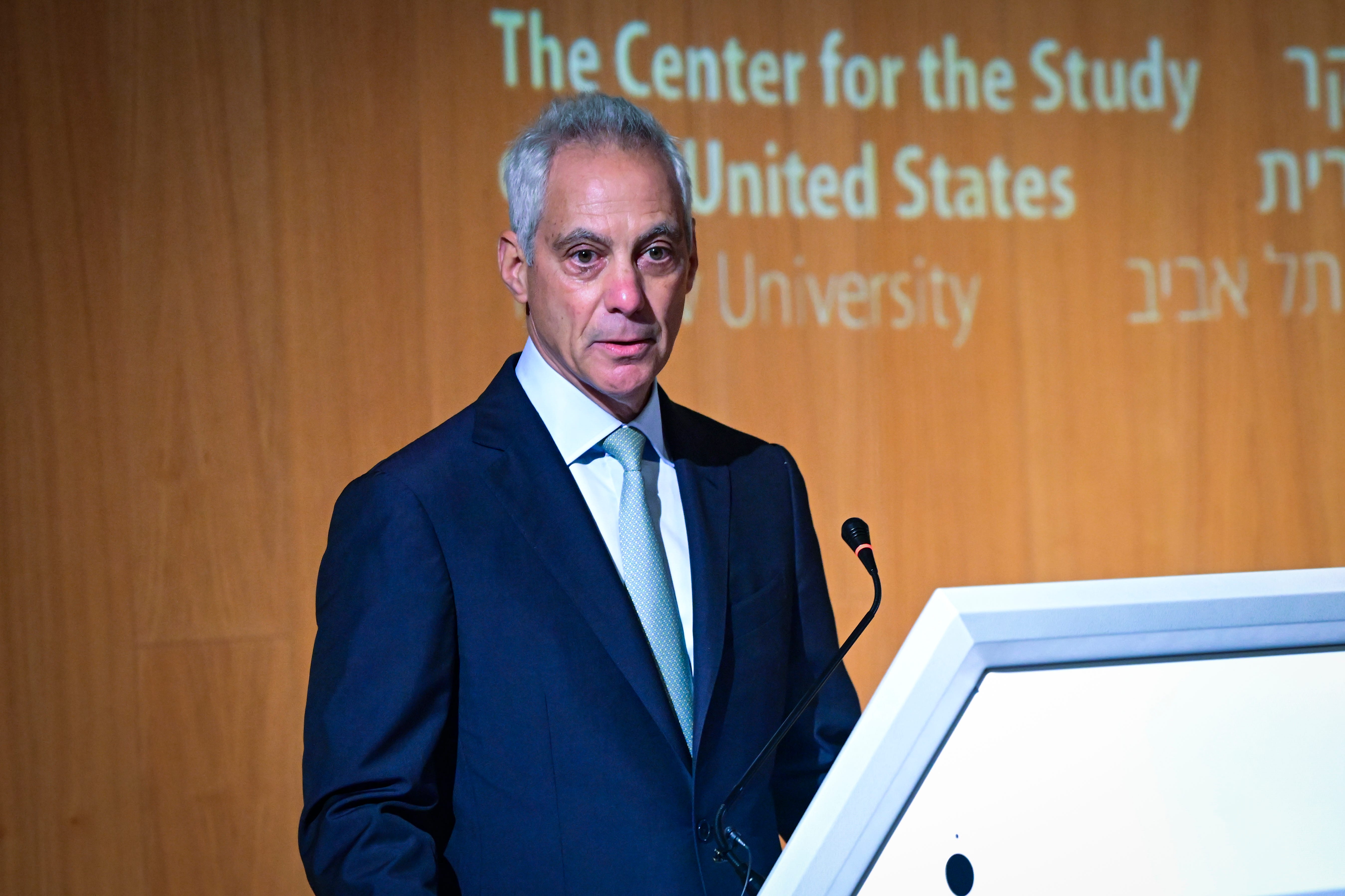
Former White House Chief of Staff Rahm Emanuel speaks during a conference at Tel Aviv University in Tel Aviv, July 8, 2026. (Avshalom Sassoni/Flash90)
It’s Friday, July 10, and four and a half fingers are brandished in my face—the missing half lost to a meat slicer when Rahm Emanuel was a teenager. Barack Obama’s former chief of staff, former mayor of Chicago, and almost certainly a candidate in the next Democratic presidential run, he has come to Jerusalem with a sense of mission. The next morning he will open his Tel Aviv University speech with “today is a day for truth.” On the terrace of the King David, the Old City spread out below us, he is already there: part Jesus, part Elijah—the savior descended for a reckoning with Israel’s sins, the prophet warning of America’s wrath and calling for repentance.
“You have lost Europe, you have lost the United States, and you picked up Somaliland,” he says. “Diplomatic, international isolation is an unsustainable path.” The solution, in his telling, is to make the problem bigger. “Sometimes when you have a problem, you make it bigger”—and what he means by bigger is adding full normalization into the old two-state formula. The 23-State Solution, as he calls it (though J Street called it that first), is the old two-state formula plus the full weight of the Arab world as guarantor, investor, and enforcer. “I think there’s an opportunity to break out,” he says. “21 is better than one.”
“That’s the carrot,” I say, “but what’s the stick?” He dodges the question in Jerusalem, but brandishes it the next day in Tel Aviv: “If I have anything to say about it,” settlers who attack Palestinians “will be sanctioned,” the officials who back them “will be sanctioned,” and the banks financing them “will be sanctioned.”
People walking next to a large billboard reading "a time for war, a time for settlement. Now is the time for the "Abraham Accords,'" in Tel Aviv, June 27, 2025. (Yehoshua Yosef/Flash90)
Back on the hotel terrace, he returns to his plan. The Arab League, he explains, has its own incentive—stability—and that desire is the lever. “This is not on Israel, like it was in the 90s. This is on them.” They have to “stand up a real partner,” one that acknowledges the “historic relationship of Jewish people to this land,” accepts that “you don’t get rewarded for killing people,” and stops teaching “your children to hate Jews because they’re Jews.” It is, he notes, a higher bar than the one set in Oslo. Here his tone turns accusatory. “I was not part of sending $6 billion to Hamas and starving the Palestinian Authority. That was not—I didn’t make that choice.” A government did, he says, with the flat affect of a man stating the obvious. “It didn’t turn out too good.”
The framework, in his telling, is a return to what has worked before: “working with nation states, like Egypt, like Jordan, and like the Abraham Accords.” This is the logic of the 21: bring the Arab League in, make them “invested,” give them a stake. “They use the Palestinians as a slogan. You gotta roll up your sleeves and create a partner here.”
I push back. In the Clinton administration, Israel tried. Ninety-three percent of Israelis have drawn their conclusions from what followed—not from this government, not from Netanyahu, but from the Palestinian side itself. The disillusionment is bone-deep and cross-partisan. Even if Eisenkot were elected tomorrow, with Bennett, Lieberman, Lapid, and Yair Golan in the coalition, no more than 7 percent of Israelis support his solution. What does he do with that, politically? He considers it for half a second. “We’re gonna test it.” I press him: test it how, on what basis, after everything that has happened? “You never know till you try. It’s not overnight.” “The reason I’m saying not two states but 23 states is it makes it more politically valuable.” He leans forward. “Bedded in the DNA of the state of Israel and the Jewish people is the notion that Ben-Gurion set out—to be a nation among nations—nobody wants to go to a ghetto.”
He is not, he wants me to know, merely a critic. “Unlike other Americans, I’m not gonna just criticize. I’ve offered a peace plan and an economic component to it.” He reaches for a line he has clearly used before, the one he carried out of the mayor’s office and the chief of staff’s office and every executive suite he has ever occupied. “You know what ends up in the executive office? Bad and worse. Good and bad, the chief of staff will handle. Bad and worse is the only thing that’s in the Oval Office.” His plan may be imperfect—he grants that much. “But if your alternative is the status quo, I’m not getting on that bus with you anymore.”
What happens in four, five years, if Israel simply doesn’t accept it? If it decides no regional solution, no two-state, no process—then what? “Everybody who’s under 30—support for Israel is in the low 20s, high teens.” “They’re only getting older, they’re not getting younger. They are going to be the most dominant factor in politics.” There is a generation, he says, that grew up with 1967 as the benchmark metaphor. “There is a generation that’s going to grow up with Gaza. That’s a fact.”
Then his tone shifts from salesman to prosecutor. “You think this is going to last another 22 years?” He doesn’t wait for an answer. The diplomatic route was tried and failed. The military route—the one Israel chose, the one four American presidents were asked to greenlight and refused, until one finally said yes—has also, in his accounting, failed. “You finally got what you wanted,” he says. “Now you’re weaker, they’re stronger.”
“You have a strengthened, confident Iran. Which you did not have before.” Before October 7, Iran was a regime hemorrhaging legitimacy from within. Now it is standing. “Iran never knew that they could take a punch from Israel and the United States. Now they’re standing,” telling every Gulf state the same thing: “We’re still alive. Not only are we alive, we own you. We told you they couldn’t protect you.”
“This is why I oppose what President Trump is doing,” he says. “You have taken our allies and you’ve thrown them away.” Allies, he adds, are “a force multiplier”—America is bigger and stronger for having them, and Trump has left the country alone. Trump has treated Israel not as a partner but as a possession, he claims. “You’ve got a president of the United States—saying, ‘I own Bibi, he’ll do what I want.’ No Democratic president has ever said that about a prime minister.”
Not only that, Emanuel claims, but “Turkey is emboldened.” Egypt and Jordan are “totally alienated.” Europe, the United States, Canada, Australia—”your historic allies”—are retreating. He leans back. “I’m fascinated. I’m an idiot of politics”—the false modesty of a man who is anything but—”I want to know the strategy. Tell me the strategy.” I raise Netanyahu. Surely the prime minister, whatever one thinks of him, is not stupid. Emanuel stops me before I finish the sentence. “That’s a premise. I didn’t say that—you said that.”
I ask him directly: “Does this emanate from your thinking about the alliance—or from the landscape in the Democratic Party these days?” He bristles, slightly. This is an American problem, a generational problem, not a partisan one. “It may be accentuated in the Democratic Party. But it’s not the Democratic Party—it’s generational.”
And yet. Almost in the same breath, he seemingly concedes there is a difference: 2015—the moment Israel made a “conscious decision” to throw its lot in with the Republican Party. He is careful to note he was mayor of Chicago at the time, nowhere near the decision. But apparently, the consequences are clear today. You think it wouldn’t happen without it? “I don’t know if it would happen without it. But it accelerated the process.”
Barack Obama and Zohran Mamdani read to a group of toddlers at Learning Through Play Pre-K Center in the South Bronx. (@NYCMayor/X)
I put it to him directly: many Israelis feel horrified by what is happening inside the Democratic Party. By Mamdani. By New York. By what Obama’s endorsement of Mamdani says about where the party is heading. They feel as if the Democratic Party was hijacked. What are your thoughts about it?
This is where the man David Axelrod once described working with as carrying a live grenade in your pocket becomes, briefly, the safest man in the room.
“I don’t think the Democratic Party has been hijacked,” he says slowly, weighing every word. On Obama meeting with Mamdani: “You put that out on Obama”—after all, “President Clinton met with him.” You don’t have a Democratic problem, he insists. You have an American problem.
Can one support “from the river to the sea”—a chant for the elimination of the only Jewish state—without being antisemitic? Emanuel does not answer. He counters. “Can you support a greater Israel without being anti-Palestinian?” It is a microcosm of his larger message. From the Tel Aviv University podium the next day, he makes the equivalence explicit: “the pursuit of a so-called Greater Israel is as self-destructive and fanatical as the chant ‘from the river to the sea.’” And again, in the speech’s closing beats: “Both are fantasies chanted by fanatics.” The formulation is intentional—two symmetrical extremes, two symmetrical rebukes—but the symmetry is manufactured. “Greater Israel” is a slogan more often invoked by anti-Israel conspiracists to describe Israeli aims than by Israelis to describe their own. Roughly 5 percent of Israelis support annexing the West Bank; the phrase itself is fringe. “From the river to the sea,” meanwhile, has been chanted from Columbia University to Sydney to London by crowds numbering in the hundreds of thousands.
Are Mamdani and the Squad antisemitic? After all, Mamdani didn’t adopt these opinions because of Israeli policy—he came with them. Emanuel pauses. “Let me say this. I met with him. When he walked in I said: ‘Who’s gonna hate this more, my rabbi or AOC?’” They talked about being a mayor, what the job actually is. And then, somewhere in the conversation, he told him directly—not behind his back, to his face: “You’re your father’s son, but I’m my father’s son. There will never be a river to the sea.” One wonders. His father was an Irgun fighter in Israel’s War of Independence—the kind of man who, one suspects, would not have endorsed Graham Platner, the Maine Senate candidate with the Nazi tattoo. He gave his son the middle name Israel, after all.
What Emanuel will say is that they don’t represent the party, they don’t represent the country—and more to the point, nobody is calling them. “None of those people are being asked to go campaign for anybody that is going to win a Senate seat, a gubernatorial race, or a congressional race that moves a Republican district blue. You asked me about three Democrats. They don’t represent the party. They don’t represent the country.”
His theory of the case remains a “victory is everything” strategy. “I’m not interested in people that turn blue districts midnight blue. I’m interested in people that turn red districts blue.” The proof is in the silence: nobody running in “any of these red-to-blue districts for Congress are asking any of these three candidates to come campaign for them. They’re isolated.” The last three presidential elections came down to “seven states, 500,000 voters”—Nevada, Arizona, Georgia, North Carolina, Pennsylvania, Michigan, Wisconsin. “None of those seven states and 500,000 voters want this politics. If they did, Jon Ossoff—who is very progressive in Georgia—would invite them in. He hasn’t. Roy Cooper in North Carolina, he hasn’t.” He is not naive about New York, he says. He is not naive about Denver, where another DSA member recently won a primary. “But I don’t think it is the party and I don’t think it’s the future.”
When do you announce running for president? Do you want to give the exclusive to It's Noon in Israel? “If I was gonna announce it ain’t gonna be with you. I know that breaks your heart,” he quips. Can a Jew get elected in the United States? In the Democratic Party? “Yeah.” Not worried about antisemitism in the party? Not more than before? Times have changed. “My faith, as I say, the faith we need to work on is the fact that the American people have lost faith with America. If my faith is your problem, don’t vote for me.”
With that, he is ushered out by his aides, leaving behind the question that underlined his entire visit: why did he come to Israel?
This is the aide who choreographed the Yitzhak Rabin–Yasser Arafat handshake on the South Lawn in 1993, over Rabin’s protestations. Three decades later, did he return just to arrange another awkward handshake—one as likely to end in peace as the last?
Looking for sense in his regional vision misreads the visit’s purpose. He was not addressing Tel Aviv University, me, or even Bibi. He was addressing the DNC. He came to Jerusalem for the same reason others with high aspirations have throughout history: to be crowned the savior. Not of Israel or the Palestinians, but of the Democratic Party.
Democratic Socialists of America rally for state congressional candidate Chris Rabb. (@DemSocialists/X)
His bet in coming to Israel is simple: the radical wave breaks before 2028, and he is standing on dry ground when it does—ready to offer the party a “tough but fair” Israel policy as the reasonable exit from a conversation that has become toxic. To this end, he comes to Israel early to cast himself as the moderate mainstream given voice: the man willing to say tough things to Israel. The anxiety and anger he channels toward the country are real—but they are not simply his own. He is ventriloquizing an institution that has decided the status quo is unsustainable—not because it is, but because it has become a liability in the Democratic primaries.
As part of this strategy, he has quietly adopted the left’s revisionist history: that Biden gave Israel a free hand, and Israel repaid the favor by biting it. American policy, he told the Tel Aviv audience the next day, had been to “blindly and silently stand behind your government, without conditions, without demands, and without consequences when we disagreed.” A remarkable claim from a man who served in both the Clinton and Obama administrations, and who was presumably awake during the Biden years and their weekly public feuds with Jerusalem. But it is what the party is telling itself—and Emanuel has decided to tell it back.
Like any good mainstream Democrat, Emanuel won’t claim genocide outright—but neither will he condemn those who do, opting instead for a vague both-sidesism that lets him keep the moral high ground without paying for it on either flank.
Emanuel’s problem is not Netanyahu, no matter how much he and other Democrats may want it to be. It is that the overwhelming majority of Israelis have arrived, from their own experience, at conclusions he refuses to accept. Israel’s problem is that Rahm Emanuel is probably the most pro-Israel Democrat likely to visit anytime soon—and his “tough love” may be the only kind of affection Israel receives from that side of the aisle for a long time to come.
English Editor: Ari Tatarka
If you enjoy the newsletter, you can show your support by becoming a paid subscriber—it really helps keep this going. I’m also offering a special monthly briefing for a small group of premium members. I’d love to have you join us—just click below to find out more.
Thanks for reading It’s Noon in Israel! Subscribe for free to receive new posts and support my work.


Amit, you summed it up well at the end. BTW - he’s unelectable. The Democrats will not elect an aggressive blunt narcissist- they prefer nuanced gaslighting narcissists.
For the life of me, I am having a very hard time understanding where the likes of Jeffrey Goldberg (Editor of the Atlantic) and Ram Emanuel get their departures from the fundamental nature of Anti-Zionism and Jew hatred. The first (JG) toward intellectual superiority believing that his American Liberalism is incompatible with Religious and secular Zionism and the other (RE) pure political superiority, “kapoism”. The more classic belief of the Jew at the railroad depot with all his bags packed. It’ll be alright in his delusional mind. It’s a temporary trip. We’ll be back soon when this nightmare ends. Except it doesn’t.
Rahm is from the John Kerry (Secretary of State under Obama) and the whole arrogant American administration’s world view. “I know what’s best for you Israel , so let me lead you to the Promised Land.”
Feels a lot like a reenactment of Korach in the Bible. Snake oil salesmen.