


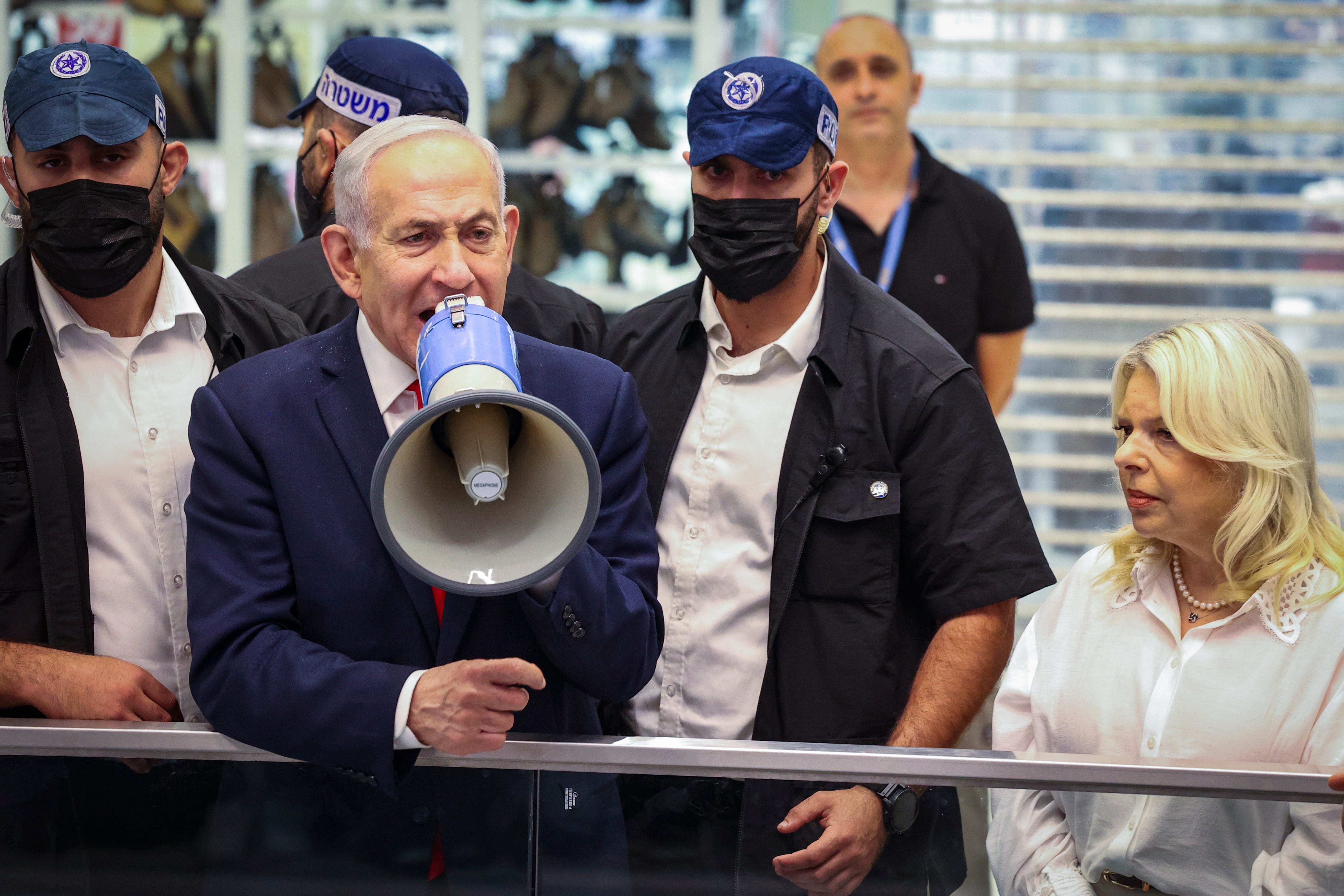
Israeli Prime Minister Benjamin Netanyahu and his wife, Sara Netanyahu, speak with members of the public in the city of Beit Shemesh, just hours before polls close on Israel’s general election day, October 27, 2026. (Yaakov Lederman/Flash90)
It’s still Tuesday, October 27, the first exit polls are out, and the winner of the 2026 Israeli election appears to be the Arabs. As most major polls predicted, no bloc has a definitive majority. Benjamin Netanyahu’s Likud is the largest party in every exit poll, but what comes next remains an open question.
We are now in what might be called the journalist’s danger zone, where an overconfident prediction can stain the rest of your career. In 2015, the exit polls showed Likud and Isaac Herzog’s Zionist Union roughly tied at 27 or 28 seats each, and both camps claimed victory. The final result was Likud 30, Zionist Union 24, a six-seat gap no exit poll saw coming. So let’s stick to what we know.
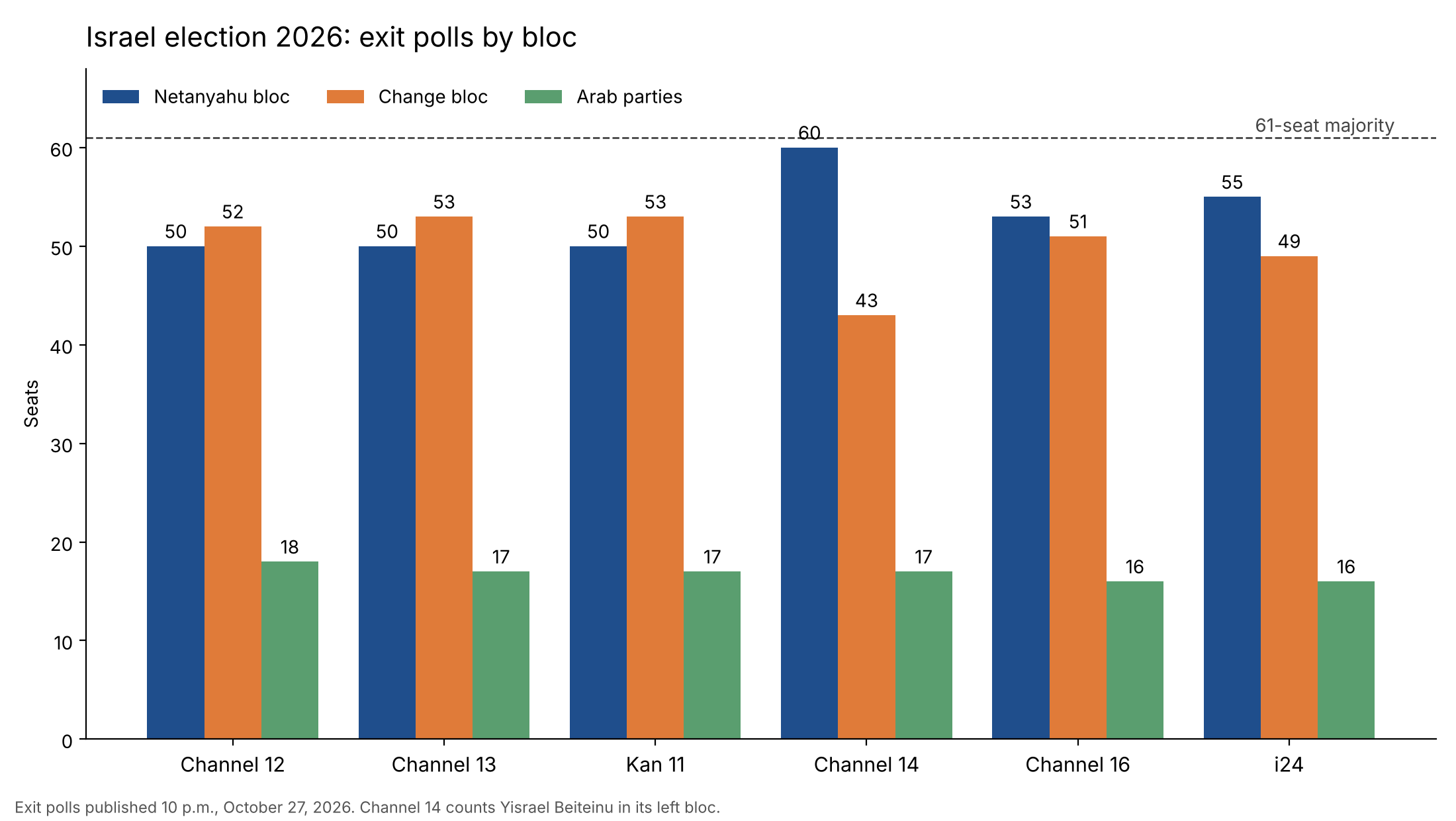
All six exit polls tell the same basic story: Likud is the largest party, with 24 to 30 seats, ahead of Yashar, led by former military chief of staff Gadi Eisenkot, at 19 to 23, and neither bloc reaches 61. Five of the six have Netanyahu’s bloc at 50 to 55 and the change bloc at 49 to 53. The outlier is Channel 14, which gives Netanyahu’s bloc 60. Arab parties hold the balance with 16 to 18 seats, and the parties of Ofer Winter, a reserve brigadier general, and Yoaz Hendel, a former communications minister, fall below the threshold in every poll. In short, no one has a clear path to 61.
Taking the polls at their word, three options remain: new elections, a minority government or unity.
With neither bloc at the magic number in any exit poll, if no one can form a government, Israel goes back to the polls within 90 days, with Netanyahu as caretaker until then. As for a minority government, the prospects aren’t good: the change bloc plus the more moderate Ra’am comes to only 59 or 60 in most polls. That’s enough to beat Netanyahu’s 50 if the Joint List abstains, but it would leave the government dependent on an explicitly anti-Zionist party.
The final option, and one made more likely by tonight’s numbers, is unity. Likud and Yashar win 46 to 49 seats together, and 58 to 62 with former Prime Minister Naftali Bennett’s Beyachad. With the Arab path so fraught, this may be the road Netanyahu and Eisenkot end up taking, though it will be a bumpy one.
In the history of Israeli elections, 2026 will be remembered for a dramatic, historic, unprecedented surge in Arab turnout. Arab voters beat every forecast, including the Joint List’s own internal polling. For most of the day, Arab turnout was actually higher than Jewish turnout, something hard to believe for anyone familiar with the usual 20-point gap, which has now closed. Driven by soaring crime and the promise of a reunited Joint List, they came to the polls in droves, and the exit polls give the Arab parties 16 to 18 seats.
Meanwhile, garments are being rent and calls for repentance echo through the Haredi city of Bnei Brak, as disillusionment over the draft has translated into a drop in turnout. Shas and United Torah Judaism won 18 seats together last time. Tonight’s exit polls give them 12 to 16, and both Channel 12 and Kan have UTJ at six, the number its own officials said they wouldn’t be surprised by.
Here is where we add the asterisks. Shy voters are no more forthcoming on the way out of the booth than on the way in, so surprises may still be in store. Historically, shyness has been a condition of right-wing voters. This time, all eyes are on the Haredi Public party. The exit polls have it below a threshold that tonight’s turnout has pushed even higher, but it may still cut off just enough oxygen to leave the Haredi parties in Netanyahu’s camp gasping.
But the real game changer is the 600,000 or so double-envelope ballots sitting in a presumably very large pile at the Knesset. These are cast away from voters’ home polling stations: soldiers, diplomats, hospital patients, prisoners, polling staff and people using accessible stations. They are not a random sample (soldiers, for example, are young and don’t vote like the general public), and in past elections they have moved a seat or two. With every exit poll placing both parties below the threshold, these ballots are the last hope for Hendel’s Reservists and Winter’s Amcha Yisrael. In 2021, some of the first exit polls had Mansour Abbas’s Ra’am below the threshold, which would have handed Netanyahu’s bloc roughly 61 seats. Ra’am ended up with four, and Netanyahu ended up in opposition.
The election is far from over. Stay tuned.
English Editor: Ari Tatarka
If you enjoy the newsletter, you can show your support by becoming a paid subscriber—it really helps keep this going. I’m also offering a special monthly briefing for a small group of premium members. I’d love to have you join us—just click below to find out more.
Thanks for reading It’s Noon in Israel! Subscribe for free to receive new posts and support my work.


2 comments: 1. Its time to start paying attention to the Arabs. No one should be sitting with representatives who don't believe in a Jewish State of Israel. And in fact, that should be a qualification for anyone running for office. But, crime and other domestic problems are out of control for the Arabs - who are citizens of the country. Now, they are realizing they have power. And they really do have rights that should be respected. If they are treated as equals, maybe they would start to nominate serious candidates who would be contributing members of Israeli Democratic Society. That would be nice. 2. When folks vote for a party that doesn't make the threshold, it would be good if the system allowed them to vote again, so their votes aren't wasted. It would be very interesting to see, once the field is narrowed, where those votes end up in each election. Could totally change the outcomes we see now.
One voter, in the White House, has yet to cast his ballot.
If or when he does, perhaps there is hope for a government of the four right-wing Zionist secular parties (Likud, Yashar, B'Yahad, Yisrael Beiteinu) to form a unity government with 67 MK majority and allow that lone voter the diplomatic achievements he needs in the Middle East to secure his legacy.