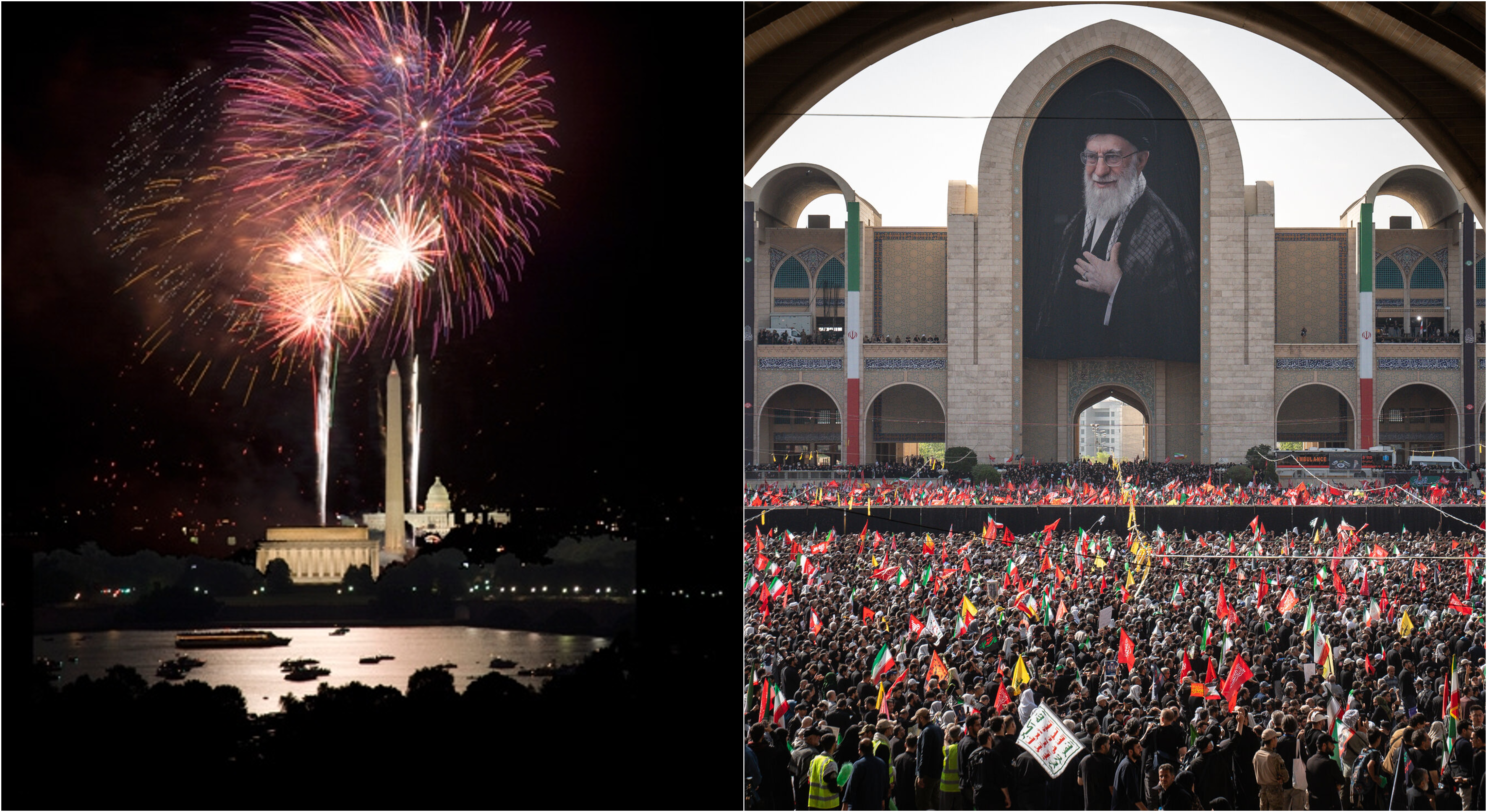
Fireworks and a Funeral
The U.S. Iran honeymoon appears to be over and new documents reveal why Hezbollah didn't join October 7.
Fireworks on 4 of July in Washington DC and the funeral of Supreme Leader Ali Khamenei. (@NationalMallNPS/Leader.ir/X)
It’s Sunday, July 5, and when I think of America, I think of Reagan-era, American-dream action movies—Rocky, Rambo, Top Gun—something just oozing red, white and blue. Over the weekend, I got some déjà vu.
“For 250 years, the United States of America has been the hope, the promise, the light and the glory among all of the nations of the world,” Trump declared in his Fourth of July address on the National Mall, fireworks lighting up the sky behind him.
Cut. Pan the camera. Transition to an entirely different ceremony. “TEHRAN” flashes at the bottom of the screen. Hundreds of thousands of mourners are packed into the Imam Khomeini Mosalla Grand Mosque for the funeral of Supreme Leader Ali Khamenei. An emcee at the podium calls for Trump’s death before the crowd. The response is instant: thousands of voices erupt into “Death to America! Death to Israel!”
It’s been about 10 years since Hollywood stopped casting the turbaned Islamist as the villain in movies like these—but at this point, Iran’s just casting themselves in the role.
Call this the end of the brief U.S.-Iran honeymoon—the stretch where Iran kept acting against American interests but hid it behind a thin veneer of ambivalence and relatively polite rejectionism toward U.S. demands. Now the mask is coming off, and underneath is the exact same face.
In the Strait of Hormuz, Iran is still using threats to compel commercial vessels through its shipping lanes. The calculation is simple: keep threatening and attacking, and countries and international bodies will think twice before facilitating alternative transit routes. Meanwhile, Tehran is floating the idea that it could weaponize both the Strait of Hormuz and the Bab el-Mandeb as leverage if the U.S. violates their memorandum of understanding.
But things seem to be moving. Benjamin Netanyahu has been invited for his seventh trip to the White House during Trump’s second term. If Bibi’s been keeping a punch card, I’d guess the next visit’s free. What the meeting’s actually about remains to be seen—though if my knowledge of 1980s action movies is any guide, it may be something explosive.
An Israeli soldier examines anti-tank ordnance seized from Hezbollah’s Radwan Force in Southern Lebanon. (IDF)
One of the enduring mysteries of October 7 is why Hezbollah’s leader, Hassan Nasrallah, chose not to join in. When Hamas’s Nukhba forces flooded into the south, Hezbollah’s Radwan forces were poised for a similar push in the north—but the order never came.
A newly published set of internal Hezbollah documents, analyzed by researchers at the Amit Institute for Terrorism and Intelligence Research, sheds light on years of coordination between the two Iranian tentacles in the run-up to the attack and why Nasrallah ultimately didn’t pull the trigger.
The alliance faced its first real test two years earlier, during the May 2021 conflict, Operation Guardian of the Walls. Internal Hamas documents reveal that during the operation, a joint intelligence war room was established in Beirut, staffed by Hamas, Hezbollah and the IRGC. Through this channel, Hezbollah supplied Hamas with intelligence on request. Khaled Ghanem, then head of Hamas’s overseas military intelligence, wrote in an internal report that the war room was operational from the second day of fighting through the day after it ended, and that Hamas had requested—and received—information on Israeli military deployments, aerial intelligence activity and fighter jet movements.
That wasn’t the only intelligence Hezbollah seemingly had access to.
One of the most striking disclosures involves the Israeli military’s “Metro” operation—a deception designed to lure Hamas fighters into their tunnel network by making them believe a ground invasion was imminent so Israeli forces could then strike underground. According to the same Hamas intelligence report, it was Hezbollah that tipped Hamas off, roughly two hours before the ground assault began, that the operation wasn’t a real invasion at all but a ploy to draw fighters into the open and build a target bank—effectively exposing the Israeli bluff before it worked. A senior Israeli security official who helped command the operation later confirmed to Army Radio that Hezbollah did indeed play a significant role in unraveling that ruse.
The documents also reveal that Hezbollah helped Hamas avoid the targeted killing of Ahmad Ghandour, commander of the northern Gaza brigade (later killed during the current war), by detecting a buildup of Israeli intelligence surveillance over his location in the Jabaliya refugee camp and warning Hamas roughly two hours in advance that an assassination attempt on a senior figure appeared imminent.
Despite this support—along with tacit approval for Palestinian factions in Lebanon to fire rockets into Israel from Lebanese territory—Hamas came away from the operation disappointed. In one exchange, a senior Hamas official abroad pressed Hezbollah’s response coordinator to push for greater involvement in order to tie down Israeli forces in the north, complaining that Hezbollah’s support so far had been limited.
A year later, in May 2022, a pivotal meeting took place in Beirut: senior Hamas officials sat down with Nasrallah and a senior Iranian Revolutionary Guard general. The Hamas delegation argued conditions were ripe for expanding the conflict with Israel into a full-scale, multi-front campaign—pointing to a wave of terror attacks then sweeping the West Bank and Israeli cities, Israel’s fragile political standing at the time (the meeting came just two days after the ruling coalition shrank to 59 Knesset seats and two months before the Bennett-Lapid government collapsed), and a wave of regional normalization that Hamas wanted to derail.
Surprisingly, Nasrallah didn’t embrace the idea. He told the Hamas delegation the concept was sound in principle and worth discussing, but insisted any campaign first needed clearly defined objectives. Did Hamas expect this confrontation to force a complete Israeli withdrawal? Or was the aim something more limited, like simply preventing Jews from entering the Al-Aqsa Mosque compound—a modest goal, he noted, that wouldn’t require war at all? In effect, Nasrallah was asking Hamas to define its strategy and war aims before he’d commit Hezbollah to anything.
Hamas reported back to Sinwar that they hadn’t yet defined clear war objectives and that Nasrallah remained hesitant. Sinwar responded with his plan.
The most ambitious scenario—internally called “The Second Promise” (later renamed the “Jericho Wall” plan behind October 7)—envisioned Hamas striking with full force in a surprise, multi-front war aimed at toppling Israel. Sinwar called it the preferred option, tying its timing to a Jewish holiday—Passover, most fittingly. This is the first evidence that he didn’t originally target October 7 at all; he was initially eyeing Passover 2023. He also sketched softer scenarios involving partial Hezbollah participation, but in every version treated the Jordanian border as key, envisioning guerrilla forces infiltrating from Syria and Jordan.
Nasrallah responded favorably, calling it a realistic scenario, and said he’d bring it to Khamenei for final approval.
By June 2023, Sinwar appeared confident that Hezbollah and Iran were coming around. Addressing Hamas’s political bureau in Gaza, he said recent efforts had succeeded in pulling both out of what he called their lingering psychological trauma from the 2006 Second Lebanon War, and that they were now highly prepared to form an alliance with Hamas for a future campaign.
Two months before the attack, in August 2023, Sinwar addressed Hamas’s Shura Council, sounding even more certain, telling members that if the great strategic campaign broke out, multiple fronts would open against Israel.
Not everyone inside Hamas shared his confidence. An internal military intelligence document from around that time referenced a lingering “psychological barrier” on Hezbollah’s part, along with hesitation within Hamas’s own ranks about how reliable that support would really be.
None of that seems to have shaken Sinwar. At 6:29 that morning, having caught Israel completely by surprise, he sent a letter to Nasrallah apologizing for the lack of advance warning and urging him to join the fight immediately, asking for a concentrated rocket barrage and a major ground offensive. He was met with silence.
In the hours that followed, Sinwar himself appears to have been stunned to find Hezbollah wasn’t joining him. Only a full day later did any assistance arrive—and even then, it was relatively symbolic in scale.
Had Hezbollah joined the fight as Sinwar expected, October 7 would have been incalculably worse. In the end, it was Nasrallah’s hesitation—not Israeli preparedness—that spared the Galilee from a similar fate.
English Editor: Ari Tatarka
If you enjoy the newsletter, you can show your support by becoming a paid subscriber—it really helps keep this going. I’m also offering a special monthly briefing for a small group of premium members. I’d love to have you join us—just click below to find out more.
Thanks for reading It’s Noon in Israel! Subscribe for free to receive new posts and support my work.


