From Rome to Southern Lebanon
The sixth round of discussions with Israel's northern neighbor, Torah study becomes a constitutional value, and more.
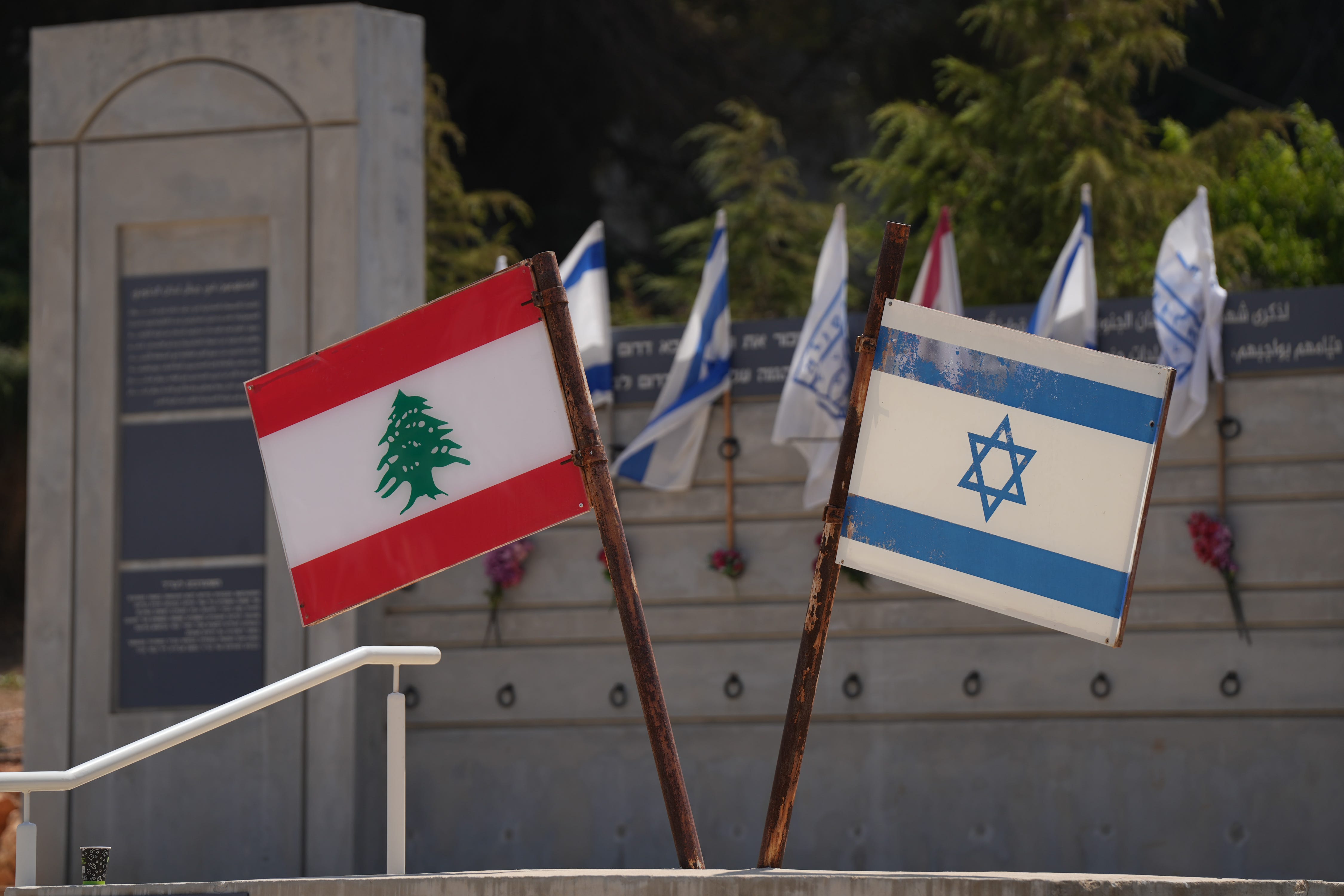
Israeli and Lebanese flags at the South Lebanon Army Memorial near Metula following the signing of an agreement between Israel and Lebanon, June 28, 2026. (Ayal Margolin/FLASH90)
It’s Wednesday, July 15, and Israel and Lebanon are in Rome, on day two of a sixth round of talks—the first since last month’s framework agreement. There is exactly one item on the agenda: the pilot zones.
A quick reminder: the framework agreement signed three weeks ago in Washington essentially gave Israel a lease on southern Lebanon. It stays until it evicts the problem tenant, Hezbollah, at which point the property reverts to the Lebanese army. The pilot zones are the trial run: the IDF demolishes the terror infrastructure, withdraws, and the Lebanese Armed Forces assume its positions.
The problem is that Israel doesn’t trust the LAF, and for good reason. Lebanon has an awful record of asserting its own sovereignty. In the state’s entire history, the only ones to have disarmed a militia on Lebanese soil remain Syria and Israel.
Ahead of the new round, a senior Israeli official told Channel 12 on Monday that the sides will discuss—and likely disagree over—the pace of the pilot program.
“In Lebanon, they are trying to assert as much control as possible over the process, to enable the expansion of the pilot program in the future,” the official told the network. “As far as we’re concerned, as long as the first pilot doesn’t prove itself, there will be no further withdrawals.”
Anticipating that concessions are coming, Israel has already begun demolition operations in the zones—leveling as much terror infrastructure as it can before the LAF arrives to stand around while Hezbollah rebuilds.
The Lebanese know they aren’t ready. President Joseph Aoun heads to Washington next week—a first face-to-face with Trump on July 21—in search of financial support to restructure the Lebanese Army.
At home, he is walking a tightrope. The obvious truth is that for all the government’s militant anti-Hezbollah statements, more than a few of its members support the terror group. His own defense minister flew to Tehran for Khamenei’s funeral, and Aoun defended the trip, insisting Lebanon’s relations with Iran are “ongoing and unbroken.” Some Lebanese officials, meanwhile, learned of the Rome talks only when Israel announced them publicly.
Lebanese President Joseph Aoun discussing the security situation in the country with Army Commander General Rudolphe Haykal. (@LBpresidency)
Two weeks ago Aoun denied rumors that he was prepared to dismiss army commander Rodolphe Haykal and the heads of the security agencies, calling the claims “unfounded.” “Their roles remain vital to maintaining national security and enforcing state sovereignty,” he said. I would amend that to: preserving the status quo.
When Hezbollah joined the fight after Operation Roaring Lion began—revealing itself to be nothing more than an Iranian cutout—the cabinet ordered Haykal to disarm the group. He refused. There is a word for this: mutiny. The cabinet did not press the issue, for the same reason the Lebanese never press anything: fear of civil war. The Americans, the French, and the Saudis have all pushed for Haykal’s dismissal, and will likely do so again when Aoun lands in Washington.
Then there is the problem of Parliament Speaker—and Hezbollah cutout—Nabih Berri. In his reassurances about Haykal, Aoun struck a conciliatory but pointed tone. “I commend Speaker Nabih Berri’s stance in averting civil strife,” he said. “We are all in agreement that strife and targeting the military are strictly forbidden.”
Berri has been less delicate: “If they touch the army or its commander, we will never remain silent.” He has been openly hostile to the agreement from day one. The direct negotiations that produced it, by his account, “brought no truly positive results for Lebanon”—though he allowed that he would welcome the framework “if they manage to secure a withdrawal, the return of displaced Southerners to their villages, the liberation of Lebanese prisoners in Israel, and reconstruction.” Disarmament did not make the list. Neither did sovereignty. The list, give or take an item, is Qassem’s. On Lebanon’s aims for the talks, Berri told al-Joumhouria: “In the end, what matters to me is to eat the grapes, not to kill the vineyard keeper.”
The vineyard keeper and Iranian proxy, Hezbollah, meanwhile, is working through the five stages of grief, having finished with anger at the agreement they have arrived at bargaining. The group is now recasting itself as a willing partner of the Lebanese government and a devoted guardian of the internal stability Beirut prizes. Senior officials, Secretary General Naim Qassem among them, have spent recent weeks insisting that Hezbollah seeks national unity and supports the LAF’s deployment to the south. It has even granted the army permission to deploy “wherever it wishes”—provided it does not “approach” Hezbollah positions, and provided the government secures an Israeli withdrawal before anyone raises the subject of disarmament.
In sum: nothing has changed. They have simply realized that honey slows peace down better than vinegar.
The Rome talks are likely to end with declarations of progress on pilot zone implementation. In a reversal of the usual pattern, the gap between what gets announced and what happens on the ground will run the other direction: the LAF will eventually deploy, but slower than the communiqués suggest. If the first pilot zone does not immediately collapse, more are likely to follow, incredibly slowly.
Members of Knesset attend a plenum session on a bill proposes to enshrine Torah study in a basic law at the assembly hall of the Knesset, July 13, 2026. (Chaim Goldberg/Flash90)
Torah study is now a “foundational value” of the Jewish people and the State of Israel, according to a quasi-constitutional law passed last night. The outraged response has nothing to do with the value of Torah study itself and everything to do with what the law makes possible: mass exemption from military service.
The original Basic Law was more direct. It equated long-term Torah study with military service—both would be recognized as “meaningful service” to the state. That clause was scrubbed following intense pressure from every non-Ultra-Orthodox coalition party. What remains is the legal architecture for draft avoidance: a gambit to insulate the exemption from the High Court’s reach with a new constitutional principle.
The gambit is almost certainly futile. The High Court does not care whether the law carries a quasi-constitutional label. It has public opinion at its back and will strike it down without hesitation—accepting the nominal constitutional crisis that follows, in which a court voids the very legislation intended to constrain it. It also has the option of treating the measure as merely declarative—not binding legislation—making the entire effort at deriving exceptions pointless. The outcome will be the same regardless: the court will demand that the Ultra-Orthodox draft.
So why pass legislation Netanyahu knows will be struck down? Because Torah study is not his core value. Three more months in office is. And this was the Ultra-Orthodox price for remaining in coalition. When the court inevitably rules against them, the Ultra-Orthodox will wail. When they come crying to Netanyahu, he will shrug and say he promised them effort, not outcome.
The real gamble is whether he can absorb the damage. Elections are 104 days away. He is betting on improved security conditions to move the needle. He is playing with narrow margins: the opposition is just two or three seats from a majority, all it would take is 60,000 defections to transform him from prime minister to leader of the opposition.
He is gambling that Israel’s strategic situation will drastically shift in the next three months. That is entirely possible. What is not clear is whether it shifts for the better.
Me at the primaries for the Likud party, at the Tel Aviv Likud polling station on February 5, 2019. (Gili Yaari/Flash90)
In a bizarre kind of good news, a newly published official document offers a rare glimpse into the Islamic Republic’s hate list. Iran’s Ministry of Intelligence has compiled a detailed blacklist of entities it deems “hostile” to the regime—dozens of media outlets, journalists, researchers, advocacy activists, and influential social media accounts, alongside the major international news organizations.
The directive was published on Monday, without apparent embarrassment, on the regime’s own legal portal, and it warns that cooperation with anyone on the list is grounds for criminal prosecution under Iran’s espionage law.
Topping the media list are Israel’s three main television channels—Channel 12, then Channel 13, then Channel 14. Immediately behind them: BBC Persian, Iran International, Voice of America Persian, Radio Farda, and IranWire. Among the individuals named are Yosef Haddad, Emily Schrader, and—it would be false modesty to omit—myself.
There is no greater compliment than being deemed a threat by a paranoid dictatorship. I’ll gladly take FDR’s advice and ask to be judged by the enemies I have made.
Thank you, Iran—it’s a true honor.
English Editor: Ari Tatarka
If you enjoy the newsletter, you can show your support by becoming a paid subscriber—it really helps keep this going. I’m also offering a special monthly briefing for a small group of premium members. I’d love to have you join us—just click below to find out more.
Thanks for reading It’s Noon in Israel! Subscribe for free to receive new posts and support my work.


Congrats on the badge of honor! May those who compiled the list not have the opportunity to make an update. 🤣
The court really has no jurisdiction when it comes to who serves in the military. Yet another place they have inserted themselves without a shred of legal basis