From Yellow to Blue and White
Also, the decision that needs to be made, behind the scenes of the hostage return, and more.
Itzik Gvili welcomes his son Ran home after 844 days. (IDF)
It’s Tuesday, January 27, and it is still sinking in. After 844 days, the final hostage, Ran Gvili, is home. With the return of Hadar Goldin and Oron Shaul—taken during Operation Protective Edge in 2014—this marks the first time in 4,208 days that there are no Israeli hostages in Gaza.
As a reporter, my job is to make events clear—but a moment this large in the national consciousness resists encapsulation.
Let’s begin with the testimony of the commander of Operation Brave Heart, Lt. Col. Eliasaf Verman:
“We dug with our hands for entire nights. We worked on a conveyor belt—nonstop. We entered on Sunday at four in the afternoon and kept digging by hand, continuously, in freezing cold. We pulled hundreds of bodies from the ground.
At a certain point, I saw the doctor on site. She told me, ‘Bring me one of the findings immediately.’ I saw her hands shaking over the instruments. As the examination went on, I saw her eyes redden and a tear fall. Then I looked at her and saw a smile.
For us, a very meaningful circle was closed.”
At 3:50 p.m. yesterday, Ran's recovery was announced, and 10 million Israelis breathed a collective sigh of relief. Soldiers who took part in the operation burst into tears; others shouted in celebration. The October 7 war had finally ended.
Countless aspects of the operation pull at the heart:
The participation of Fauda star Idan Amedi, who joined Operation Brave Heart after recovering from a near-fatal injury in Gaza. Ran being found in the same uniform he donned on October 7, when he left his home to fight. The stirring rendition of the ancient Jewish song of faith, Ani Maamin (“I believe”), sung by the soldiers who took part in the operation.
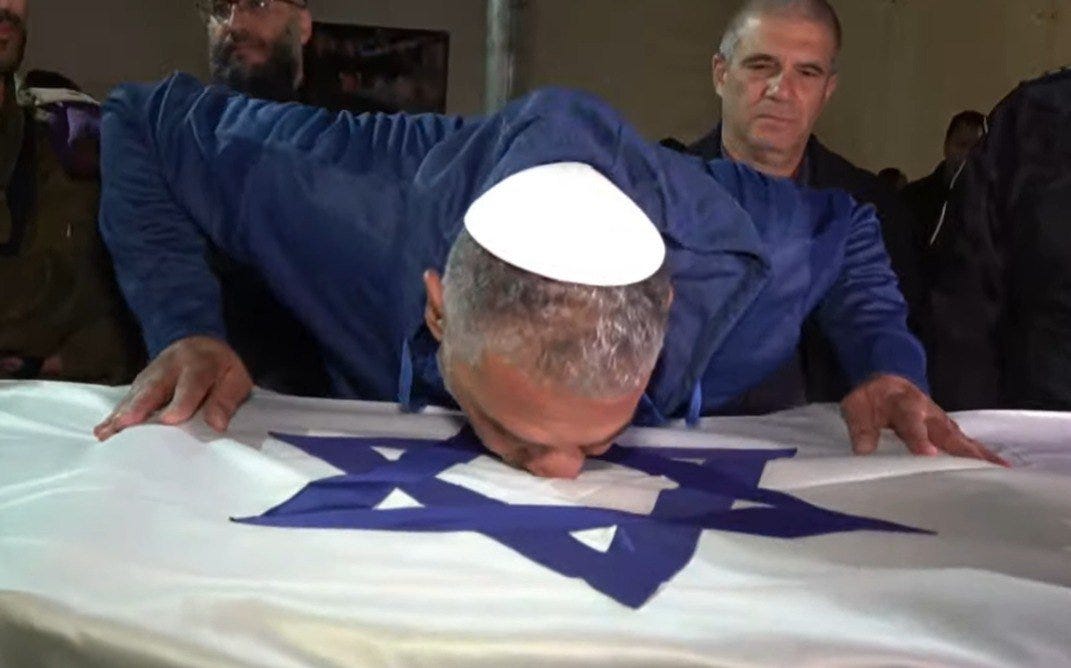
The images are just as emotional: Ran’s coffin draped in an Israeli flag; IDF soldiers pressing forward to place a hand on the casket; Ran’s father, Itzik, leaning down to kiss its surface—welcoming his son home while saying goodbye. Itzik, arm in arm with Ran’s commander, singing Israel’s national anthem, Hatikvah (“The Hope”).
But one thing I cannot stop thinking about is the ribbons.
If you’ve visited Israel since October 7, you’ve seen them: every street sign, fence, and telephone pole wrapped with a thin yellow string. In restaurants, offices, and countless homes, an empty place was set—inviting those still in captivity to remain present in everyone’s thoughts. After two years, the ribbons are faded and worn, but in the heart of every Israeli, they are just as tightly wound as on October 8.
Now, at last, we see them come down. The pins that have decorated every politician’s lapel are removed. The seats left empty for two years are filled. And that ribbon bound on every heart is finally untied.
The moment feels truly biblical. Psalm 126 describes what it will be like when the captives return to Zion. For those who couldn’t imagine this day would come—and there were many—the psalm’s opening line, that those who witness the return “will be like dreamers,” feels apt. But one part of the psalm speaks to me now: “Those who sowed with tears will reap with joyous song.”
Israel has sown in tears long enough; may we at last begin to reap in joy.
Gilad Shalit reunited with his parents after being held hostage by Hamas for five years in 2012. (IDF)
There is a saying in the Talmud about the return of bodies after a massacre by the Roman Empire: On the day the Martyrs of Beitar were returned for burial, it became possible to recite the blessing “Hatov veHaMeitiv” (“Who is good and does good”). It always sounded strange. For this, you say Hatov veHaMeitiv?
When we see these images, 1,891 years later, we really don’t need commentary to explain them to us.
After saying this and allowing ourselves to feel moved, we need to state the bitter truth.
Any Israeli who reads this could soon be a hostage, the daughter of a hostage, or the parent of a hostage—because the conclusion our enemies have drawn from the last two and a quarter years is that Israeli blood is cheap and hostages are expensive. Very expensive.
Israel crossed quite a few red lines over the past two and a quarter years to bring hostages back. Israel allowed massive strategic concessions and the release of hundreds of murderers and terrorists for its people. In most cases, this was done with almost full consensus. The fierce debate over what comes first—saving lives now or risking lives in the future—is in the past. Let’s hope it never returns.
But for it not to return—and not to tear Israeli society apart once more, we need a consensus between right and left, religious and nonreligious, God forbid Bibi or only Bibi—the time has come, now, on the day after, to restore the rules.
Now that there are no hostages—no mothers looking at us with pleading eyes, saying: “Don’t impose your new rules on the blood of my son” we can focus.
Israel has had these rules for almost 15 years; they were simply never implemented.
After the 2012 return of Gilad Schalit at the cost of more than 1,000 terrorists with blood on their hands—including Yahya Sinwar, the mastermind of October 7—a committee chaired by High Court Justice Meir Shamgar produced a report setting out clear principles for hostage exchanges:
Hostages should be exchanged for a single-digit number of terrorists per hostage.
Bodies only in exchange for bodies.
No payment of broader strategic prices for hostages.
It was never legislated. But now the excuses are over. The discussion is over. This needs to be done immediately.
Once, I met with opposition leader Yair Lapid and asked him whether he would shape or change his strategy based on polls. He told me: “Listen, if you change your strategy during a crisis, then it was never a strategy—it was a tactic.”
The same applies here. If Israel thinks the Shamgar Report is not suitable for dealing with such situations, fine—discard it and write a new report. But what cannot happen is reaching the same place Israel has arrived at over the last 15 years, facing utterly unimaginable costs, and then continuing to pay them.
Because everyone in our region knows exactly what needs to be done to paralyze Israel.
I suggest everyone think about what would have happened if the Iranians had kidnapped 15 Israeli tourists in the UAE and transported them to Iran. Or what would have happened if Hezbollah had done something similar on October 7?
This is the time to make the decisions, so that Israel does not find herself ripped apart again.
U.S. ambassador to the UN Mike Waltz speaking to Israeli Mission at start of Hanukkah 2025. (@USAmbUN/X)
Getting Ran and the rest of the hostages home was no easy diplomatic feat. Journalists like to speculate that, behind the scenes, the U.S.–Israel relationship is more fraught than it appears. The hostage effort suggests otherwise.
Washington made it clear to the mediators—Qatar and Turkey—that the living hostages will be returned immediately, and the bodies would follow right after. The U.S. warned that if they fail in this, they would not be invited to mediate again.
At the time, the hostages were classified by the difficulty of recovery. Ran Gvili was ranked second-hardest, after Thai hostage Suthatisak Rintalak, who was returned on December 3.
It’s worth noting that despite U.S. pressure, Hamas barely helped in the recovery Ran. Despite the 104 day extention on Hamas’s 72-hour deadline, the key intelligence seems to have come from an Islamic Jihad operative captured in southern Gaza City and interrogated by IDF intelligence. Hamas dragged its feet for months on the search and sharing of intelligence; in the end, it took an IDF operation—which Hamas fiercely resisted—to bring him home.
Back to the behind-the-scenes story:
U.S. Ambassador to the U.N. Mike Waltz had a speech ready for Wednesday declaring there would be no Phase Two without Ran Gvili. Thank God it wasn’t needed—but it underlines American commitment to the mission.
As for what comes next, a senior American official says Israel’s security remains the first principle. The goal is full demilitarization. There’s certainly a debate over how to achieve it, but the order of operations is clear: Israel’s security first; everything else follows.
Yesterday I joined BBC’s The World Tonight to share some thoughts on the national mood after the return of the last hostage.
There is one final thing I need to mention:
At the entrance to the Knesset stands a memorial—an eternal flame burning above a pool of water—in memory of the fallen soldiers of the IDF.
Foreign visitors consistently ask if it is a monument to the Unknown Soldier, and each time it must be explained: in Israel, there is no such thing as an unknown soldier. Because in Israel, every possible effort is made to redeem every fallen soldier from anonymity and to bring each one home for burial.
It is not for nothing that the President of the United States repeatedly expressed amazement at the families’ desire that their loved ones be brought to rest in the Land of Israel.
The fact that the most recently fallen soldier was brought back in an operation that involved thousands of soldiers, into the very heart of the inferno, searching through the bodies of a cemetery in Gaza, only emphasizes this national commitment.
Engraved on the memorial is a line from the poetess Lea Goldberg: “In their blood the morning shall rise.”
For two years, Israel was frozen at 6:30 a.m., October 7.
But the morning is finally over.
If you enjoy the newsletter, you can show your support by becoming a paid subscriber—it really helps keep this going. I’m also offering a special monthly briefing for a small group of premium members. I’d love to have you join us—just click below to find out more.


You have such a beautiful and poignant way of using g words to capture emotions that are so powerful, most of us cannot find the words to describe them. You are accurate and balanced in your approach. The one time I would dare correct you, is in your claim that 10 million Israelis can now move on. There are millions of us in the diaspora, who have suffered and ached alongside you. Those of us in the diaspora for whom the world changed on October 7th are rejoicing with the dawn of a new day, and praying for comfort for the almost 100 families for whom the unbearable pain does not heal today. We join Israelis in עושר, בכי וצחוק. Today and always.
May his memory forever be for a blessing.