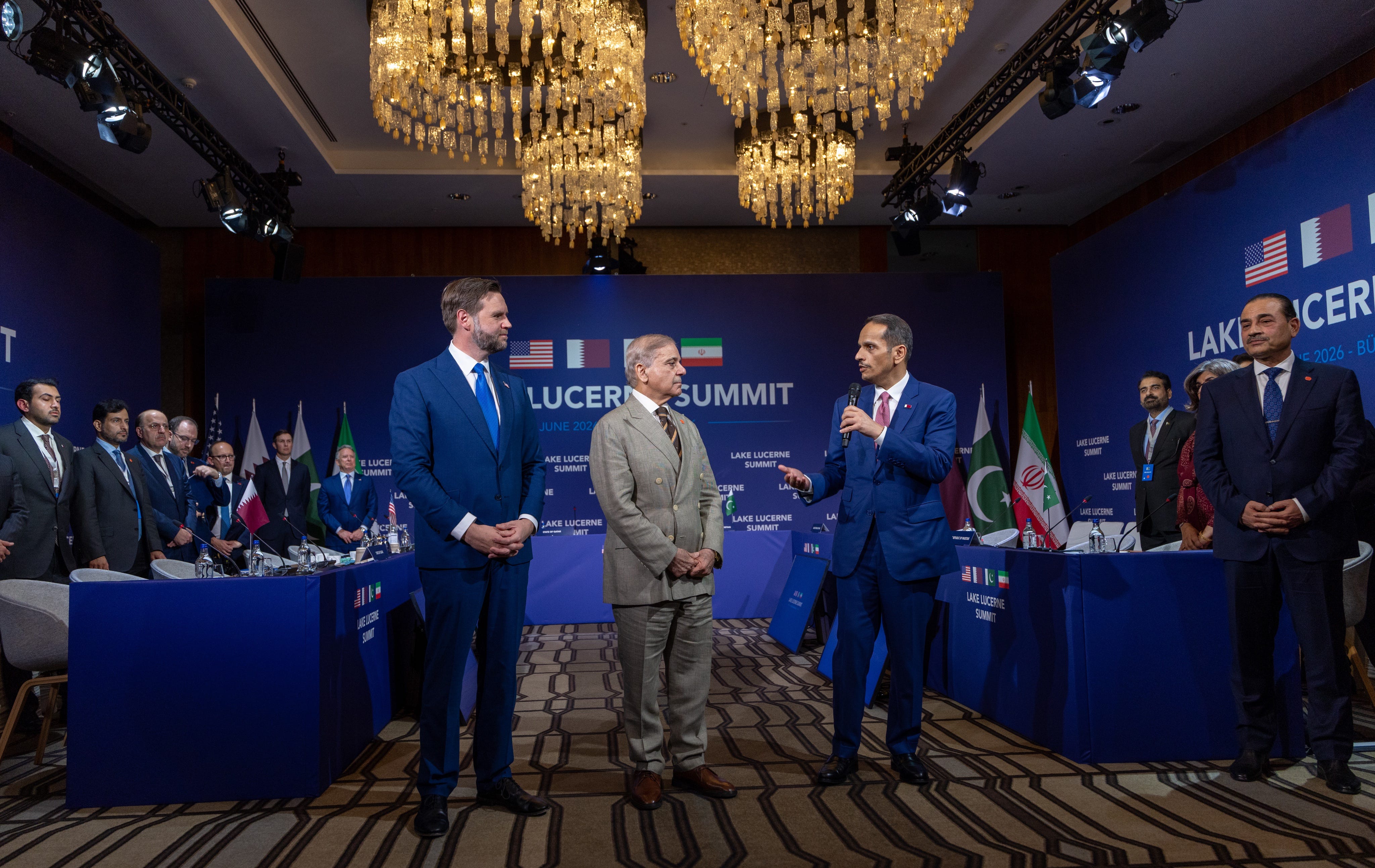
Geneva Talks II: Ultimately Pointless
The first round of talks has concluded and, as always, the U.S. has little to show for it, and more.
Qatari Prime Minister and Minister of Foreign Affairs Sheikh Mohammed bin Abdulrahman bin Jassim Al-Thani leading Qatar's delegation in Geneva yesterday. (@MofaQatar/X)
It’s Monday, June 22, and Vice President JD Vance is hailing the Geneva talks as “historic,” pointing to the unprecedented level of face-to-face engagement between U.S. and Iranian leaders. Historic indeed—rarely have the two sides been close enough for Iran to spit directly in Washington’s face.
After eighteen hours of “intensive” talks, the second major round of U.S.–Iran negotiations in Geneva this year concluded with Tehran projecting absolute confidence and Washington walking away with little of substance to show for it.
Reports swirled yesterday that negotiations had already been derailed, after Trump warned the Iranians to restrain Hezbollah or be struck again, “harder.” In response, the Iranian delegation walked out, threatening to boycott the talks unless Trump issued an apology and Israel fully withdrew from southern Lebanon. Neither outcome materialized. Instead, mediators circumvented the roadblock by establishing a “High-Level Committee” for overseeing further technical discussions and a joint “de-confliction cell,” involving Lebanon, to monitor and halt military operations.
What does this mean for Israel? Iran’s maximalist posturing is driven by necessity: the regime must signal strength to an increasingly fractured hardline base at home while reassuring Hezbollah that it is not abandoning its most powerful ally and core deterrence asset. But the posturing is also engineered to pay off. Clause 13 of the MoU holds that talks on a final nuclear deal begin only once the U.S. implements clauses 1, 4, 5, 10, and 11—a ceasefire on all fronts including Lebanon, the lifting of the naval blockade, the reopening of Hormuz, oil-sanctions waivers, and the release of frozen assets. By design, then, the longer Tehran can keep Lebanon lodged as a roadblock, the more frozen assets it reclaims and the more oil it exports—all before conceding a thing on its program. Fittingly, Iran’s negotiating team focused solely on implementing these clauses; Iranian media noted that not one member of its “nuclear committee” even made the trip.
So while the optics are ambiguous, we shouldn’t assume the U.S. has abandoned the Israeli position in southern Lebanon. Given what Iran had to gain by making the maximalist demand, it was inevitable. Ultimately, Tehran may settle for a half-victory in Lebanon, halting Hezbollah’s active degradation rather than forcing a full withdrawal, in exchange for a fuller victory in the economic or nuclear arena.
Meanwhile, Trump’s idea of handing the fight against Hezbollah to Syria seems never to have reached the table. In a Fox News interview yesterday, he said he was “disappointed Israel can’t put Hezbollah away.” “They can’t do anything without knocking buildings down,” he added. Praising the Syrians as more “precise,” he went further: “I’m close to giving it over to Syria.”
Syrian President Ahmed al-Sharaa, May 2026. (@AH_AlSharaa/X)
Syrian President Ahmed al-Sharaa responded to the offer with a polite but firm no thank you, insisting Trump’s remarks had been “misunderstood.” Trump wasn’t proposing a Syrian invasion, al-Sharaa said, but pointing to Syria’s role in seeking “a safe and peaceful solution.” Credit to the former jihadist for the restraint—an American offer to march into Lebanon would have had either of his Assad predecessors salivating.
Given the flat rejection, we’re unlikely to see Syrian troops rolling into southern Lebanon, and it was an absurd prospect to begin with. But the image of ex–al-Qaeda fighters squaring off against Hezbollah is too entertaining to pass over. There is a historical irony in the prospect: Syria does hold the best record of disarming Lebanon’s militias. As the power broker behind the 1989 Taif Agreement that ended the civil war, Damascus oversaw the disbanding of nearly every armed faction in the country—every one except Hezbollah, which it intentionally spared, claiming it was not a militia but a “resistance force” justifiably fighting Israel. For a moment it seemed as though they would have to finish what they started over thirty years ago. The notion that the Syrian regime would be more “precise,” though, is the real joke: it’s true they won’t be flattening buildings—Israel destroyed their ability to do that with their air force in 2024—but the Alawites and Druze can attest to the regime’s idea of precision when it comes to minorities.
On the files beyond Lebanon, Iran again came away ahead—largely because so little was pinned down. U.S. negotiators pressed for firm guarantees on freedom of navigation in the Strait of Hormuz. The current 60-day interim agreement lets commercial shipping pass through the chokepoint unimpeded, but current drafts leave a loophole: they do not explicitly bar Iran from imposing transit tolls in the future—a gap the U.S. is likely working to close.
In exchange for tentative commitments, Iran pursued its main goal: immediate, front-loaded financial relief ahead of any binding nuclear concessions. According to Iranian state media, the delegations drafted provisions for “temporary sanctions waivers for oil and petroleum derivatives”—a key concession that would let Tehran sell crude legally on the open market and unlock billions in frozen assets, such as those held in Qatari banks, to shore up its economy. The regime affiliated Fars News reported that Iran still expects the United States to imminently release $12 billion in Iranian assets, which it claimed includes a planned $500 million “test purchase” from Iranian assets in Qatar.
The most positive outcome from the U.S. perspective was agreement on a “roadmap” to a final deal within sixty days. Color me skeptical. A roadmap is a schedule, not a meeting of minds, and the two sides have spent this entire round proving they read the last text they agreed to completely differently. Layering a sixty-day clock over that gap doesn’t close it. It just guarantees we’ll be here again in sixty days, watching the same argument over interpretation play out against a deadline one side has no interest in meeting.
Leaving the negotiations, Iran’s Foreign Minister Abbas Araghchi hailed “major progress” and mediators called the talks “encouraging.” Washington offered its usual post-Iran refrain: vague, upbeat phrasing stretched thinly over an obvious lack of enthusiasm.
In Geneva, Vance opted to answer a question in the Jewish manner—with another question. “The question before us now is how much more can we accomplish together? Can we turn over a new leaf?” he told reporters. If you ask me, the answer is no: Iran is high on victory and in no mood to make any but the lightest of concessions. As the Iranians grow increasingly bold, the question is indeed whether the two sides can turn over a new leaf—not from war to peace, but from a dynamic in which Iran wins every negotiation to one in which the U.S. stops handing it the victory.
Hamas militants and ordinary Gazans on the Israeli side of the security fence on October 7. (Abed Rahim Khatib/Flash90)
“The only electrical appliance that Yahya Sinwar hangs around,” Gadi Eisenkot said during the war, “is a 25-watt light bulb, and even that is not certain.” The Hamas leader loathed cellular phones, conveyed his messages on notes or by faxes (!), a recipe for longevity and avoiding assassinations.
It was somewhat surprising, therefore, to discover that the arch-terrorist was shot to death by IDF soldiers while wearing a running watch, the kind that transmits, or can transmit, data on routes, speed in km/h, and other goldmines of intelligence. His belongings, like a change of underwear, a vest, and a uniform, appear in a rare, difficult, and essential exhibition to visit, called “Return to October” at the Intelligence Heritage Center, somewhere in central Israel. Meters away, they are now renovating the memorial center for the fallen of the intelligence community, including the fallen without a name, or picture, or circumstances of falling.
The dark rooms and tunnels where the exhibition is housed manage to recall the depth of the murderousness that burst like a tidal wave of evil into Israel’s borders. There are abduction videos there that have never been seen before. In the corner of one room stands a hoe, as if someone forgot it. And then the horrific clip is screened in which, with that same hoe, a Hamas murderer decapitates a Thai worker while he is still alive. There is unbearable documentation there of a lynch of IDF soldiers in one of the tanks that would become a symbol.
The time that has passed has a tendency to blur and repress the fact that what happened here was an attempted genocide that was simply halted in its tracks after a few hours thanks to the heroism of individuals and the delayed recovery of the Israel Defense Forces. The Nukhba terrorists were given abduction kits (zip ties, sedatives, equipment for live broadcasting), instructions for preparing toxic gases “for synagogues, schools, and homes” and standard-issue jihad manuals (fatwas and books explaining why there is an obligation to slaughter Jews). The center’s staff did not locate material ordering rape; this was apparently a spontaneous local initiative, for both men and women.
Gaza is today the quietest front; there are Israelis who probably tend again to underestimate the dimensions of the neighbors’ lust for murder and blood. The visit to the exhibition testifies to a satanic Nazi plan in its scope to kill Jews. The evidence regarding the Gazans themselves, who knew and enthusiastically encouraged Hamas, reminds us that they are the “and their helpers.” It is worth remembering that the only ones in the Middle East besides the Israelis who democratically elected their leadership are the Gazans, who continue to support them to this day. Like with Germany 1945, Gaza 2026 also needs to be treated in both ways: encouraging emigration and de-Nazification.
This is an excerpt from my weekly column in Israel Hayom.
English Editor: Ari Tatarka
If you enjoy the newsletter, you can show your support by becoming a paid subscriber—it really helps keep this going. I’m also offering a special monthly briefing for a small group of premium members. I’d love to have you join us—just click below to find out more.
Thanks for reading It’s Noon in Israel! Subscribe for free to receive new posts and support my work.


Thank goodness for Amit and his daily column as he is the only one out there telling the truth, not simply telling people what they want to hear. Trump is proving weak, the Iranian leadership proving murderous and the Israeli government not aggressively going in to dismantle Hezbollah root and stem as they worry too much about US ever-changing positions.
Hamas had proven that only extreme vigilance and extreme military aggressiveness will protect Israeli’s and will even protect the Jewish diaspora.