
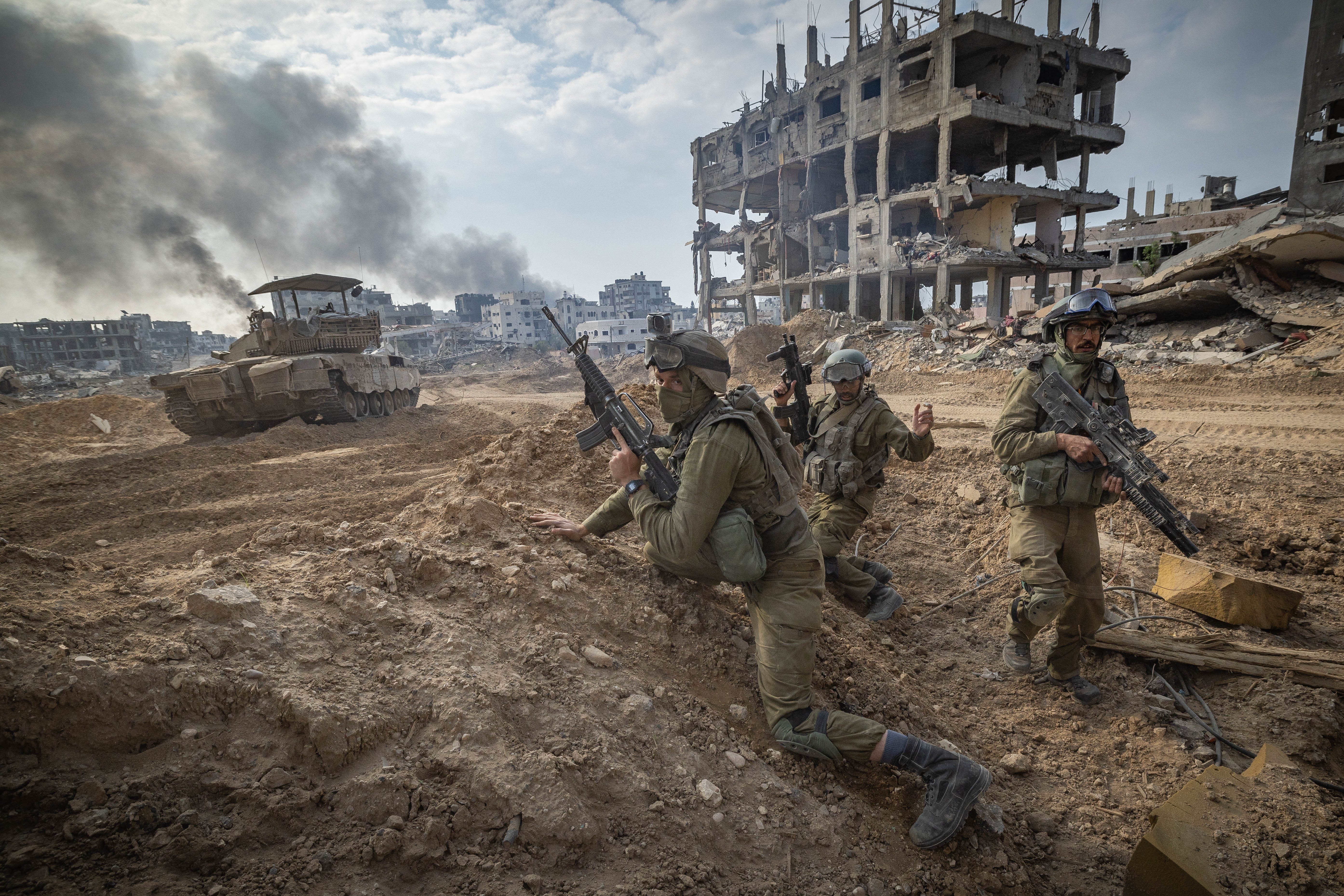
Israeli soldiers from the 8717 Battalion of the Givati Brigade operating in Beit Lahia, in the northern Gaza Strip, during an Israeli military operation in the Gaza Strip, December 28, 2023. (Yonatan Sindel/Flash90)
It’s Monday, October 12, and it took a Holocaust scholar six days after October 7 to accuse Israel of genocide in print, and South Africa less than three months to take the charge to the International Court of Justice. The Gaza Ministry of Health beat both to the punch: its count began with the first Hamas gunman to fall in southern Israel.
So far, researcher Salo Aizenberg has identified by name 364 Hamas attackers killed on October 7. Eighty percent of them appear on the Health Ministry’s list, counted among the victims of the “genocide.”
This not-so-subtle sleight of hand has been there for anyone to see for years. Of the 692 Gazans the ministry lists as dying on October 7, 2023, 646, or 93 percent, were men of fighting age. Most of the children recorded that day were boys aged 14 to 17.
More recently, under the October 2025 ceasefire, Israel returned roughly 400 Palestinian bodies to Gaza. To help families identify them, the Health Ministry published photos of the bodies along with the names of those already identified. Of 396 bodies listed, 91 have been named.
All 91 are on the ministry’s casualty list. All are men between 18 and 60. Sixty-three of them, 69 percent, are listed as having died on October 7, 2023, the day they crossed into Israel. Only three are listed as dying at any point between mid-November 2023 and the ceasefire, nearly two years of war. Twelve are recorded as dying after the ceasefire began, which for bodies dead this long most likely means no one knew the date and logged the day they came home. At least 23 have already been claimed as “martyrs” by Hamas’ Qassam Brigades or Islamic Jihad’s al-Quds Brigades.
All of them, regardless, made it into the database as victims of a supposed genocide.
But that’s not all. Roughly a third of the 91 were on the list before their bodies came back, and 26 were still on the last list published before the ceasefire. A Gazan family can report a presumed death with no body and no location, and the ministry will count it. That may be understandable for grieving families. It is not how you build a casualty count anyone should cite as evidence of genocide.
Add this to the mounting blows against the genocide accusation, and the charge is faltering. On Friday, the Nobel Committee tried to shore it up by awarding its Peace Prize to Navi Pillay, the South African jurist whose U.N. commission accused Israel of genocide last year. The infinitesimal courage it took to condemn Israel from a U.N. commission does not earn her a place beside laureates like Nelson Mandela, Elie Wiesel and Yitzhak Rabin, though she would have a comfortable seat beside Yasser Arafat.
The committee honored her for her efforts to promote “peace and international law.” Yet few things have done less to advance peace and international law than the genocide libel. The accusation did nothing to hasten the end of the war or the suffering in Gaza. If anything, it prolonged both by generating American pressure that could not stop Israel, only delay it. As for international law, the genocide campaign degrades law’s most basic principle: impartiality. In the trial of international law, its blatant anti-Israel bias is Exhibit A.
If President Donald Trump would kindly return Venezuelan opposition leader María Corina Machado’s medal and take Pillay’s instead, everything would be where it belongs.

Former Israeli Attorney General Avichai Mandelblit seen leaving the Jerusalem District Court after testifying in the corruption trial of Prime Minister Benjamin Netanyahu at the Jerusalem District Court, October 11, 2026. (Chaim Goldberg/Flash90)
Sixteen days before the election, a trial Benjamin Netanyahu was long accused of trying to escape is now accused of being timed to help him win. The cause for this change is the testimony of the man who first indicted him, former Attorney General Avichai Mandelblit.
Seven years after he indicted the prime minister, Mandelblit took the stand at the Jerusalem District Court as a witness for the defense. In no hurry to hand Bibi a boost so close to the election, he had asked to push his testimony to November or December, citing his duties as dean of the law faculty at Ramat Gan Academic College. The court said no.
As the late Supreme Court President Miriam Naor once remarked, this is not just Netanyahu’s trial. It’s also Mandelblit’s. Indicting a prime minister, let alone one as prominent as Bibi, defines a career. On the stand, Mandelblit would face the possibility of being remembered either as a crusader for justice or a patsy who caved to his subordinates’ pressure to prosecute a controversial prime minister.
He certainly did not cast himself as the former.
The head of the prosecution, in the most important trial of his term, arguably the most important since the founding of the state, the Eichmann trial aside, with every possible distinction between the two, admitted that he had never reviewed the 315 Walla article that made up the alleged bribe Bibi received in exchange for regulatory favors to Bezeq owner Shaul Elovitch.
More central to the defense’s claim of deep-state interference was this exchange. Asked by Netanyahu’s attorney, Amit Hadad, whether he had approved every investigative step, Mandelblit answered: “In retrospect, that’s not true.” Pressed on whether that included serious steps, he agreed. He called the pressure on state’s witness Nir Hefetz improper and said the wiretap on Netanyahu confidant Natan Eshel went ahead without his authorization. He told the court he demanded it be stopped at once.
Mandelblit maintains he was not required to sign off on every police action, that this is permissible, and that he approved all the principal steps. The prosecution flatly rejects the defense’s claim that the investigation was never properly authorized. The trouble is that even on the prosecution’s own account, there was no clear, formal approval. Its case rests on what can be inferred from the minutes of meetings in his office.
So is calling Mandelblit before the election a campaign move? Of course it is. That doesn’t make the answers any less embarrassing.
English Editor: Ari Tatarka
If you enjoy the newsletter, you can show your support by becoming a paid subscriber—it really helps keep this going. I’m also offering a special monthly briefing for a small group of premium members. I’d love to have you join us—just click below to find out more.
Thanks for reading It’s Noon in Israel! Subscribe for free to receive new posts and support my work.

