Has Trump Turned His Back on Israel?
Also, a lie about settler violence, and the voter that's supposedly impossible to find.
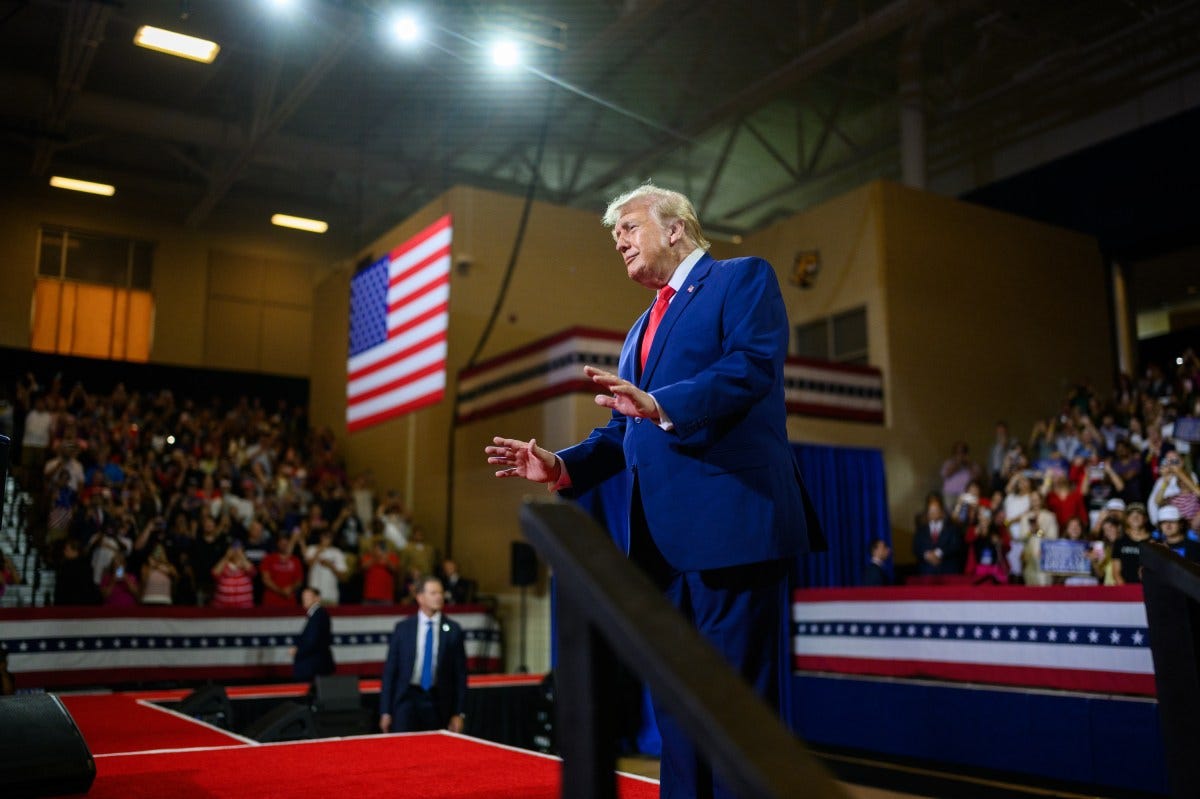
Donald Trump delivers remarks on Trump Accounts. (White House)
It’s Sunday, July 26, and “There’s never a dull moment, it’s either a scandal or a festival.” That’s the Naomi Shemer line that came to mind this weekend, watching the most recent installment of “Has Trump Turned His Back on Israel?”
This week’s installment: the Turks, ruled ineligible for the F-35 program over their Russian S-400s and direct support to Hamas. It follows the last episode, the Saudi nuclear file, which closed on a similar good-for-Israel twist—not unless they normalize with Israel first.
For all the ink spilled, the U.S.-Israel relationship looks far more resilient than many believed and some hoped. The turn that launched a thousand speculation pieces began with the MoU and Vance’s press campaign. On Fox News, he insisted that “the Israelis and the United States have a lot of shared interests, but we also have some situations where our interests diverge.” When someone states the obvious, listeners search for the less obvious implication—namely, where, precisely, those interests were meant to diverge.
The common reading was that Vance intended America First to mean Israel Last—an impression he’s done little to dispel across his many media appearances since. But more damaging than the speculation it fueled was what the administration’s own conduct reinforced: not merely the obvious, that Israel comes after America, but that Saudi Arabia, Turkey, Lebanon and Iran all stand ahead of it in line. Yet a month and a half on—and setting aside the significant toll taken on the physical well-being of Republican hawks—little materially has changed.
Does that mean Trump entered these deals knowing they wouldn’t hold? Offered the F-35s aware Turkey was still ineligible? Signed the nuclear deal with normalization already in mind? Probably not. More likely, he signed the Saudi deal fixated on the investment dollars, then heard it would cost him leverage in a wider normalization play and bolted on the normalization condition as an afterthought. With the Turks, he got what he wanted—Erdogan’s deference, the appearance of a win—and stopped thinking about whether it would actually land. But then again, only the president knows for sure.
Silicon Valley calls it “vibe coding”: describe what you want in plain language, let the AI write it, and reword the prompt until the thing runs. Trump does foreign policy the same way—float a pitch, wait for the error messages and keep re-prompting until something compiles that he likes.
That’s the state of the board as Netanyahu heads to Washington for Senator Lindsey Graham’s funeral—his seventh visit of Trump’s second term. There will, no doubt, be Axios reports of the harsh language the president used, his frustration with the Israeli prime minister, perhaps even a few swear words—some of them may even be true. But at round seven, the question worth asking is whether any of it changes something fundamental. Most likely not.
IDF forces attempting to deescalate a confrontation between a hiking group and local Palestinians.
The “settler violence” narrative has a template. Settlers instigate, IDF forces arrive to back them, and trigger-happy Israelis, now with military cover, are unleashed on defenseless Palestinians. But consider what happened near Havat Gilad on Friday morning.
By the end, two Israelis were dead. Benayahu Melet, 32, a father of two from the outpost’s emergency squad, was murdered rushing to defend a group of hikers; Maj. Yuval Ezra, 27, an artillery battery commander, later succumbed to his wounds. The group—some 60 in all, a number of them minors accompanied by armed adults—had set out from Har Bracha before dawn on what was meant to be a hike. But they walked into Area B, where Israelis are not meant to enter without prior coordination. The army later confirmed the entry had not been cleared.
The first attack came around 7:05 a.m. as they passed the village: Palestinians throwing stones and swinging clubs, with one hiker struck in the face. Rather than escalate, the group fired warning shots in the air and withdrew toward Havat Gilad.
An hour later, dozens more surrounded them from three directions. Here the template says the soldiers arrive and the shooting starts. Instead, by the hikers’ account, armed civilians fired in self-defense while the first soldier on the scene refused to fire; when more troops arrived, they too “did nothing.” The video shows the IDF hesitant and trying to deescalate. Only when one of the attackers wrested a rifle from a civilian guard and opened fire—killing two Israelis—did the soldiers finally return fire.
The group should not have been in the area without IDF coordination. But the punishment for trespass is not death. Yet the international framing treats the mere existence of Jews beyond the Green Line as an implicit acceptance of that consequence—as if presence itself is provocation and violence its inevitable answer. This is not a story of settler violence. It’s an example of Palestinians treating the presence of Jews itself as an act of aggression—and answering that “aggression” with violence.
Benjamin Netanyahu and his wife Sara cast their vote during the elections for the Likud Central Committee at the International Convention Center in Jerusalem, November 25, 2025. (Chaim Goldberg/Flash90)
A major client recently approached a respected polling institute and requested a very specific series of focus groups: coalition supporters from 2022 who are switching to the opposition in 2026. The institute thought it would be an extremely difficult task. After all, despite the collapse of the Netanyahu bloc in most polls, there hasn’t been a single protest or rally where you’d find even one such voter, and none in any panel either. Recently, on a well-known program, an interviewee was presented as having abandoned the coalition—until it turned out he hadn’t voted Likud in the last decade.
In short, they quoted the client a very high price and warned it would take time to find them. But they were found relatively easily and quite quickly. “They’re there, they exist,” the pollster reported after going into a room personally to check they weren’t holograms.
What emerged in the focus groups was no less interesting. Until recently, there was a consistent return to the Netanyahu bloc. From its low point after October 7, it climbed in polls to 54 seats, most from voters coming back home. Since the Iran war ended, the bloc has been contracting again. It’s elastic, but only to a point: for most defectors, even the second voting option is a different party from the Change bloc. Likud or Religious Zionism are already off their radar. Territory that was regained won’t be relinquished.
Elections are complicated by persuading voters and by bloc structure. Netanyahu typically invests the beginning of his campaign in arranging the bloc, and only then, once he’s prevented vote waste, turns to voters themselves. That’s why he invested his efforts in reconciling the haredim and is now focused on arranging the Likud list.
But his bloc too is in troubled waters. The right-wing party designed to bring Netanyahu’s disappointed supporters into his next coalition is stuck. The party fragments can’t unite—quite the opposite. In most scenarios, rather than crossing the electoral threshold, they bury Religious Zionism, which is again approaching dangerous territory.
This is an excerpt from my weekly column in Israel Hayom.
English Editor: Ari Tatarka
If you enjoy the newsletter, you can show your support by becoming a paid subscriber—it really helps keep this going. I’m also offering a special monthly briefing for a small group of premium members. I’d love to have you join us—just click below to find out more.
Thanks for reading It’s Noon in Israel! Subscribe for free to receive new posts and support my work.


When all the emotive language disolves we are left with not Jewish terrorism but Arab aggression aimed at Jews. What I write next will not be recieved well by those who choose adleheaded ideology over reality. The fact is we are at war with these interlopers and our settlers should be lionised not discredited to satisfy a political agenda based on appeasement.
The Times of Israel describes the “hike” (which they put in quotations) very differently. Would be helpful if we could figure out the truth of what really happened.