History in the Making?
A diplomatic revolution in Lebanon and the U.S. strikes Iran.
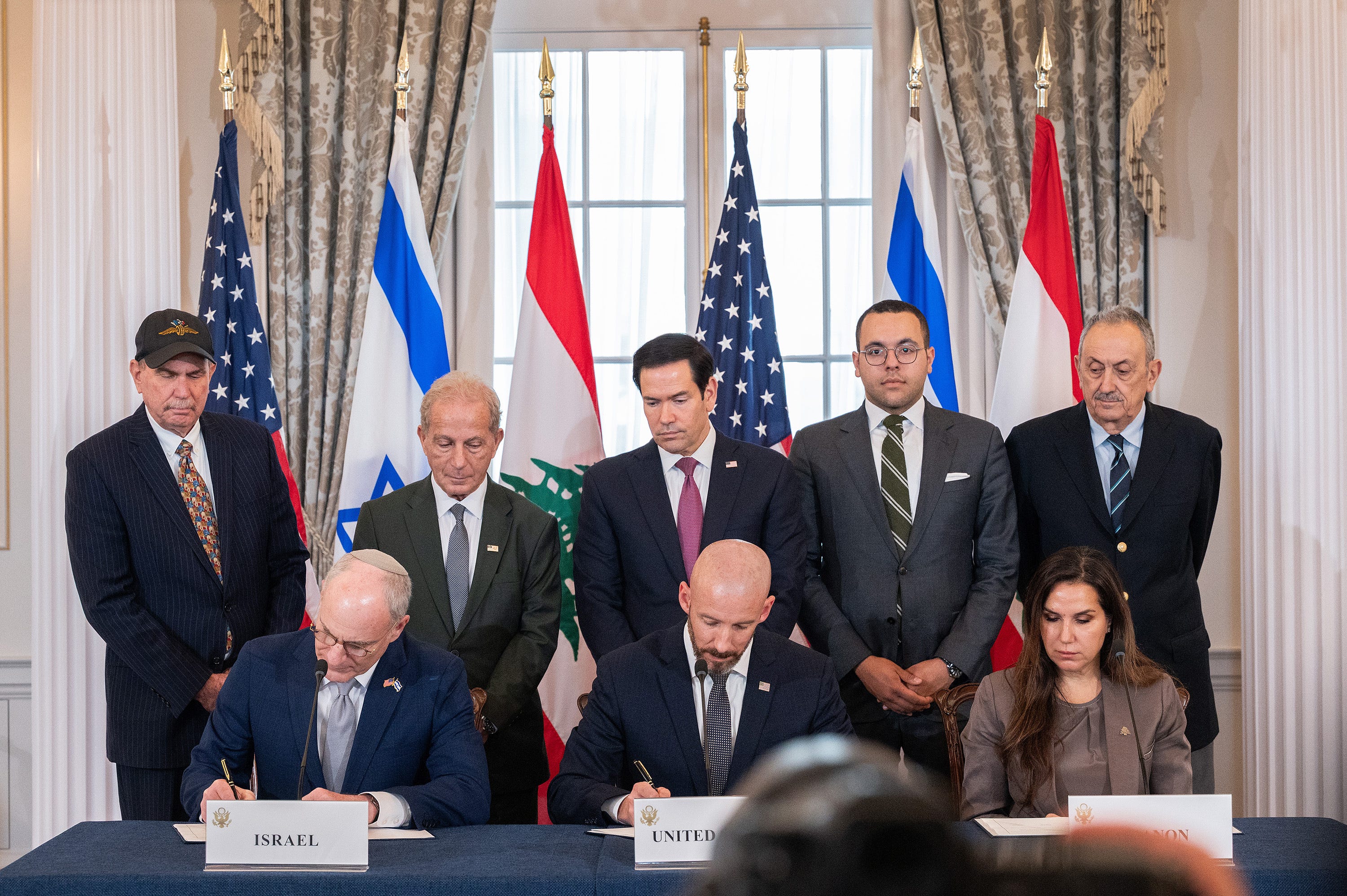
The signing of the framework agreement between the U.S., Israel and Lebanon in Washington, D.C., on Friday. (Marco Rubio/X)
It’s Sunday, June 28, and forty-four years ago, as Israeli forces drove deep into Lebanon, U.S. special envoy Philip Habib arrived determined to take Defense Minister Ariel Sharon to task. Habib—who made little secret of his contempt for Sharon—believed he held the upper hand and pressed the case that Israel pull back and stop bending Lebanon’s fragile government toward Israel’s terms. Sharon sat back and let the American diplomat run through his lecture. When Habib finished, Sharon reportedly produced a card of his own: a secret document, quietly drawn up with a confidant of the Lebanese leadership, already sketching the outline of an accord—normalization, security arrangements and a phased Israeli withdrawal that would leave Israel holding outposts on Lebanese soil.
Sharon had bypassed the U.S. mediators entirely, having quietly negotiated his own full-blown peace agreement directly with Lebanese President Amin Gemayel through a private emissary. Habib’s trip was pointless.
This time, the agreement went through Washington.
On Friday, Israel announced a framework agreement with Lebanon, its first accord with the country since the short-lived 1983 treaty. The two sides commit to formally end their state of war and pursue normal relations through later negotiations. The engine is a reciprocal, sequenced process: Lebanon pledges the complete, verified disarmament of all non-state armed groups—Hezbollah is named—and the restoration of Lebanese Armed Forces control over all its territory, while, in exchange, the IDF redeploys zone by zone as disarmament is verified. Two initial “pilot zones” are agreed, with the rest left to a forthcoming Security Annex. Lebanon affirms Israel’s right to exist and that only the Lebanese state may authorize force on its soil; Israel disclaims any territorial ambitions.
In short: Lebanon sublets its own territory to Israel so Israel can evict the problematic tenant, Hezbollah, and hands the keys back once the premises are cleared—with normalization as the reward at the end of the eviction. On paper, it’s a phased withdrawal. In practice, it’s an admission that Israel stays in southern Lebanon until Hezbollah is gone. The price of that presence was paid again early this morning, when Captain David Hazut, 21, fell in a firefight with a Hezbollah operative in southern Lebanon. For the past four months, Iran has been demanding Israel withdraw from sovereign Lebanese soil; Lebanon’s own government has effectively answered, “You first.”
Even if the ultimate goal of normalization goes unmet, this is a genuine achievement for Israel because it upends the entire conception that has governed Lebanon until now. The old arrangement was simple: If Israel wanted to stay, the authority it had to consult was Washington, while Hezbollah took its marching orders from Tehran. The Lebanese government, meanwhile, oscillated between the roles of Hezbollah cutout and impotent failed state.
Now the United States has pulled the Lebanese government itself into the anti-Iran camp. And unlike Israel’s first treaty with Lebanon, this one is built to require America as a partner. Lebanon isn’t merely choosing a future without Hezbollah; it’s choosing a new Lebanon—rebuilt and bankrolled by the United States. Put plainly: It needs Trump to hold its spine straight for the confrontation with Hezbollah, and it needs Israel to do the dirty work to win that confrontation.
The agreement is a godsend for Netanyahu. Hezbollah won’t be eliminated by Election Day even if it’s pushed to the last possible day, but if the Israeli public reads southern Lebanon as a story of progress rather than an attritional swamp, he has a chance. Internationally, the framework isn’t about to get his face taken off the dartboard—but it has validated a strategy that drew enormous criticism. It turns out you don’t always need to know the “day after” before you launch an operation. As in Gaza, if you focus on degrading capabilities and keep your options open, opportunities may materialize on their own.
But let’s turn to the negatives.
The biggest risk is a simple reality: What Lebanon giveth, Lebanon can taketh away. The very existence of this second agreement is proof that the first, in 1983, didn’t hold. Back then, hopes of a full peace were dashed by the assassination of Israel’s intended intermediary, President-elect Bashir Gemayel; the agreement that did get signed was stripped back, then collapsed under a combination of internal Lebanese opposition and overwhelming regional pressure, above all from Syria. Within a year, Lebanon abandoned it, and it never took effect.
Hezbollah will do everything in its power to ensure that outcome, and it has several tools at hand. The first, and its favorite, is intimidation: President Joseph Aoun and other prominent figures backing the deal likely have targets on their backs. Hezbollah members of Lebanon’s Parliament have already declared that they will resist any effort at disarmament and labeled the LAF as incapable of forcing them to do so.
The second is mobilizing the street. Hezbollah’s supporters have already poured into Beirut to protest the framework, making good on the group’s threat to set the Lebanese “street” against any move toward implementation.
The third is delegitimization. Other Hezbollah figures have moved to brand the agreement unlawful and muddy its terms—parliamentary bloc leader Mohammad Raad calling it a “cover-up” for a permanent Israeli military presence, even though the text explicitly disclaims any Israeli territorial ambitions in Lebanon. The implicit, and sometimes explicit, threat behind all of Hezbollah’s actions is unmistakable: Cross us, and Lebanon returns to civil war.
Behind the group stands Iran, which has never respected Lebanon’s sovereign decisions and won’t start now. Tehran is already treating the framework as a pretext to stall nuclear negotiations, claiming it violates the Lebanon clause of the MoU. Which means it comes down, once again, to Trump—to whether he holds the line on his diplomatic revolution in Lebanon.
As we have experienced recently, history in this region is written and rewritten by the week, and there is every chance this agreement ends up where so many others have: abandoned, unenforced and simply a footnote to the next war. But should it hold, June 26 may be remembered as the date a broken country began the long climb back to being the Paris of the Middle East. For now, that possibility alone is more than Lebanon has had in decades.
All that’s left to say is: Good job, Marco Rubio.
U.S. Sailors conduct nighttime operations aboard USS George H.W. Bush while sailing the Arabian Sea. (CENTCOM/X)
Meanwhile, on Vance’s side of U.S. diplomacy: The U.S. conducted strikes across Iran overnight after the Islamic Republic attacked American positions in Bahrain. The trigger for this exchange of fire is a dispute over control of the strait.
During the blockade, as part of a covert freedom-of-navigation operation, the U.S. and Oman set up a southern shipping route hugging the Omani coast, away from Iran’s mine-infested waters. Now that the strait is officially open, they’ve built it out into a full shipping lane. Iran insists ships seek its permission and use a northern route that hugs the Iranian coast instead, and its Persian Gulf Strait Authority has declared that any vessel taking the “unauthorized” southern route forfeits its safe-passage guarantees. So when ships began using the Omani route, Iran’s IRGC started hitting them.
Hilariously, Tehran frames this not as breaking the ceasefire but as “ceasefire management,” which is like calling arson “aggressive thermal management.”
The escalation cycle continued from there. The U.S. struck Iranian missile and drone storage, radar and air-defense sites in retaliation, accusing Iran of violating the ceasefire; Iran then fired drones at U.S. positions in Bahrain and warned the Gulf states not to let their territory be used against it. Vance, to his credit, declared that “violence will be met with violence”—proving that an Iran hawk is simply an Iran dove who’s been mugged by reality.
The Iranians seem to be in the back half of a Greek tragedy, their hubris becoming their undoing. It’s unlikely they expected the U.S. to strike back at their provocations given its previous restraint, nor that they anticipated a maneuver in Lebanon that left them on the back foot. That doesn’t make their move in the strait illogical: Their entire leverage in this war has been the ability to threaten the strait, and they have repeatedly accepted U.S. strikes as the cost of asserting that control.
The U.S. has the better of the legal argument. Under the MoU, Iran’s obligation is to arrange “safe passage of commercial vessels”—not safe passage along a route of Iran’s choosing. The text commits Iran only to a future dialogue with Oman over the strait’s administration and binds any such arrangement to international law and the sovereign rights of all coastal states. Nowhere does it hand Iran a monopoly the United States must honor—despite what both parties’ recent conduct has implied.
It was probably a mistake on all our parts to believe that an agreement between the unpredictable Trump and a chronically dishonest regime would be assiduously observed by either side. The recent events in Lebanon and the strait prove the MoU wasn’t worth the digital paper it was printed on. The terms of treaties aren’t decided in hotels in Geneva, but by facts on the ground.
English Editor: Ari Tatarka
If you enjoy the newsletter, you can show your support by becoming a paid subscriber—it really helps keep this going. I’m also offering a special monthly briefing for a small group of premium members. I’d love to have you join us—just click below to find out more.
Thanks for reading It’s Noon in Israel! Subscribe for free to receive new posts and support my work.


But let’s turn to the negatives.
Or as some of us say....Reality.
The upshot of this column is that the MOU would make second-rate toilet paper. The key question is what happens after the November election. Who can read Trump's mind?