
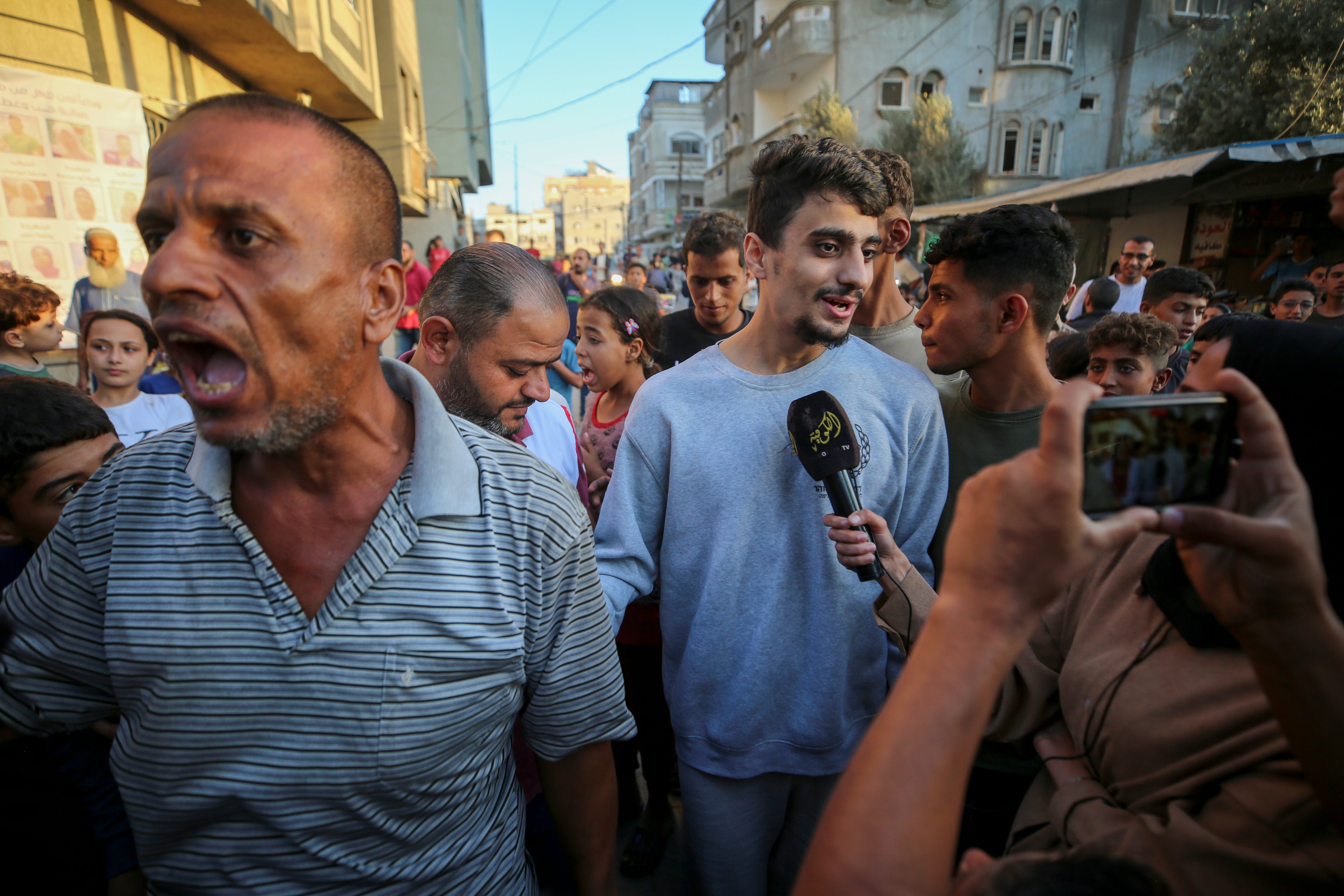
Palestinians released by Israel arrive at Al-Awda Hospital in the Nuseirat refugee camp on October 13, 2025. (Ali Hassan/Flash90)
It’s Sunday, September 20, and the most revealing sentence spoken from Gaza’s press corps this year came on a podcast from one of its greatest stars. “If someone says something like this, many journalists lower the camera.”
That is Motaz Azaiza—one of TIME’s 100 most influential people of 2024, GQ Middle East’s man of the year—explaining how, when faced with dissent, the Gaza media complex fixes the narrative on Hamas’s behalf.
Speaking on the Palestinian podcast Taqarob, Azaiza described a WhatsApp group that “all the Gaza journalists are in.” For anyone picturing a professional association: its icon is a Hamas flag, and its administrator, he said, is the media director of the Rafah crossing.
Azaiza is no friend of Israel. TIME’s honoree celebrated October 7 and filmed hostages being beaten in a Gaza street, but then promptly buried the footage. When Yahya Sinwar was killed, he told mourners that anyone who had not answered Sinwar’s call to go out and engage the enemy had “no right to mourn and boast about the manner of his death.” Sinwar, he wrote, “wanted you in the field.”
That Gaza is an authoritarian hellscape is hardly worth stopping the presses for. Anyone thinking critically assumed Hamas controlled the narrative from the very beginning. Azaiza’s testimony is less an indictment of Hamas than of the media complex that lapped up its releases.
The Committee to Protect Journalists ran a feature in May of last year in which the head of the Palestinian Journalists’ Syndicate listed Hamas’s methods—summonses, interrogations, threats, beatings, arrests, publication bans, interference with content, surveillance—and his deputy conceded that most journalists in Gaza now censor themselves. One photographer, beaten unconscious by plainclothes police beside Nasser Hospital, told CPJ that when colleagues tried to intervene, they were informed that “the spy and the journalist are one and the same.” CPJ noted the violations were vastly underreported, because the victims were too frightened to say so.
Despite publishing all that, CPJ joined the foreign press in doing what Gazan journalists did out of loyalty or under duress: carrying the Hamas line. For two years its casualty database was the load-bearing source for the charge that Israel systematically targets journalists. In June it quietly removed 20 names from that database—eight of them after Hamas and Islamic Jihad published obituaries claiming the dead as their own fighters. The Meir Amit Center found a further 23 examples, and there are doubtless more.
To be fair, “Totalitarian Islamists co-opt the press” is a far more compromising headline for a media organization to run than “Israel targets press.”
The foreign press has omitted Hamas control since 2008, when Hamas stopped the West Bank dailies at the crossing and told their editors, according to the head of the Palestinian Journalists’ Syndicate, that they could enter Gaza once they signed an undertaking not to criticize Hamas. It broke cover once again in 2014, when, in a rare moment of lucidity, the Foreign Press Association condemned the “blatant, incessant, forceful and unorthodox methods” used against its members in Gaza. A Hamas information official then confirmed it on Lebanese television: the security services, she explained, “would give them some time to change their message.”
When the war began, Hamas already had years of evidence that the foreign press would take what it was served. That is how a single group chat, with no foreign members, set a global narrative.
Will the world take note of Azaiza’s testimony? Unlikely. The most serious piece of journalism of Azaiza’s career will likely be his least cited.
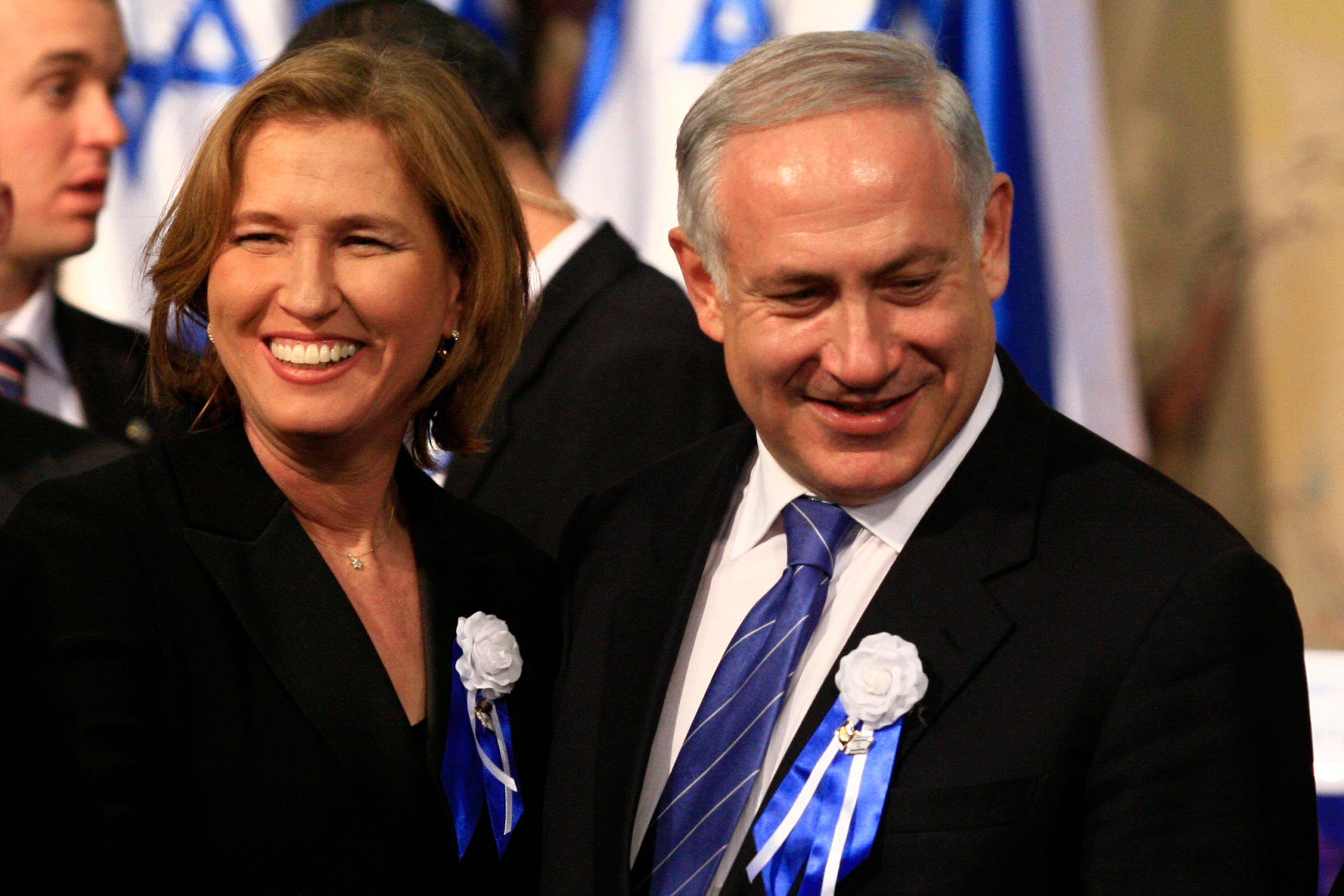
Leader of the Likud party as well as prime minister soon to be Benjamin Netanyahu and leader of the Kadima party Tzipi Livni attend the opening session of the 18th parliament. February 24, 2009. (Yossi Zamir/Flash90)
An old title, once very important but since all but forgotten, may soon return: largest party. Netanyahu has been so successful at drilling in the importance of the bloc and the number 61 that almost no one is impressed anymore that a party fresh out of the wrapper, Gadi Eisenkot’s Yashar!, takes first place in nearly every poll. Why does size matter if the bloc is what counts? No one will again risk the humiliation of Kadima’s 2009 victory celebrations, “28 is more than 27,” only to discover that four years of opposition lay ahead, because 65 is more than 55.
So it is natural, understandable and even logical that this past week’s headlines have focused on how fast Eisenkot’s bloc is shrinking, rather than on how much Eisenkot’s party is widening its lead over Likud. His rivals within the bloc also make a point of noting that ever since he struck out on his own, the bigger he gets, the smaller the bloc gets. It’s called cannibalization.
And yet, the largest-party question may make a comeback in this election. Right now, Netanyahu is like a commander who can’t strike inside a civilian area for fear of collateral damage. If he grows too much, he’ll knock Bezalel Smotrich below the electoral threshold, Ofer Winter will burn votes, and Itamar Ben-Gvir, according to the polls, is also nearing the danger zone. But then again, will he simply walk into the 20-seat range, maybe lower, of sound mind? In the 2019 elections, the genius of forming Blue and White lay in creating a race for first place. Netanyahu closed a 10-seat gap, but at a heavy price: Moshe Feiglin and Naftali Bennett fell below the threshold, and he lost his Knesset majority. That is exactly what Eisenkot is doing now.
It is almost the opposition’s only way to change what looks like a headlong gallop toward an inconclusive outcome, or worse, losing the ability to replace the government under almost any scenario. The polls that once put the change bloc within touching distance of a Zionist majority now signal a landslide and collapse. The shrinking Zionist-secular-center-left bloc is being eaten away by demographics, the Smotrich–Ra’am link, the reunited Joint List, the founding of Winter’s party and the remnants of the third bloc.
Despair and dejection have spread through the camp this past week, an ominous sign for its chances of replacing the government. In a parallel universe, the decision would be to jolt the campaign awake. But that strategy is impossible, since the only chance of bringing Netanyahu down is for his voters to stay apathetic. If they wake up and turn out at the last election’s rate, he will probably be prime minister again.
On the reasonable assumption that the dream of 61 is dead, we are not far from another possible turning point in the campaign: the moment Netanyahu’s bloc has one more seat than the opposition bloc. At that point, even the plan to form a government with the Arab parties abstaining from outside won’t be enough. It would take Ra’am’s active support, plus abstentions from Balad and perhaps Goldknopf, to form a rickety, reviled stopgap government. On the other side of the ledger, of course, will be the fear of going to elections again with Netanyahu still prime minister, after the opposition won a crushing majority.
“What will you do in that case?” I asked a senior figure in the bloc the day before yesterday. “It’s a choice between bad and very bad.”
This is an excerpt from my weekly column in Israel Hayom.
We are taking a break for Yom Kippur; We will be back on Tuesday.
English Editor: Ari Tatarka
If you enjoy the newsletter, you can show your support by becoming a paid subscriber—it really helps keep this going. I’m also offering a special monthly briefing for a small group of premium members. I’d love to have you join us—just click below to find out more.
Thanks for reading It’s Noon in Israel! Subscribe for free to receive new posts and support my work.


Anyone still voting Likud after 3 years of continuing to enable the Charedi “we will die and not enlist” blackmail should commit for themselves and their children to join the army full time, indefinitely.
My reservist son would like his life back.