IDF vs. Mossad: How to Defeat Iran
Also, death from above in southern Lebanon.
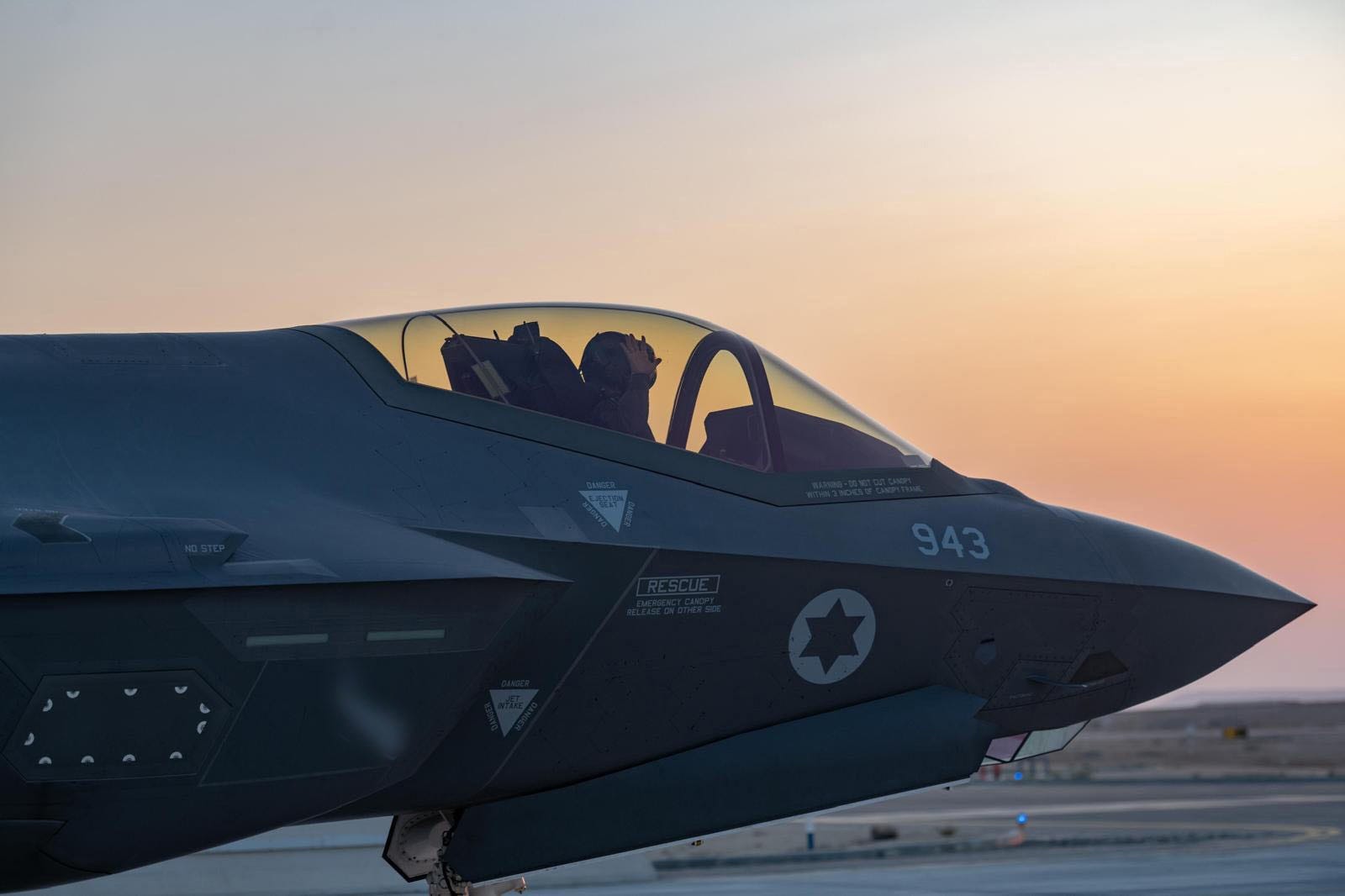
An IAF pilot prepares for a sortie over Iran. (IDF)
It’s Thursday, May 7, and a severe dispute has erupted—and still persists—between the army and the Mossad over the ultimate goal of the war in Iran. The IDF views the removal of uranium from Iranian territory as the ultimate achievement. The Mossad, however, believes the objective is toppling the regime. Even today, contrary to the retrospective cover-your-ass culture prevalent in our region, the Mossad insists on this. While the IDF settled for the amorphous definition of “creating the conditions to topple the regime,” the Mossad simply dropped the first four words.
From here, reality splits into two perspectives, sometimes entirely opposed. Senior IDF officials are intensely frustrated by the American decision not to seize the enriched uranium in a military operation. Thus, Operation Roaring Lion was halted with almost no improvement in the struggle against the Iranian nuclear program compared to Operation Rising Lion. Uranium, uranium, uranium, they chant. Take it, and you’ve erased the nuclear program.
The second approach argues: What good does it do to extract it via an operation or an agreement? If the regime stands, and even if tons of 3 percent enriched uranium remain, you’ve only set them back a few years—a blink of an eye in geopolitical terms. A regime without sanctions will be richer, more despicable, and will want to destroy Israel just as before. Only regime change will uproot the plans for Israel’s destruction from the source. This contrasts with senior defense establishment figures who would gladly welcome the liberation of tens of millions of Iranians from the yoke of dictatorship, but for whom the priority remains strictly Israel first.
The practical expression of this lies in a hypothetical question: What happens if President Trump tells Israel, “You have a green light for one operation”? Most of the defense establishment would say thank you and send the Air Force to raid the uranium stockpiles. The Mossad, one might guess, would support destroying energy plants and refineries, literally plunging Iran into total darkness. This would drastically accelerate the population’s rebellion process. Their anger threshold has already surpassed the levels recorded during the January riots, but simultaneously, the fear threshold has also spiked. When there is no electricity—and with starvation expected to begin in Iran in two months—that wall of fear will collapse.
Which goal is more ambitious? At first glance, toppling the regime seems like a monumental task, while destroying the uranium appears to be a localized, manageable event. But history suggests otherwise: regimes have fallen throughout history, but no country has ever willingly surrendered or lost its enriched nuclear material while the government survived. As the old Talmudic proverb goes, the dilemma is whether to take a “short path that is long”—a quick tactical strike that fails to solve the root problem—or a “long path that is short”—the arduous task of regime change that permanently removes the threat.
This is an excerpt from my weekly column in Israel Hayom
To read on my website click here.
The moment the Radwan Force commander was eliminated last night in Dahyeh, Beirut. (IDF)
Google claims logging is the most dangerous job on earth, citing a fatality rate of over 100 per 100,000 workers. It’s a tough gig, sure, but if we’re talking pure survival rates, an enemy of Israel would be better off picking up an ax. If the search results reflected that reality, the now-former commander of Hezbollah’s Radwan Force might have thought twice before taking a job that his predecessor explosively vacated in 2024. Hezbollah must have excellent hazard pay.
Regardless, Israel delivered a kinetic reality check last night with a precision strike in the majority-Shiite suburb of Dahyeh. While the Radwan commander was the primary target, his deputy and other senior officials were also in the crosshairs; reports suggest the deputy survived, but the message was sent regardless. This marks a serious escalation, as it is Israel’s first strike on the Lebanese capital since the mid-April ceasefire began.
The agreement, forged with the intent of affording the U.S. room to maneuver in negotiations with Iran, is still technically in place. While it granted Washington the quiet it was craving, it has proven less satisfying for Jerusalem. The IDF was hoping for a return to the “pre-Roaring” status quo with Hezbollah—which one might call an airstrike equivalent of “I get to punch you and you don’t get to punch me back.” But the circumstances have changed. The shadow of Donald Trump looming over Israel has emboldened the terror group; knowing the president is holding Israel back, Hezbollah has been poking at the north and throwing jabs at Israel’s security zone in southern Lebanon.
The IDF appears to have accepted this possibility, assuming Hezbollah didn’t have the capacity to inflict significant damage. That was until they introduced their deadly new weapon: fiber-optic FPV drones.
These devices are effectively commercial drones rigged to explode, tethered to their operators by miles of physical wire thinner than dental floss. Since there are no radio signals to jam and no GPS coordinates to spoof, the drones are essentially invisible to electronic shields and advanced drone defenses. Unlike traditional rockets that follow a predictable arc, these drones creep at low altitudes, using electric motors and nonmetallic frames to evade radar and acoustic detection.
The drones are also equipped with another weapon: video cameras. For anyone familiar with Israel’s history in southern Lebanon, that sentence likely triggers a bout of PTSD. Hezbollah was notorious in the 1990s for poorly shot propaganda films showing their embellished victories over IDF positions in the security zone. Despite the low production value, they were a critical component in building Lebanese support for the fledgling terror group. For Israelis, it was intensely demoralizing; combined with the constant fatalities of low-intensity guerrilla warfare, the footage contributed directly to the Israeli withdrawal from southern Lebanon in 2000.
Smoke rises from southern Lebanon during an Israeli military operation, May 6, 2026. (Ayal Margolin/Flash90)
That’s the strategy Hezbollah is trying to revive in the new security zone: a grinding, low-intensity war of attrition. By ensuring a steady drip of casualties from the front, they are banking on the Israeli public to eventually lose its nerve and demand a withdrawal. While that possibility seems far off in today’s post-October 7 Israel, remember that it took Hezbollah 15 years to get Israel out of the last one; they are willing to play the long game.
Still, this marks a sharp departure from their previous doctrine of saturating the Israeli home front with rockets. They didn’t change approaches out of choice; after most of their arsenal and command structure were retired by IDF munitions, the group has been forced back to its guerrilla origins.
The drones themselves are an adaptation to this forced devolution. Before the Assad regime collapsed and severed the Iranian land bridge, Hezbollah could easily smuggle heavy ballistic missiles through Syria. Now, choked off from advanced weaponry, they have pivoted to cheap, consumer-grade Chinese components that are easily hidden in standard commercial transit and assembled locally.
Ironically, countering this rudimentary threat is forcing the IDF into a regression of its own. After decades of optimizing for futuristic, multilayered air defenses, the military is scrambling to dust off relics like the cannon-based Vulcan systems of the 1970s, pairing them alongside AI-integrated rifle sights. It is an uncomfortable reversion—and so far, an unsuccessful one. If Israel cannot find a way to neutralize this threat, the security zone will have an expiration date.
Still, the asymmetry cuts both ways. Hezbollah is devolving because it has to; Israel is doing it by choice. When it comes to sheer firepower, the IDF can escalate to a degree the terror group simply cannot match. That is exactly what last night’s strike in Dahyeh was about: a reminder that Israel still dictates the stakes.
There is, however, one crucial difference between this new security zone and the last: this one might eventually become obsolete. The channel between Beirut and Jerusalem remains busy, and the current Lebanese government certainly harbors the desire—if not the actual capacity or spine—to disarm Hezbollah. But Israel has another hope that rests on a different capital entirely. The prevailing assumption within the IDF is straightforward: if the regime in Tehran collapses, Hezbollah falls with it.
English Editor: Ari Tatarka
If you enjoy the newsletter, you can show your support by becoming a paid subscriber—it really helps keep this going. I’m also offering a special monthly briefing for a small group of premium members. I’d love to have you join us—just click below to find out more.
Thanks for reading It’s Noon in Israel! Subscribe for free to receive new posts and support my work.


You have the rare ability to make me laugh and tear up at the same time. 🤭 always looking forward to your Newsletter.