Iran Deal: It’s Worse Than We Thought
Also, the Israeli public sours on Trump, and more.
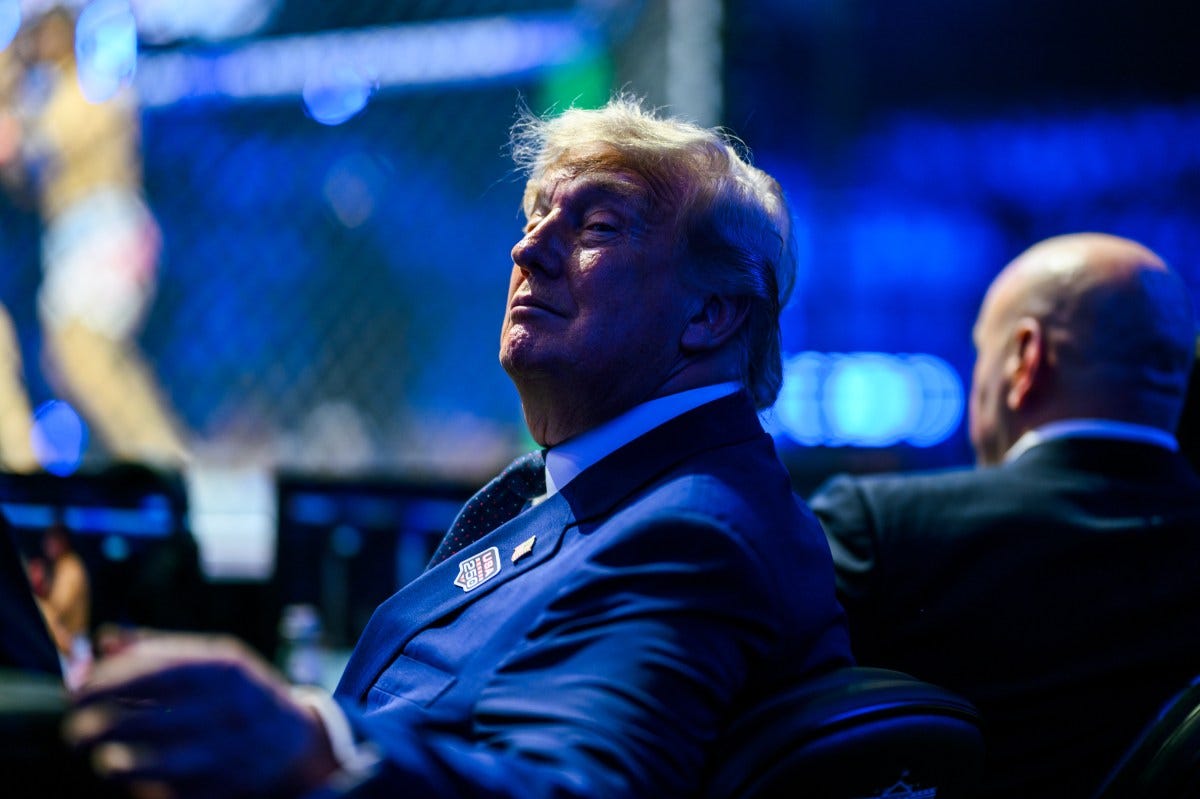
Donald Trump attends UFC Freedom 250. (White House)
It’s Thursday, June 18, and the official terms of the U.S. Memorandum of Understanding are out—and it’s worse than anticipated. The official signing ceremony isn’t until Friday, but the agreement was already signed digitally last night during a dinner at the Palace of Versailles. Anyone familiar with the palace’s history knows this makes the MOU the second great surrender signed at Versailles. Except this time, the U.S. is the one capitulating.
Here’s why it’s worse than we thought. As the details slowly leaked, it became clear that this agreement is not a pause—the status quo held in place while negotiations ran their course. It was a rewind, actively restoring the Islamic Republic. The only question left was how fast it would run, and according to these clauses, faster than we would like.
U.S. officials, including the vice president, previously assured reporters that the agreement provides a “dial,” with economic and sanctions relief increasing only as Iran demonstrates good behavior and compliance. The text is less specific. The clearest financial concession involves the issuance of oil waivers in Section 10, which on their own will return monthly revenue of $5 billion; meanwhile, Section 11 seems to imply that all of the regime’s assets will be made available immediately—best case, that remains credit the Islamic Republic can use only for humanitarian purchases; worst case, it is transferred to them directly. Either way, money is fungible, and besides, I’m not sure exactly what leverage the U.S. assumes it will retain once it has surrendered Iranian assets up front.
As has been clear for the past couple of months, two of the conflict’s four goals—the funding of proxies and the ending of the ballistic missile program—have been abandoned. In fact, Trump defended the omission. “If other countries have them, it’s a little bit unfair for them not to have some,” Trump said in France, where he held a press conference on the sidelines of a Group of Seven summit. “If Saudi Arabia and Qatar, and they all have some, I would say that in relative proportion, I think it’s okay” for Iran to have ballistic missiles as well. I haven’t seen Saudi Arabia firing those missiles at the U.S. recently, but I digress. The JCPOA famously made the same omission—but at least it didn’t promise the removal of all primary and secondary sanctions on the ballistic missile program and on terror sponsorship. Section 7 provides for the removal of all sanctions pending a final deal—so even if Trump somehow clutches victory from the claws of defeat and secures a strong nuclear deal, Iran’s other malign activities can continue without sanction. Indeed, Lebanese and regional sources told Reuters that Iran has promised to increase Hezbollah’s funding “as soon as possible” once the United States unfreezes Iranian assets. Chalk up a point for the JCPOA.
The third of the original four goals fares no better: the MOU codifies the abandonment of the protesters, enshrining noninterference in Iran’s “internal affairs”—those hoping for an uprising in the next 60 days are likely to be disappointed. That leaves only the nuclear front—the last remaining goal, and one whose outcome remains entirely unclear. Zero enrichment was already abandoned by Trump last week, but the MOU goes further, defining the new U.S. minimum not as exporting its enriched uranium, but as on-site down-blending under IAEA supervision. In the case of uranium, what goes down can also go up. Without the material in friendlier, less fanatical hands, “good” is not an applicable adjective for the deal.
U.S. Navy warships and air assets patrol the Strait of Hormuz enforcing the blockade against Iran, June 12. (CENTCOM)
Not only that, Clause 5 gift-wraps the regime’s trump card—the one it has played to such great effect against the U.S. Iran’s leverage over Gulf shipping was always its readiest threat, the valve it could squeeze whenever it needed the world’s attention. A serious agreement would have taken that card out of their hands. Instead, the MOU merely gestures at “negotiating the status” of the waterway with other states in the region—language that quietly abandons the prior baseline of freedom of the seas and hands the question to bilateral talks between Tehran and its neighbors. That is not a settlement; it is leaving the shopkeepers alone with the mob and telling them to work it out among themselves. The U.S. assiduously avoided the word “tolls,” so Iran rebranded them “service fees.” The honest term is protection money—and the only thing Iran is offering protection from is itself.
Clause 6, the reconstruction fund, must come as an even more bitter pill for the Gulf allies—particularly those who took the U.S. at its word two weeks ago, when it pledged to make “Iranian assets [available] to its Gulf allies to support, repair and mitigate future damage that Iran may cause.” That promise has been inverted. Rather than Iran paying for the damage it inflicts, the MOU drafts a Marshall Plan while the Nazis are still in power—and leaves France and Britain to foot the bill for German reconstruction.
The most immediate problem for Israel is the first clause: Lebanon, whose status is left unclear by the MOU. A Hezbollah source told Emirati media that Iran had informed Hezbollah that the MOU provides for an Israeli withdrawal from Lebanon over a phased, 60-day period. The same source added that any withdrawal now rests with Israel, which, along with Hezbollah, is not a party to the MOU. A Lebanese political source told the same outlet that Lebanon has received “no official guarantees” of an Israeli withdrawal and has not yet raised the matter with U.S. officials—an account that sits at odds with Iran’s claim that the MOU plainly obligates Israel to withdraw. Despite U.S. Ambassador to Israel Mike Huckabee’s assurance that “Israel doesn’t need Iran’s permission to defend itself,” the agreement has created a circumstance in which increased attacks on the country could pry the U.S. and Israel apart as Israel is compelled to respond.
And note the sequencing, buried in the final clause: negotiations on the substantive terms of the final deal—the nuclear restrictions, the enrichment ceilings, everything still ostensibly up for grabs—will only begin after the ceasefire, the blockade’s removal, the maritime opening, the oil waivers, and the unfreezing of assets are already implemented. That ordering gives away the game. This is not the “Hormuz for Hormuz” swap the administration is selling—open the Strait, lift the blockade, call it even. The concessions that matter to Iran are all front-loaded, banked before Tehran has to concede anything of substance in return. By the time the real bargaining starts, the sanctions relief is flowing, the oil is moving, and the assets are unfrozen. The regime gets restored first and negotiates second. That is the rewind in a single clause—and it runs fast.
The silver lining, thin as it is, is that the U.S. military is not withdrawing until the conclusion of a final deal. As Trump put it yesterday, “If I don’t like it, if they don’t behave, we’ll go right back to dropping bombs.” With sanctions relief and waivers already forthcoming, the threat of military action is fast becoming the only stick left in the American arsenal. Do I believe him? Less than I did two months ago, and less still than a week ago—but it remains, at the very least, an option on the table.
Trump, for his part, seemed unbothered by the holes in the deal. At a press conference in France—shortly before he declared the agreement “signed” at Versailles—Fox News correspondent Peter Doocy read him back a famous line of his own: that Iran “never won a war, but never lost a negotiation.” Trump asked who had said it. Told it was him, he replied that he’d figured as much, then drew the distinction he wanted on the record: this time, Iran “lost militarily.”
Yes, Mr. President, they always do, that’s the point.
Donald Trump greets Benjamin Netanyahu, April 2025. (White House)
Even within the ongoing carnival that is Israeli politics, there is no precedent for such a dramatic turnaround in attitude toward a leader. Just three weeks ago, at the height of the negotiations with Iran, we asked here about support for the U.S. president. Trump was then already very reserved about returning to war and still enjoyed an approval rating of 58 percent against 35 percent who opposed him, meaning he is the most popular politician in Israel: more than the president, more than the prime minister, more than the heads of the opposition, almost like the IDF chief of staff.
Three weeks have passed, a surrender agreement was signed, and Trump is collapsing, no less. Instead of plus 16 percent, he is at minus 23 percent. That’s less than Eisenkot, less than Bennett, less than Netanyahu. The significant drama occurred among the 2022 opposition voters, the exact same segment that will decide the upcoming elections: last month they supported him at a rate of 74-20 percent. Now, the majority have a negative opinion: 48 percent against 46 percent who still see the president in a positive light.
What is the reason for this? It is easy to isolate the variables. Trump weakened by about 10 percent across the board (including Arabs, by the way) because of the surrender to Iran. And he weakened dramatically among supporters of the Netanyahu bloc because he insulted and cursed the prime minister. If he had a local adviser, he would have rehearsed what was rehearsed in the past to every candidate against Netanyahu, and not always successfully: Do you want the right wing? Don’t insult its leader.
These figures have political significance that may go beyond a mere footnote. One, it casts doubt on Trump’s visit of support to Netanyahu, which is scheduled to take place before the elections, not only on the part of the guest but also on the part of the host. It was already written here not long ago that presidents’ attempts at intervention have mostly failed, and when the president is not so popular, he is expected to join the statistics. If I may guess, Bennett’s attempts to get Trump’s support, which were conducted vigorously throughout the past year, are also expected to weaken.
But two, and more importantly, they raise, for the first time, the possibility that it will pay off for Netanyahu to confront the president of the United States, as inconceivable as that seemed until a few weeks ago. If he has already lost his comparative advantage in his closeness to Trump, perhaps he will try to gain an advantage as the only one who can confront him. All that is missing is a poster on the Ayalon Highway with his picture and the caption: “He won’t dictate.”
This is an excerpt from my weekly column in Israel Hayom
A U.S.–Iran deal signed at Versailles, Israeli troops still in Lebanon with no guarantee of withdrawal, sanctions relief and unfrozen assets already flowing to Tehran—and an Israeli election hanging over all of it. I recently joined Dan Senor on Call Me Back to break down what’s actually in this MoU: why the terms are worse than anticipated, what it means for Lebanon and Israel’s security, and how it could reshape Netanyahu’s election chances. We get into all this and more.
To listen click here.
English Editor: Ari Tatarka
If you enjoy the newsletter, you can show your support by becoming a paid subscriber—it really helps keep this going. I’m also offering a special monthly briefing for a small group of premium members. I’d love to have you join us—just click below to find out more.
Thanks for reading It’s Noon in Israel! Subscribe for free to receive new posts and support my work.


It is very difficult to click a like on this truthfully depressing post, but if truth is what we are all looking for, this is the gut punch most of us are feeling about this Presidency. We not only supported it in our cognitive dissonance, but continually justified it to our friends on the other side. It’s what happens when moral turpitude is ignored in the name of policy. I believe the deep Narcissism so many of us witnessed over the last 10 years but chose to ignore because of our agreement in policy has come home to roost. I’m afraid it’s going to be a very long 2 1/2 years until 2028.
I read that Lebanon’s President said the MOU is not binding on his country, leaving the door open that he reads the clause about territorial integrity and sovereignty directed as much at Hezbollah as at Israel - with the former remaining the greater threat. I suspect that Lebanese dignity recoils at the hubris of others making their country someone else’s playground.
If President Aoun means what he says, then the issue remains part of the discussion among the U.S.-Israel-Lebanon negotiators. Why Israel does immediately build on Alun’s declaration and make that clarification is anyone’s guess. Rather than only talk about defending itself, why can’t Israel add the hat of helping Lebanon help itself in excising a foreign element that responds exclusively to a malevolent outside party and starts wars that have nothing to do with Lebanon? In fact, why can’t one of the negotiation’s goals be a straightforward non-aggression pact with Lebanon formally announcing an end to the war it declared in 1948?
What will continue behind the scenes (Mossad operatives in Iran, for instance) will remain cloaked in secrecy. The regime has many internal enemies, so who can really say who is controlling any particular kamikaze drone.
On the “bright” side, if one takes the MOU at face value, then Israel is revealed as a U.S. vassal just as Hezbollah is Iran’s - so the antisemites of the world can no longer claim that Israel controls the U.S. Someone needs to inform the Squad.