Iran Is Drowning in Oil
Also, stolen Ukrainian property sold to Israel.
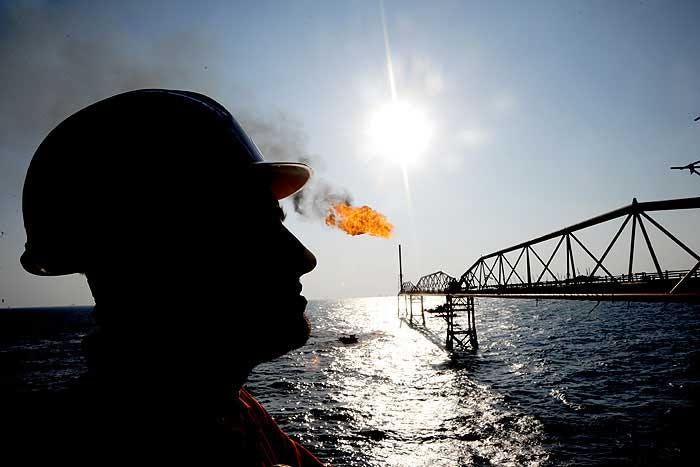
Drilling operations in the Forouzan oilfield in Iran, 2021. (NIOC)
It’s Tuesday, April 28, and Iran is beginning to crack. Vindicating Donald Trump’s Saturday claim that Iranian officials could “come to us, or they can call us,” Iran has reportedly presented a new proposal, offering to “reopen” the Strait of Hormuz and end the current hostilities, provided that U.S.-Iran nuclear negotiations are postponed to a later date.
Trump responded that while this offer is “much better” than previous proposals—which demanded Iranian sovereignty over the Strait—it remains “not enough.” It goes without saying why surrendering Washington’s primary point of leverage over the regime before securing ironclad guarantees on the nuclear issue is a non-starter.
It is unclear if IRGC commander and aspiring dictator Ahmad Vahidi even supports this diplomatic off-ramp. According to Axios, Foreign Minister Abbas Araghchi admitted to Pakistani, Egyptian, Turkish and Qatari mediators that there is currently no consensus among Iran’s leadership on how to navigate U.S. demands.
Iran’s inability to export its oil is strangling the regime financially, and keeping that oil onshore is posing a growing existential threat. According to a recent report by The Wall Street Journal, the U.S. blockade has pushed Tehran to the brink of desperation, forcing officials to stockpile crude in makeshift “containers” and disused oil tanks in poor condition. This reporting aligns with an April 12 estimate indicating that Iran had only about 13 days of onshore storage capacity remaining. Once that critical threshold is crossed, Tehran will have no choice but to initiate the drastic step of shutting down domestic oil production entirely.
Shutting down an oil well is far worse than merely pausing operations or stranding valuable resources; it is a death sentence for the industry. When a well is “shut in,” the delicate pressure required to push crude to the surface permanently dissipates. Worse, stagnant oil cools and solidifies, permanently clogging the porous rock, rendering it inaccessible. Oil production is strictly a game of “use it or lose it.”
Loss of future production isn’t the only risk. Around one to two percent of the Iranian workforce is directly engaged in oil extraction, with an even larger number employed in downstream petroleum products and related industries. Lose the wells, and you immediately have that many more angry, desperate and unemployed Iranians on the streets.
All this is to say: time remains on Trump’s side.
Aerial view of Haifa port. January 29, 2026. (Yossi Zamir/FLASH90)
Two weeks ago, a cargo ship docked at the Port of Haifa. Beneath its nondescript exterior, the vessel hid a secret: millions of dollars’ worth of wheat stolen from Russian-occupied areas of Ukraine. According to an official statement from the government in Kyiv, it had explicitly warned Israel that the ship was part of Putin’s shadow fleet, but the alert was ignored.
A recent Haaretz investigation reveals this is not an isolated incident. As early as 2023—roughly a year after the full-scale invasion of Ukraine—at least two ships carrying stolen grain unloaded their cargo in Israel. The erratic behavior of seven other ships docking in Israel that same year raises serious suspicions that they, too, actively sought to conceal the origin of their grain. Furthermore, internal records from authorities in the occupied Ukrainian ports list more than 30 shipments of stolen goods specifically destined for the Israeli market.
To bypass Western sanctions, Russia has been laundering the origin of this wheat. Instead of loading at standard ports, bulk cargo ships execute secret ship-to-ship transfers, receiving grain from small feeder ships or massive “floating silos.” During these transfers, the ships turn off their tracking transponders to conceal the cargo’s illicit origin—a clear violation of maritime regulations that mirrors the tactics of Russia’s oil “ghost fleet.” Once fully loaded, the trackers are switched back on, and the vessels sail the laundered grain straight to designated piers in Haifa and Ashdod.
Plausible deniability remains the primary defense for local importers. One Israeli buyer who purchases Eastern European wheat noted that Russian suppliers provide documents claiming the grain originated in Siberia and was transported westward by train. Without independent verification, buyers have no way of checking the paperwork’s authenticity. “Only after the Ukrainian embassy contacted us and warned us not to buy from these specific suppliers did we understand the source of the wheat,” the buyer claimed.
When pressed on why Israel allows the smuggling of stolen grain and why advance warnings were ignored, the Foreign Ministry responded: “We have passed answers on the matter to our Ukrainian friends through diplomatic and professional channels.”
Before we speculate, it is worth mentioning that wheat is not an issue of national importance in Israel. Unlike grain-deficient authoritarian regimes that must heavily subsidize and monitor wheat imports to pacify their populations, wheat is simply not a critical issue of high-level national policy in Israel. The only people closely monitoring most imports are often port officials who are either unaware, apathetic or potentially incentivized to look the other way.
The more significant consideration is Israel’s highly complex relationship with Russia. For years, this transactional pragmatism was anchored by a strategic military deconfliction mechanism in Syria; Russia deployed major military forces there but turned a blind eye to Israeli airstrikes targeting Iranian proxies. Following the 2022 invasion of Ukraine, Israel—led initially by Naftali Bennett—adopted a policy of “calculated neutrality” to protect the Jewish diaspora in Russia and preserve that operational freedom in Syrian airspace.
Even recently, as Russia deepened its strategic alliance with Iran—supplying Tehran’s primary air defenses (which ultimately proved ineffective)—and Ukraine offered support during the recent war, Israel’s posture has not shifted.
Here is where the speculation comes in: If three wildly different prime ministers maintained the exact same policy of cautious neutrality regarding Moscow, there must be more to the story. It stands to reason that there may be a highly classified, back-channel security understanding between the two nations. While the exact parameters are unknown, it might pertain to limits on advanced air defense transfers, constraints on ammunition provided to Tehran or something of that nature.
Regardless of the details, I highly doubt it hinges on a few shipments of stolen grain. If, for critical geopolitical reasons, we are unable to support Ukraine, the very least we can do is not fund their enemy with their own stolen property.
English Editor: Ari Tatarka
If you enjoy the newsletter, you can show your support by becoming a paid subscriber—it really helps keep this going. I’m also offering a special monthly briefing for a small group of premium members. I’d love to have you join us—just click below to find out more.
Thanks for reading It’s Noon in Israel! Subscribe for free to receive new posts and support my work.


The only consensus Iran should consider in navigating US demands is to prepare for further war .. the clock is ticking.
Clown hasbara at its finest. Fk the illegal squatter colony and fk you, too!