It’s Noon in Israel: Iran's Last Chance
Also, Yair Lapid starts his anti-Bennett campaign, and Hamas's lethal use of emojis.
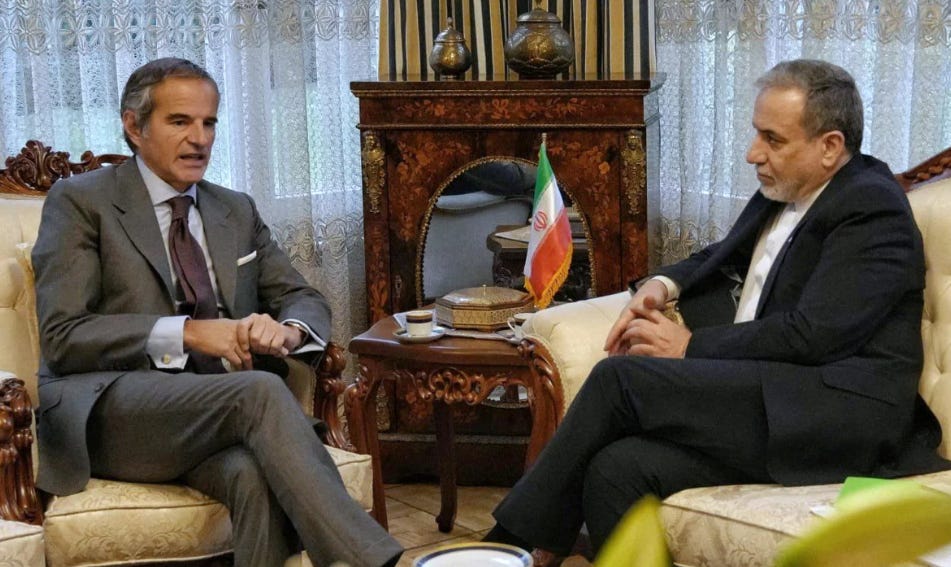
Iranian Foreign Minister Abbas Araghchi meeting with International Atomic Energy Agency Director-General Rafael Grossi in Geneva yesterday. (Iranian Foreign Ministry)
It’s Tuesday, February 17, and Iran has one last chance—and they’re going to blow it. The second round of high-level talks between the Islamic Republic and the United States opens this afternoon in Geneva, and the omens for a deal are not good.
Despite fourteen years, the destruction of their proxies, and the giant hole where their nuclear program used to be, Iran is still living in 2012. A senior Iranian official said on Sunday that it is open to a nuclear deal if the administration is willing to discuss lifting sanctions.
What about ballistic missiles? Terror proxies? The regime’s bloody repression at home?
Well, Tehran is still holding to the nothing-but-nuclear line.
Trump is not looking to be Obama 2.0 so that formula won’t satisfy him. Iran either doesn’t understand who it’s dealing with—or thinks it can run out the clock. They can’t. And if they don’t start acting like it, then the question is no longer if a strike is coming, but when.
We have three signals that point to the answer.
The first is Trump himself. After his meeting with Netanyahu last week, he said he expects a deal to take shape within the next month. So when the Iranians sink the negotiations, we might expect a strike in March.
Second, the Shiite mourning calendar. In Shiite tradition, the 40th day marks the end of the formal mourning period. After the regime’s reported massacre of over 30,000 protesters on January 8 and 9, that fortieth day falls tomorrow and the day after. During the Iranian Revolution, forty days after each violent crackdown, a new protest wave erupted—until the Shah fell. Trump may not wait for another massacre; he may simply be hoping that whatever comes in the next few days will last until he is ready.
The third is the U.S. ambassador to Israel, Mike Huckabee. This evening, the ambassador indicated that “we are talking about weeks, not months.” He’s not the only one saying this—Senator Lindsey Graham said the same in Israel last night.
Going into the weekend, there is real nervousness in Israel and elsewhere. Will something happen—or will we have to wait longer?
My suspicion is that after the Geneva press briefing, we’ll know.
Yair Lapid at the Yesh Atid party meeting last night. (@YeshAtidEnglish/X)
There’s a principle in marketing: the more generic the product, the more its success depends on branding. For voters seeking a cure for Netanyahu, the electoral pharmacy is stocked with options—Yair Lapid, Benny Gantz, Gadi Eisenkot, Yair Golan, Avigdor Lieberman, and Naftali Bennett.
Lapid’s problem is that everyone has borrowed from the original Yesh Atid formula. Yair Golan’s Democrats now advertise a “moderate-left” and security blend. Bennett added his own spin, offering a non-Netanyahu option with just enough Bibi flavor to attract voters who liked the taste. Avigdor Lieberman picked up the anti-Haredi slogan, leaving Lapid stranded in the bargain bin next to Gantz’s faded Blue and White packaging.
Lapid wants back on the top shelf, so he’s attempting a rebrand. His options are limited:
Outflank Golan on the left—which risks sliding off Israel’s political map.
Outdo Bennett as the most credible anti-Netanyahu figure.
Or out-Lieberman Lieberman on the Haredi issue—difficult without veering into outright antisemitism.
A few weeks ago, Lapid chose the second path. His new message rests on two questions:
Which party will be more effective—Yesh Atid, with its established institutions and ground game, or “Bennett 2026,” a one-man vehicle still operating under a temporary name?
If the numbers don’t add up on election night, Lapid will never cross the aisle to sit with Netanyahu. Can Bennett say the same?
With six straight months of polls projecting the opposition short of 61 seats and Israel firmly in its era of personality politics, it is the second question that truly matters.
So far, most of the opposition has declared their contingency plans in the case of a minority outcome. Golan is offering the Arab solution, Eisenkot floated a minority government option, and Gantz has declared his willingness to bring Netanyahu into the Change Bloc.
Bennett has been silent, which Lapid interprets as keeping his options for a Netanyahu-Bennett coalition open.
Whether enough of Bennett’s voters are allergic to that side effect remains to be seen.
(ChatGPT)
Of all the failures of October 7, one of the most jarring was the defeat of digital by analog. Hamas evaded Israel’s multi-billion-dollar intelligence apparatus with hard-wired phones, fax machines, and even coded emojis.
According to a newly published IDF investigation, emoji-based signals were sent to members of Hamas’s Nukhba force indicating where to assemble, when to ready weapons, and when to activate Israeli SIM cards ahead of the invasion. All without Israel noticing.
When the sophisticated systems finally did flash—detecting hundreds of Israeli SIM cards lighting up simultaneously inside Gaza—the warning failed to translate into action.
It’s a stark reminder: in the right hands, simple can be as lethal as complex; in the wrong hands, complex can be weaker than simple. For a country that has always seen itself as David facing Goliath, on October 7 it was David who trusted the armor—and forgot the power of the sling.
If you enjoy the newsletter, you can show your support by becoming a paid subscriber—it really helps keep this going. I’m also offering a special monthly briefing for a small group of premium members. I’d love to have you join us—just click below to find out more.


