Iran’s Nuclear Program: Buried but Not Dead
Also, a meeting to determine the future of Lebanon, and the establishment of Israel's protest party.
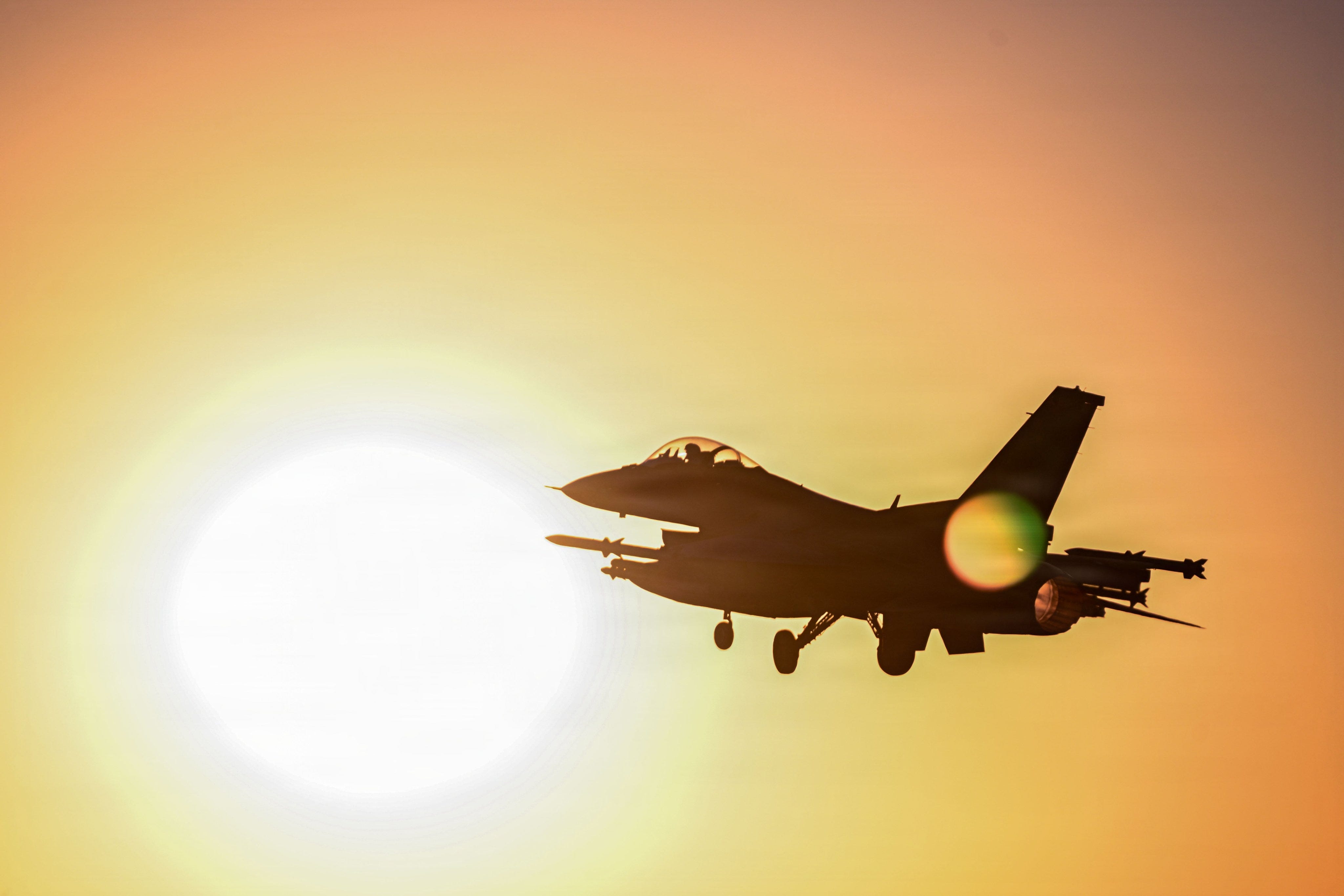
A U.S. Air Force F-16 fighter jet takes off from a base in the Middle East. (CENTCOM/X)
It’s Tuesday, July 21, and buried at least 100 meters deep beneath a mountain near the city of Natanz lies a critical piece of Tehran’s nuclear program. But it isn’t enriched uranium that makes Pickaxe Mountain the stuff of Israeli nightmares.
According to The Wall Street Journal, Israeli intelligence has determined that Iran moved thousands of uranium-enrichment centrifuges into tunnels deep within the mountain last fall, following the 12-day war in June. If accurate, this represents a significant acceleration of Iran’s path to reviving its nuclear program—one that both the U.S. and Israel believed was effectively dead and buried.
Pickaxe Mountain has been under construction since the fall of 2020. At the time, Iran claimed the underground halls would replace the destroyed above-ground centrifuge assembly facility at Natanz’s main site, which was severely damaged in an explosion widely suspected to have been an act of sabotage. Iran describes the facility publicly as a centrifuge assembly plant. Israeli intelligence, however, indicates the purpose is far more ambitious: The site is believed capable of supporting not just assembly operations but limited uranium enrichment.
Over the past 15 months, satellite imagery has documented steady activity: truck traffic, tunnel reinforcements, and expanding security perimeters. The assumption had been that U.S. overflights and the implicit threat of precision strikes would deter Iran from restarting its nuclear program—but that calculation appears to have been wrong. The facility was not targeted during last year’s Israel-Iran war, nor has it been struck during the current round of U.S.-Iran fighting, either because operators assessed that bombs would have minimal effect or because the site remained under construction. But that calculus may now be shifting.
Last week, Donald Trump broke his public silence on Pickaxe Mountain. “Pickaxe is a possible target for a nice big fat shot right near the front door,” Trump said. “We’re going to take out Pickaxe Mountain. Tell the Iranians to be ready.” He added that while U.S. intelligence currently observes “no activity” at the site, Washington would “probably give Pickaxe a shot relatively soon.”
An Israeli military official involved in recent targeting decisions expressed frustration that current airstrikes have insufficiently prioritized nuclear-weapons-related infrastructure, specifically citing Pickaxe Mountain as an example. During the campaign, Israel focused on regime targets, hoping to achieve its goal of creating the necessary conditions for regime change. Military industry also received considerable attention, though much of the second-order production remains untouched. Focus also had to be shifted from the original target bank to military infrastructure around the Strait of Hormuz after the Iranians failed to collapse from the initial strike.
With escalating strikes ongoing, the next round may be forthcoming, likely with a far less optimistic target bank.
But there are other voices. Speaking after a lengthy security discussion last night, Finance Minister Bezalel Smotrich articulated the calculation that has long animated Benjamin Netanyahu’s approach: “The State of Israel has no interest in joining the contained confrontation between Iran and the United States—the current situation is the best one for us.” In other words, the status quo of blockade and regular strikes may be better than one final operation.
Yet the ultimate decision belongs neither to Smotrich nor Netanyahu. It belongs to Trump. The president could opt for one comprehensive strike rather than the current tit-for-tat exchange. In such an event, Israel would confront a simple choice: join in or lose out on what is likely its last shot at acting with U.S. support. If those are the two options on the table, I’m fairly certain which choice Israel would make.
Lebanese President Joseph Auon meeting with Secretary of State Marco Rubio in Washington. (@LBpresidency/X)
This morning, Israel withdrew from its first Lebanese village since the invasion in March, and the Lebanese Armed Forces have moved in to fill the void. The question is: Does this signal the beginning of a forced Israeli retreat, or the start of Lebanon’s long road to recovery?
The answer is complicated.
Israel can continue destroying Hezbollah infrastructure indefinitely, but it will pay massive international costs for doing so, with no way, short of a full invasion, to extinguish the group entirely. The framework agreement gives Israel legitimacy and time to uproot Hezbollah, but what Lebanon gives, it can also take away. If Beirut loses momentum and descends into state collapse, the entire agreement evaporates, and Hezbollah recovers out of Israel’s reach.
This is the project President Joseph Aoun carries to Washington, where he meets Trump for the first time. Trump had no direct communication with Aoun during his first year in office—no meetings, calls, or letters. His sole contact has been in the form of inconsistent messaging on Lebanon’s fate: declaring after the June 26 agreement that “Iran is out, Hezbollah is out, and the road to peace between Israel and Lebanon is in,” then pivoting to pressure Netanyahu for unconditional withdrawal in the spirit of the Iran MOU, telling him, “They don’t want you there. You should redeploy,” before abandoning both positions altogether in favor of his own scheme, declaring, “Syria will do the job.”
Aoun has already proven his willingness to buck Iran and pursue eventual peace with Israel. That was enough to earn this meeting. But anyone with a functioning memory knows the track record is bleak. Lebanon’s LAF claimed to have cleared Hezbollah infrastructure south of the Litani in late 2025, yet Israel continues finding significant assets there a year since their declaration. More damning still, LAF commander Rodolphe Haykal has explicitly prioritized “civil peace” over confronting Hezbollah—a strange priority for a general with orders to the contrary. The Lebanese military has proven as effective at disarming Hezbollah as UN peacekeepers have been, which is to say, not at all. Lebanese leaders have repeatedly promised and failed to disarm the group over the past 35 years—from the Taif Accord through the 2024 ceasefire. The uncomfortable truth is that throughout Lebanon’s history, only foreign powers—the United States, France, Israel, and Syria—have successfully disarmed Lebanese militias.
Before Aoun goes all in on Hezbollah disarmament, he needs ironclad U.S. commitments. That means Delta Force-style training units for elite LAF operations, drones and sensors for border security, organized international fundraising for reconstruction, and business initiatives to rebuild Lebanon’s shattered economy. He also needs assurance that Trump will not abandon him halfway through his push.
The Lebanese army deploying in the village of Zutar al-Gharbiya in southern Lebanon, after an IDF withdrawal.
Trump, for his part, will demand specifics: a detailed plan for Hezbollah disarmament, removal of military officers complicit with the group, suspension of anti-normalization laws blocking Israeli-Lebanese civilian contact, and a clear reaffirmation that peace with Israel is Aoun’s strategic objective. Most critically, Aoun must decisively kill Trump’s recurring fantasy of deploying Syrian troops into Lebanon—a move that would resurrect memories of Assad-era brutality and paradoxically strengthen Hezbollah’s popular support.
The circumstances favor success. The U.S.-Iran MOU is in tatters, eliminating easy alternatives to the framework. This week’s Rome talks were productive. Pilot zones are advancing. Trump will likely warm to Aoun personally, provided he takes a note from Zelensky and wears a suit. But this is about far more than personal rapport; the future of Lebanon hangs in the balance.
Activists blocking the Ayalon Highway during a protest against the government's judicial reform in Tel Aviv, July 20, 2023. (Chaim Goldberg/Flash90)
According to most estimates, between 450,000 to 500,000 Israelis rallied in the streets against the government’s judicial reform in 2023. Naturally, when such numbers assemble for political purposes, minds turn to party formation, and as expected during that time, there was discussion about the establishment of a “Protest Party.”
It didn’t end up being formed—until yesterday’s Democrats primary effectively brought it into existence.
Israel’s Democrats Party primary drew 86.2 percent of the party’s 114,000 eligible voters, with 51 candidates competing for what are considered nine to 12 realistic spots on the party’s Knesset list. While the results left Netanyahu’s favorite candidate—the militantly secular provocateur Naor Narkis, who threatened to demolish Torah institutions with a bulldozer—in 22nd position, many of the realistic 12 seats went to protest leaders. Attorney Gaby Lasky, who has represented violent Palestinian activists, secured the 6th spot, while Omri Ronen, co-founder of Brothers and Sisters in Arms—an organization that called for military refusal during the 2023 judicial reform protests—took 7th place. High-tech entrepreneur Moshe Radman Abutbul, who led the “High Tech Protest” movement against the judicial overhaul, claimed 9th position. Women’s rights activist Moran Zer Katzenstein, who gained prominence by dressing in dystopian garb at the “Handmaids’ Protest,” placed 12th.
Despite the protest movement’s self-image as an expression of authentic popular will, none of the prominent leaders from the streets sought or were offered positions on lists associated with political centrists like Naftali Bennett or Gadi Eisenkot. Instead, they converged on a single party—and the most left-wing party at that. Beyond giving further evidence of the protests’ primary constituency, it may serve as a referendum on the movement itself. With Naor Narkis’s entry into the Knesset relegated to the realm of impossibility, the question for prospective Democrats voters won’t be framed as secular or religious, but protest or no protest.
English Editor: Ari Tatarka
If you enjoy the newsletter, you can show your support by becoming a paid subscriber—it really helps keep this going. I’m also offering a special monthly briefing for a small group of premium members. I’d love to have you join us—just click below to find out more.
Thanks for reading It’s Noon in Israel! Subscribe for free to receive new posts and support my work.


Ok, this is really getting ridiculous. I am just a regular person with no ties to anything political in the US or Israel. Why is anyone surprised that Iran has been spending its time shoring up its nuclear capabilities. Why do we, the collective we, not take them at their word. They've been saying it over and over and over, yet the collective we believes we can negotiate with people who publicly state they want to destroy Western civilization, including Israel and the US. They never have stopped their nuclear ambitions and they never will, unless it is totally and 100% obliterated, which obviously the US and Israel did not achieve. It is a fantasy to believe that Iran will just give up their nuclear program. Wake up people!!!!
It’s certainly not “protest vs. not protest”, because charedim protest at least as much as The Democrats.