It’s Noon in Israel: Iran Struck Out Turkey’s Up to Bat
Also, James Bond has nothing on this Israeli rescue, and the Oscars nominate propaganda.
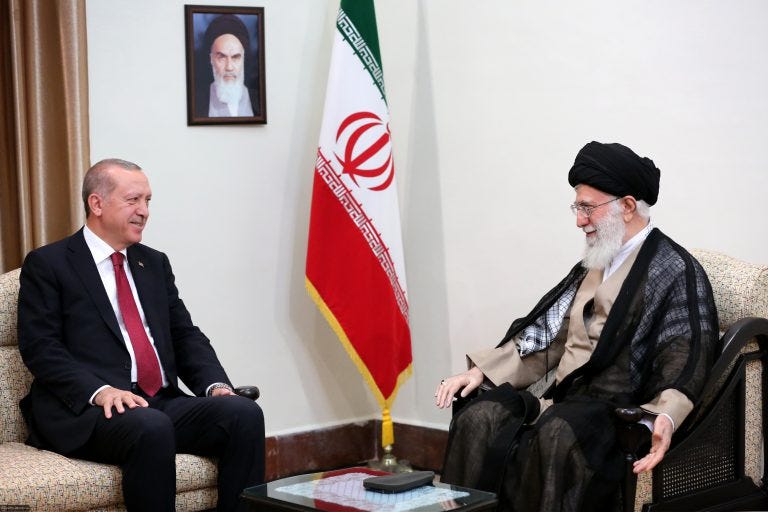
Iranian President Khamenei and Turkish President Erdogan. (Khamenei.ir)
It’s Friday, January 23, and should we start with the good news or the bad? As clouds of war once again gather over Tehran, senior officials in the region assessed this week the Iranian regime’s chances of survival as “very high.” If there is no genuine military intervention—said the officials, crossing their legs and leaning back—Khamenei could make it to January 20, 2029, the inauguration date of the 48th president of the United States, still ruling the Islamic Republic. It is extremely difficult to topple a regime that is prepared to kill even three hundred thousand of its own people if necessary, they explained.
Even if the regime were to fall, there is no reason to hope for a secular, liberal Iran. In their assessment, the regime that would arise would be a Persian version of Pakistan: a centralized, Muslim, hostile, and far-from-democratic system; the product of a “palace coup” within the Revolutionary Guards rather than a popular uprising from below, whose activists were mown down en masse in the streets. That is why there is not much enthusiasm in the region for an American attack—if, in their view, nothing good is going to come of it anyway.
And now for the good news: even if the regime does not fall, they believe the Iranian threat as we knew it no longer exists. The era in which Iran could calmly and without interference cultivate a formidable proxy army across the Middle East while inching step by step toward a nuclear bomb is over. They are “who they were,” and it is preferable to focus on eliminating the Houthis and the remnants of Hezbollah, the last remaining arms. The Middle East has already internalized the “day after” Iran; entirely different things now preoccupy it.
At the top of the list: Turkey. Within ten years, perhaps even less, the Sunni, terror-supporting regime in Ankara will try to take control of the Middle East. It too will have proxies, and it too will try to encircle Israel and make its life miserable. Senior officials in the region are not particularly troubled by Turkey’s and Qatar’s integration into Gaza’s “executive council,” which they see as largely symbolic. Qatar as well, in their view, is undergoing a slow process of turning in the right direction after years of a stormy romance with terror and incitement. But what will happen if Jordan—already a state with a Palestinian majority—falls into Turkey’s sphere of influence? What if Egypt falls? Or Lebanon? Attention must also be paid to the worrying processes underway in Syria and its effective transformation into Erdogan’s murderous client state. It is not yet too late to act, before the Muslim Brotherhood and their patron wash over the region.
This is an excerpt from my weekly column in Israel Hayom.
To read on my website click here
Fallen IDF soldier Oron Shaul.
New details emerge around the recovery of Oron Shaul’s body in January 2025. This operation is more spy thriller than reality—even with a surprise twist at the end.
The movie opens on Gaza. Operation Protective Edge, 2014: IDF soldier Oron Shaul is killed, his body captured by Hamas—fade to black.
Ten years later.
An Israeli soldier finds a computer during a routine operation. It says there’s someone who knows where Oron is—and he’s already in Israeli custody. The man is interrogated and tells investigators that the body was held by former Hamas commander Ibrahim Hilo. He also says Oron’s body is being kept in a freezer beneath Hilo’s home. IDF forces had already been there, but they didn’t check the freezer.
The IDF have to find Hilo and make sure the intelligence is correct. The problem? Hilo is in Deir al-Balah, the humanitarian zone on the coast of Gaza. They need to lure him out and grab him without anyone noticing.
But this is a heart-pounding thriller—so of course, there’s a ticking clock.
It’s Wednesday, January 15; a U.S.-brokered cease-fire is starting on Sunday morning. They have four days to capture Hilo, confirm the intelligence, and retrieve the body. The operation is ready.
It almost doesn’t work. Hilo is convinced to come to a warehouse. That morning, he says he’s not coming—but is cajoled back into it. On the way, he backs out again, makes a U-turn, and begins returning to the camp.
At the last moment, he agrees again, and the signal is given to the undercover unit to go in—they turn the key, but their truck won’t start. After agonizing minutes, the engine roars to life—and Hilo is captured.
Hilo confirms the body is hidden in the freezer beneath his house. But now, a new problem: how to reach the house without endangering living hostages held nearby, as IDF forces are already withdrawing from parts of Gaza due to the approaching cease-fire.
Meanwhile, on the home front:
It’s Friday morning, and the Shaul family receives a call from then–Shin Bet chief Ronen Bar. He informs them that the negotiating team has failed to recover their son—all the while knowing that a bold operation might soon be launched to retrieve Oron’s body.
Now it’s time for the climax.
With the cease-fire just hours away and Israeli forces already withdrawing, a Palestinian collaborator is sent alone to retrieve the body. The IDF fires artillery into nearby open areas to mask the noise as the agent breaks into the shop. He finds the freezer, pulls the handle—it’s locked.
Under cover of the shelling, the agent breaks open the freezer to reveal the prize. He wraps Shaul’s body in a carpet and, as the sun rises, carries it roughly 1.5 kilometers to a waiting IDF unit.
Oron is brought back to Israel and laid to rest more than 10 years after his death.
The end.
My heart was pounding just writing this. The best part is, it’s all true—from the ticking clock, the broken truck, to the climactic rescue at the hands of Yaʿqūb Bond. That’s just how Israel does it.
Promotional poster for Palestine 36. (Philistine Films)
Speaking of movies, it’s Oscar season, and this year two pro-Palestinian films—Palestine 36 and The Voice of Hind Rajab—have been shortlisted for Academy Awards. Cinema is threatening to settle the story, and we aren’t doing enough in response.
What’s in these movies?
Well, Palestine 36 depicts the history of the 1936 Arab revolt against the evil British colonialists. Over what was it again? “Land transfers” seem to be the problem—shame they didn’t exist.
The reality was that virtually all of these “land transfers” were purchases, mostly from wealthy Arabs.
But transfers to whom?
The movie doesn’t make that clear. Jews aren’t really characters—only glimpsed in the background twice in the film. I suppose making more explicit anti-Jewish characters set in 1936 doesn’t put them in the best company.
But speaking of being friends with Nazis, the undisputed leader of the revolt—and later friend of Hitler—Haj Amin al-Husseini does not make an appearance, nor do the hundreds of dead civilians from the violence, or the other Arabs who helped repress the revolt. Only at the end of the film do they admit that it’s fiction, and merely “inspired by actual events and characters.”
Meanwhile, The Voice of Hind Rajab, which at least admits that it’s only “based on true events” at the outset, takes place in the Red Crescent offices in Ramallah, as operators try desperately to save the young Hind trapped in Gaza City. While Israel is not the mustache-twirling villain in this movie, it is an uncaring and malicious presence throughout the film—only referred to by the occasional “they.”
Things not mentioned in the film include: serious questions surrounding Hind’s presence in the area, the timeline of the event, and any mention of Hamas.
Don’t worry—that didn’t stop The New York Times from praising its “ideological neutrality,” or it being called “history” by CNN’s Christiane Amanpour. Hind Rajab’s story is a tragic one, but also more complex than depicted in the film.
This isn’t just a debunk piece. If you want to know how the movies distort reality, read Oren Kessler’s fantastic piece in The Free Press and Mark Zlochin’s investigation of the case of Hind Rajab. I’m also not going to go into the fact that Palestine 36 is backed by Qatar and Turkey, or that a Hezbollah member heads the Hind Rajab Foundation.
My question is: Where are the pro-Israel movies?
I thought we ran Hollywood—but how many blockbusters about Israel have there been this year?
If Palestine 36 is any indication, they don’t need to be about October 7. Israel has more than enough history of heroism fit for the silver screen that wouldn’t require a mass twisting of reality.
Here’s a bit of history: In 1958, Leon Uris published a book called Exodus, a historical novel about the years surrounding the founding of the State of Israel. It was the biggest bestseller since Gone with the Wind and stayed at No. 1 on The New York Times Best Seller list for eight months. It was one of the most effective pieces of hasbara Israel has ever had—and it was entertainment.
If any movie producers are reading, I’d be happy to give some suggestions. Maybe start with the heart-pounding rescue of Oron Shaul—if it’s legal in Hollywood to have Palestinians as the bad guys.
If you enjoy the newsletter, you can show your support by becoming a paid subscriber—it really helps keep this going. I’m also offering a special monthly briefing for a small group of premium members. I’d love to have you join us—just click below to find out more.


Here’s an idea for a movie, the eradication of malaria from Mandatory Palestine thanks to the efforts of Dr. Israel Kligler who overcame British resistance and the Arabs “inshallah” view of the world.
https://pmc.ncbi.nlm.nih.gov/articles/PMC8415063/
Among the topics covered would be the sale of land by absentee effendi, that these purchases at high prices closely mapped malarial infested areas, a bit about Zionism bringing modern ideas to the region and how the eradication effort enlisted the help of both Jews and Muslims.
I suppose you could throw in a romance, this being Hollywood - though more likely Israel’s equivalent as Hollywood lacks the courage at the moment.
Either that uplifting story or, as a direct counter to Palestine 36, how about Hebron 29? At least then you have the Grand Mufti in all his malevolence quoting the Qur’an and Hadiths, provoking violence with the British mostly (though not always) appeasing the Arabs at that stage. You could have scenes displaying British antisemitism and maybe a British official deploring the selection of the demagogue al Husseini over the more pacifist Nashashibi clan and musing about how things might have been.
not necessarily relevant to israel, but if they’re actually interested in recapturing palestinian history accurately by using passionate cinema, hollywood should be looking at the real events… black september between jordan and the PLO, or the real mass exodus of hundreds of thousands of palestinians from kuwait during the iraqi invasion. could produce actual thrilling films worthy of tears… but they’d NEVER do that. as long as israel is not the villain, the box office will flop