It’s Noon in Israel: Is Steve Naive?
Also, Trump and Netanyahu clash over Gaza, and what happened to Bibi's voters?
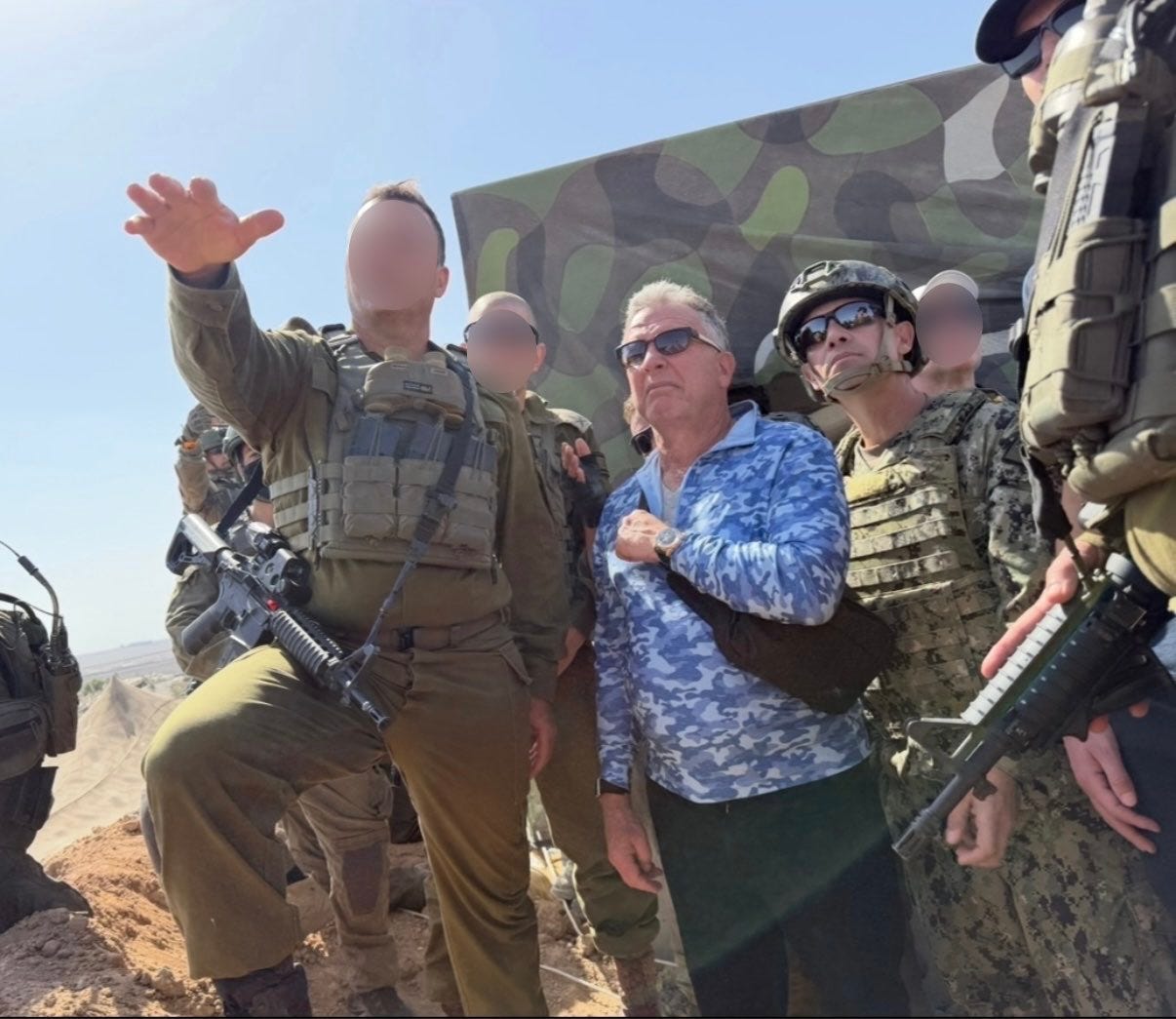
Steve Wtikoff getting a tour of Gaza with the IDF in October 2026. (X/@SEPeaceMissions)
It’s Sunday, January 18, and “There’s no plan for executions or an execution,” Trump said last Wednesday. “I’ve been told that on good authority. We’ll find out about it. I’m sure if it happens, I’ll be very upset.” A strange statement to make while reports of protesters being gunned down in the streets by regime forces were still coming in.
The question is: who was this “good authority”?
It seems it was Trump’s envoy at large, Steve Witkoff, passing on a reassuring text from Iranian Foreign Minister Abbas Araghchi.
At the time, attention centered on the planned execution of Erfan Soltani, a 26-year-old protester whose death sentence had reportedly been delayed under U.S. pressure.
Trump’s comments sparked speculation that the reprieve for Erfan was an excuse for the president to cancel his own consequences for Iran—courtesy of Witkoff. I don’t believe that was the case. But even if it were, unconfirmed reports indicate that Erfan was recently killed in regime custody.
That begs the question: Why did Witkoff believe Iran in the first place?
Why anyone would take the word of ayatollahs who openly admit to killing more than 4,500 of their own citizens is beyond me. I’ve never quite understood how Witkoff built a real estate empire while putting so much faith in people—Qatari clientele excluded.
While passing Iranian lies to Trump, he’s also showing the same blind trust toward Hamas and the Board of Peace. Regimes that murder their own citizens don’t draw the line at lying—that shouldn’t come as a surprise.
When the IDF ends up disarming Hamas and Iran keeps executing its own people, “Steve the Naïve” does have a certain ring to it.
Benjamin Netanyahu and Donald Trump. (whitehouse.gov, knesset.gov)
Trump and Netanyahu are clashing over Gaza. Yesterday, the makeup of the new Gaza Executive Board was announced, with some surprise members: senior officials from Turkey and Qatar. Netanyahu’s office released a statement claiming the choice “was not coordinated with Israel and contradicts its policy.” I’m not so sure.
First, some context.
You might remember Israel’s foreign minister, Gideon Saar, stating unequivocally last year, “Israel will not accept the presence of Turkish armed forces in Gaza.” Well, the U.S. landed short of that red line, but any Turkish influence is more than Israel was hoping for. Qatar—aka the funder and gracious host of the people they are meant to get rid of in Gaza—is not a welcome presence either. It’s a bad sign when the only sponsor of Hamas left not sitting at the table is Iran.
But back to the question that has the world press salivating: Did Trump blindside Netanyahu?
I don’t think so. More likely, it was a bitter pill Netanyahu had to swallow, and his public response of “I didn’t know” was just a way to make it go down easier.
Journalists have seized on an American senior official’s tirade against Netanyahu—complete with the headline quote, “This is our show, not his show.” But I wouldn’t be so quick to declare that the daylight has finally been found between Israel and the United States.
It all depends on what comes next.
The Executive Council sits beneath the new Board of Peace, a body composed of international officials and leaders. The structure bears an uncanny resemblance to another organization devoted to global harmony—the United Nations. This may well be Trump’s attempt to build a replacement for that sclerotic institution—one, coincidentally, with himself as its president.
This has major implications for Turkey and Qatar—their influence will depend entirely on Trump and the board’s next move.
If he takes charge and issues an ultimatum for Hamas to disarm, authority will bypass the council altogether and fall squarely into the hands of the IDF. But if the Peace Board proves as ineffective as its U.N. counterpart, Hamas will thrive under Turkish and Qatari protection.
The crowd at the Likud victory party after the 2015 elections. (Screengrabs used in accordance with Section 27a of the Copyright Law)
A veteran figure in Israel’s election industry recently said he has never seen sums of money like those now being invested in the concentrated effort to defeat Netanyahu in the upcoming elections. Not even in 2015 with the anti-Netanyahu V-15 NGO, and not in the endless rounds of the early 2010s— simply nothing comparable.
Here are rich people’s problems: what do you do with all the money? Campaigns usually focus either on mobilization or persuasion. In the current era, moving voters from one side to the other is almost impossible. One can focus on getting center-left voters to the polls—what is called “maximizing turnout”—and perhaps, in parallel, run a targeted campaign in the urban wings of Religious Zionism.
It is doubtful one even needs to spend a dollar to mobilize opposition voters. They have voted at very high rates for years. In 2022, there was indeed a small, marginal drop of 2–3% in turnout in places like Ramat HaSharon, Hod HaSharon and the like, the result of disappointment with the “change government.” But the assumption is that this time they will flood the polling stations en masse. Avigdor Lieberman, for example, is convinced that if turnout rises by five percent, that will be enough to defeat Netanyahu—the question is whether that is even possible.
In normal times, most of the money would go toward boosting turnout in the Arab sector. But the leaders of the change bloc have not yet decided whether they want Arabs to turn out in massive numbers or stay home. If they believe some of the polls, only two or three seats separate them from a Zionist majority, and higher Arab turnout would shatter that dream. If they believe other polls, raising turnout is essential to prevent Netanyahu from securing a majority.
There is another issue that is discussed less. According to polls projecting 52 seats for Netanyahu’s bloc, about 8–9 mandates moved directly to Bennett and another 3 to Lieberman—some due to the judicial reform, most due to October 7. The question is: where are they? In the 1996 election, Netanyahu presented a gallery of disappointed Shimon Peres voters. In 1999, Ehud Barak boasted of well-known figures in and outside politics who had voted for Netanyahu and defected. Where are they now?
How is it that every Saturday night there are demonstrations, but all those religious Zionists or Likudniks who speak of themselves as “the right” have not voted for Netanyahu’s bloc for at least a decade? Those who defected to Lieberman are unlikely to appear, since most are immigrants from the former Soviet Union—but what about the rest?
One explanation is that this is not a direct shift, but rather Likud voters who will stay home. When that happened in 2006 and 2021, Netanyahu lost power. When they came out in droves, as in 2022, he won easily.
And here lies his opponents’ main dilemma: if there is one lesson from past elections, it is that Israel is too small a country to mobilize half of it to vote while putting the other half to sleep. You cannot blast horns in your camp without the other camp hearing and waking up—assuming, still unproven, that Likud voters are asleep at all.
This is an excerpt from my weekly column in Israel Hayom.
To read this article on my website click here.
If you enjoy the newsletter, you can show your support by becoming a paid subscriber—it really helps keep this going. I’m also offering a special monthly briefing for a small group of premium members. I’d love to have you join us—just click below to find out more.


Witkoff is a clown who is in the deep end of the pool but forgot he didn't know how to swim. He is oblivious to Middle East mentality, unless of course it's a real estate deal. Trump is a bigger fool than I thought, being led by fools (Kirshner, Witkoff, among others)
Witkoff is an embarrassment.