Israel Loses Its Greatest Friend on Capitol Hill
Also, Iran talks from both sides of its mouth while Qatar interferes in Germany.
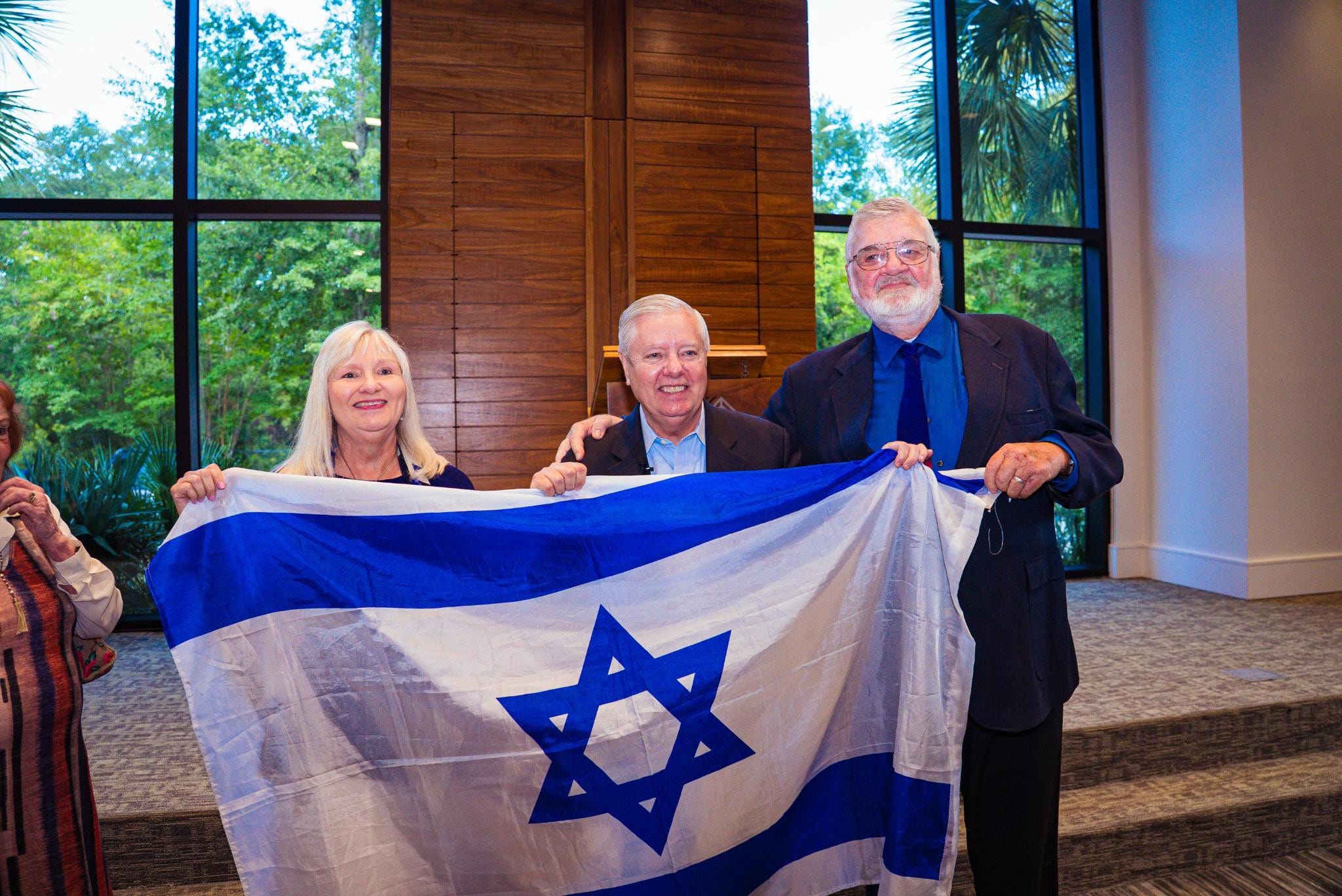
Lindsey Graham addressing Chabad of Charleston, July 2025. (@LindseyGrahamSC/X)
It’s Sunday, July 12, and this morning the office of South Carolina Sen. Lindsey Graham announced that he passed away Saturday evening after a sudden and brief illness—two days after turning 71. He had returned from Kyiv on Friday, where he met Volodymyr Zelensky, and was booked on Meet the Press for this very morning. Israel has lost its greatest friend on Capitol Hill.
That isn’t an exaggeration; it’s the consensus of the Israeli opposition and coalition, who rose in unison this morning to eulogize the beloved senator.
Born and raised in his beloved South Carolina, Graham grew up living in a cramped room behind his parents’ combined pool hall, bar and liquor store. Later becoming a lawyer and enlisting in the U.S. military, he entered Congress in 1995, becoming the first Republican to represent South Carolina’s 3rd District since Reconstruction. In 2003, he moved up to the Senate, where he and John McCain became a trio with Joe Lieberman—dubbed the “Three Amigos” by Gen. David Petraeus on one of their endless trips to Iraq and Afghanistan. Hawks, travelers and crossers of aisles for wars worth fighting. Especially Israel’s.
Sander Gerber, his partner on the Taylor Force Act, once quipped that the senator was “more pro-Israel than AIPAC,” while Christians United for Israel counted him among Israel’s most stalwart allies in Congress. His evangelical base—a pillar of both South Carolina politics and American Zionism—wasn’t a constituency he courted so much as one he belonged to.
Addressing AIPAC’s annual dinner on March 22, 2010, he told the room the evening was about “our best friend in the world, the State of Israel”—and had every member of Congress present stand while he pledged that Congress had Israel’s back and would not let it down. In the same speech, he declared Jerusalem the undivided capital of Israel and the eternal home of the Jewish faith, said it was sometimes better to go to war than to allow a second Holocaust to develop, and closed with “never again.”
He more than lived up to the commitment. From Obama’s JCPOA—which he fought—to Donald Trump’s short-lived rapprochement with Tehran this past month, through the Taylor Force Act, the anti-BDS legislation, the embassy move and the Golan recognition he personally championed, Graham operated on a single axiom, the one the Hebrew press identified this morning as his signature line: Israel’s security is America’s security. He applied it without exception. In 2013, he threatened to sink Chuck Hagel’s nomination as the most anti-Israel defense secretary in American history; in December 2014, standing in Jerusalem beside Netanyahu, he promised on Iran sanctions that “the Congress will follow your lead”—a sentence no other American senator would say to a foreign leader, and Graham said it on camera.
Just 15 days after the October 7 massacre, Graham was in Tel Aviv leading a bipartisan delegation—noting that “10 percent of the United States Senate is in Israel.” Destroying Hamas, he made clear, was nonnegotiable, and he had stark words for Tehran: “We’re here today to tell Iran, we’re watching you”—if the war grew, it was coming to their backyard: “There won’t be two fronts, there will be three.” He told the room exactly why it had happened, insisting no one would ever convince him the massacre was about anything but stopping reconciliation between Saudi Arabia and Israel—the very normalization project he had spent the preceding months building.
He wasn’t shy about Biden’s flip-flopping either. When the administration threatened to withhold weapons over Rafah, Graham hauled Lloyd Austin before the Armed Services Committee and asked whether he’d have supported Hiroshima and Nagasaki—then demanded to know how Washington could dictate terms to a country whose neighbors want to kill all the Jews. He called Biden’s approach “ass-backwards.” When the ICC prosecutor moved on Israeli leaders, his warning was five words of pure Graham: “If they do this to Israel, we’re next.”
Lindsey Graham speaking in Munich, Germany at a rally of 250,000 supporting the Iranian people, February 2026. (@LindseyGrahamSC/X)
When Israel launched Operation Rising Lion on June 13, 2025, his reaction was five words: “Game on. Pray for Israel.” The tweet drew fury from all directions—including from Meghan McCain, his late best friend’s daughter, who informed him it was not a game—but it was, in its way, the most honest sentence of the war: the fight he had demanded since at least 2010 had finally arrived, and he was not going to pretend otherwise. By August, he was telling South Carolina Republicans that if America pulls the plug on Israel, God will pull the plug on us. By 2026, per The Wall Street Journal, he was shuttling to Jerusalem to coach Netanyahu on making the case for war to Trump.
In January, no sooner had he disembarked than he posted: “I just landed in Israel, the one and only Jewish State, and America’s strongest ally and friend since its founding.” He returned once more in February 2026—Netanyahu, Defense Minister Katz, the General Staff—the final visit of several dozen across the decades. In March, amid the MAGA backlash over the Iran war, he gave the line that now reads as a valediction: “I will be with Israel until our dying day.”
Far too soon, that day arrived. It found him the same as always: back from an ally’s capital, stalwartly defending a country’s right to freedom and safety, and scheduled for Sunday television to explain why.
In 1995, an American president needed two Hebrew words to bury an Israeli prime minister. In 2026, Israel needs the same two for a Baptist son of a South Carolina pool hall.
Shalom, chaver.
A KC-135 Stratotanker refuels U.S. Air Force F-16 fighter jets while flying a patrol over the Middle East. (CENTCOM/X)
A death far fewer Israelis are mourning occurred last week, when President Trump declared the MoU to have passed—quietly, or not so quietly—killed by Iranian fire in the Strait of Hormuz. The Iranians have been expressing their grief in two ways: firing on more ships and desperately trying to re-engage in negotiations.
Over the weekend, the IRGC attacked another tanker. Claiming the vessel ignored maritime directives, Tehran declared the strategic waterway closed “until further notice,” triggering a massive U.S. counteroffensive early Sunday morning. U.S. forces struck at least 140 Iranian military targets—drone sites, missile launchers and ammunition depots—bringing the total to more than 300 targets hit across three separate operations over the past week. The IRGC answered as they usually do, with wide-ranging missile and drone attacks on U.S. bases in Qatar, Kuwait, Bahrain and the UAE. Meanwhile, the U.S. is reviving Operation Economic Fury, sanctioning eight individuals and six entities associated with Iran, including Dubai-based financier Ali Ansari, who oversees assets benefiting Mojtaba Khamenei, other regime elites and the IRGC.
Meanwhile, “moderate” Iranians have been blaming the attacks on “errant” hardline factions and requesting a resumption of talks, which the U.S. indulged. There likely is a power struggle inside Iran between more and less hardline factions. A moderating force, however, there is not. The split is not between hawks and doves but between two species of fear: those who fear what the economic damage will do to the regime and the true believers who fear what negotiating with the infidels will do to their place in paradise—and who remain convinced the Americans will fold first.
What unites the factions is an inability to compromise on anything that matters. Neither the memorandum of understanding nor the recent rounds of U.S.-Iran talks have bridged the gaps on the key issues of the war: Iran’s control of the strait, Iran’s nuclear program and Israeli operations in Lebanon. Two senior Iranian sources told Reuters last week that the regime considers its control over the strait “important leverage” and that relinquishing it would be tantamount to “surrender.” The sources added that Iran will not discuss its nuclear program unless the United States recognizes Iran’s control over the strait. In short: nothing has changed.
Still, the pragmatist wing is very eager to keep sitting down. The New York Times reported that President Masoud Pezeshkian, reportedly fearful of the U.S. blockade and Iran’s deteriorating economy, implored the supreme leader to accept the MoU despite Mojtaba Khamenei’s insistence on retaining control of the Strait of Hormuz. Foreign Minister Abbas Araghchi traveled to Oman yesterday to discuss safe passage through the strait with Omani officials.
Iran’s neighbors, who cannot afford to wait for negotiations to fail, are choosing sides accordingly. The UAE, Bahrain and Kuwait are demanding stronger measures against Iran through the Gulf Cooperation Council, including an international arrangement for free transit backed by an international military initiative to defend the strait. Oman and Qatar, the war’s designated matchmakers, naturally prefer that the diplomacy continue.
I hold it as a truism that when a man extends one hand in friendship while slapping you with the other, believe the slap. For once, Washington is returning the favor—shaking Iran’s hand with the left while choking it with the right. As far as I’m concerned, so long as the right hand doesn’t loosen its grip, the left can shake all it likes.
Israeli President Isaac Herzog meets with Chancellor of Germany Friedrich Merz at the President residence in Jerusalem, December 6, 2025. (Yonatan Sindel/Flash90)
Israel had a problem, and Germany had a solution. Israel needs more manufacturing capacity for Iron Dome components. Volkswagen, having failed to establish itself as a leader in electric vehicles and bleeding market share to Chinese imports, has capacity to spare. So the two problems found each other: Volkswagen’s management board green-lit converting a production line to defense manufacturing under a deal with Israel’s Rafael, saving thousands of German jobs in the process. A win-win.
Until the Qataris intervened and sank the deal.
Why do the Qataris have a say in what German factories build? Because, according to Bild, the Qatari sovereign wealth fund holds 10.4 percent of Volkswagen’s shares and 17 percent of its voting rights—and it vetoed the deal for one reason: the company slated to manufacture at the plant is Israeli. Qatar spent years funding Israel’s enemies and is now spending its equity blocking Israel from intercepting the missiles it paid for.
Volkswagen confirmed that its Qatari shareholders vetoed the cooperation at the Osnabrück plant but said it would keep seeking partnerships to save the site. Good luck to the 2,300 workers employed there—all facing layoffs by the end of 2027.
The Qataris had help, of course. Peace activists and opposition parties had criticized the conversion from the start, insisting Volkswagen manufacture only for the civilian market—never mind that everyone in Germany has understood for over a year that tens of thousands of jobs are gone without exactly this kind of reform. The protests intensified once the partner turned out to be Israeli, with radical left-wing activists, backed by the Left Party, declaring it “a deal that the German public cannot accept” given Netanyahu’s military activity across the Middle East.
And this is not just about Volkswagen. According to Bild, the $4.2 billion deal for German shipping giant Hapag-Lloyd to acquire Israel’s Zim is also apparently collapsing—and here too, senior Israeli sources point to Gulf money inside the German corporation: the Qatari sovereign wealth fund holds 12.3 percent of Hapag-Lloyd, the Saudi fund another 10.2 percent.
Nor is the creeping problem exclusive to Germany. As FDD’s Natalie Ecanow has documented, the state of 330,000 citizens, half the size of New Jersey, has invested some 400 billion dollars in the United States—roughly 1.2 million dollars per Qatari citizen. From defense and energy to basic infrastructure and manufacturing, the Qatari octopus has slipped its tentacles into countless sectors of the U.S. economy. As the Volkswagen case demonstrates, these investments can pay more than one kind of dividend.
English Editor: Ari Tatarka
If you enjoy the newsletter, you can show your support by becoming a paid subscriber—it really helps keep this going. I’m also offering a special monthly briefing for a small group of premium members. I’d love to have you join us—just click below to find out more.
Thanks for reading It’s Noon in Israel! Subscribe for free to receive new posts and support my work.


A comment on the VW plant - disgusting as that move was, maybe it will go a longer way for better PR for Israel. That move may not endear a few thousand workers to the benevolent Qatari sovereign wealth fund. Saecasm intended.
Also curious to learn “the details” about Grahams death à la Trumps Truth Social post
Finally, a chance to explain to German workers that Palestinians and their allies are taking away their jobs and working against Germany's best interests while Israel is doing everything it can to help German workers keep their jobs.
Elections, please!