Israel Returns to the "Monster on the Mountain"
IDF forces push further into southern Lebanon, and more.
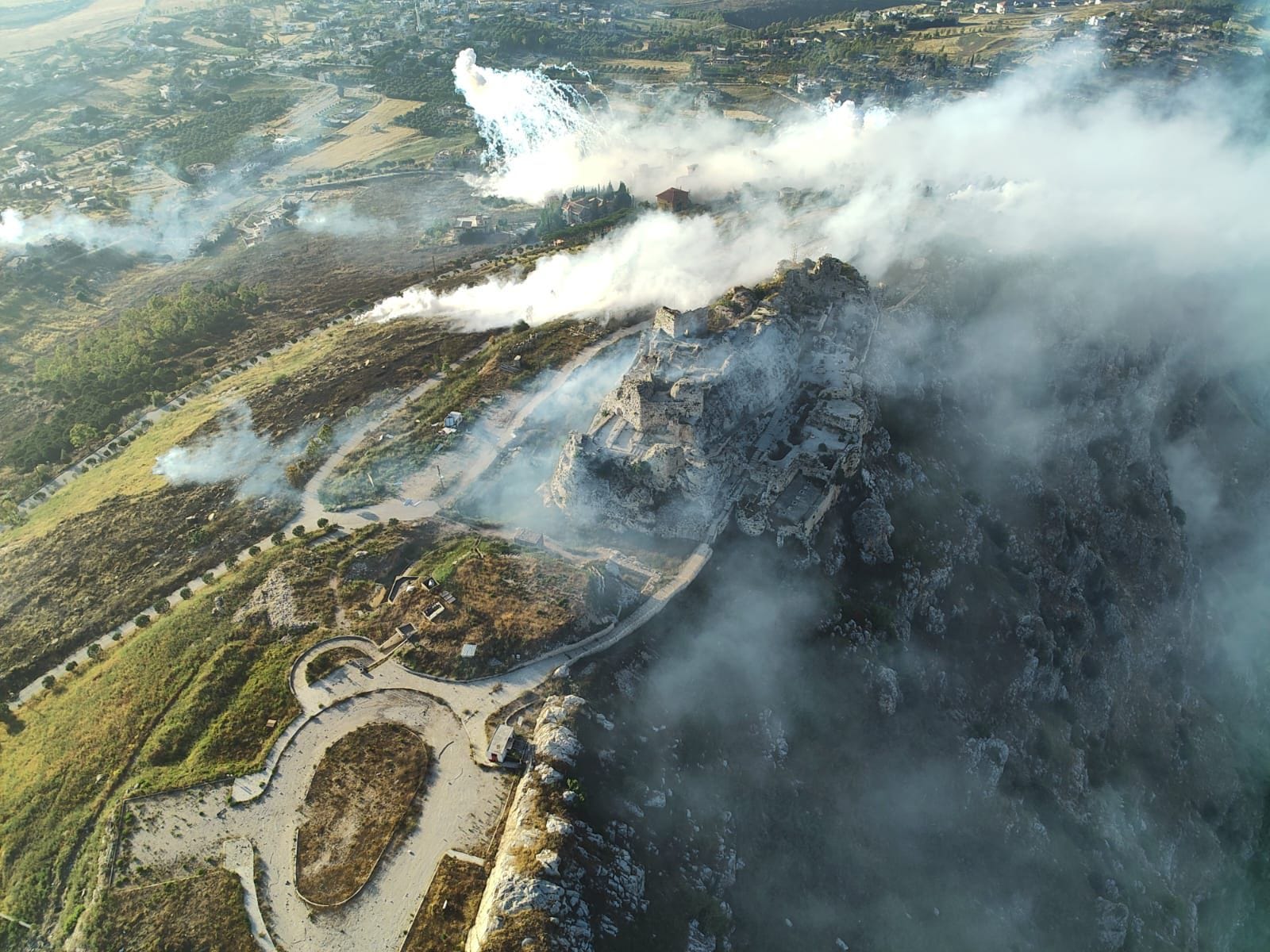
It’s Sunday, May 31, and as Israel Defense Forces troops crossed the Litani River over the weekend they saw a ghost hanging over them in the distance. High on a rocky outcrop overlooking the rolling hills of southern Lebanon sits Beaufort Castle. Today, 26 years after the withdrawal from southern Lebanon and exactly 44 years after the initial capture (on the Jewish lunar calendar), the fortress is back in Israeli hands. Of all the battlegrounds and outposts that define Israel’s entanglements in southern Lebanon, none carries the historical and emotional weight of these crumbling Crusader ruins.
To understand why this particular hill is dominating Israeli headlines, we have to do a bit of history.
Prime Minister Menachem Begin and Defense Minister Ariel Sharon in Beaufort Castle after its capture, 1982.
Prior to 1982, the fortress was a stronghold for the Palestine Liberation Organization militants, who exploited its commanding height to rain mortar fire and Katyusha rockets down on Galilee communities. At the onset of Operation Peace for Galilee, the operational name for the First Lebanon War, Israel’s defense establishment concluded that neutralizing this “monster on the mountain” was the key to securing the north.
That mission fell to the Golani Reconnaissance Unit. On a dark June night in 1982, they scaled the mountain’s narrow, winding paths to initiate one of the first major offensives of the war. What followed was one of the most storied and agonizing battles in Israeli military history—a point-blank, trench-to-trench fight through fortified bunkers against fierce resistance. The unit took the hill, but at a steep price: six fighters and commanders fell in the battle.
As the broader campaign eventually ended with the siege of Beirut and the withdrawal of IDF and Syrian forces from most of Lebanon, the IDF dug into its newly established security zone. Beaufort swelled into one of Israel’s largest military outposts, setting the stage for a grinding war of attrition against a new adversary: Hezbollah. The approach to the fortress quickly earned the grim moniker the “Bloody Route” due to an endless gauntlet of roadside bombs. For nearly two decades, infantry and engineering soldiers lived a subterranean existence in reinforced bunkers, absorbing thousands of Hezbollah mortar shells and anti-tank missiles.
The final chapter was written under the cover of darkness on May 23, 2000. During the rapid IDF withdrawal from southern Lebanon orchestrated by then-Prime Minister Ehud Barak, Beaufort was evacuated in total secrecy. To deny Hezbollah the ultimate propaganda victory of flying its flag over the Israeli bunkers, combat engineers rigged the sprawling modern compound with tons of explosives. The resulting detonation leveled the outpost and punctuated the end of Israel’s long presence in Lebanon.
In his award-winning novel Beaufort, Ron Leshem captures the paradox of the titular outpost, observing that while “it’s wide expanses of green countryside checkered with patches of brown and red, snowy mountains, frothing rivers, narrow, winding, deserted European roads, and the sweetest wind there is,” it remains a place where, “If there is a heaven, this is what it looks like, and if there is a hell, this is how it feels”.
IDF troops taking Beaufort Castle over the weekend.
The Beaufort and Wadi Saluki area is home to “significant” Hezbollah infrastructure, which the IDF states terrorists have used to direct fighting and execute numerous attacks. Hundreds of rockets have also been fired from the sector toward Israel and at troops operating in southern Lebanon. In response, the military is currently maneuvering near Nabatieh—a major Hezbollah stronghold—and has signaled it is “prepared to expand the offensive as required.”
According to former head of Northern Division Major General Gershon Hacohen, the current northern advance is driven by a fourfold strategy. On a tactical level, the goal is to capture and hold territory while simultaneously creating conditions to encircle Hezbollah forces. Operationally, ground troops are tasked with neutralizing the weapons caches and rocket launchers that cannot be eliminated from the air. Finally, on a psychological level, the advance is an exercise in cognitive deterrence—proving the military’s ability to decisively defeat the enemy in close-quarters combat, regardless of how heavily fortified their positions may be.
The return to Beaufort—much like the return to Gaza—cements a brutal lesson Israel has internalized over the past two years: wherever you withdraw from, they will eventually try to kill you from. Israelis are not happily marching back what Ron Leshem called "cage of ugliness right at the center of heaven," but there is simply no alternative.
Inside the claustrophobic concrete bunkers of the original outpost, a green and white sign once hung on the western wall, reminding the exhausted soldiers of their purpose: "The aim: to defend Israel’s northern border, from Mount Dov in the east to Rosh Hanikra in the west.” Israel spent twenty-six years paying the price for abandoning that outpost; it will not surrender the mountain a second time.
Israeli troops pass by destroyed Egyptian vehicles in the Sinai Campaign, 1956.
“And after the Six-Day War, didn’t all the fronts remain open?” Prime Minister Benjamin Netanyahu asked this week, against the backdrop of the bitter disappointment over the emerging agreement with Iran and the continued fighting in the north. “Would they have said back then that the war failed?”
The more interesting, and largely forgotten, historical example is actually the Sinai Campaign. There are striking similarities between the regional war of 1956 and the regional war of 2026.
Like Operation Roaring Lion, the Sinai Campaign was also the product of collaboration between Israel and a global power—in that case, two: France and Britain. Israel sought to eliminate an existential threat, while the powers aimed to strengthen their grip on the Middle East. In that instance, the casus belli was the nationalization of the Suez Canal by Egypt’s ruler, Nasser.
Today, it is dozens of American refueling planes parked in Israel; back then, it was French aircrews training our pilots here. Against Iran, the goal was to avoid a ground operation at all costs, whereas then, the objective was a joint conquest of the Sinai Peninsula. The IDF swept in from the Negev, while the English and French tried to conquer the canal from the west, and, in typical fashion, dragged their feet.
But in both campaigns, an international shipping lane was suddenly blocked by a Muslim dictatorial power, sending energy prices soaring. In response to the invasion, the Egyptians scuttled 47 ships in the canal, blocking it entirely, while Arab states cut off the oil supply to the West. The United States pressured the United Kingdom to withdraw from Egypt, and the Soviet Union, fearing the loss of its regional influence, threatened war if the military forces did not pull back.
What can we learn from that war? Some will say that sometimes you can win every battle and still suffer a strategic defeat. The Egyptians lost thousands of soldiers and the entire Sinai Peninsula, but ultimately gained international recognition of their control over the canal, and Nasser became a hero of the Arab world. The prime ministers of Britain and France were forced to resign in disgrace in the months following the campaign, and Israel evacuated Sinai down to the last centimeter. The partnerships soured and never returned to what they were. The United States forced Israel’s hand. A troubling hint of things to come?
An alternative, more realistic interpretation would be that Israel nevertheless secured a crucial strategic achievement. It distanced an existential threat from its borders, hostilities ceased, and one of the quietest decades in the country’s history allowed it to thrive and grow. From a global perspective, the powers lost. But in the Middle East, it was actually Israel that emerged stronger. The Iranians today are weaker than they were, more vulnerable, and much poorer. The front is open, indeed. And the public is disappointed. This time, they were promised absolute victory; seventy years ago, the Prime Minister declared the “Third Kingdom of Israel,” a moment before he was forced to retreat and back down.
This is an excerpt from my weekly column in Israel Hayom.
English Editor: Ari Tatarka
If you enjoy the newsletter, you can show your support by becoming a paid subscriber—it really helps keep this going. I’m also offering a special monthly briefing for a small group of premium members. I’d love to have you join us—just click below to find out more.
Thanks for reading It’s Noon in Israel! Subscribe for free to receive new posts and support my work.


The IDF must take as much defensive land positions possible while President Trump and the Republicans hold office. If/when the newly emerging anti-Semitic Democrat party take hold, they will cut off aid and pressure Israel to give up land.
Israel will need to build bridges to China, India and Russia to counter balance the Democratic Party of Mamdani and AOC.
.. great reading for a Sunday morning. May the IDF continue to succeed with their objectives in both Lebanon and Iran, and may Hashem protect them at all times, together with our wonderful nation of Israel. 💜✡️💙🇮🇱