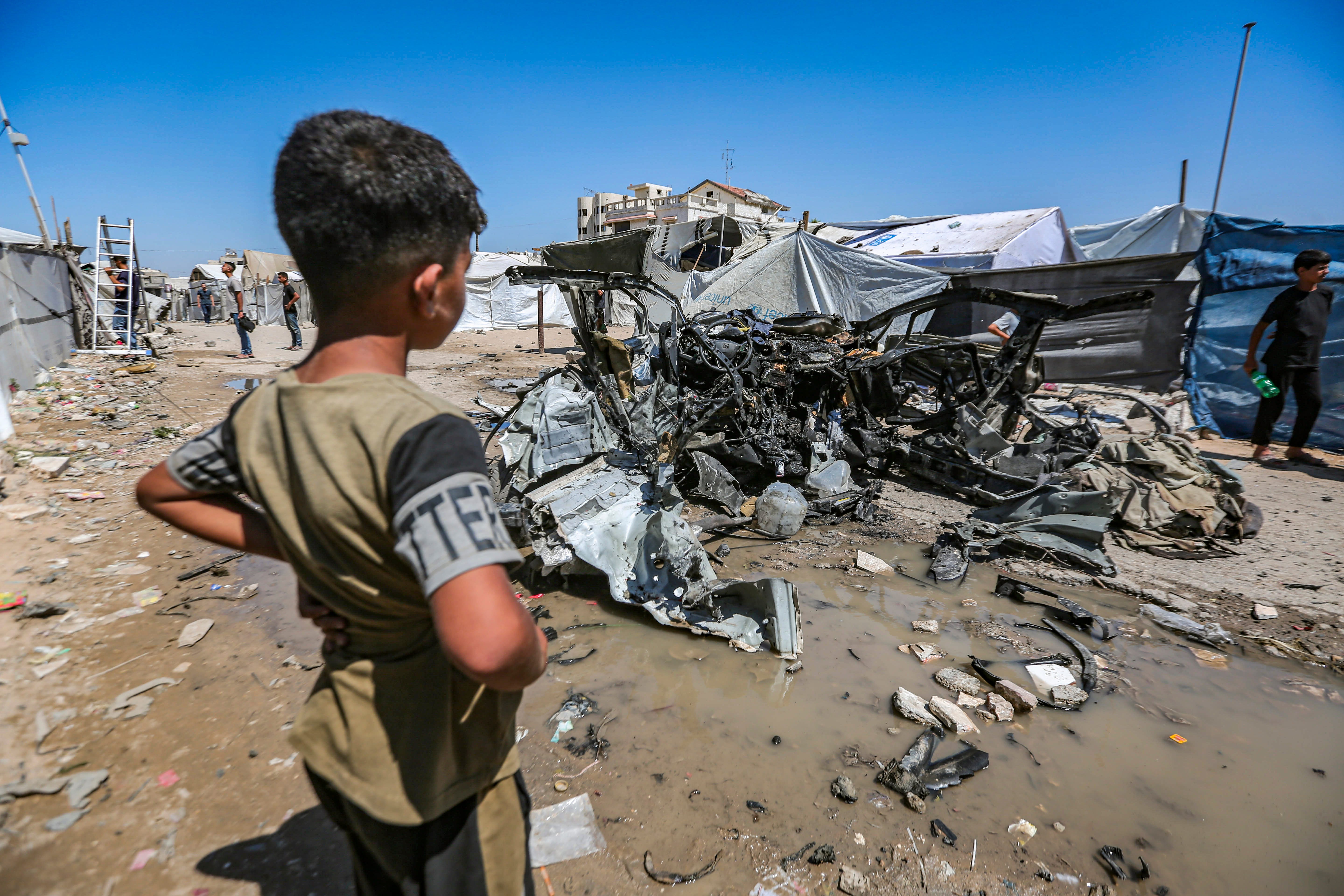
Palestinians inspect a car after it was hit in an Israeli airstrike in Gaza City, on September 1, 2026. (Mohammed Mohammed/ Flash90)
It’s Monday, September 7, and “I think we agree with the Israelis on the end state for Gaza,” Jared Kushner said yesterday. “They just have crazy elections, and that makes them a little irrational in certain regards.” He is not wrong. Election season does bring certain sicknesses with it. But its important to remember, in politics the line separating irrational from rational isn’t sanity but polls.
For the past 7 months there has been a status quo in the Strip, stuck at phase 1 with Israel sitting on the ever-encroaching Yellow Line and semi-regularly striking Hamas operatives. But now that Iran is stable, the Trump administration has focus to spare, and would like to start building momentum in Gaza. Until now the status quo has been maintained by an unstoppable force colliding with an immovable object—the former being Israel’s determination not to give an inch of ground, the latter, Hamas’s refusal to disarm.
The problem for the unstoppable force is that the immovable object is at least rhetorically entertaining motion, leaving the unstoppable force to run into the Americans, with potentially explosive results. According to a senior source on the Board of Peace, Israel had an opportunity to break the stalemate by destroying Hamas in 2026 but Bibi chose “not to exercise the full destruction of Hamas.” Though the source seemingly forgets that a campaign was planned for March, until other fronts intervened.
But let’s review Israel’s options today.
According to the source, Israel has four.
The first is to keep the current policy, which “could lead to another October 7”: attacking Hamas but never fully destroying it, with Hamas still in control of the Gazan population, still fully armed, and with more terrorists than it had before the war began. I would quibble with the prediction of another October 7, but the reputational and alliance costs he didn’t explicitly mention are considerable.
The second option is to hand Gaza over to the PA. This is the preferred option of most of the Arab states and the UN, which is itself enough to disqualify it. I would count this as the most likely to lead to another October 7.
The third, according to them, is for Israel to conquer and control all of Gaza, assuming responsibility for 2 million Gazans with no international support and likely copious amounts of international hostility. The IDF would have to draft tens of thousands of reservists to take Gaza and even more to maintain their hold on the Strip. This we can agree is unviable.
The fourth and “only viable option,” they claim, is to cooperate with the Board of Peace and abide by the 20-point peace plan. It’s a “win-win for Israel,” they insist. Israel keeps the Yellow Line and does not withdraw. If Hamas fully disarms, the BoP and National Committee for the Administration of Gaza take control of Gaza, headed by President Trump. Israel withdraws fully only after Hamas is removed from governing and stripped of all its military capabilities. If Hamas does not fully disarm, then Israel has a green light to destroy it, while the BoP takes care of the population in areas outside Hamas control. No isolation for Israel, no bill for occupation.
Unfortunately he doesn’t consider Gaza Riviera an option, but it’s quite obvious which choice he endorses. I would humbly submit that his vision of sunshine, rainbows and cooperative terrorist organizations is exaggerated. Israel has long since learned to be skeptical of Americans bearing solutions. Trump has never been interested in the granular implementation of any of his policies, and I don’t believe he will begin in Gaza. The fact that Qatar and Turkey also sit on the board, masters of exploiting gaps and sponsoring terror organizations as they are, raises suspicion. Nothing stops the BoP from bureaucratically disarming Hamas, handing them gun licenses or police badges and declaring that total victory. Not to mention that the quibbling over definitions of “military capabilities”—light or heavy, personal or otherwise—portrays a significantly less civilian-minded Hamas than the source depicts.
The source believes that Israel’s current policy ignores “the lessons of the last 20 years and especially October 7.” But one might easily argue that the lesson of that day is beware slippery slopes.
Yet for all my criticism of his framing, I don’t disagree. Israel needs to entertain the process and put the pressure back on Hamas to start moving on disarmament. Despite what newly minted Israel critics may claim, the country never had the luxury of unconditional support or a blank check. Uncompromising stubbornness comes at an incredibly high price, but Israel can reduce the bill with the occasional cooperation. It’s called give and take.
My take: see how many Kalashnikovs the BoP can collect, how many Hamas members they include in their police force, and proceed accordingly. Regardless, ensure Israel isn’t the one to blame if the process collapses. But as Kushner accurately diagnoses, none of this will happen before elections.
Yoaz Hendel, Hili Tropper and party members attend an election campaign conference of the Bayit Tzioni (Zionist Home) political alliance in Jerusalem, on August 5, 2026. (Yonatan Sindel/Flash90)
If someone had told us a year ago that a magnificent crowd would gather at the center of the political map—legendary officers in the reserves, reservists from every sector, bereaved families, Israeli icons, media stars, hasbara artists. If someone had said that above them a cluster of senior politicians would assemble—defense ministers, Likud heavyweights, ambassadors to the UN. If all of that had been said, how many seats would we have projected for the center? 10? 15? Perhaps even a party of government?
And yet the latest polls teach us that the public isn’t interested in the merchandise. According to them, all of the following names fail to clear the electoral threshold: bereaved parents Shira Shapira and Elyasaf Peretz. Yoseph Haddad, the Arab-Israeli hasbara artist. Journalist and television star Netali Shem Tov. Oren Smadja, the Olympic judoka who lost his son in Gaza. Reserve colonel Hezi Nechama. Former fire chief Dedi Simchi. Even the top tier: Brigadier General Ofir Winter, former UN ambassador Gilad Erdan, refusenik and former Knesset speaker Yuli Edelstein, former chief of staff Benny Gantz, and longtime lawmaker Chili Tropper. None of them clears the bar.
The frustration mounts for that crowd as the polls reveal themselves to be a fata morgana: the closer you get, the further the threshold recedes. The reservists cleared the threshold and then collapsed. The same polls showed that if they merged with Tropper they would clear it—only for them to dive back under. The same thing happened to Erdan, and before him to Gantz, and after him to Winter. You put up a building only to find it was built on a whale that has since swum off; you merge only to find that anything times zero is zero.
Right now, too, the illusion persists. Below the threshold, according to the polls, sits roughly 10 percent of votes—an astonishing number of voters. Is that really the situation? Or do all those fractions of a percent scattered across the parties represent nothing more than a passing mood?
Anyone who holds, as before October 7, that everything will again drain into the question of Netanyahu yes or no has an easy job of it. He will simply explain that there was never a chance to begin with. But what about those who believed there really was demand for the goods of unity and the third way? Could this be, as the economists say, a supply-side problem? Or was it an illusion from the outset? The speed with which parties are shot into existence and are then forced to fall in with the right-wing or left-wing camp, to declare loyalty or commit to a formula, and then to evaporate, suggests this may not yet be the round in which conclusions are drawn. That, as in the 1973 election, another round will be needed before the shockwaves of the surprise and the failure break against the old fortifications of the political system and bring them down.
This is an excerpt from my weekly column in Israel Hayom.
The road sign of the Neve Dekalim. (Gershon Elison/Flash90)
According to the Oxford English Dictionary, there are 24 ways to spell Hanukkah. Personally I am faithful to two k’s and no C at the front, but the lesson—as anyone who has tried to reach Safed, or Tzfat, or Akko, or Acre, or Jaffa, or Yafo already knows—is that spelling Hebrew is complicated.
On Sunday the Prime Minister’s Office published its intention to spend some NIS 250,000—about $85,000—with the Academy of the Hebrew Language on standardizing how Israeli place names are written in English and Arabic.
Anyone who has driven north out of Tel Aviv can report on the results. Petah Tikva turns into Petah Tiqwa, and Bnei Brak has at least four spellings in official circulation, none of which is wrong and none of which is right.
The underlying disputes are small and unwinnable. Does kuf get a K or a Q. Does tzadi get a Z or a TS. In 2002 a resident wrote to complain that somebody at the Public Works Department was “desperately in love with the letter Q.” The Yarqon (Yarkon) River. The village of Elyaqim (Eliakim). The town of Kefar Uriyya (Kfar Uria), the product of his affection. That was 24 years ago and the letter is still at large.
Israeli bureaucracy is chaos from top to bottom, and I suppose we have to start somewhere. Before we can settle borders, constitution or draft law, let’s agree on the spelling.
English Editor: Ari Tatarka
If you enjoy the newsletter, you can show your support by becoming a paid subscriber—it really helps keep this going. I’m also offering a special monthly briefing for a small group of premium members. I’d love to have you join us—just click below to find out more.
Thanks for reading It’s Noon in Israel! Subscribe for free to receive new posts and support my work.


