Israel’s Secret Base in Iraq Revealed
Also, inside the mind of Hamas.
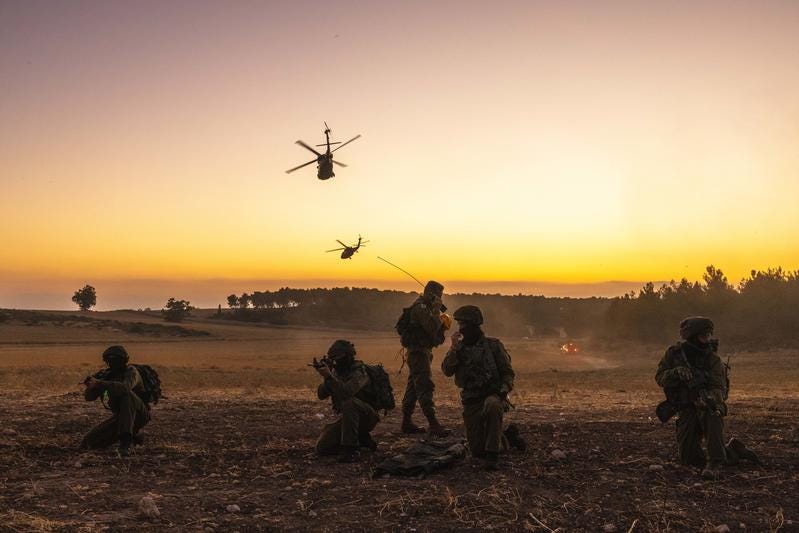
Members of the Yamas special forces counter-terrorist unit seen during a training operation with military helicopters in southern Israel, 2022. (Nati Shohat/FLASH90)
It’s Sunday, May 10, and in mid-March, while the war rages in Iran, a shepherd in Iraq’s western desert witnesses helicopters and gunfire illuminating the horizon. Following the publication of his testimony by Iraqi state media, the military sent forces to investigate this “unusual military activity,” only to be repelled by airstrikes.
What was happening in this remote region of a hostile country? According to a report by The Wall Street Journal, the IDF was operating a secret military base.
Citing U.S. officials and other sources, the report claims Israel established the base shortly before the joint U.S.-Israeli strikes on Iran commenced. Serving as a logistical hub for the IAF, the site reportedly housed special forces and search-and-rescue teams on standby to recover any downed pilots. This marks the first time Israel has established a base in Iraq—or at least the first time we know about it. The outpost is likely what IAF Chief Maj. Gen. Tomer Bar was alluding to when he noted that the air force’s special units were carrying out “extraordinary missions that can spark one’s imagination.
During the high-stakes rescue of an American F-15 crew in early April, while U.S. forces performed the lion’s share of the extraction, Israel provided suppressive airstrikes—likely launched from this very base.
Following the skirmish with Iraqi forces, a member of parliament for the local Karbala governorate stated that a force, likely American, had “carried out a rapid landing under air cover in the Najaf-Karbala desert.”
Satellite imagery of the temporary Israeli base in Iraq. (N12)
His suspicion that a foreign power was operating there was well-founded. An expert told the WSJ that the western desert is a perfect spot for a clandestine outpost due to its vast size and sparse population, noting that U.S. special forces made extensive use of this region in 1991 and 2003. Locals had noticed unusual helicopter activity before the war but had “learned to stay away” given the history of the site.
The crown jewel of Iran’s “Axis of Resistance” was Hezbollah in Lebanon; the Ayatollahs had successfully created a land border with their enemy to support and launch operations. It appears that years later, Israel has done the same.
Photographs of Hamas leader Yahya Sinwar and Hezbollah Secretary-General Hassan Nasrallah posted near Begin Boulevard in Jerusalem, 2024. (Chaim Goldberg/Flash90)
In the Middle East, there is an entity that believed it could wipe out its arch-enemy in one grand operation. In pursuit of this goal, it dragged its allies into a war they did not believe in, and one they would ultimately lose. I speak, of course, of Hamas.
According to an analysis of captured Hamas documents by the Hebrew University’s Dr. Daniel Sobelman, Hamas’s thinking was the precise opposite of Israeli intelligence assumptions. By 2019, the terror group had come to believe that it was Israel that was deterred from action. In the words of Hamas’s political leader Ismail Haniyeh, “Any violation of the red lines... the resistance will be capable of deterring.”
The turning point came in 2021. In early January, a top-secret Hamas military command document emphasized the need to bring Jerusalem into its “rules of engagement.” That May, Hamas initiated a 12-day conflict over tensions on Temple Mount. Israel responded with Operation Guardian of the Walls. Israel’s head of IDF Military Intelligence, Maj. Gen. Aharon Haliva, came out of the operation with the now-painfully overconfident assessment that “five years of complete calm with Gaza” was achieved.
In Gaza, however, Hamas was celebrating a paradigm-shifting strategic victory. The fighting had sparked unprecedented Arab Israeli uprisings—an internal vulnerability Hamas chief Yahya Sinwar realized could be weaponized as a “nuclear bomb” to destroy Israel. The war had also seen the organization’s first active wartime coordination with Iran and Hezbollah via a joint situation room. Most of all, Hamas watched Israel scramble to contain the domestic violence and avoid a larger regional war. Paraphrasing Hezbollah Secretary General Hassan Nasrallah, they assessed Israel was “weaker than a spider’s web.” Far from a deterrent, the 2021 conflict was a highly successful “dress rehearsal” for the full liberation of Palestine.
But to fund their big plan, they needed Tehran. In June 2021, Sinwar, Hamas military commander Mohammed Deif, and deputy commander Marwan Issa sent urgent telegrams requesting $20 million a month and training for 12,000 fighters to “uproot this dirty entity.” By the spring of 2022, Hamas’s leadership had coined a name for the impending war: “the big project.”
That timing wasn’t a coincidence. In late 2022, Israel swore in a new, right-wing government. In a “Top Secret” internal assessment, Hamas’s leadership concluded that the unprecedented domestic political crisis protesting the new government was “melting the glue” that held the Zionist entity together. Furthermore, Sinwar believed that the highly publicized actions of Israel’s new ministers regarding Muslim holy sites would provide the ultimate religious catalyst to convince his hesitant regional allies that an immediate, coordinated attack was justified.
Supreme Leader Ayatollah Ali Khamenei meets with the head of the Political Council of Hamas, Mohammed Ismail Darwish, and senior officials of Hamas, in 2025. (Leader.ir)
But even with a plan in place, Hamas had not secured a solid commitment from the Axis of Resistance. In June 2022, ahead of a critical diplomatic trip to Lebanon, Sinwar sent Haniyeh a five-page letter titled “Uniting the Fronts and the Decision to Seize the Opportunity.” Noting that his military wing was fully prepared for immediate implementation, Sinwar outlined three distinct scenarios for joint action:
Scenario One (The Promise of the Hereafter): A full-force, multi-arena surprise confrontation involving Hamas, Hezbollah, and other regional forces (with Iran supporting from the sidelines) to immediately bring down and end the State of Israel. Crucially, this relied on simultaneous, massive uprisings in Judea and Samaria and among Arab Israelis.
Scenario Two (The Medium-Level Battle): Designed to humiliate Israel and crush its morale. Hamas would enter with full force, but Hezbollah would commit only a third or a quarter of its capabilities. The goal was to trigger mass Israeli emigration, release prisoners, and liberate Judea and Samaria—driven by violent internal revolts from Arab Israelis and Palestinians.
Scenario Three (The Scenario of Necessity): Hamas goes it alone. Hezbollah does not join the fight, but remains on standby and permits Hamas to activate its own forces from within Lebanese territory. To compensate for the lack of foreign military support, Hamas planned to “blow up the situation” from within, banking heavily on an Arab Israeli uprising to destabilize the country.
Days later, Haniyeh sat down in Beirut with Nasrallah and Said Izadi, the head of the IRGC Quds Force’s Palestine Branch. In a highly urgent telegram back to Gaza, Haniyeh reported a massive breakthrough: Nasrallah had expressed “clear and resolute” support for the first scenario, believing the immediate end of Israel’s existence was “realistic and achievable.” Izadi, however, pumped the brakes. He supported the plan “in general,” but insisted they needed to study capabilities and investigate hurdles before moving forward.
Sinwar had actually accounted for this from the start. He had long assessed that the Axis operated on a “completely different” strategic calculus, prioritizing the protection of Iran’s nuclear program over Gaza’s ambitions. His suspicions were explicitly confirmed a year later, during a June 2023 visit to Tehran. There, Supreme Leader Ali Khamenei bluntly rejected Hamas’s push for an immediate, decisive battle, advising them instead to focus on Judea and Samaria while Israel was “gradually” encircled.
Still, Sinwar gambled that once the first shots were fired, even if his allies didn’t fully commit to his grand vision, the sheer scale of the attack would drag them into the battle as at least a secondary force.
Israeli police on the streets of the central Israeli city of Lod, where synagogues and cars were torched by Arab rioters, 2021. (Yossi Aloni/Flash90)
But while he was willing to gamble on foreign support, Sinwar left nothing to chance regarding his most indispensable ally: the internal front. Violent uprisings in Judea and Samaria and among Arab Israelis were an absolute requirement in every single scenario. Even in the minimal “scenario of necessity”—the contingency where Hezbollah decided to sit the war out entirely—Hamas planned to “blow up the situation in the West Bank and the inside,” banking heavily on Arab Israelis to destabilize the country from within.
To light that internal powder keg, Sinwar needed a spark. This necessity explains one of October 7’s most gruesome aspects. Sinwar was convinced that capturing and broadcasting “explosive images” right at the start of the offensive would “trigger a surge of euphoria, frenzy, and momentum” among Palestinians and Arab Israelis. The goal was to spur a violent mass uprising while simultaneously paralyzing the Israeli public with terror. That is why Hamas terrorists wore body cameras and gleefully livestreamed their own atrocities.
Hamas originally intended to spring this trap in April 2023, timing the slaughter with the Jewish holiday of Passover. The only reason October 7 didn’t happen in April is that the IDF picked up on faint intelligence signals and raised its alert level. Tragically, when the holiday passed without incident, Israeli intelligence concluded it had been a false alarm, plunging them even deeper into a false sense of security.
A Palestinian stands on an Israeli tank at the border fence on October 7, 2023. (Yousef Mohammed/Flash90)
Yet when zero hour arrived, Hamas’s foreign allies were caught completely off guard. According to Israeli intelligence, leadership in Beirut and Tehran were “deeply surprised.” As the slaughter unfolded, Hamas commanders Deif, Sinwar, and Issa fired off desperate telegrams to Nasrallah and the IRGC, begging them to “hurry to take part.” They believed a concentrated, immediate bombardment from Hezbollah would finally trigger Israel’s “quick collapse.”
But the Axis of Resistance was furious at being handed a fait accompli. In his first public speech following the attack, Nasrallah delivered a veiled rebuke of Hamas’s attempt to inflict a single “decisive blow.” He stated flatly that the Axis had not yet acquired the capacity to defeat Israel that way, and that resistance movements instead must “win by points” through an “accumulation of achievements.”
Privately, the backlash was even more blunt. One senior Hezbollah official later summarized Hamas’s grand operation with two bitter words: a “catastrophic success.”
It is tempting to dismiss fanatics as simply irrational, but Sinwar’s blueprints reveal a remarkably shrewd calculator. He accurately predicted Tehran’s hesitancy and understood exactly how to force his allies’ hands. But in the end, his allies were right. Israel was not as weak as a spider’s web, and the Axis did not have the capability to destroy it for good. By forcing their hand, Sinwar didn’t achieve a “Promise of the Hereafter”; he merely ensured that almost every name in these documents would eventually be found in a rubble-strewn grave.
English Editor: Ari Tatarka
If you enjoy the newsletter, you can show your support by becoming a paid subscriber—it really helps keep this going. I’m also offering a special monthly briefing for a small group of premium members. I’d love to have you join us—just click below to find out more.
Thanks for reading It’s Noon in Israel! Subscribe for free to receive new posts and support my work.


Fascinating article!
What else is known about the suppressive fire from the IDF base in Iraq? They could not have based manned combat aircraft there as they require maintenance facilities. Several IDF drones have 36+ hours of endurance so they could have provided cover while flying from Israel.