It’s Noon in Israel: Israel's Syrian Dilemma
Also, Netanyahu goes nuclear, and Iranian protestors reverse the revolution.
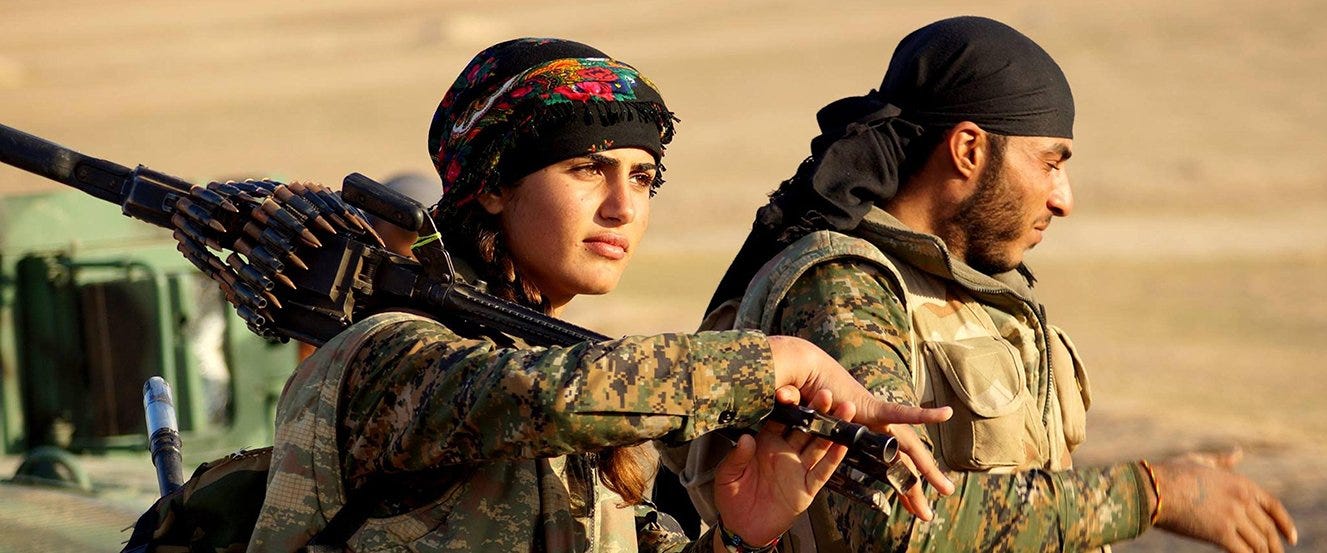
A woman in the People’s Protection Units, fighting against ISIS in Syria in 2016.
It’s Monday, January 19, and another civil war may be brewing in Syria. Kurdish forces have been pushed back across the north of the country, while a suburb of Aleppo was besieged by government forces. What does this mean for Syria—and what does it mean for Israel?
First, some context.
The northeastern region of Syria has functioned as a semi-autonomous zone since 2012, granting limited independence to the ethnic Kurds, a nation spread across Syria, Turkey, Iraq and Iran. Historically, they’ve aligned themselves with the United States and Israel, playing a key role in the fight against ISIS.
In March 2025, the Kurds signed an agreement to integrate into the Syrian national forces, but a series of massacres of Alawites and Druze later that year made that prospect far less appealing. So Syrian President Ahmed al-Shaara, likely with a push from Ankara, made them pay—launching an offensive against Kurdish areas across the country.
This morning, they signed a cease-fire—but that doesn’t mean the conflict is over. Under the terms of the deal, the Kurds lost control of most of the eastern oil fields. That means a fiscal crisis for them—and a cash windfall for al-Shaara.
But that’s not the only reason the war isn’t over.
You might recall the violence in Suwayda, the Druze region on the border of Israel. In July 2025, Syrian government forces massacred civilians and displaced hundreds of thousands in the region. Israel intervened with airstrikes on military targets, forcing a temporary agreement that de-escalated the confrontation. To this day, Druze in Suwayda are still suffering the aftermath of those attacks—and tensions haven’t disappeared.
What’s clear is that minorities in Syria are not safe. That poses the question: what should Israel do?
Like the Druze, the Jewish state has maintained decades-long ties with the Kurds. Unlike the Druze, the Kurds have always sought an independent state—an aspiration the Jews can relate to. So when the next flare-up comes should Israel, like with the Druze, intervene to help the Kurds?
Besides the difficulty of trying to gerrymander Syria into a favorable balance of power, such a move would also delay peace with the government in Damascus and run counter to the Trump administration’s policy—particularly that of its Turkey-friendly representative, Tom Barrack.
Israel’s Syria policy is at a crossroads: should it align with the ruling majority—or stand with the embattled minorities?
Benjamin Netanyahu and Donald Trump shaking hands at their meeting in December. (PMO)
The U.S. is building a nuclear power plant in Israel as part of a broader investment in AI and data centers. But wait—isn’t that illegal? After all, Israel isn’t part of the Non-Proliferation Treaty.
Well, it’s complicated.
Israel never signed the treaty—largely because of that “sock factory” it built in Dimona in the 1960s, which it preferred to keep away from international inspectors. As a non-signatory, the U.S. is technically barred from transferring nuclear technology to Israel. But here’s the catch—it’s not transferring anything.
The new nuclear facility will sit on Israeli soil, but under American sovereignty. Legally, that makes it no different from a reactor in North Carolina. Except this American power plant will only power foreign clients—Israel’s data centers—strengthening a key node in Washington’s emerging Pax Silica Alliance.
What is this alliance?
It’s the U.S.’s grand plan to secure high-tech manufacturing—from chips to AI—through a trusted network of partners such as Japan, South Korea, Singapore, Great Britain and, for some reason, Qatar.
Israel’s place in that network is obvious. Its human capital, technical expertise and geographic centrality make it indispensable. The plan calls for Israel to become an AI hub. The problem? Israel is energy-poor. As Golda Meir once quipped, “Moses led us through the desert for forty years to bring us to the one place in the Middle East without oil.” While she was slightly off in her criticism of Moses, Israel found major gas reserves in the Mediterranean in 2010, there is not enough gas to power the scale of AI Israel is aspiring to.
This problem was discussed during Benjamin Netanyahu’s meeting with Donald Trump at Mar-a-Lago in December—nuclear energy was their solution.
Now Israel can finally say it has at least one nuclear reactor—maybe more.
Palestinian ambassador to Iran Salam Zawawi
During the recent protests in Iran, demonstrators stormed the Palestinian ambassador’s residence, wounding the ambassador and damaging the building. To understand the symbolism, we need a little history.
In 1979, at the height of the Iranian Revolution, student activists seized the U.S. Embassy in Tehran, taking 66 Americans hostage. The embassy stood as a symbol of the American-backed Shah regime, and rumors swirled that Washington was plotting the Shah’s return. The crisis dragged on for 444 days, humiliating the United States, cost Jimmy Carter his presidency, and marked Iran’s definitive turn toward anti-Americanism.
Forty-seven years later, history repeats itself in reverse. Another revolution, another diplomatic building—but this time the target was Palestinian—a symbol of billions squandered on terrorism abroad and the corruption and neglect of the current regime. And this time, far from lashing out at America, protesters were calling out to it for help.
While the protests may have quieted for now, their chant shouldn’t be forgotten:
“Neither Gaza nor Lebanon—I sacrifice my life for Iran.”
Many already have. And one can only hope that this 47-year experiment in theocratic rule ends the way its predecessor was meant to—with the Iranian people reclaiming their country.
If you enjoy the newsletter, you can show your support by becoming a paid subscriber—it really helps keep this going. I’m also offering a special monthly briefing for a small group of premium members. I’d love to have you join us—just click below to find out more.


For sure, stick with one’s previous allies .. loyalty is a rare commodity in geopolitics. Al Jolani, the former terrorist that runs Syria is in cahoots with Turkey, and Qatar. The latter two being pals with the evil regime in Iran.
Al-Sharaa = Abu Jolani a former Al Qaeda commander whose central government has enduring ties to Al Qaeda.
Just bc he got a shave and put on a suit doesn’t mean he’s not a terrorist.
Don’t trust him just bc the Americans are dumb enough to look past his bloody hands