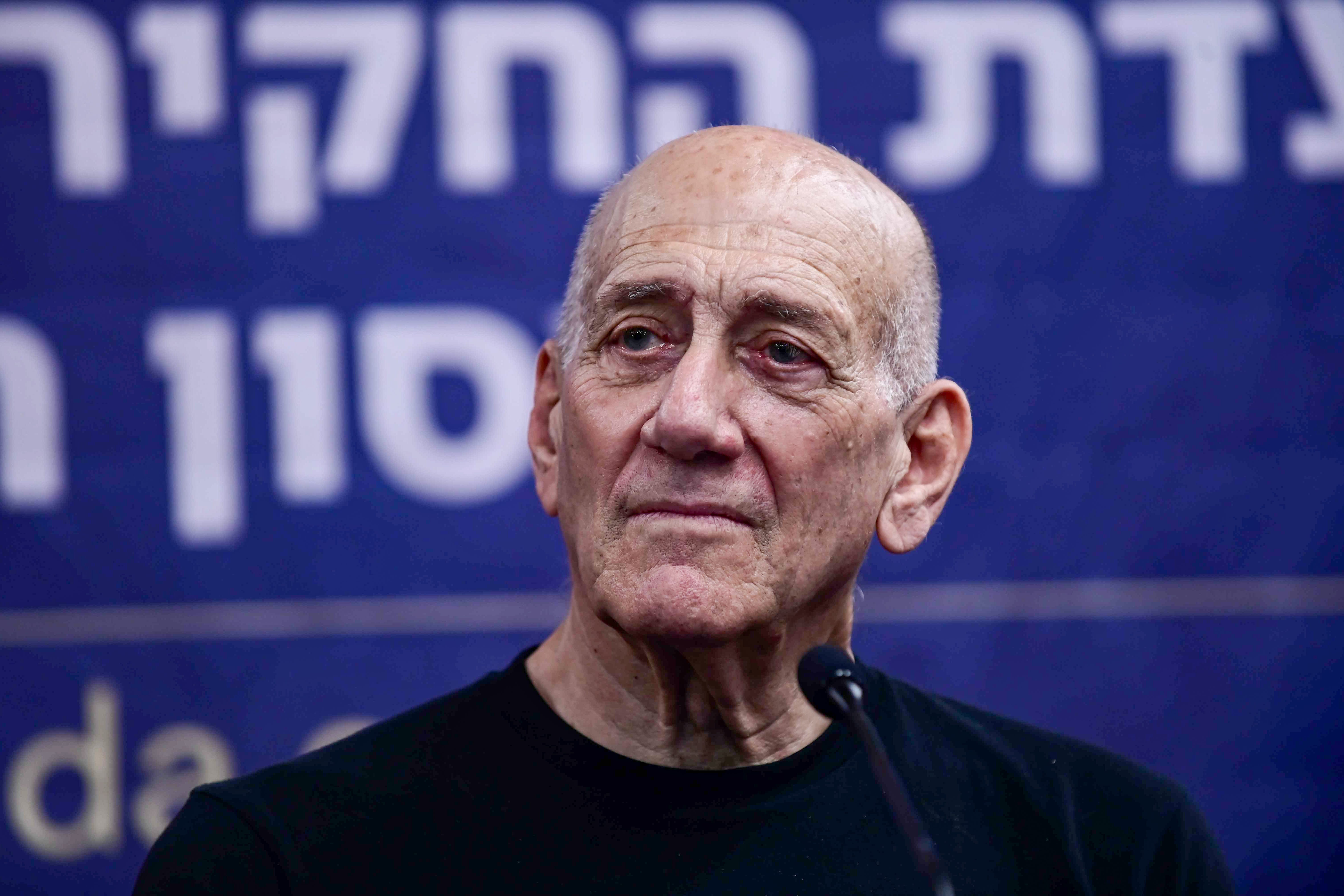
Former Israeli Prime Minister Ehud Olmert testifies during a hearing of the civil investigative committee on the October 7 massacre, in Tel Aviv, August 8, 2024. (Tomer Neuberg/Flash90)
It’s Thursday, September 3, and eighteen years ago, on a seaside balcony in Tartus, Syria, three muffled shots break the warm August air. The rounds strike the back of General Muhammad Suleiman’s neck; Bashar al-Assad’s personal confidant slumps forward over his dinner.
But who could possibly have done it?
Ehud Olmert has the answer. In his new book Arizona Kulanu, the former prime minister reveals it was Shayetet 13, the Israeli Navy’s special forces unit. But the truth, as with many shocking revelations from government officials, is that Edward Snowden got there first. A US embassy cable from Damascus, sent two days after the shooting and surfaced by WikiLeaks in 2010, recorded that Israel was the obvious and immediate suspect. In 2015, the Snowden-affiliated news site The Intercept published NSA material naming Shayetet 13 directly. To be honest, it was never much of a mystery. A high-ranking anti-Israel official being eliminated with three bullets to the head doesn’t make for a compelling game of Clue.
Suleiman had an office in the palace, a few doors from Assad’s own. He was a former army officer, an Alawite like the president, and Assad’s closest friend—but it was more than that. According to Olmert, Suleiman knew everything.
What everything meant was the nuclear reactor at Deir ez-Zor that Israel had struck a year earlier. He had made the deal with the North Koreans and organised the construction and concealment of the program. Syria’s defense minister did not know the reactor existed. Neither did its chief of staff. In July 2007, Assad had thanked Suleiman with a new Mercedes for his work concealing the facility—just a month before Israeli jets destroyed it. A year later, snipers emerged from the coast under cover of night.
Olmert’s book provides new details about the operation. There were a fair number of people on the beach; not one of them noticed the heavily armed Israelis. Suleiman and his guests were sitting out on the balcony as the commandos closed to within 150 metres, taking up positions on either side. They identified him, and when the order was given, three rounds were fired. The fighters quickly withdrew to the waterline, where a boat was idling, waiting to collect them.
Thanks to Olmert, we can finish the game. It was Israel, in Tartus, with the sniper rifle.
Gadi Eisenkot, Naftali Bennett and Yair Lapid. (Ayal Margolin/Oren Ben Hakoon/Michael Giladi/Flash90)
Put it this way and it sounds very close indeed: the election is next month. Its outcome will largely be decided this coming Tuesday, just as it was decided last time when Balad chose to break up the Joint List in 2022 and when Meretz filed its slate alone.
While all eyes are turned rightward, to Amcha Yisrael chairman Ofer Winter’s solo flight, it’s worth keeping eye contact with the rival bloc. The tectonic plates there are shifting, even if the ground above them looks stable.
The foundational axiom is that the entire right has had four leaders since the founding of the state, while the center-left has had four leaders in the last term alone: Lapid, Gantz, Bennett and now Eisenkot. Can the chairman of Yashar! be confident there won’t be a fifth? Ostensibly yes, but in practice he is stuck in the seat column while Bennett is starting to recover. Anyone who doubts it should open the Haaretz app. The former chief of staff’s face runs as an ad before every article on the radical left’s website. Whoever is buying space there isn’t convinced the campaign has been decided, and wants to take votes off the Democrats.
Bennett has one instrument to help him try to close the gap with Eisenkot: a merger with Hili Tropper’s Zionist Home, worth two or three seats in the polls. He is courting him energetically, making offers, and he isn’t the only one. Eisenkot, fully alive to Tropper’s value, would happily sell a kidney to land him.
But Bennett carries heavy risks of his own, chief among them the polls—so far on Channel 14 and i24—showing a collapse into single digits. And if not the polls, then Bennett’s own history suggests that may be his fate again this time.
A grand merger between Eisenkot, Bennett and Lapid is all of them buying down their risks. Eisenkot secures his candidacy for prime minister, his status as the largest party, and the reduction of Lieberman’s claim to the crown to absurdity. Bennett hedges himself with a reasonable number of seats, since it costs Eisenkot little to give up slots he has yet to fill.
In the background is the growing recognition among the bloc’s parties that the Arab merger, Yoav Segalovitz joining Ra’am, and the linkups taking shape in the center have sharply reduced the odds of reaching 61. The way to win the election is to reduce the number of holdouts within the bloc to the Eisenkot formula—that is, swearing in a minority government on Arab abstention. The bonus is the assumption that Netanyahu will not be able to stand aside while a rival party runs 10 seats ahead of him, and that in that race, exactly as in 2019, he will bring down the smaller right-wing slates. Is that certain to happen? Not remotely. But it is certainly being weighed with grave seriousness.
This is an excerpt from my weekly column in Israel Hayom.
MK Yitzhak Goldknopf, government ministers and members of Knesset attend a plenum session and a vote on a bill to freeze arrests of haredi draft evaders at the assembly hall of the Knesset, July 14, 2026. (Chaim Goldberg/Flash90)
A candidate for a guaranteed slot on Likud recently got a surprising phone call from the office of MK Goldknopf. “Don’t rush to sign,” they offered him, as friendly advice. “Netanyahu will promise you a minister’s post, but Agudat Yisrael won’t recommend him to form the government, so it carries no meaning at all.”
The polls count Netanyahu’s bloc as including the Haredi parties. Is that correct? This past Friday, Sol Verdiger, the foreign minister of Haredi Jewry, came to a meeting with Netanyahu. Afterward, he drove to Rabbi Lando, leader of one of the Haredi factions, to brief him and to sound out whether there might be room to cooperate after all. “Ich vil nisht heren, a ligner,” said Rabbi Lando. Loosely translated: I don’t want to hear it, he’s a liar. A few days passed, and his emissary in the Knesset, MK Moshe Gafni, put out a three-minute video explaining that Haredi children stand to gain nothing from continued partnership with the right, and that a “decision for the generations” must be taken—meaning, going with Eisenkot.
This is a little strange. After all, the entire Haredi legislation marathon two months ago, which cost the coalition some two or three seats, was meant to undo Rabbi Lando’s dramatic announcement, “We are not part of any bloc.” Did it fail? There are two possibilities. The first: that the party has decided to try their luck on the left, and the Haredi legislation was simply cash up front to keep the elections on schedule. The second: that Gafni and Likud are fully coordinated, and it’s simply convenient—certainly for Likud—to keep its distance from the unpopular Haredim. And Netanyahu? He reckons that if he gets 61, the Haredim will have no choice but to go with him. One seat fewer, and they’ll scatter in every direction.
English Editor: Ari Tatarka
If you enjoy the newsletter, you can show your support by becoming a paid subscriber—it really helps keep this going. I’m also offering a special monthly briefing for a small group of premium members. I’d love to have you join us—just click below to find out more.
Thanks for reading It’s Noon in Israel! Subscribe for free to receive new posts and support my work.


.. it seems that the established ‘right’ want to depict Eisenkot as on the ‘left’, but from everything I read and hear this is incorrect. @Amit, please can you pass comment accordingly ?