It's Official: Netanyahu vs. Bennett
Also, Hamas is finally homeless.
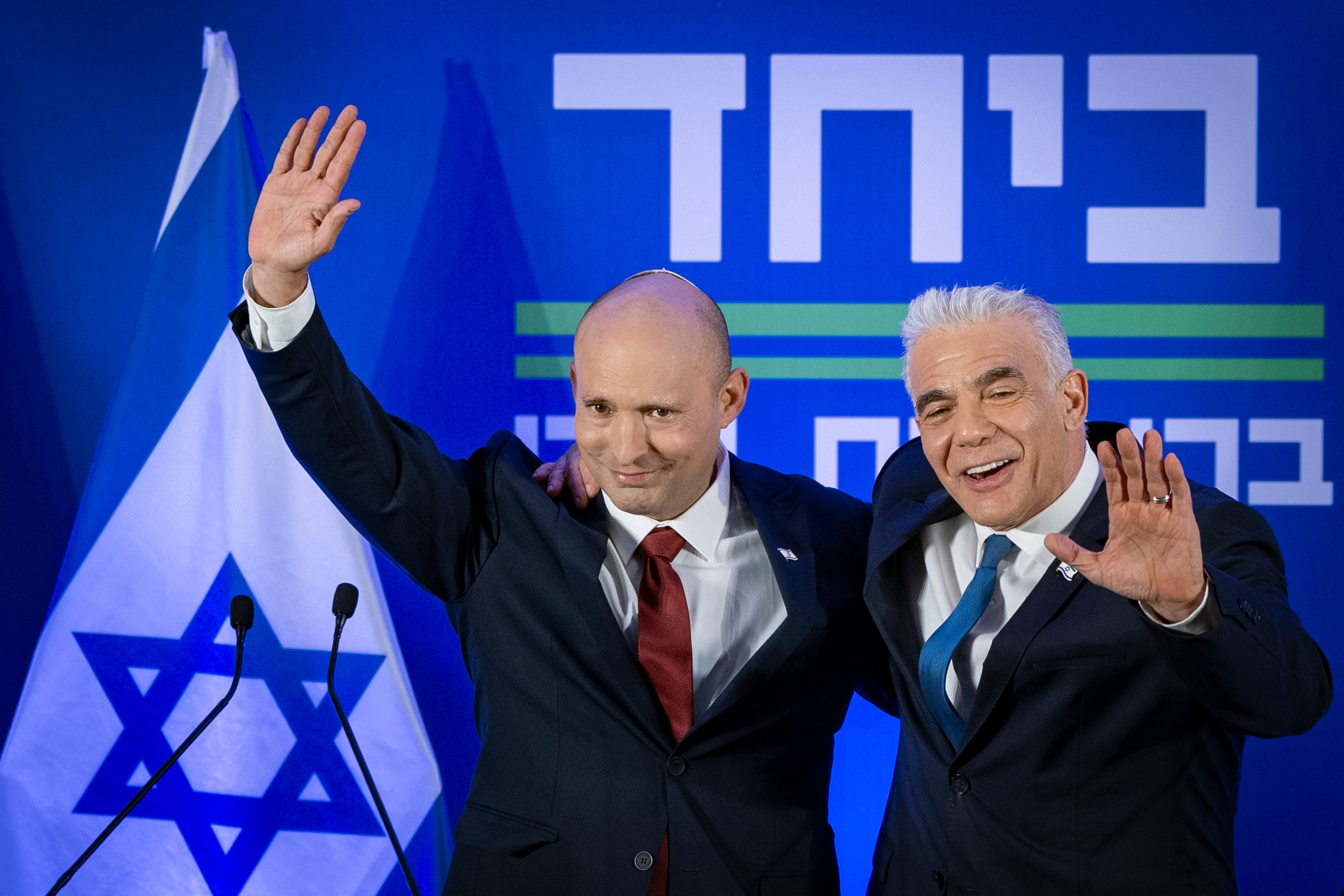
Opposition Leader and Head of the Yesh Atid party Yair Lapid and former Prime Minister Naftali Bennett speak during a press conference announcing a joint list named “Together” ahead of upcoming elections, to be led by Bennett. (Chaim Goldberg/Flash90)
It’s Monday, April 27 and it’s happening again. In 2013, Naftali Bennett and Yair Lapid joined forces to demand an end to Haredi draft exemptions, forcing Benjamin Netanyahu to exclude the ultra-Orthodox from his coalition. In 2021, they teamed up a second time to build a short-lived government that successfully forced Netanyahu into the opposition. Now, this final alliance is intended to finish the job and expel him from politics for good.
Last night, the two leaders officially merged their factions into a new joint party called Beyachad (“Together”). With Lapid’s backing, Bennett is now the undisputed prime ministerial candidate set to challenge Netanyahu at the ballot box this October.
Though Bennett’s triumphant return to fight his former boss has been the subject of whispers for years, and history may view this showdown as inevitable, it was initially anything but. In early 2024, Benny Gantz’s faction was projected to be the largest in the Knesset by a significant margin. More recently, Gadi Eisenkot—the former IDF chief of staff and currently the most popular political figure in Israel—became the subject of intense speculation as he gained ground in the polls. Meanwhile, for the last three years, Yair Lapid has sat as the official head of the opposition. Until last month, Eisenkot was viewed as the critical junior ally waiting in the wings to crown either Lapid or Bennett as the bloc’s leader—only for Lapid to be unexpectedly demoted to that very role.
That’s just the nature of Israeli politics: it is a shifting desert where parties can materialize, dry up and blow away in a matter of months. In such an inhospitable climate, this merger was an inevitable matter of political survival.
Bennett was declining in the polls, Eisenkot was closing in on him and Lapid was in a free fall. Before Eisenkot became too powerful and the opposition sank into a deeper civil war, a decision had to be made. So, Bennett offered his hand and Lapid took it. With this merger, Bennett secures his spot as the definitive prime ministerial candidate, and Lapid locks in a comfortable number of safe seats on the list, far more than the dismal six or seven that were waiting for him in October.
All of which leads to the fundamental question: Will it work?
The problem for Bennett and Lapid is that the rules of mathematics simply do not apply to Israeli politics. One plus one almost never equals two. When party leaders merge, they gamble everything on the hope that they can make it equal three—but history shows they can easily end up stranded at one and a half.
Take the worst-case scenario. Going into the 2013 elections, Benjamin Netanyahu and Avigdor Lieberman ran on a joint ticket. In the outgoing Knesset, Likud held 27 seats and Yisrael Beiteinu held 15—a combined powerhouse of 42 mandates. Polling suggested a unified right-wing behemoth would dominate the map. Instead, moderate Likudniks ran from Lieberman’s hardline rhetoric, and Lieberman’s secular Russian base walked away in disgust at the sight of Netanyahu’s ultra-Orthodox partners. The joint ticket crashed to 31 seats. Ironically, the voters who fled this mega-party parked their votes with two rising stars: Naftali Bennett and Yair Lapid.
That is what happens when the math backfires. But there is also a scenario where it works out. Before the April 2019 elections, Benny Gantz’s Israel Resilience Party and Lapid’s Yesh Atid were polling at perhaps 20 to 25 combined seats. But when they merged to form Blue and White (along with Moshe Ya’alon), the math exploded. Fueled by the momentum of a unified, centrist, anti-Netanyahu bloc, the alliance surged to a massive 35 seats.
So, is Beyachad a Blue and White or a Likud-Beiteinu?
It’s another math question: Are the voters they gain more than the voters they lose?
Channel 12 polling is showing about eight mandates’ worth of right-wing voters ripe to be peeled off Likud. If those voters were considering Bennett before, they are unlikely to now. Yair Lapid is to right-wing voters what meat and dairy are in a kosher home: strictly forbidden in the same pot, but tolerable in the same kitchen as long as they are separate. Beyachad might hope to siphon centrist votes from Gadi Eisenkot, or perhaps claw back left-leaning voters who drifted to The Democrats, but Bennett’s hawkish history may prove just as repulsive to Lapid’s progressive flank.
While it is uncertain if this merger actively weakens the anti-Netanyahu bloc, it certainly does not strengthen its overall numbers. Still, absolute numbers do not solely determine whether it was the correct strategic decision. Bennett’s leadership of the bloc may be worth a starting cost of a few mandates, and it may put him in a stronger position to pick up more as the election nears.
Gadi Eisenkot, head of the Yashar party. (Tal Gal/Flash90)
With Beyachad formed, all eyes turn to Gadi Eisenkot.
He faces a critical strategic choice. He can lean into his reputation as the political outsider and run a shadow campaign for the premiership, hoping to organically eclipse Bennett in the polls over the coming months. Or, he can ride his current solo momentum to inflate his electoral value, waiting until the final stretch to fold into Beyachad and extract maximum leverage. Either way, he won’t be making a definitive move just yet.
Then there is the question of timing. One could argue whether this merger is happening too early or too late. It might seem early, given that ballots won’t be counted for another four months. However, it is also arguably late, as it has been clear for quite some time that the opposition needs a massive shake-up to cross the finish line with 61 seats.
There is one last thing to note. In America, Barack Obama’s campaign turned the word “Change” into a national icon. In Israel, a poster like that would be actively ripped off the wall. Israelis do not like change. Insofar as something is new, it must also be incredibly familiar. It’s telling that the last two genuinely fresh entrants to the Israeli political scene were a charismatic news star, Yair Lapid, and a settlement firebrand, Naftali Bennett—and that was over a decade ago. Beyachad marks Lapid’s third party and Bennett’s fifth. But that recycling is a feature, not a bug. When you live in the Middle East, you want someone you know answering the phone at 4 a.m.
Senior Hamas officials in Qatar in December.
Traveling abroad comes with a standard set of anxieties: missed connections, lost luggage or, if you’re Israeli, a regional war erupting just before the holidays. But spare a thought for Khalil al-Hayya, Hamas’ chief negotiator, who left his five-star exile in Qatar for what was intended to be a quick diplomatic trip to Cairo. After summarily rejecting a U.S.-backed disarmament proposal that offered a staged Israeli withdrawal from Gaza, he received a text message notifying him that he had been evicted from his luxury lodgings and was officially barred from re-entering the country. It is every vacationer’s worst nightmare.
It appears that Hamas’ latest bout of intractability has finally broken its patron’s back. After 20 years, Qatar is pulling its investment in the terror group. According to my sources, Doha will no longer play the role of host and negotiator, and most of Hamas’ leadership has already departed the country.
After two decades, the obvious question is: Why now?
The decisive turning point wasn’t Cairo, nor was it October 7—if anything, the latter represented a major appreciation of Doha’s investment. The breaking point was Operation Roaring Lion. After 16 agonizing days of silence, torn between their two patrons, Hamas ultimately issued a statement defending Iran’s “right of self-defense,” but asked Tehran to refrain from targeting “neighboring countries.” For Qatar, a nation whose sovereign territory was actively being struck by Iranian missiles, this relatively weak, delayed condemnation from the group they had been funneling cash and support to for decades was not endearing.
This isn’t just about moral clarity or hurt feelings. In exchange for their luxury accommodations, Hamas provided Qatar with a highly marketable service: terrorist mediation. Alongside their shared ideological alignment, this mediation is precisely why Qatar reached out to Hamas after the group’s 2006 electoral victory when the rest of the world cut contact. Doha cornered an unserved market. But the value of that service is in steep decline—not only because a new status quo is settling over Gaza, but because the primary consumer of Qatar’s service, the United States, has developed a distaste for such intimate terrorist ties.
Hamas leader Khalil al-Hayya gives a televised speech in Doha. (Screenshot used in accordance with Article 27a of the Copyright Law)
So Hamas is looking for a new home, both metaphorically and literally. Since the regional war began, a civil war has been raging inside Hamas: the more pragmatic camp led by Khaled Mashal wants to diversify their patronage toward Sunni Arab states, while the hardline faction led by al-Hayya wants to maintain their membership in Iran’s Axis of Resistance.
At one point, they successfully kept a foot in both camps, with a house in Tehran and a house in Doha. Now, they are locked out of one, and the other is a smoking ruin. Still, a smoking ruin is better than no house at all. Qatar cutting Hamas off will likely empower the Iran-aligned faction, despite the negligible amount of support a battered Tehran can currently offer.
There remains one wild card: a place for them may be opening up in Ankara, with Turkey offering sanctuary in exchange for regional influence. But for now, the arrangement remains tentative, and the amount of tangible support flowing to the group is unclear.
Despite the infamous fog, war has an intensely clarifying effect. It answers the fundamental questions: what you stand for, who your enemies are and who your friends are. Even when the guns stop firing and life returns to normal, those understandings remain.
English Editor: Ari Tatarka
If you enjoy the newsletter, you can show your support by becoming a paid subscriber—it really helps keep this going. I’m also offering a special monthly briefing for a small group of premium members. I’d love to have you join us—just click below to find out more.
Thanks for reading It’s Noon in Israel! Subscribe for free to receive new posts and support my work.


I believe that any coalition that runs on supporting public desecration of Shabbat which the founders of the State of Israel assiduously avoided in 1948 at the time of its founding will lose and should lose at the polls as representative of a slate that seeks to reduce the Jewish nature of the State of Israel