It’s Noon in Israel: January 8: The Worst Massacre in Decades
Also, Israel hands Trump a "smoking gun", Witkoff and Kushner arrive in Israel to define demilitarization, and more.
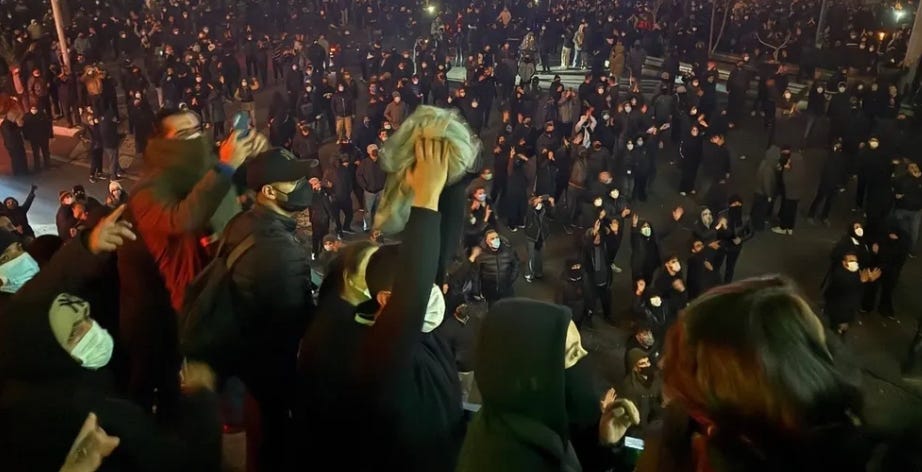
It’s Sunday, January 25, and according to senior Israeli officials, on the night of January 8—when the internet was shut off—the streets of Iran saw the worst massacre in the history of the Islamic Republic, and among the deadliest days worldwide in a generation.
The regime opened fire on thousands, possibly tens of thousands, of their own citizens. Morgues overflowed, bodies lay in the streets, and families were torn apart. Some estimates place casualties from the protests as high as 20,000; I suspect it could be higher.
It was a crime on an almost unimaginable scale—and it will be answered.
And now—the consequences.
CENTCOM’s Adm. Brad Cooper meets with IDF Chief of Staff Lt. Gen. Eyal Zamir on January 24, 2026. (IDF)
There were two surprises when Trump claimed on January 14 that “The killing has stopped. The executions have stopped.” One was that he seemingly believed it; the other was that Iran would openly admit to planning to kill 800 protesters. Since, Iran has denied those plans and—thanks to Israel—Trump now knows they carried them out.
According to Israel Hayom’s Danny Zaken, Israel handed the Trump administration intelligence amounting to a “smoking gun” showing that executions of protesters have not—and will not—stop. One case, condemned by the State Department on Friday, is worth mentioning: Javid Khales, a young Iranian soldier, was sentenced to death for refusing to shoot innocent protesters.
Israel was likely a partner in obtaining that intelligence. This reminds me of what a former head of U.S. Air Force intelligence said in the ’80s: to replace Israel, the United States would need another five CIAs.
But who told Trump that Iran had commuted the executions?
It seems the culprit was Steve “the Naïve” Witkoff, who forwarded the false text from Iranian President Masoud Pezeshkian to the commander-in-chief.
Why would he pass it on?
Well, it appears Witkoff is captaining a team with Jared Kushner seeking a diplomatic solution to the Iranian problem—hoping to avoid a war that would interrupt their current plans to reshape the Middle East for the better. That’s the generous interpretation. In their corner sit Saudi Arabia, Turkey, and Qatar.
On the other side of the Oval Office, supporting a strike, sit Secretary of State Marco Rubio, Secretary of Defense Pete Hegseth, and—surprisingly—Vice President J.D. Vance. In their corner: Israel, the UK, the UAE, and other European partners.
If military movements are any indication, Team Strike is winning.
On Thursday, Trump said that military action this time would make last year’s strike “look like peanuts.”
So far, the assets stationed in theMiddle East suggest otherwise.
Dozens of cargo jets have been in and out of the region, likely dropping off missile-defense systems to prepare for an Iranian response. Meanwhile, refueling planes and fighter jets have been transferred to the Middle East under U.S. Central Command. The big gun—the Abraham Lincoln carrier strike group—is on its way and expected to arrive between today and Wednesday. This is nothing to sneeze at; a former Israeli Air Force commander has estimated that the firepower currently deployed is roughly equivalent to the entire Israeli Air Force.
Still, the deployments have yet to exceed the June war posture.
But a quick reminder: that wasn’t America going all out. Washington could take it a lot further with what’s currently in the region.
As for the strategy, the game plan seems to be one-man offense, with a team defense. Yesterday, head of U.S. Central Command Bradley Cooper arrived in Israel for meetings regarding coordination with the IDF. Other allies like the UAE, UK, and maybe Jordan are also likely to participate in blunting any Iranian response.
Almost everything is in place.
All that remains is Trump’s to give the green light.
Steve Witkoff and Jared Kushner next to Benjamin Netanyahu at a meeting October 2025. (GPO)
Kushner and Witkoff have arrived in Israel to talk demilitarization. I’m expecting a fight—and not with Hamas. Whoever wins the battle over demilitarization, that’s not the real test.
Israel’s position is clear: complete demilitarization, down to the last Kalashnikov, as a precondition for any withdrawal. Hamas, by contrast, is demanding that certain weapons—RPGs, for example—be recognized as “defensive arms.”
Caught in the middle are Witkoff and Kushner, eager to show diplomatic progress, even if that means a lighter demilitarization. Whether they manage to stretch the definitions enough to call an RPG a “defensive arm” will depend on getting Israel’s agreement. To do that, they’ll have to face down the right flank of Netanyahu’s cabinet—if not Bibi himself.
But that’s a bit of a distraction.
In my view, the real test isn’t demilitarization. In practice, that will only be achieved through an IDF operation likely to come in the months ahead.
As a general rule, when you’re the one on the ground, you get to decide what “demilitarization” means—how many Kalashnikovs need to be piled up, and what counts as “defensive weapons.”
What really matters are two other issues:
Withdrawal: Israel must not withdraw a single centimeter before demilitarization is fully implemented and verifiably enforced.
Reconstruction: No construction materials should enter Gaza until there is a real, enforceable oversight mechanism that prevents the rebuilding of terrorist infrastructure.
Witkoff and Kushner have gone into battle. Let’s see who wins.
Liam Or-Nassar reuniting with his father Ramzi Nassar. (IDF)
When his son was taken by Hamas on October 7, this father had to hide his parentage. Liam Or-Nassar was abducted from Kibbutz Re’im, and his Muslim Arab father, Ramzi Nassar, made the agonizing decision to erase himself from the public story to protect his child.
Fearing that Hamas might view his son as a symbol of betrayal—a Muslim father married to a Jewish mother—Nassar asked that his family name be removed from all official and media references. Liam Or-Nassar became Liam Or and stayed that way until now.
Nassar also made the painful choice not to campaign publicly for Liam’s release, worried that exposure could either endanger him in captivity or elevate his “value” to his captors.
Despite Liam’s release in the first hostage deal of November 2023, Friday was the first time Nassar identified himself as Liam’s father since October 7.
Between Jew and Arab there are borders; between parent and child, none. To draw that line to save your son must have been unimaginably painful. Liam is home now—father and son can wear their names openly, together.
If you enjoy the newsletter, you can show your support by becoming a paid subscriber—it really helps keep this going. I’m also offering a special monthly briefing for a small group of premium members. I’d love to have you join us—just click below to find out more.


no agreement without a safe solution - save our Israeli men from having to die for stupid agreements.
PRAY FOR THE DOWNFALL OF THE ISLAMIC DICTATORSHIP OF IRAN.
🙏🙏🙏
FREE THE PEOPLE OF IRAN FROM ARAB COLONIALISM.