JD Vance's Toxic Relationship
Also, the location of the next October 7? And Israel's economy receives a glowing endorsement.
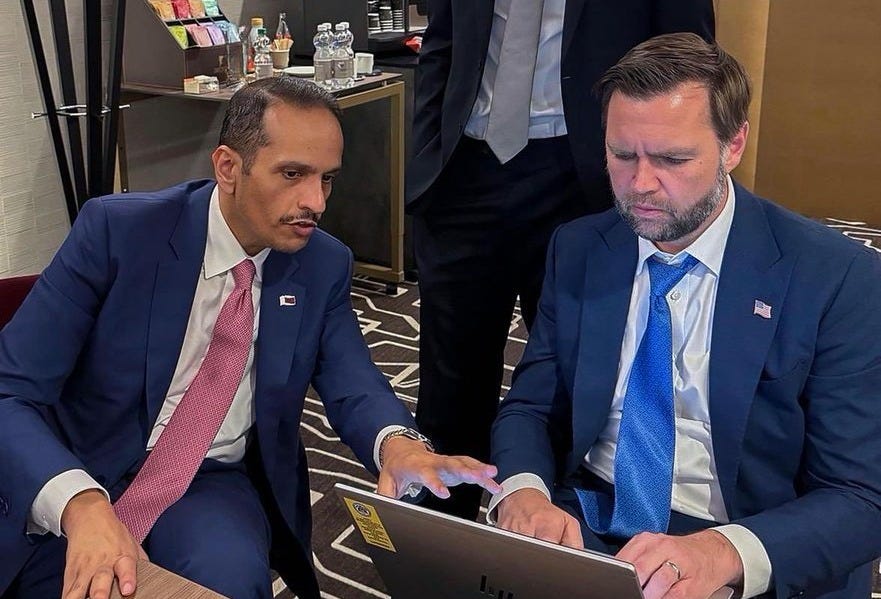
Qatari Prime Minister and Foreign Minister Mohammed bin Abdulrahman Al Thani posts a photo alongside US Vice President JD Vance and Jared Kushner in Lucerne, captioned “work continues” amid the Iran-US negotiations in Switzerland. (@MBA_AlThani_/X)
It’s Tuesday, June 23, and I’m no professional, but I think I can spot the signs of a toxic relationship. Threats of violence. Desperately defending the partner’s behavior. Cutting you off from your friends. Draining your resources. Gaslighting. By most of these measures, Vice President JD Vance is in a toxic relationship with the Islamic Republic.
Coming out of the talks in Switzerland yesterday, Vance hailed a “good foundation” for ending the regional war. He claimed Iran had agreed to let the International Atomic Energy Agency back into the country—only for Iranian Foreign Ministry spokesman Esmaeil Baghaei to state flatly that Tehran had not negotiated on its nuclear program and had accepted no new commitments.
Then there's the intimidation. Even as it talked peace, Iran kept a hand on the region’s throat, threatening to shut the Strait of Hormuz in response to Israel’s actions. Trump answered threat with threat, warning Tehran it “won’t even make it back” to its own country if it closed the strait. And when Iran turned the same pressure on the talks themselves—threatening to storm out of the summit over insults from Trump—Vance ran interference, waving it off as mere “social media threats” and insisting all was fine because, after all, they’d kept talking late into the night.
Next comes the lopsided exchange. Yesterday, the US Treasury issued a general license letting Iran freely sell crude oil and petrochemicals through the 60-day negotiation period, while talks continued on releasing frozen assets—a potential economic windfall worth billions. And what did Washington get in return on the nuclear file? According to the Iranians, nothing. Vance even tried to pass off appeasement as boundary-setting, reportedly insisting the freed-up money could only go toward American wheat and soybeans. Iran didn’t bother to counter. Its officials simply made clear they’ll spend their money however they please.
Then there’s the isolation. Iran has maneuvered the US into a Lebanon “deconfliction” mechanism built around Washington, Qatar, Pakistan and Tehran—but not Israel, the country actually being shot at. On its face, that’s a loss for Israel. But Tehran may have overplayed its hand. Unlike Hezbollah, and contrary to Iran’s assumptions, Israel is not a U.S. puppet—and a seat at this table would have been more trap than prize. Inside the mechanism, Israel would face constant, hard-to-refuse pressure to stand down; outside it, those calls are far easier to ignore. An invitation would have forced Israel into an awkward bind: either sign on to a framework stacked against it, or openly reject Trump’s solution. By shutting Israel out, Iran inadvertently spared it that choice.
And throughout, Iran works to pin the blame on Israel, casting the closest U.S. ally as the saboteur out to wreck the deal. Vance seems to be falling for it, explaining away ceasefire violations as the work of rogue commanders: Hezbollah supposedly didn’t mean it.
On the ground, the story is far from Vance’s excuses. Iran is reportedly funneling IRGC officers into southern Lebanese towns to rebuild Hezbollah’s command structure, all while Israel is left blindfolded—forced to pass its messages secondhand through the United States.
As Netanyahu surely understands, when a friend is trapped in a toxic relationship, lecturing them about how awful their partner is rarely works; it only breeds resentment. The best you can do is hope they see it for themselves. And given how brazenly Iran is behaving, I’m growing optimistic that they will.
So all that’s left to say is: JD Vance, I hope you get help.
View of the Southern Israeli city of Eilat. September 9, 2025. (Yaniv Nadav/Flash90)
“The next October 7 will be in Eilat.” That, according to a Haaretz report, is what the head of Israel’s internal security service, David Zini, has been telling colleagues behind closed doors. The small city on the country’s isolated southern tip is vulnerable, the Shin Bet chief argues—not to Hamas or Hezbollah, but to Israel’s newest enemy, the Houthis.
Plenty of security officials are skeptical. One source told Haaretz that no one in the establishment even knows what intelligence Zini is relying on. And the geography invites doubt: Eilat sits wedged against the borders of Egypt and Jordan, some 1,200 miles from the Yemeni group’s main base of operations.
Still, the concerns deserve a hearing. The Jordanian frontier is Israel’s most porous, threaded with thousands of smuggling cases and repeated instances of human trafficking across vast, thinly watched desert. Jordan’s internal security is not world-class, and a few thousand fighters might conceivably slip into the kingdom’s south without Amman ever knowing. Just last month, Israeli forces foiled a jet-ski infiltration attempt from Jordan near Eilat—a reminder that the threat isn’t purely theoretical. Zini is now directing the agency’s intelligence units to focus on exactly this kind of scenario.
The groundwork predates him. Back in January, Maariv reported that Prime Minister Benjamin Netanyahu had convened a discussion on the military’s readiness for a multi-front war spanning Iran, Yemen, Lebanon and Gaza. Military Intelligence, the Mossad and other branches assembled target banks for each arena, though no priority was set among them.
Even then, Israel had flagged a “learning curve” underway among the Houthis. Despite their own internal strife and friction with Saudi Arabia, the group kept probing for ways to strike at Israel—from ballistic missiles to pushing ground forces toward its borders. Around the same time, the IDF ran a large-scale drill in the 80th Regional Brigade’s southern sector, gaming out enemy raids: Houthi fighters trying to seize outposts, infiltrate a tourist city, take hostages and carry out killings.
The Houthis, for their part, have been signaling intent. Borrowing a creative page from Hezbollah, they have built mock Israeli villages and released propaganda videos staging “conquest” operations against them.
Even if Zini’s concerns are ultimately unfounded, it’s worth appreciating this event as another manifestation of Israel’s October 8 mindset. As the mayor of Eilat said, “Since October 7, painful and important lessons have been learned so that the worst disaster in Israel’s history will not be repeated anywhere in the country.”
To put it quite simply, no enemy will be underestimated again.
Bill Ackman answering questions at ValueX BRK. (Screenshot used in accordance with Section 27a of the Copyright Law.)
“You hold the Tel Aviv Stock Exchange, and the pricing is rather high. How do you see it now?” billionaire investor Bill Ackman was asked recently. The answer is worth hearing.
“I’m very bullish on Israel economically. Think of it as Silicon Valley as a country—an incredible density of talent, IP, and raw IQ packed into a tiny place. You now have a generation of 24- to 28-year-olds who’ve come through a brutal war and developed real grit, plus a military that’s deeply sophisticated technologically. Every top venture firm has opened an office there.”
And there’s more.
“Israeli entrepreneurs used to sell early—take Google’s $100 or $200 million and walk. Now, after exits like Waze, they realize they can build big companies at home. I think you’ll see a trillion-dollar company come out of Israel before long—probably AI or cybersecurity—and that value gets amortized over a relatively small economy, which makes it one of the best in the world.”
Ackman has reason to be confident. He and his wife, Neri Oxman, bought roughly 5 percent of the Tel Aviv Stock Exchange in January 2024 at NIS 20.60 a share—a $25 million bet that was up about 300 percent by September 2025 and has since climbed past 500 percent, briefly worth more than eight times their entry price at the stock’s May 2026 peak. He isn’t done, either: in an interview with Globes last year, he claimed he wants to invest another $1 billion in Israeli companies.
His case for the purchase is simple:
“Owning a piece of the exchange is like owning a royalty on the success of capitalism in the country. That’s why I’m bullish—and I think it’s cheap.”
Cheap is a bold word for a stock that has risen more than sixfold. But that’s the whole wager: that a country the size of New Jersey is still in the early innings of building trillion-dollar companies, and now is still the time to get in on the ground floor.
English Editor: Ari Tatarka
If you enjoy the newsletter, you can show your support by becoming a paid subscriber—it really helps keep this going. I’m also offering a special monthly briefing for a small group of premium members. I’d love to have you join us—just click below to find out more.
Thanks for reading It’s Noon in Israel! Subscribe for free to receive new posts and support my work.


Every passing day gets us closer to President Marco Rubio. Keep your head down Marco, that winning sense of humor and humility. The Hillbilly is imploding before our eyes into Tuckerland. Couldn’t happen to a nicer guy.
Someone needs to inform Vance that he's barking up the wrong tree. He will go down, that is for sure. It's like the blind leading the blind. It's so bad i can't even read it all anymore. Totally disgusted.